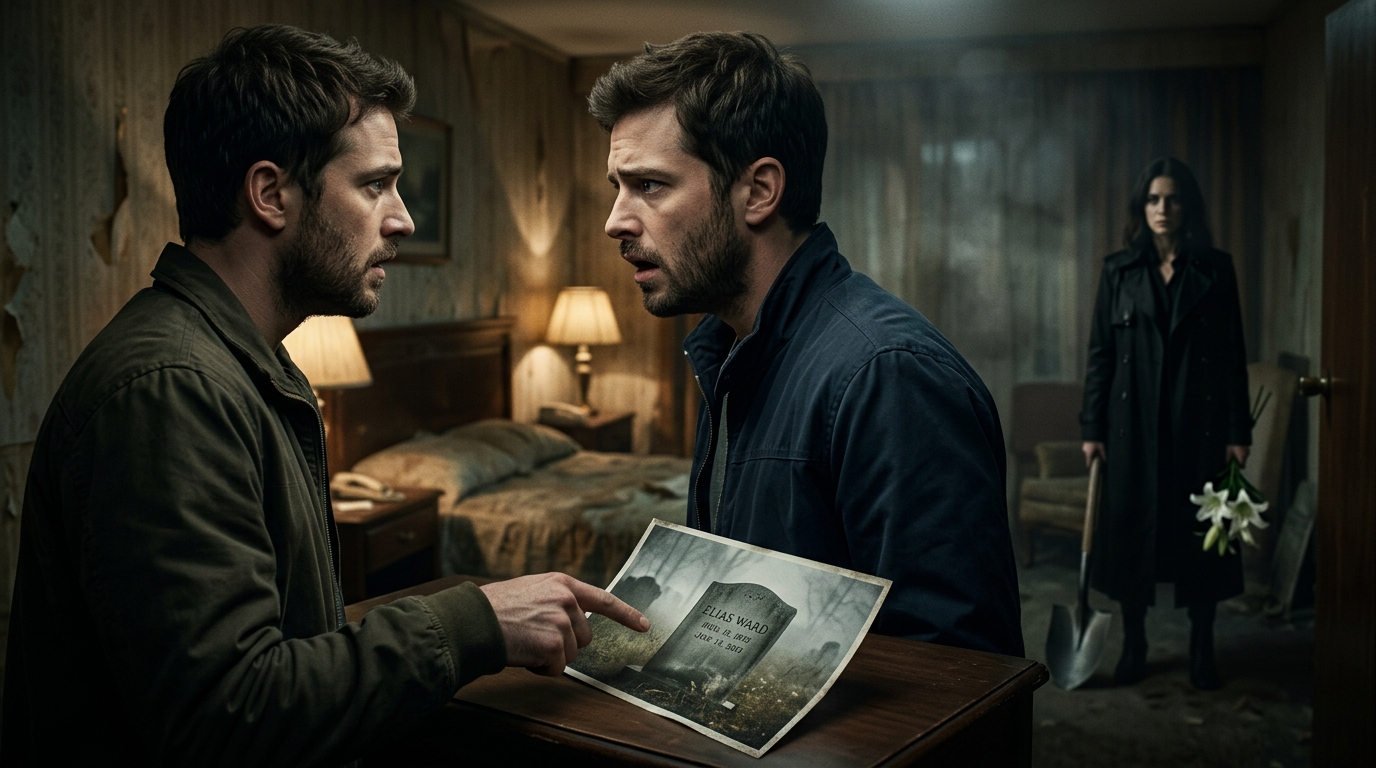
The Contract That Paid Too Much
Private detectives learn one rule early.
If a client offers too much money, they are not buying your time.
They are buying your silence.
That was the first thing I thought when the envelope arrived at my office.
No return address.
No stamp.
No courier name.
Just a black envelope slid under my door sometime between midnight and morning.
Inside was a contract.
One page.
Clean legal language.
Private surveillance.
Three nights.
Subject: wife of a businessman.
No police involvement.
No digital records.
Payment: enough money for me to close my agency for a year.
I read the number three times.
Then laughed.
Not because it was funny.
Because fear and hunger sound similar when they hit the same place.
My name is Elias Ward.
I had been a private investigator for eleven years.
Cheating spouses.
Insurance fraud.
Missing teenagers.
Corporate leaks.
The usual dirty laundry of people who wanted truth but not consequences.
My office sat above a pawn shop, smelled like old coffee and printer dust, and leaked every time it rained.
That morning, rain had been tapping against the window since dawn.
My bank account had less than two hundred dollars.
My landlord had stopped using polite language.
And my last client still owed me for three weeks of work.
So when someone offered me a year’s salary to watch one woman for three nights, I should have been suspicious.
I was.
I still took the meeting.
Desperation is not stupidity.
But it can look exactly like it from a distance.
At the bottom of the contract was one handwritten line.
Meet me tonight. 11:30 p.m. Room 604. No cameras.
No hotel name.
No signature.
Only an address printed beneath.
The Meridian Grand.
One of the most expensive hotels in the city.
The kind of place where rich men went when they needed doors that did not ask questions.
I folded the contract carefully.
Then noticed something on the back.
A small smear of dark red near the corner.
Not ink.
Blood.
Room 604
The Meridian Grand looked like a building designed to make ordinary people feel temporary.
Gold doors.
Marble floors.
A lobby chandelier large enough to crush a family.
The receptionist did not ask my name when I arrived.
That bothered me.
People in expensive hotels always ask names.
She only looked at my coat, then at my face, and slid a keycard across the counter.
“Room 604,” she said.
“I haven’t checked in.”
“I know.”
Her voice stayed flat.
Like she had been instructed not to hear her own answers.
I took the card.
The elevator ride felt too slow.
Mirrored walls reflected me from every angle.
Dark coat.
Unshaven jaw.
Tired eyes.
And the scar on the left side of my neck.
A thin white line from an old knife wound.
Most people did not notice it.
The ones who did usually looked away quickly.
The elevator doors opened on the sixth floor.
The hallway was empty.
Thick carpet swallowed my footsteps.
Room 604 waited at the end beneath a dim gold lamp.
I checked the corridor once.
No cameras.
Just like the note promised.
That should have made me feel safer.
It did not.
I knocked twice.
A man’s voice answered immediately.
“Come in, Elias.”
My hand froze on the door handle.
I had not told anyone at the hotel my first name.
I opened the door slowly.
The room inside was dark except for one lamp near the window. Rain streaked down the glass behind heavy curtains. A table sat in the center of the room with two chairs facing each other.
One chair was empty.
In the other sat a man in a black suit.
He looked up.
And my body forgot how to move.
The Man With My Face
The man sitting across from me was me.
Not similar.
Not family resemblance.
Me.
Same face.
Same eyes.
Same mouth.
Same small break in the nose from a fight outside a bar when I was twenty-six.
Same scar on the left side of the neck.
The scar nobody could copy unless they knew exactly where the blade had entered.
For several seconds, neither of us spoke.
I heard rain.
I heard the old hotel heater rattling beneath the window.
I heard my own heartbeat.
The man watched me calmly.
Too calmly.
Like he had already lived through this moment once and was only waiting for me to catch up.
I stepped backward.
He lifted one hand.
“Don’t leave.”
His voice stopped me.
Because it was mine.
Same tone.
Same slight rasp from too many cigarettes I kept promising to quit.
Same tired rhythm.
Hearing your own voice come from another man’s mouth is not like hearing a recording.
It is worse.
Recordings are dead things.
This voice was alive.
I reached under my coat for the gun at my belt.
He smiled faintly.
“I wouldn’t.”
“Give me one reason.”
“Because you hate shooting with your left hand, and your right shoulder still locks when you draw too fast.”
My blood turned cold.
Nobody knew that.
Not my doctor.
Not my ex-wife.
Not even my old partner.
The injury happened during a case I never reported properly.
I kept my hand near the gun anyway.
“Who are you?”
He leaned back slightly.
“You.”
“No.”
His smile faded.
“Not yet.”
The room seemed to tighten around those two words.
Not yet.
I looked at him again.
Really looked.
His suit cost more than my car.
His hair was cut cleaner than mine.
His skin looked healthier.
But the face beneath all that polish was mine.
Older maybe.
No.
Not older.
More finished.
Like someone had taken every rough edge from me and replaced it with money.
He gestured toward the empty chair.
“Sit down.”
I did not move.
He sighed.
“I know you don’t trust orders.”
“Then stop giving them.”
For the first time, something like amusement moved across his face.
Then he placed a thick envelope on the table.
“Fine. Look inside.”
The Wife I Was Paid To Follow
I approached the table slowly.
Every instinct in my body screamed trap.
But curiosity has always been my worst habit.
I picked up the envelope without sitting.
Inside were surveillance photographs.
A woman leaving a courthouse.
A woman entering an art gallery.
A woman standing beneath a streetlamp with one hand pressed to her chest.
She was beautiful in a careful, guarded way.
Dark hair.
Pale coat.
Eyes that seemed to be looking past the camera even though she could not know it was there.
I flipped to the first document.
Name: Clara Voss.
Age: Thirty-six.
Marital status: Married.
Husband: Adrian Voss.
Businessman.
Real estate.
Private equity.
Charity boards.
Money so old it stopped needing explanation.
I looked at the man across from me.
“Adrian Voss?”
He nodded once.
I almost laughed.
“Your file says you want me to follow your wife.”
“Yes.”
“Why?”
“I need to know where she goes after midnight.”
“Ask her.”
“I did.”
“And?”
“She lied.”
I looked back at the photos.
Clara Voss appeared in every image alone.
No lover.
No suspicious exchange.
No secret meeting.
Just a woman moving through the city like someone carrying invisible weight.
“This doesn’t look like adultery.”
“It isn’t.”
“Then what is it?”
Adrian Voss folded his hands on the table.
Our hands.
Same knuckles.
Same old scar across the right index finger from my father’s broken bottle when I was fifteen.
I wanted to look away.
I couldn’t.
He said, “My wife visits graves.”
That answer landed strangely.
Soft.
Cold.
“What graves?”
“One grave.”
“Whose?”
He watched me for a long moment.
Then said:
“Yours.”
The room went silent.
Rain dragged itself down the window behind him.
I stared at the envelope in my hand.
“What did you say?”
He did not repeat it.
He only nodded toward the remaining photograph.
The one I had not looked at yet.
The one turned face down at the bottom of the envelope.
The Photograph From Fifteen Years Later
I knew before touching it that I should not turn it over.
Some part of the body understands danger before the mind has language.
My fingers hesitated on the edge of the photograph.
Adrian watched me.
Not impatient.
Not concerned.
Waiting.
I turned it over.
The photograph showed Clara Voss standing in a cemetery beneath a gray sky.
Her hair was shorter.
Her face older.
Still beautiful.
But changed by grief.
She wore a black coat and held white flowers against her chest.
In front of her was a grave.
The name on the stone was mine.
ELIAS WARD.
Beloved husband.
Beloved father.
My throat closed.
I had no children.
No current wife.
No grave.
I forced myself to look lower.
The birth date was correct.
My birthday.
The death date was not.
It was fifteen years from now.
Exactly fifteen years.
Same month.
Same day.
My hands went numb.
The photograph slipped halfway from my fingers.
Adrian reached out and caught it before it hit the table.
I jerked backward.
“Where did you get this?”
“My wife.”
“She gave it to you?”
“No.”
“Then?”
“I found it hidden inside a locked drawer in our bedroom.”
I stared at him.
“You expect me to believe your wife has a photograph from the future?”
“I expect you to do what I paid you to do.”
I laughed once.
It came out wrong.
Sharp.
Almost hysterical.
“You look like me. You sound like me. You have my scar. You hand me a picture of your wife visiting my future grave, and you think this is a surveillance job?”
His expression hardened.
“You always get angry when you’re scared.”
That stopped me.
The words were too intimate.
Too exact.
“Stop talking like you know me.”
“I do know you.”
“No, you don’t.”
He leaned forward slightly.
His eyes locked onto mine.
“I know you still sleep with a chair under your apartment door even though nobody has broken in for eight years.”
My pulse stopped.
“I know you keep your mother’s wedding ring in the second drawer of your desk but pretend you sold it.”
My breath caught.
“I know you never take cases involving missing children because of what happened in Camden.”
I grabbed him by the collar before thinking.
The chair scraped backward.
The table shifted.
The lamp flickered.
Adrian did not fight.
He only stared up at me with my own eyes.
“Who are you?” I whispered.
He answered quietly.
“The man who survives if you don’t.”
Clara’s Grave Visits
I let go of him.
Not because I wanted to.
Because my hand had started shaking.
Adrian straightened his collar slowly.
“Clara has gone to that cemetery every Thursday for six months.”
“That cemetery doesn’t exist yet.”
“It does.”
“No.”
“It is private land right now. It becomes a cemetery in nine years.”
My mouth went dry.
“How do you know that?”
“Because I own it.”
Of course he did.
Men like Adrian Voss always owned the places where people eventually ended up.
I looked at the photograph again.
Clara standing over my future grave.
White flowers.
Black coat.
Tears on her face.
Something about her grief bothered me.
Not because it looked fake.
Because it looked familiar.
She was not mourning a stranger.
She was mourning someone she knew.
Someone she loved.
I looked at Adrian.
“Why hire me?”
“Because she follows you.”
“No, she doesn’t.”
“She will.”
The room seemed to tilt slightly.
“What does that mean?”
He opened a second folder and slid it across the table.
Inside were photos of me.
Leaving my office.
Buying cigarettes.
Standing outside my apartment.
Sleeping at my desk with one hand near my gun.
Some taken from close range.
Too close.
My stomach turned violently.
“You’ve had me watched.”
“No.”
“Then who took these?”
“My wife.”
I froze.
Adrian tapped one photo.
Clara’s reflection appeared faintly in a shop window behind me, half hidden beneath a hood.
My pulse hammered.
I had never seen her.
Not once.
But she had been there.
Watching me.
Following me.
Documenting me.
And somehow grieving me before I died.
“She knows me,” I said.
“Yes.”
“How?”
Adrian’s expression darkened.
“That is what I need you to find out.”
“You’re her husband.”
“Not in the way she thinks.”
The sentence sat between us like a loaded gun.
I slowly lowered myself into the empty chair across from him.
“What are you?”
For the first time, he looked away.
Only for a second.
But long enough.
“Running out of time.”
The Scar On His Neck
I looked at his neck.
The scar matched mine exactly.
Same angle.
Same length.
Same pale ridge against the skin.
I remembered getting mine.
A warehouse near the docks.
A missing accountant.
A man with a box cutter.
Blood under my collar.
Rain outside.
My old partner shouting my name.
No one else had been there.
No one could have copied that scar unless they copied the wound.
I leaned forward.
“Show me your scar.”
He stared at me.
“I can see it.”
“Show me.”
He hesitated.
That was the first truly human thing he had done.
Then he loosened his collar and turned his neck toward the light.
The scar was perfect.
Too perfect.
But beneath it, just below the skin, was something I did not have.
A tiny raised mark.
Like a surgical port.
Or an implant.
My stomach tightened.
“What is that?”
He buttoned his collar quickly.
“Nothing.”
“You have something under your skin.”
“So do you.”
I almost laughed.
“No, I don’t.”
Adrian reached into his pocket and pulled out a small black device.
No logo.
No buttons.
He placed it on the table between us.
It began to blink.
Once.
Twice.
Then it beeped softly.
A sharp pain lit up beneath the scar on my neck.
I grabbed my throat and stumbled backward.
The pain was so sudden I nearly fell.
Adrian watched me with something like pity.
“I told you,” he said.
My fingers pressed against my scar.
For the first time, I felt it.
A tiny hard point beneath the skin.
Something that had never been there.
Or something I had never noticed because I had been taught not to.
The black device beeped again.
The hotel lights dimmed.
My vision blurred.
A memory flashed.
Not mine.
Or maybe mine from a place I had not lived yet.
Clara screaming my name.
A hospital room.
A machine counting backward.
Adrian’s face above me.
My face.
A voice saying:
Only one of them can keep the original timeline.
I slammed my hand against the table.
“Turn it off.”
Adrian clicked the device once.
The pain vanished.
I stood breathing hard, sweat cold on my back.
He put the device away.
“You need to follow Clara tomorrow night.”
“Why tomorrow?”
“Because tomorrow she visits your grave again.”
I stared at him.
“And what happens then?”
He looked at the future photograph.
“She brings a shovel.”
The Grave With My Name
I should have walked away.
Called police.
Called a doctor.
Cut the scar open myself in the bathroom mirror.
Anything.
Instead, I took the envelope.
Because some cases do not ask whether you want them.
They arrive already inside your body.
Adrian stood as I reached the door.
“One more thing.”
I stopped.
He placed a small photo on the table.
Not Clara.
Not the grave.
Me.
But different.
Older.
Fifteen years older.
Standing beside Clara Voss in front of a house I did not recognize.
A little girl stood between us.
Maybe seven years old.
She had Clara’s eyes.
And my scar on her neck.
My voice barely worked.
“Who is that?”
Adrian’s expression changed.
Pain.
Real pain.
“Our daughter.”
I turned slowly.
“We don’t have a daughter.”
“No,” he said. “You do.”
Before I could answer, my phone rang.
Unknown number.
The hotel room seemed to darken around the sound.
I answered without thinking.
For a second, there was only wind.
Then a woman’s voice.
Clara.
I knew it before she said anything.
Not from memory.
From the photograph.
From the grief.
From some place inside me that had already loved her and lost her.
Her voice shook.
“Elias?”
I looked at Adrian.
His face went pale.
Clara whispered through the phone:
“Don’t trust the man with your face.”
The call ended.
The room lights flickered once.
Adrian took a step toward me.
I backed into the hallway.
At the far end, the elevator doors stood open.
Inside stood Clara Voss.
Black coat.
White flowers.
Mud on the hem of her dress.
She looked directly at me.
Then at Adrian behind me.
Her eyes filled with terror.
And in her hands, beside the flowers, she held a cemetery shovel.
The elevator lights blinked.
When they came back on, Clara was gone.
Only the flowers remained on the elevator floor.
And attached to them was a small card written in my handwriting.
Do not let him reach the grave first.
Leave a Reply