The Grave That Already Existed
I did not sleep after leaving Room 604.
That would imply my body still believed in ordinary things.
Rest.
Safety.
Morning.
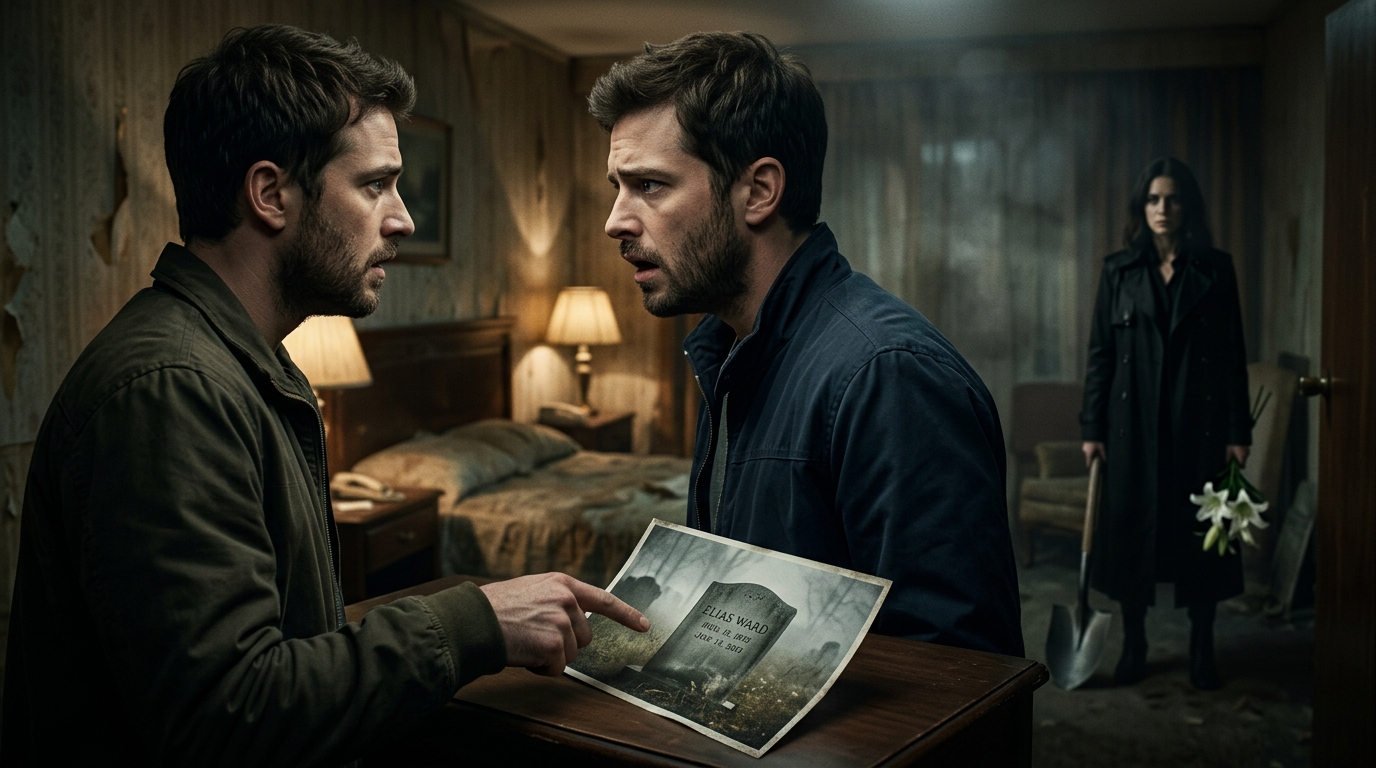
Instead, I sat in my office above the pawn shop until sunrise with the photograph of my own grave lying on the desk in front of me.
ELIAS WARD.
Beloved husband.
Beloved father.
Death date fifteen years from now.
I stared at the image until the letters stopped looking like letters and began looking like a sentence someone had already passed over my life.
The woman in the photograph was Clara Voss.
My client’s wife.
Or future wife.
Or something much worse.
She stood in a cemetery that should not exist yet, holding white flowers over my grave like she had loved me long enough to lose me.
I called in every favor I had before noon.
Photo analyst.
Former police tech.
A guy named Miles who could tell you whether a shadow was real by the way it bent over concrete.
I lied to all of them.
“Old case,” I said.
“Possible forgery.”
“Need confirmation.”
Nobody asked why the dead man in the photograph had my name.
People in my line of work know when not to ask questions.
By 4:17 p.m., Miles called back.
His voice was quiet.
That was the first bad sign.
“It’s not edited.”
I closed my eyes.
“Check again.”
“I did.”
“Check the date metadata.”
“There is no metadata.”
“Then it’s fake.”
“No,” he said. “It’s printed on paper that hasn’t been manufactured yet.”
My throat went dry.
“What does that mean?”
“It means either someone made a very expensive custom fake for no reason, or this photograph shouldn’t exist.”
I looked at the grave again.
The stone.
The flowers.
Clara’s face.
Her grief looked too specific to be forged.
Miles kept talking.
“And the cemetery?”
My hand tightened around the phone.
“What about it?”
“It exists.”
“No, it doesn’t.”
“Elias.”
His voice dropped.
“It’s private land now, but the development permits were approved three months ago. The cemetery opens in nine years.”
I stared at the photo.
“Where?”
He gave me the address.
I wrote it down with a hand that no longer felt like mine.
Then Miles said one final thing before hanging up.
“The strangest part isn’t the grave.”
I swallowed.
“What is?”
“The shadow.”
I looked at the photo again.
“What shadow?”
“Behind the tree line. There’s a man watching her.”
My pulse slowed.
Miles exhaled softly.
“I cleaned it up as much as I could.”
“And?”
“It’s you.”
Following Clara
I took the case because I no longer understood the difference between choice and momentum.
For one week, I followed Clara Voss.
Not because I trusted Adrian.
Not because I believed him.
Because every time I thought about walking away, the scar on my neck pulsed like something beneath it had started counting down.
Clara was not having an affair.
That was obvious by the second night.
She did not meet lovers.
She did not slip into hotels.
She did not send secret messages while smiling at her husband over dinner.
She moved through the city like someone searching for a door only she could see.
Every evening at 8:30, she left the Voss residence alone.
No driver.
No security.
Black coat.
White flowers.
Same as the future photo.
She drove past restaurants, apartment towers, churches, and boarded storefronts until the city thinned into warehouse roads and empty lots.
Then she always stopped at the same place.
A house.
Abandoned.
Two stories.
Windows boarded.
Roof sagging.
Front gate half broken.
No address number.
No lights.
No reason for a wealthy businessman’s wife to stand outside it every night in the rain.
But she did.
The first night, she only stood at the gate and cried.
The second, she unlocked it.
The third, she went inside.
I followed.
Quietly.
Carefully.
The kind of careful that keeps private detectives alive.
The front door had been forced years ago, then repaired from the inside.
That bothered me.
Abandoned houses are usually broken from outside.
This one looked like something had tried to get out.
Inside, the air smelled of dust, old smoke, and rain trapped in wood.
Clara moved through the darkness without a flashlight.
Like she knew every step.
Like she had walked that hallway in another life.
I kept my distance.
She entered a room at the back of the house and closed the door.
A soft click.
Lock.
I waited in the hallway for three minutes.
Then five.
Then ten.
No sound.
No movement.
Only the slow drip of water somewhere inside the walls.
When she finally came out, her face was pale and wet with tears.
She was holding something.
A photograph.
She pressed it to her chest and whispered one sentence into the dark hallway.
“I’m trying to save him.”
Then she left.
She never saw me.
At least, I thought she didn’t.
But when I stepped into the room after her, I realized Clara had known I would follow.
Because the first photograph on the wall was of me entering the house.
Taken from inside the room.
Seconds earlier.
The Room Full Of Me
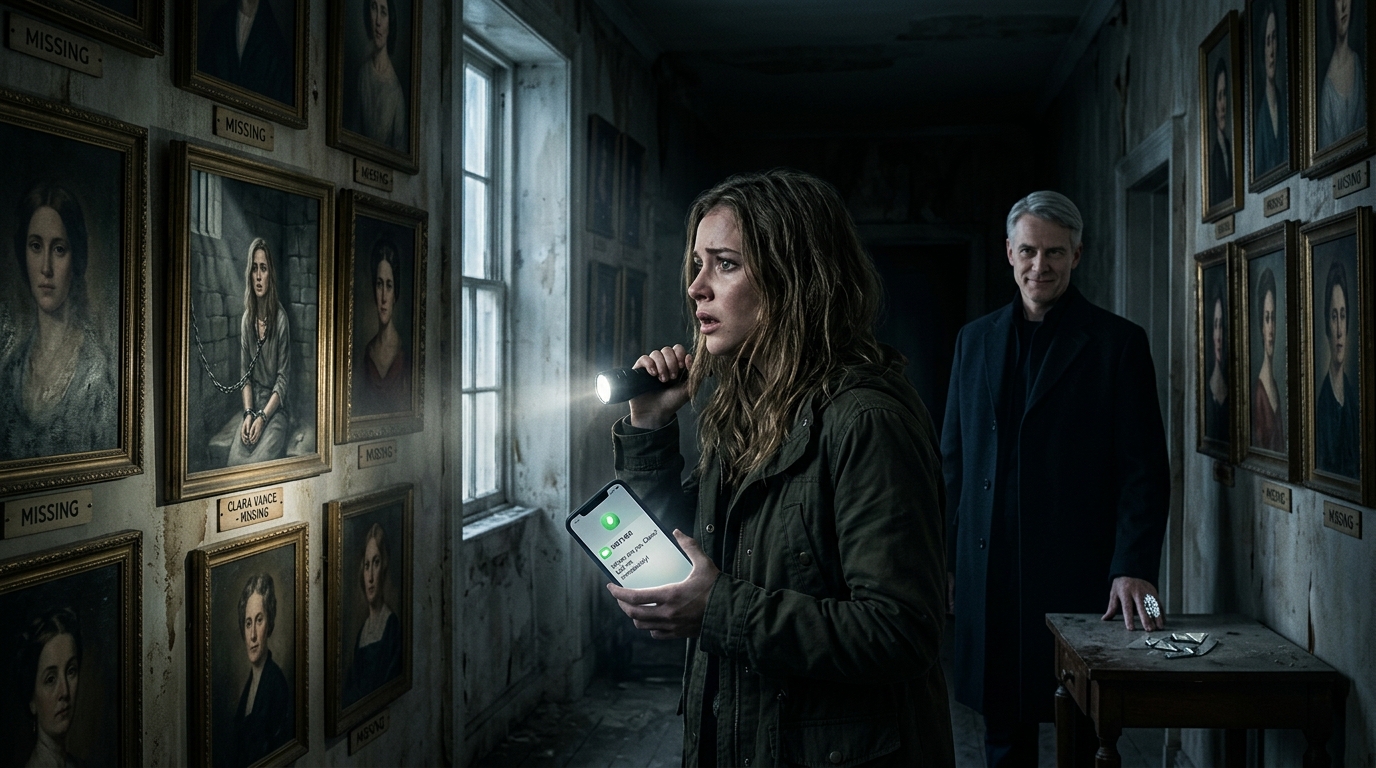
The walls were covered with my life.
Photographs.
Maps.
Newspaper clippings.
Surveillance stills.
Hospital records.
Police reports.
Images of me leaving my office.
Sleeping in my car.
Drinking coffee outside the courthouse.
Bleeding from the neck after the warehouse case that gave me my scar.
Some photos were recent.
Some were impossible.
One showed me fifteen years older, standing in front of a white house with Clara and a little girl between us.
Another showed me in a hospital bed, gray at the temples, tubes in my arms.
Another showed the cemetery.
The same photograph Adrian gave me.
Clara standing at my grave.
White flowers.
Black coat.
The same grief.
Only this copy had writing across the bottom in red ink.
NOT YET.
My skin went cold.
I moved closer to the wall.
At the center hung a timeline.
My name appeared at the top.
ELIAS WARD.
Below it were dates.
Some past.
Some future.
My birth.
My mother’s death.
My first arrest as a teenager.
My first private investigation license.
The day I got the scar on my neck.
Then dates that had not happened yet.
Meeting Clara.
The birth of a daughter named Lily.
A house fire.
A court hearing.
The grave.
The death date.
My mouth went dry.
Every future event had been crossed out and rewritten multiple times.
Like someone had tried changing my life and failed.
Again.
And again.
And again.
On a table beneath the wall sat a file labeled:
TRIGGER EVENT.
I opened it with shaking hands.
Inside was a single photograph.
Me.
Standing in a room I did not recognize.
Holding a gun.
My face twisted with rage.
The barrel pointed at someone just outside the frame.
On the back, one line was written in my own handwriting.
This is where it always starts.
I dropped the photograph.
It landed face-up on the floor.
The room seemed to tilt around me.
Then my phone buzzed.
Unknown number.
One message.
GET OUT BEFORE SHE COMES BACK.
I turned toward the doorway.
Clara stood there.
Black coat.
White flowers.
Eyes full of terror.
“You shouldn’t be here,” she whispered.
Clara Knew My Death
For a moment, neither of us moved.
The abandoned house groaned softly around us.
Rain ticked against boarded windows.
The photographs of me stared from every wall.
Clara stepped inside and closed the door behind her.
Her hands were trembling.
I noticed the flowers first.
White lilies.
Not roses.
Funeral flowers.
My funeral flowers.
“How long have you been following me?” she asked.
My voice came out rough.
“How long have you been following me?”
She looked at the wall.
Pain moved across her face.
“Longer than you remember.”
I almost laughed.
“You people keep saying that.”
Her eyes snapped back to me.
“You people?”
“The man with my face. You. Whoever built this shrine to my obituary.”
“It isn’t a shrine.”
“What is it then?”
She swallowed.
“A warning system.”
I looked around the room.
“My life on a wall is a warning system?”
“Your deaths.”
The plural hit me harder than the word itself.
Deaths.
Not death.
I stepped toward her.
“Explain.”
Clara’s eyes filled, but she did not cry.
Not yet.
“I’ve seen you die four times.”
The room became very quiet.
That kind of quiet again.
The kind that stands behind truth before it enters.
“Impossible,” I said.
She nodded.
“Yes.”
“That’s not an explanation.”
“I know.”
I grabbed the trigger-event photograph from the floor and held it up.
“What is this?”
Clara flinched.
“Where did you find that?”
“On the table.”
She covered her mouth.
“No.”
“What?”
“That means he’s already been here.”
My pulse jumped.
“Adrian?”
She looked toward the door.
“He isn’t Adrian.”
“Then what is he?”
Her voice dropped.
“The version of you who survived what you did.”
My grip on the photo loosened.
The man in Room 604.
My face.
My voice.
My scar.
The surgical mark beneath his skin.
The future grave.
The little girl.
The warning.
I forced myself to breathe.
“What did I do?”
Clara stared at me like she had been waiting years to answer and dreading the moment it arrived.
“You pulled the trigger.”
“At who?”
She closed her eyes.
“Me.”
The Gun On The Table
I went back to Room 604 the next night.
That was what Clara told me not to do.
Naturally, I did it.
Private detectives survive by mistrusting everyone equally.
But that night, mistrust felt useless.
Everyone knew more about my life than I did.
Clara said I killed her.
Adrian said he hired me to follow her.
The photograph said I died fifteen years later.
The room in the abandoned house said all of it had happened before.
I needed the man with my face to explain what kind of nightmare had been using my name.
The Meridian Grand receptionist did not look surprised when I arrived.
She only slid the keycard across the counter again.
“Room 604.”
I stared at her.
“Do you ever ask questions?”
Her eyes flicked to mine.
“Not twice.”
I took the elevator up alone.
This time, the mirrored walls did not show only me.
For half a second, I saw another version of myself standing behind my reflection.
Older.
Tired.
Blood on his shirt.
Then the elevator dinged.
Sixth floor.
The hallway was empty.
Room 604 was unlocked.
I stepped inside with my gun already in hand.
Adrian sat at the same table.
Same black suit.
Same face.
Mine.
This time, he did not smile.
On the table between us lay another gun.
Not mine.
A revolver.
Old.
Polished.
Loaded.
He pushed it toward me with two fingers.
The sound of metal against wood made the room feel suddenly smaller.
“What is this?” I asked.
He looked exhausted.
Not rich.
Not controlled.
Exhausted in a way money cannot hide.
“The weapon you use.”
“I haven’t used it.”
“Not yet.”
I did not touch it.
Adrian leaned back.
“Good.”
The rain pressed against the window behind him.
He looked older than he had the first night.
Or maybe I was finally seeing the years beneath his face.
“I am you,” he said quietly.
I said nothing.
“Fifteen years from now.”
Still nothing.
“And I came here to stop you from pulling the trigger.”
The revolver sat between us.
Heavy.
Patient.
Like it had always belonged in the room.
Fifteen Years From Now
“You expect me to believe time travel?” I asked.
Adrian laughed softly.
It sounded exactly like me.
That made it worse.
“No. I expect you to reject it until evidence leaves you no other room.”
“Convenient.”
“Very.”
He unbuttoned his collar.
Beneath the scar on his neck, the implant-like mark pulsed faintly blue.
Mine burned in response.
I grabbed my throat.
Adrian nodded.
“That’s how they keep the versions connected.”
“Who are they?”
He looked at the window.
“The people who discovered grief is the easiest door into time.”
I stared at him.
“Try again without sounding insane.”
He turned back to me.
“Clara built the first loop.”
That stopped me.
“No.”
“Yes.”
“She’s your wife?”
“She becomes ours.”
I hated the softness in his voice when he said that.
Ours.
As if I had already shared a life with him.
As if Clara had already belonged to both of us in different timelines.
“She was trying to save her daughter,” he said.
“Our daughter.”
I saw the photo again.
The little girl between us.
Clara’s eyes.
My scar.
Lily.
My throat tightened despite myself.
“I don’t have a daughter.”
“You will.”
“I don’t even know Clara.”
His eyes darkened.
“You know her enough to kill her.”
I slammed my hand on the table.
“Stop saying that.”
He did not flinch.
“You pull the trigger because you believe she betrayed you.”
“Did she?”
“No.”
“Then why would I believe it?”
“Because I make you.”
The words froze the room.
I stared at him.
“What?”
Adrian looked at the gun.
“I was sent back to prevent the trigger event. Instead, every time I interfere, I become the reason it happens.”
Silence.
Rain.
The low hum of the hotel lights.
My scar pulsing beneath my fingers.
Adrian continued.
“In the first timeline, you find Clara in that abandoned house with the photos. You think she has been manipulating your life. You confront her. Someone shoots. She dies.”
“Someone?”
His jaw tightened.
“You.”
“No.”
“In the second timeline, I try to warn you. You think I’m the threat. You follow her sooner. You bring the gun. She dies faster.”
I backed away from the table.
“In the third?”
He closed his eyes.
“Our daughter watches.”
The room seemed to lose all oxygen.
“The little girl?”
He nodded.
“Lily.”
“What happens to her?”
He opened his eyes.
“She becomes the first person to send me back.”
The Trigger Event
I should have called him crazy.
I wanted to.
But his grief was too specific.
Madmen can invent stories.
They cannot fake grief that knows exact dates.
Adrian slid a folder across the table.
I did not open it.
He said, “Tomorrow night, Clara goes back to the house.”
“For what?”
“To burn the room.”
“The photographs?”
“The timeline.”
I frowned.
“That room is more than photos.”
“Yes.”
“What is it?”
He looked at me carefully.
“A memory anchor.”
I hated how little I hated that answer.
Because standing inside that room, surrounded by my life and my death, I had felt it.
Not just evidence.
Not just obsession.
Something recording possibilities.
Something waiting for one version to become permanent.
“Why would Clara build it?”
“She didn’t build all of it. She found it.”
“Where?”
“In the basement.”
Of course.
It always came back to basements.
Buried rooms.
Hidden floors.
Places rich people used to hide consequences.
Adrian touched the revolver.
Not picking it up.
Just one finger on the handle.
“The man who owns that house created the first version. He used it to remove people from outcomes he didn’t like.”
“Who?”
Adrian’s mouth tightened.
“Your client.”
“You’re my client.”
“No.”
The hotel room door behind me clicked softly.
My body went rigid.
Adrian looked past me.
Fear crossed his face.
Real.
Immediate.
I turned.
The door opened.
Another man stepped in.
Same face.
Mine.
But older than Adrian.
Blood soaked through his white shirt.
His left eye was bruised shut.
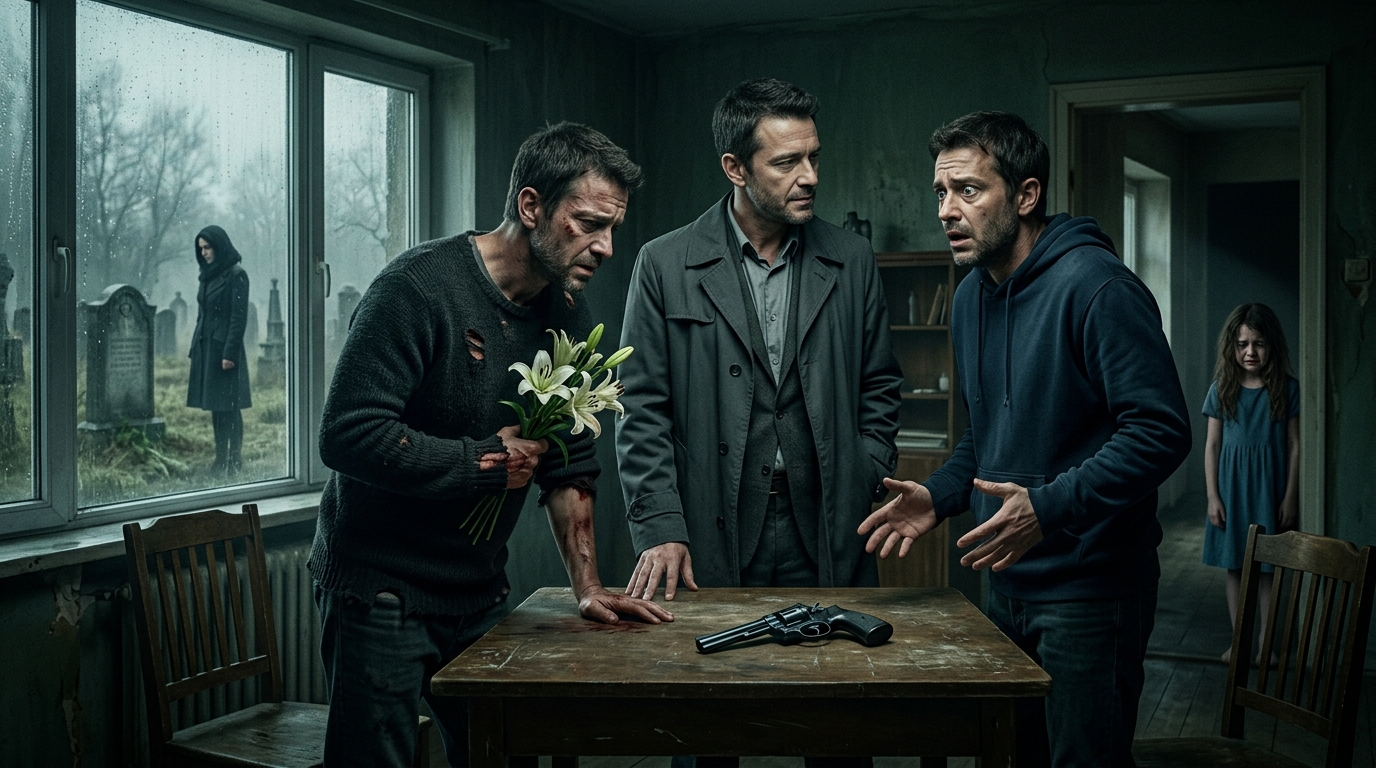
In his hand, he held white lilies.
Funeral flowers.
He looked at me first.
Then at Adrian.
Then at the revolver on the table.
“Don’t listen to him,” the bleeding man said.
My stomach dropped.
Adrian stood slowly.
“No.”
The bleeding man laughed.
“You never understand in time.”
I backed away until my shoulder hit the wall.
Three versions of my face stood in one room.
Me.
Adrian.
The bleeding man.
The revolver lay on the table between us.
The bleeding man looked at me and smiled through blood.
“He didn’t come to stop you from pulling the trigger.”
Adrian shouted, “Elias, don’t—”
The bleeding man finished.
“He came to make sure you aim at Clara instead of him.”
The Man Who Lied First
The room shattered into movement.
Adrian lunged for the revolver.
The bleeding man grabbed his wrist.
I drew my own gun before thinking.
Three weapons.
Three versions of the same man.
One hotel room that suddenly felt too small for the timeline.
“Stop!” I shouted.
Neither listened.
Adrian and the bleeding man crashed into the table.
The revolver spun across the wood and slid toward my hand.
I caught it instinctively.
The moment my fingers closed around the grip, the scar on my neck burned white-hot.
The room vanished.
I saw Clara.
Not as a photograph.
Real.
Standing in the abandoned house with tears on her face.
She whispered:
“Elias, please. That isn’t him.”
Then the vision changed.
A little girl hiding under a table.
Lily.
Hands over her mouth.
Watching someone die.
Then another flash.
My own grave.
The date fifteen years from now.
Then Clara again.
Blood on her white coat.
My hand holding the revolver.
My finger on the trigger.
I came back to the hotel room gasping.
Adrian and the bleeding man both stared at me.
They knew I had seen it.
The revolver shook in my hand.
“Who do I shoot?” I whispered.
Adrian’s face broke.
“Put it down.”
The bleeding man smiled.
“That’s how she dies.”
A phone rang.
Not mine.
Not Adrian’s.
The sound came from inside the envelope on the table.
Adrian turned pale.
“No.”
The bleeding man’s smile disappeared too.
That frightened me most.
I opened the envelope.
Inside was a small black phone.
No logo.
No signal bars.
Incoming call.
CLARA VOSS.
I answered.
For one second, there was only breathing.
Then Clara’s voice came through.
Terrified.
“Elias, I’m at the house.”
My grip tightened on the revolver.
She whispered:
“He’s already here.”
The call crackled.
Then another voice came on.
My voice.
But not from either man in the room.
Older.
Colder.
Closer to the phone.
“Bring the gun,” it said. “Or I kill her before you get the chance.”
The line went dead.
The hotel lights flickered.
When they came back, both future versions of me were looking at the door.
In the hallway outside Room 604, a child began crying.
A little girl’s voice.
Lily.
“Daddy,” she whispered, “please don’t do it again.”