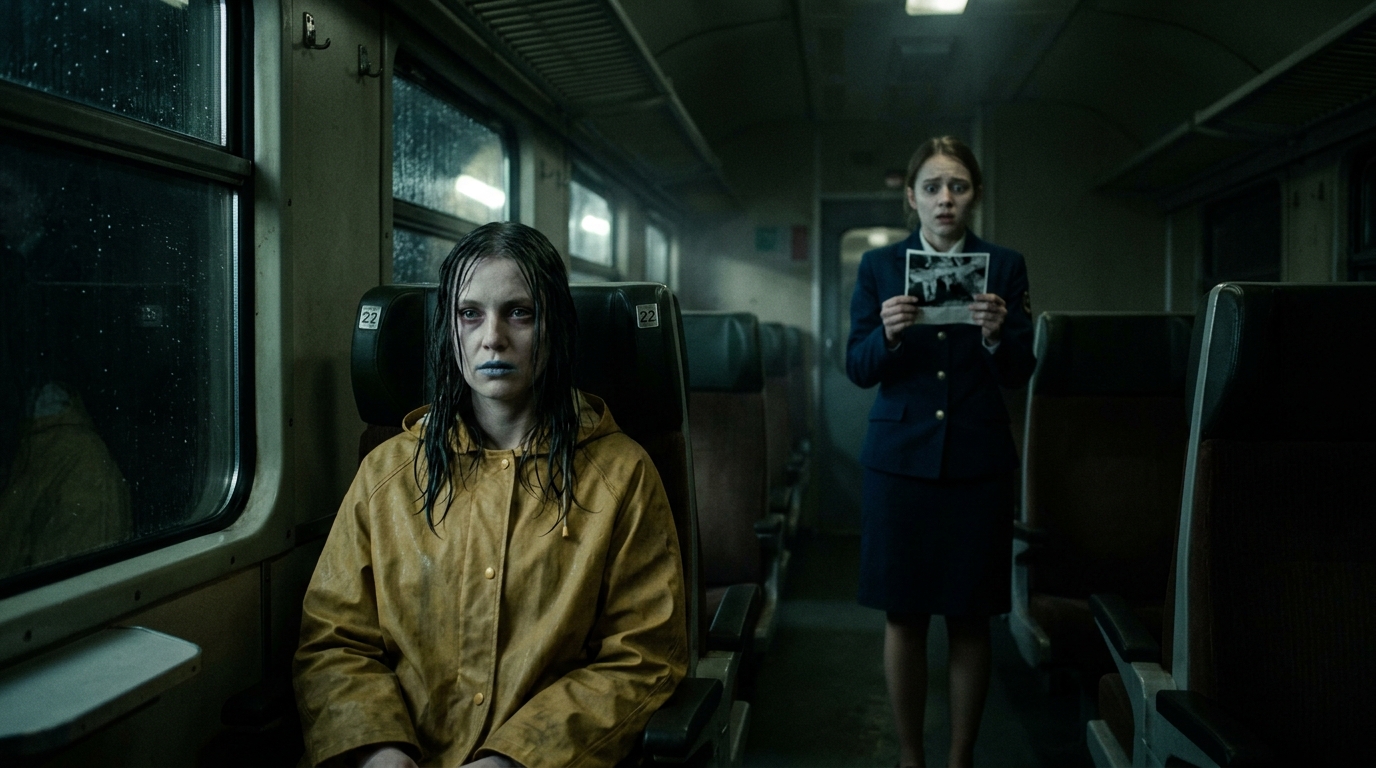
Seat 22 Was Never Sold
The first passenger disappeared on a Thursday night.
That was what the company called it.
Disappeared.
Not missing.
Not taken.
Not dead.
Disappeared.
As if the man had simply misplaced himself somewhere between Carriage B and the sleeping cabins.
His name was Daniel Price.
Forty-six.
Business traveler.
Boarded the 11:40 night train from Harrow Station with one suitcase, one coffee, and one first-class ticket.
He never got off.
His luggage remained under his seat.
His coat stayed folded on the overhead rack.
His phone was found charging beside the window.
But Daniel Price was gone.
The train did not stop between stations.
The doors never opened.
The cameras showed no one leaving.
And still, by morning, seat 14 was empty.
I was working that night.
My name is Mara Ellis, and I had been a senior attendant on the Westbound Night Line for five years.
I knew every sound that train made.
The brake hiss before tunnels.
The metal groan near mile marker 82.
The little rattle in the coffee trolley that maintenance kept promising to fix.
Night trains have personalities if you work them long enough.
They also have secrets.
After Daniel Price vanished, management told us not to panic the passengers.
After the second disappearance, they told us not to speak to reporters.
After the third, they stopped using the word disappearance at all.
They called them “unverified passenger exits.”
That was when I knew they were afraid.
Because companies only rename things they cannot control.
But the cameras showed something they could not rename.
Every time someone vanished, one person appeared on the footage.
A woman in a yellow coat.
Sitting in seat 22.
The problem was simple.
Seat 22 was never sold.
The Woman In The Yellow Coat
At first, I thought it was a booking error.
Trains have errors.
Overlapping tickets.
Ghost reservations.
System bugs.
Old passenger records that refuse to clear properly.
But seat 22 was different.
It was not unavailable.
It was not blocked.
It was not reserved.
It simply did not exist in the ticketing system.
On the seating chart, Carriage C went from seat 20 to seat 24.
No 21.
No 22.
No 23.
A design change from years ago, according to engineering records.
Three seats removed after a carriage renovation.
Except the physical seat remained there.
I saw it every night.
Blue fabric.
Small metal tray table.
Window to the left.
Seat number 22 printed above it in faded white paint.
Passengers asked about it sometimes.
“Why can’t I book that seat?”
I always gave the answer management taught us.
“Maintenance hold.”
That was a lie.
No one repaired it.
No one cleaned it.
No one sat there.
Except her.
The woman in the yellow coat appeared only on camera footage.
Never when I walked through the carriage.
Never when passengers boarded.
Never when tickets were checked.
But after every disappearance, security reviewed the recordings.
And there she was.
Yellow coat.
Dark hair.
Hands folded neatly in her lap.
Face turned toward the window.
Seat 22.
Always alone.
Always still.
Then one night, the camera captured her doing something new.
She turned her head.
Not toward the missing passenger.
Not toward the aisle.
Toward the camera.
Then she lifted one hand and pointed directly at me.
I was watching the footage in the security room when it happened.
My supervisor paused the video immediately.
Nobody spoke.
On the screen, the woman in yellow pointed toward the camera with a pale hand.
Then the footage glitched.
When it returned, she was gone.
My supervisor cleared his throat.
“Video corruption.”
I looked at him.
“She pointed at me.”
He closed the laptop.
“No, she didn’t.”
That was the first time I understood something.
Everyone on that train knew seat 22 was wrong.
They were just waiting for someone else to be brave enough to say it.
The Passenger List
The fourth disappearance happened three weeks later.
A woman this time.
Evelyn Hart.
Traveling alone.
Booked cabin 6.
She asked me for tea at 12:17 a.m. and told me she hated tunnels.
I smiled and said the Westbound Line only passed through one long tunnel before dawn.
She laughed nervously.
“That’s one too many.”
At 2:09 a.m., the train entered Hollowbridge Tunnel.
At 2:13, the carriage lights flickered.
At 2:16, we exited.
Evelyn Hart was gone.
Her tea sat untouched.
Her cabin door was locked from the inside.
The window did not open.
Her purse remained on the bed.
But the camera in Carriage C showed the woman in yellow sitting in seat 22 again.
This time, something lay on the tray table in front of her.
A photograph.
The security footage was too grainy to see it clearly.
But I could tell it was a face.
A woman’s face.
My supervisor stopped the video before anyone could zoom in.
“We send this to central,” he said.
“No,” I said.
He stared at me.
“What?”
“I want to see the photo.”
“You want a lot of things that are above your job.”
I looked at the frozen screen.
Yellow coat.
Seat 22.
Photograph on the tray.
The woman’s head turned slightly toward the aisle, as if she were waiting for someone to sit opposite her.
Maybe for me.
I said, “People are vanishing.”
My supervisor’s jaw tightened.
“People vanish everywhere.”
“Not from locked trains.”
He leaned closer.
His voice dropped.
“Do not make yourself part of this.”
That sentence stayed with me.
Not “do not investigate.”
Not “stay safe.”
Do not make yourself part of this.
As if the train chose people.
As if attention was an invitation.
That night, I checked the passenger logs from every disappearance.
Daniel Price.
Mark Halen.
Sofia Reed.
Evelyn Hart.
Different ages.
Different tickets.
Different destinations.
But one detail connected them.
All four had been assigned seats or cabins within two carriages of seat 22.
And all four vanished after the train passed through Hollowbridge Tunnel.
I went deeper into the archive.
Old incident reports.
Renovation files.
Carriage replacement logs.
Buried inside a maintenance folder, I found a file from eighteen years earlier.
Accident report.
Carriage C.
Seat 22.
Passenger deceased before arrival.
Name redacted.
My hands went cold.
The woman in the yellow coat had not started with the disappearances.
She had started with a death.
I Sat Across From Her
I decided to wait for her.
That sounds foolish now.
It was foolish then too.
But after you watch enough people disappear while management calls it scheduling noise, fear starts to feel like complicity.
That night, I changed my shift route.
At 1:57 a.m., I told the junior attendant I would inspect Carriage C alone.
At 2:05, I walked through the sleeping car.
At 2:09, the announcement chimed softly overhead.
Approaching Hollowbridge Tunnel.
Passengers shifted in their seats.
Some slept.
Some stared into phones.
Some looked out at the rain sliding sideways across the windows.
Seat 22 stood empty beneath the dim carriage light.
The blue fabric looked darker than the surrounding seats.
Older.
Like the rest of the carriage had moved on and seat 22 had refused.
I stood in the aisle.
My heart beat so hard I could hear it.
Then the tunnel swallowed the train.
Darkness pressed against the windows instantly.
The carriage lights flickered.
Once.
Twice.
On the third flicker, she appeared.
Not gradually.
Not like someone walking from another carriage.
One moment seat 22 was empty.
The next, the woman in the yellow coat sat there.
Hands folded.
Hair damp.
Face lowered.
My breath stopped.
She looked real.
That was what terrified me most.
Not transparent.
Not glowing.
Not ghostly.
Real.
Rainwater dripped from the hem of her yellow coat onto the train floor.
Inside a sealed carriage.
Inside a tunnel.
I should have run.
Instead, I sat across from her.
The seat opposite 22 was cold.
Colder than metal should be.
For several seconds, neither of us moved.
The train roared through the tunnel around us.
Dark windows.
Flickering lights.
Sleeping passengers who did not wake.
I whispered, “Who are you?”
The woman did not answer.
Her face remained hidden beneath wet strands of hair.
Then she lifted one hand slowly and placed something on the small table between us.
A photograph.
My fingers went numb before I even saw it clearly.
Because some part of me already knew.
It was a picture of me.
Not from years ago.
Not from staff records.
From that night.
I was wearing the same uniform.
Same name badge.
Same silver hair clip.
In the photograph, I stood in Carriage C beside seat 22.
But I was not alive.
My eyes were open.
My face was pale.
My mouth slightly parted like I had tried to speak at the moment death arrived.
I could not breathe.
I turned the photograph over.
There was one word written on the back.
Tomorrow.
The Photo From Tomorrow
The train lights flickered harder.
I looked up from the photograph.
The woman in yellow was staring at me now.
Her face was pale.
Her lips almost blue.
There was a faint bruise around her throat, hidden beneath the collar of the coat.
For one second, I thought she might speak.
Instead, she pointed toward the end of the carriage.
Toward the door leading to the luggage compartment.
The same door passengers were not allowed to use during tunnel crossings.
My voice shook.
“What’s there?”
She lowered her hand.
Then pressed one finger to the photograph of me.
Tomorrow.
I felt cold spread from my hands into my chest.
“Am I going to disappear?”
The woman’s eyes filled with tears.
She shook her head once.
Slowly.
Not disappear.
Worse.
The train began to slow inside the tunnel.
That was impossible.
The Westbound Night Line never slowed in Hollowbridge.
Not unless something blocked the track.
The lights went out completely.
For three seconds, there was only darkness and the scream of metal wheels against rails.
Then emergency red lights clicked on.
The seat in front of me was empty.
The woman in the yellow coat was gone.
Only the photograph remained on the table.
My photograph.
My death.
Tomorrow.
A child two rows behind me began crying in her sleep.
Someone in the carriage murmured.
The train exited the tunnel with a violent shudder.
Normal lights returned.
Passengers stirred.
No one seemed to have seen her.
No one except me.
I grabbed the photograph and stood too quickly.
My knees almost failed.
At the far end of Carriage C, the luggage compartment door was slightly open.
It had been locked earlier.
I knew because I had checked it.
A strip of yellow fabric was caught in the hinge.
I walked toward it slowly.
Every instinct told me not to.
Every breath told me to run.
But the photograph in my hand felt heavier with each step.
Tomorrow.
I reached the door and pulled it open.
The luggage compartment smelled of dust, cold iron, and old rain.
On the floor sat a small black suitcase.
No passenger tag.
No lock.
No dust.
I knelt and opened it.
Inside was another photograph.
This one showed the woman in the yellow coat.
Alive.
Smiling.
Standing beside a man in a conductor’s uniform eighteen years earlier.
On the back, written in the same handwriting as my photo, were six words:
He sold my seat after I died.
The train loudspeaker crackled overhead.
A voice whispered through the entire carriage.
Not the driver.
Not the announcement system.
A woman’s voice.
“If you see seat 22, he has already chosen you.”
I turned slowly toward the aisle.
At the opposite end of the carriage stood the conductor.
Mr. Vale.
My supervisor.
The man who told me not to make myself part of this.
He was staring at the suitcase.
Then at the photograph in my hand.
Then at me.
His expression was not surprised.
It was disappointed.
And behind him, every passenger seat in Carriage C was suddenly empty.
Leave a Reply