Author: box2026

  • The Driver Said He Woke Up From A Car Crash With My Dead Husband’s Watch In His Pocket. Then I Found His Face In A Photo From 20 Years Ago

    The Driver Said He Woke Up From A Car Crash With My Dead Husband’s Watch In His Pocket. Then I Found His Face In A Photo From 20 Years Ago

    The Second Man At The Door

    There are moments when fear becomes too large for the body.

    You stop shaking.

    You stop breathing fast.

    You simply stand there while reality bends into something impossible.

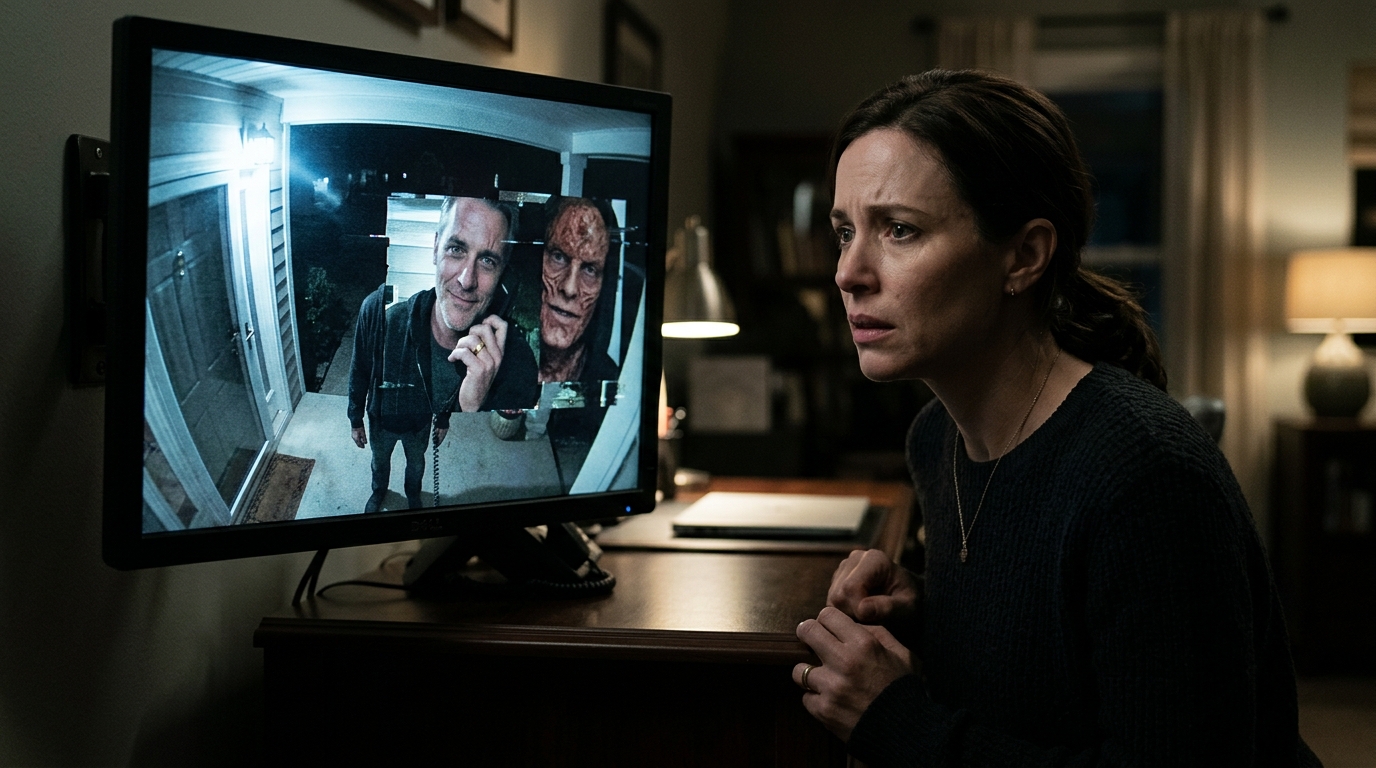
    That was how I felt staring at the security monitor in my study.

    Elias Reed stood inside my house.

    The man from my nightmares.

    The man wearing my dead husband’s watch.

    And outside my front door stood another man with the same face.

    Same gray eyes.

    Same scar above the right brow.

    Same still posture beneath the rain.

    Except the man outside was smiling.

    And on his left hand, catching the porch light, was Daniel’s wedding ring.

    My husband’s ring.

    The one they supposedly returned to me after the accident.

    The one I buried in an empty velvet box because I could not bear to look at it.

    Elias stared at the monitor like he was seeing his own ghost.

    For the first time since entering my house, he looked truly afraid.

    “Who is that?” I whispered.

    He did not answer.

    The doorbell rang again.

    Deep.

    Slow.

    Final.

    The house seemed to hold its breath around us.

    Upstairs, the dragging sound stopped.

    The silence after it was worse.

    I looked at Elias.

    “If that’s you…”

    “It isn’t.”

    His voice was hoarse now.

    “How do I know that?”

    He turned to me.

    “You don’t.”

    That honesty frightened me more than any lie could have.

    The man outside lifted his hand toward the camera.

    Daniel’s ring glinted under the rain.

    Then he spoke through the intercom.

    His voice came from the study speaker.

    Soft.

    Amused.

    “Open the door, Helena.”

    My blood froze.

    No one called me Helena anymore.

    Not staff.

    Not friends.

    Not even Daniel after our first year of marriage.

    Only one person had used my full name like that.

    My husband.

    Before he learned how to make affection sound like ownership.

    Elias stepped closer to the monitor.

    His face had gone white.

    “That voice…”

    I looked at him.

    “You know it?”

    He swallowed.

    “I heard it after the crash.”

    The Watch In His Pocket

    I turned slowly toward him.

    “What crash?”

    Elias pressed one hand against the edge of my desk as if his balance had suddenly failed.

    His eyes stayed on the monitor.

    The man outside continued smiling.

    Rain ran down his face without bothering him.

    Elias whispered, “Last year.”

    I said nothing.

    He looked down at the watch on his wrist.

    Daniel’s watch.

    The cracked gold face.

    The black leather strap.

    Tick.

    Tick.

    Tick.

    “I woke up in a hospital outside Vienna,” he said. “They told me I had been in a car accident.”

    My throat tightened.

    “You were in Europe?”

    “I don’t know.”

    “What do you mean you don’t know?”

    His expression twisted with frustration.

    “I mean I woke up with no passport, no phone, no memory of the accident, and three months of my life missing.”

    The intercom crackled softly.

    The man outside said nothing now.

    Only watched.

    Elias continued.

    “They told me my name was Elias Reed. They gave me documents. A wallet. A discharge envelope. They said I had no family listed.”

    “And the watch?”

    He looked down again.

    “It was in my coat pocket when I woke up.”

    My stomach turned.

    “You expect me to believe that?”

    “No.”

    He gave a broken laugh.

    “I didn’t believe it either.”

    His fingers moved over the cracked watch face.

    “I tried throwing it away twice. It came back both times.”

    Cold moved through my chest.

    “What do you mean it came back?”

    “I left it in a train station restroom. It was in my pocket the next morning. I threw it into a river. Two days later, I found it under my hotel pillow.”

    The room felt smaller.

    The rain sounded louder.

    The man at the front door tilted his head slightly.

    Like he could hear us.

    Elias looked at me.

    “I don’t know where this watch came from. I don’t know why I have it. I don’t know why I look like the man at your door.”

    His voice dropped.

    “But I know I was sent here.”

    “By who?”

    He looked toward the ceiling.

    Upstairs, the floor creaked again.

    This time directly above the study.

    “By someone who wanted me to remember.”

    The Photograph In The Safe

    The man outside rang the bell a third time.

    I flinched.

    Elias moved toward the study door.

    “Don’t open it.”

    I almost laughed.

    “You were the stranger in my house ten minutes ago.”

    “I still am.”

    “At least you admit it.”

    He looked at me.

    “But I’m not the one wearing your husband’s ring.”

    That sentence made something inside me harden.

    Fear had kept me alive for years.

    But rage had built the house around it.

    I walked to the portrait of Daniel above the fireplace and pressed the small brass button hidden behind the frame.

    The painting slid open.

    Elias stared.

    Behind it sat the wall safe Daniel never knew I knew about.

    He thought I was ornamental.

    A wife.

    A name.

    A piece of polished furniture inside Whitmore House.

    He forgot I had grown up around men like him.

    Men who believed secrecy was intelligence.

    I entered the code.

    Not my birthday.

    Not our anniversary.

    The date of the accident.

    The safe opened with a soft click.

    Inside were documents I had not touched in three years.

    Insurance files.

    Police reports.

    A sealed envelope from Daniel’s private investigator.

    And one photograph.

    Old.

    Water-damaged.

    Taken twenty years earlier.

    I had found it after Daniel died, hidden behind the false back of his desk drawer.

    For three years, I had not understood it.

    Now I did.

    I pulled it out and placed it on the desk beneath the green lamp.

    Elias stepped closer.

    Then stopped breathing.

    The photo showed three people standing beside a black car on a rain-dark road.

    Me.

    Younger.

    Terrified.

    Daniel.

    Younger too, smiling in that effortless way he used before people learned not to trust him.

    And beside us—

    Elias.

    Not a similar man.

    Not an ancestor.

    Him.

    The same face.

    The same scar.

    The same gray eyes.

    Only younger by twenty years.

    Elias gripped the desk.

    “No.”

    I watched him carefully.

    “You said you don’t remember.”

    “I don’t.”

    “Then explain that.”

    He touched the photograph with one shaking finger.

    His face had changed.

    Not fear now.

    Pain.

    Like something buried inside him had begun clawing upward.

    “I know this road,” he whispered.

    My pulse jumped.

    “What road?”

    He closed his eyes.

    Rain struck the study windows.

    The clock ticked.

    The watch ticked.

    The man outside waited.

    Elias whispered:

    “There was a woman screaming in the back seat.”

    My blood turned to ice.

    “That was me.”

    His eyes opened.

    And I saw the horror in them before he spoke.

    “I wasn’t there to kill you.”

    I swallowed.

    “Then why were you there?”

    He looked at Daniel in the photograph.

    “I was there to save you from your husband.”

    The Accident That Never Happened

    The memories came back to him in pieces.

    Not gently.

    Not like a door opening.

    Like glass breaking under skin.

    He staggered away from the desk, one hand pressed to his head.

    I reached for him instinctively, then stopped.

    I still did not know what he was.

    Or who.

    Or whether the man from my dreams had returned to save me or finish what he failed to do.

    Elias gripped the side of the bookshelf.

    “I was a driver,” he whispered. “Not private. Not for hire.”

    “What were you?”

    He looked at me.

    “Police.”

    The word hit the room strangely.

    Impossible and yet horribly fitting.

    “Undercover?”

    He nodded slowly.

    “I think so.”

    “You think?”

    He shut his eyes again.

    “My name wasn’t Elias Reed.”

    The study phone rang once.

    Then died.

    The house lights flickered.

    The front monitor showed the man outside still smiling.

    Elias kept speaking faster now, as if the memory might disappear if he slowed down.

    “Daniel Whitmore wasn’t just your husband. He was moving identities. Passports. Faces. Dead men’s names.”

    My mouth went dry.

    “Faces?”

    Elias touched his own.

    His hand trembled.

    “He had surgeons.”

    The air left my lungs.

    “Daniel was a financier.”

    “He financed bodies.”

    The phrase made me sick.

    Elias looked toward the photograph again.

    “I got close to him twenty years ago. Too close. I found the files. I tried to get you out because I thought you were his next victim.”

    My voice broke.

    “Victim of what?”

    Elias’s eyes met mine.

    “Replacement.”

    The word moved through me slowly.

    Replacement.

    Not murder.

    Not kidnapping.

    Something more methodical.

    Something colder.

    He pointed to Daniel in the old photograph.

    “That man was not your first husband.”

    My body went numb.

    “What?”

    “The real Daniel Whitmore disappeared before your wedding.”

    The room tilted.

    I grabbed the desk.

    “No.”

    “I don’t remember all of it.”

    “No.”

    “But I remember his face.”

    “No.”

    Elias stepped closer.

    “The man you married was already wearing someone else’s life.”

    The monitor crackled suddenly.

    The man outside finally spoke again.

    “Careful, Elias.”

    Both of us turned toward the screen.

    The man smiled wider.

    “Memory is unreliable after surgery.”

    Surgery.

    My stomach dropped.

    Elias stared at the monitor.

    Then slowly touched the scar above his brow.

    “No,” he whispered.

    The man outside lifted his left hand.

    Daniel’s ring gleamed.

    “Did you really think the crash was an accident?”

    The Face They Gave Him

    Elias backed away from the monitor.

    His breathing turned uneven.

    I had seen panic before.

    In employees caught stealing.

    In investors after bad calls.

    In myself, late at night, waking from the nightmare where he killed me.

    But this was different.

    This was a man realizing his own face might not belong to him.

    “What crash?” I asked.

    Elias swallowed hard.

    “The one last year.”

    The monitor flickered.

    For one second, the front camera feed glitched.

    Instead of the porch, it showed a hospital room.

    White lights.

    A metal bed.

    A man lying unconscious.

    His face wrapped entirely in bandages.

    Doctors moving around him.

    A voice off camera said:

    “Use the Reed template. He needs the old face.”

    The screen returned to the porch.

    I stared at Elias.

    He looked like someone had just died inside him.

    “They changed your face,” I whispered.

    He shook his head.

    “No.”

    But his voice had no strength.

    “They gave you the same face you had twenty years ago.”

    “No.”

    “Why?”

    He looked toward the man outside.

    The answer sat between us before either of us said it.

    Because Daniel needed him recognized.

    By me.

    By the past.

    By the crime.

    Elias whispered, “The accident last year wasn’t an accident.”

    The watch ticked louder.

    “It was when they rebuilt me.”

    My stomach twisted.

    “Who did?”

    The man outside answered through the intercom.

    “We did.”

    His voice was calm.

    Proud.

    “Faces are fragile things, Helena. People think identity lives in bone. It doesn’t. It lives in paperwork. In memory. In who people are told to believe.”

    Elias moved closer to the monitor, rage cutting through the shock.

    “Who are you?”

    The man outside smiled.

    “You already know.”

    The camera zoomed slightly without anyone touching it.

    The man lifted his face toward the porch light.

    For one terrible second, his features shifted in the rain.

    Not physically.

    Not exactly.

    But the camera struggled to hold him.

    One frame showed Elias.

    One frame showed Daniel.

    One frame showed a burned face I did not recognize.

    Then the feed stabilized.

    My husband’s voice came through the speaker.

    “Come now, Helena. You buried me badly, but you did bury me.”

    I stopped breathing.

    Daniel.

    Not dead.

    Not gone.

    Not the man in the accident report.

    Alive.

    Wearing another body.

    Standing at my door.

    My Dead Husband Was Alive

    I do not remember reaching for the desk.

    Only that my fingers were suddenly wrapped around the edge hard enough to hurt.

    Daniel was alive.

    The man I had mourned.

    The man whose funeral filled this house with white roses and black suits.

    The man whose ashes I scattered into the river while his lawyers watched.

    Alive.

    Outside my front door.

    Smiling in the rain.

    Elias stared at the monitor with hatred so raw it looked almost holy.

    “You used me.”

    Daniel’s voice softened.

    “I preserved you.”

    “You cut me apart.”

    “I restored a useful face.”

    Elias slammed his hand against the desk.

    “Why?”

    Daniel did not answer immediately.

    The house lights dimmed again.

    Upstairs, the dragging sound returned.

    Closer.

    Closer.

    Something heavy moved above the study.

    Daniel finally spoke.

    “Because my wife needed to remember what she paid for.”

    I turned slowly toward Elias.

    “What does that mean?”

    His expression changed.

    “No.”

    The old photograph lay between us.

    Twenty years ago.

    Me.

    Daniel.

    Elias.

    Rain.

    A black car.

    A night I thought was only a nightmare.

    Daniel’s voice came through the monitor again.

    “You wanted a problem removed, Helena.”

    “That’s a lie.”

    “Is it?”

    The study walls seemed to breathe.

    The dragging sound stopped at the top of the stairs.

    Elias looked at me.

    “Don’t listen to him.”

    But his voice was uncertain.

    And that uncertainty cracked something open inside me.

    A memory flashed.

    Not dream.

    Memory.

    Daniel’s hand over mine.

    A pen.

    A paper.

    A sentence written in legal language I could not understand.

    If anything happens, he cannot be allowed to testify.

    My stomach lurched.

    “No.”

    Daniel whispered through the speaker:

    “You hired the driver once.”

    The front door unlocked by itself.

    A soft click echoed through the house.

    Elias turned sharply toward the hallway.

    I grabbed the photograph from the desk.

    My hands shook.

    In the background of the picture, behind the black car, I noticed something I had never seen before.

    A fourth person.

    A woman standing in the rain.

    Face blurred.

    Hands tied.

    Mouth covered.

    And around her neck—

    My necklace.

    Not similar.

    Mine.

    The one Daniel gave me on our first anniversary.

    My skin turned cold.

    “Who is she?” I whispered.

    Elias looked at the photo.

    His face went white.

    Before he could answer, the study door opened.

    Not from the hallway.

    From inside the wall behind Daniel’s portrait.

    A hidden panel.

    A woman stepped out.

    Thin.

    Pale.

    Older than me.

    Wearing my necklace.

    Wearing my clothes.

    Wearing my face.

    She looked at me and whispered:

    “Helena, I am the real Mrs. Whitmore.”

    Then the man at the front door began laughing.
  • I Hired A Night Driver. When He Arrived, He Was Wearing My Dead Husband’s Watch

    I Hired A Night Driver. When He Arrived, He Was Wearing My Dead Husband’s Watch

    The Interview At Midnight

    I should never have scheduled the interview after midnight.

    That was my first mistake.

    My second was opening the door myself.

    Rich women are not supposed to do that.

    At least, that was what my late husband used to say.

    Let the staff answer doors.

    Let guards check names.

    Let strangers stay strangers until someone else decides they are safe.

    But my husband had been dead for three years.

    The staff had gone home.

    And I was tired of being afraid inside a house I owned.

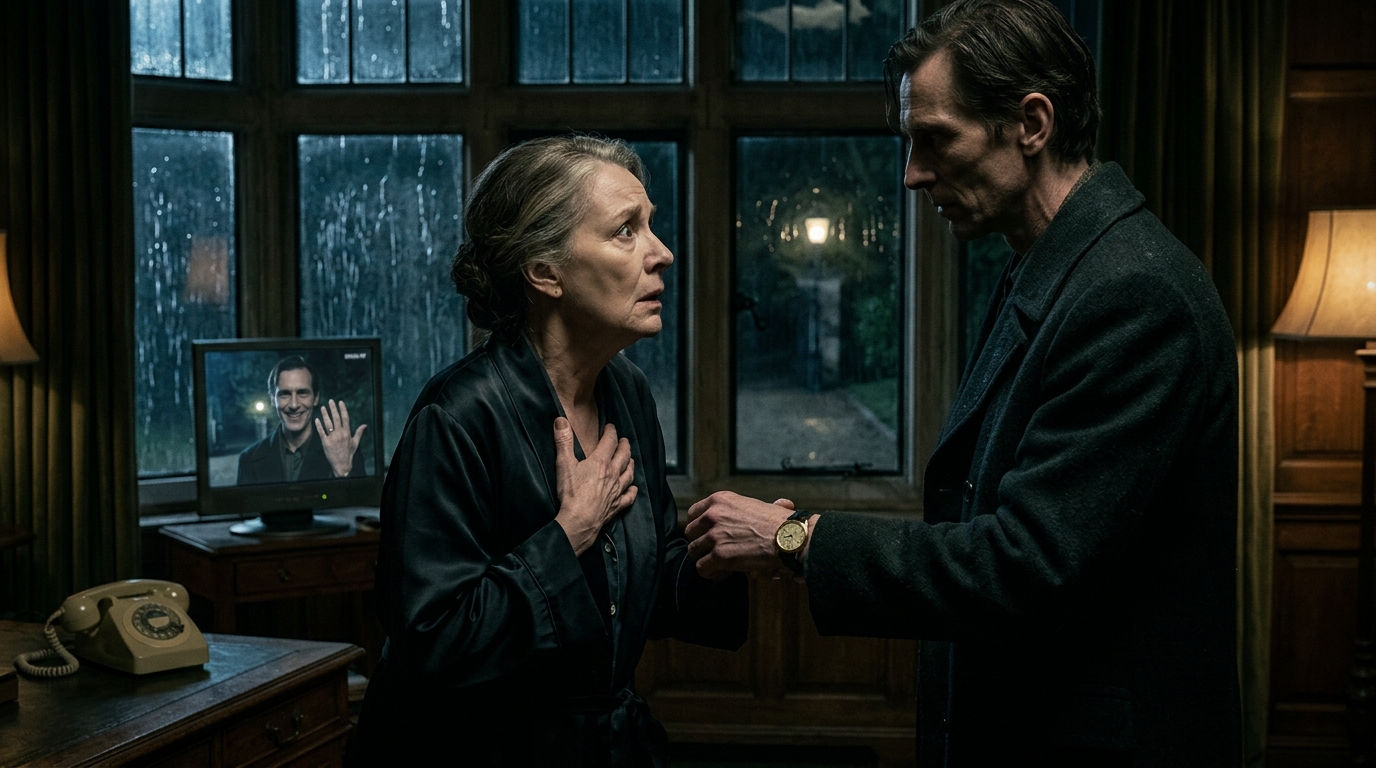
    So when the gate intercom buzzed at 12:07 a.m., I walked downstairs alone.

    Rain slid down the tall windows of Whitmore House in silver lines. The hallway lights were dimmed low, turning the marble floor into a pale river beneath my bare feet.

    The house was too large at night.

    Too many closed doors.

    Too many mirrors.

    Too many places for memory to stand quietly and wait.

    I reached the front monitor and saw him through the gate camera.

    A man in a dark coat.

    Late thirties.

    Maybe early forties.

    Standing under the rain without an umbrella.

    His head was slightly lowered, so the camera caught only part of his face.

    Sharp jaw.

    Dark hair.

    Still posture.

    The kind of stillness that does not belong to ordinary people.

    The kind I had seen before.

    Not in real life.

    In my nightmares.

    For twenty years, I had dreamed of the same man.

    Always the same ending.

    A dark road.

    A stopped car.

    Rain on glass.

    A man opening the back door.

    His hand around my throat.

    My own voice unable to scream.

    Then his face leaning close as he whispered:

    You hired me.

    I would wake choking.

    Sweating.

    Alive.

    And every time, my husband would tell me it was only stress.

    Only grief.

    Only childhood trauma trying to wear a new face.

    But the man standing at my gate was the face from the dream.

    Exactly.

    The intercom buzzed again.

    I did not move.

    Then his voice came through the speaker.

    “Mrs. Whitmore? I’m here for the night driver position.”

    My hand went cold against the wall.

    I had posted the job three days earlier.

    Private driver.

    Night shift only.

    Discreet.

    Background check required.

    High pay.

    No questions about destination.

    I had received twenty-seven applications.

    His was the last.

    No profile picture.

    No references.

    Just one sentence under experience:

    I know how to drive in the dark.

    I almost deleted it.

    I don’t know why I didn’t.

    Now he stood at my gate after midnight, wearing the face of the man who had killed me in my dreams.

    And somehow, he knew my name.

    The Man From My Nightmare

    I let him in.

    That was the third mistake.

    Or maybe by then, something larger than choice had already begun moving.

    The gate opened slowly.

    The man walked up the long driveway without looking left or right.

    Rain soaked his coat.

    Water darkened his hair.

    He did not hurry.

    That frightened me immediately.

    Most people rush through rain.

    Guilty people rush.

    Cold people rush.

    Men arriving for job interviews rush because they want to look respectful.

    This man walked like he had already been expected.

    I opened the front door before he knocked.

    For one moment, neither of us spoke.

    He stood beneath the porch light, rain dripping from the edge of his coat onto the stone.

    Up close, the resemblance was worse.

    Not similar.

    Not suggestive.

    Exact.

    The same eyes from the dream.

    Gray.

    Calm.

    Almost empty.

    The same mouth that never smiled before killing me.

    The same scar above the right eyebrow.

    In the nightmares, I always noticed that scar right before waking.

    Now it was real.

    A thin pale line cutting through his brow.

    My fingers slipped from the door handle.

    The glass of water in my other hand fell.

    It struck the marble and shattered at my feet.

    The sound tore through the entrance hall like a gunshot.

    He looked down at the broken glass.

    Then back at me.

    “Are you all right, Mrs. Whitmore?”

    His voice.

    God.

    Even his voice was the same.

    Low.

    Controlled.

    Gentle in a way that felt practiced.

    I forced myself to breathe.

    “Yes.”

    The lie scraped my throat.

    “You startled me.”

    He looked at me carefully.

    “Should I leave?”

    That would have been the correct answer.

    Yes.

    Leave.

    Leave this house.

    Leave my life.

    Leave whatever doorway my nightmares had opened.

    Instead, I stepped aside.

    “No. Come in.”

    He entered the house.

    The air changed with him.

    Not temperature.

    Pressure.

    As if the walls remembered something my mind had not been allowed to know.

    He removed his coat and hung it neatly on the brass stand beside the door.

    His movements were precise.

    No wasted gesture.

    No nervousness.

    I noticed his hands then.

    Long fingers.

    Clean nails.

    No wedding ring.

    And on his left wrist—

    My world stopped.

    A watch.

    Gold case.

    Black leather strap.

    Small crack across the face near the number six.

    I knew that crack.

    I had traced it with my thumb the night the police returned my husband’s personal effects.

    The watch belonged to Daniel Whitmore.

    My husband.

    My dead husband.

    The man at my door wore it like it had always belonged to him.

    My Husband’s Watch

    I could not stop staring.

    The man noticed.

    Of course he noticed.

    People like him notice everything.

    He glanced down at the watch on his wrist, then back at me.

    “Is something wrong?”

    I tried to speak.

    Nothing came out.

    The entrance hall tilted slightly.

    The broken glass glittered between us like ice.

    “That watch,” I whispered.

    His expression did not change.

    “What about it?”

    “It belonged to my husband.”

    A pause.

    Small.

    Almost invisible.

    But there.

    “Did it?”

    My blood turned cold.

    He did not deny it.

    He did not apologize.

    He did not ask if I was sure.

    He only said:

    Did it?

    Like a man testing which lie I would accept.

    I stepped back.

    “My husband is dead.”

    He looked at me for a long moment.

    Then smiled faintly.

    Not kindly.

    Not cruelly.

    Knowingly.

    “I’m sorry for your loss.”

    The sentence sounded correct.

    That made it worse.

    I wanted to scream.

    Instead, training took over.

    The old training of wealthy women who learned early that fear must never be served visibly.

    I straightened.

    “Your name?”

    “Elias Reed.”

    The application had said Adrian Cole.

    My heart kicked hard against my ribs.

    “That isn’t the name you applied under.”

    His smile disappeared.

    Only for a second.

    Then returned.

    “I use different names for private work.”

    “Why?”

    “Because private people often have private problems.”

    I stared at him.

    Outside, thunder rolled over the estate.

    The lights in the entrance hall flickered once.

    The portrait of my husband above the staircase seemed to darken.

    Daniel Whitmore.

    Dead three years.

    Car accident.

    Rainy road.

    Body burned badly enough that I had only identified him by dental records and personal items.

    His wedding ring.

    His wallet.

    His watch.

    The watch now ticking softly on a stranger’s wrist.

    I heard it.

    That was impossible from where I stood.

    But I heard it.

    Tick.

    Tick.

    Tick.

    Like a heartbeat someone had stolen.

    The Job Description

    I led him into the study because I did not want him deeper inside the house.

    The study still smelled faintly of my husband’s cigars, even though I had forbidden anyone from smoking there after his death.

    Dark wood shelves.

    Green desk lamp.

    Rain tapping against the windows.

    A room built for men to keep secrets in comfort.

    Elias Reed sat across from me without being invited.

    That should have offended me.

    Instead, it frightened me.

    He placed both hands on his knees.

    Calm.

    Patient.

    Waiting.

    I opened his printed application folder even though the paper shook in my hands.

    “Previous employer?”

    “Private.”

    “That is not an answer.”

    “It is the only one I can give.”

    “References?”

    “Unavailable.”

    “Driving record?”

    “Clean.”

    “Criminal record?”

    He looked at me.

    “Would you believe me if I said no?”

    The question was almost playful.

    I closed the folder.

    “I don’t think this position is right for you.”

    He nodded once.

    As if he had expected that.

    Then he leaned back slightly.

    “Because of the watch?”

    My fingers tightened around the file.

    “Because I don’t hire men who lie about their names.”

    “Everyone in this house lies about names.”

    The study went very still.

    I looked at him.

    “What does that mean?”

    His eyes moved toward my husband’s portrait on the wall.

    Daniel was younger in that portrait.

    Handsome.

    Polished.

    Confident.

    His smile looked different now.

    Not warm.

    Victorious.

    Elias said softly, “Your husband lied about his.”

    A cold wave moved through me.

    “My husband was Daniel Whitmore.”

    “Was he?”

    I stood so quickly the chair scraped against the floor.

    “Get out.”

    Elias remained seated.

    He looked almost sad now.

    That frightened me more than the smile.

    “I came because you asked for a night driver.”

    “I asked for a driver. Not a stranger wearing my dead husband’s property.”

    His gaze dropped to the watch again.

    “This watch was not taken from a dead man.”

    My breath stopped.

    Rain struck the window harder.

    “What did you say?”

    He looked back at me.

    “It was given to me by someone who wanted you to remember before tomorrow night.”

    “Remember what?”

    He did not answer.

    Instead, he reached into his coat pocket and placed something on my desk.

    A photograph.

    Old.

    Water-damaged.

    Taken at night.

    A black car parked beside a forest road.

    Its rear door open.

    Rain streaking across the image.

    Beside the car stood a woman.

    Me.

    Younger.

    Paler.

    Terrified.

    And behind me stood the man from my nightmares.

    Elias Reed.

    His hand wrapped around my wrist.

    The timestamp on the photo was twenty years old.

    I stumbled backward.

    “No.”

    Elias watched me carefully.

    “You’ve seen that night before.”

    “In dreams.”

    “Not dreams.”

    The room seemed to collapse inward.

    Tick.

    Tick.

    Tick.

    The watch on his wrist grew louder.

    “What are you?” I whispered.

    He looked at the photo.

    Then at my husband’s portrait.

    Then back at me.

    “The man you hired once.”

    My throat closed.

    “Once?”

    He nodded slowly.

    “Twenty years ago.”

    The Night I Couldn’t Remember

    I wanted to run.

    But where does a woman run inside her own house when the danger is already sitting in her husband’s chair?

    I grabbed the edge of the desk to steady myself.

    “I was twenty-two,” I whispered. “I didn’t have a driver.”

    “You did for one night.”

    “No.”

    “Yes.”

    “I would remember.”

    Elias’s expression softened.

    “No. You were made not to.”

    The words struck something inside me.

    A locked door.

    A hospital smell.

    White lights.

    A woman crying.

    My husband’s voice saying:

    It’s better if she forgets.

    I pressed a hand to my forehead.

    Pain flashed behind my eyes.

    Sharp.

    Sudden.

    Elias stood slowly.

    I backed away.

    “Don’t.”

    He stopped immediately.

    “I’m not here to hurt you.”

    I laughed once.

    It came out broken.

    “You expect me to believe that?”

    “No.”

    He looked toward the window.

    “Not yet.”

    A sound came from upstairs.

    Soft.

    A floorboard creaking.

    I froze.

    No one else was supposed to be in the house.

    The staff had gone.

    The east wing was locked.

    Elias heard it too.

    His eyes sharpened.

    “Who lives upstairs?”

    “No one.”

    The answer came too quickly.

    The house answered for me.

    Another creak.

    Then something dragged slowly across the ceiling above us.

    Heavy.

    Deliberate.

    My skin turned cold.

    Elias moved toward the study door.

    “Stay here.”

    I almost laughed again.

    He thought he could give me orders.

    Then I saw his face.

    He was afraid.

    Not of me.

    Not of the house.

    Of whatever was upstairs.

    Before he reached the door, the study phone rang.

    An old landline.

    The one no one used anymore.

    The sound made both of us stop.

    One ring.

    Two.

    Three.

    I picked it up with trembling fingers.

    “Hello?”

    For a moment, there was only static.

    Then a man’s voice spoke.

    My husband’s voice.

    Daniel.

    Dead Daniel.

    “Do not trust the driver.”

    My body went numb.

    Elias’s face turned white.

    Daniel’s voice continued.

    “He remembers what you paid him to do.”

    The line cut off.

    I lowered the phone slowly.

    Elias stared at me.

    “What did he say?”

    The ceiling above us creaked again.

    This time, closer to the staircase.

    I looked at Elias.

    At the watch.

    At the photograph.

    At my husband’s portrait.

    Then the doorbell rang.

    Once.

    Deep.

    Heavy.

    The front camera monitor beside the desk flickered on by itself.

    A man stood outside in the rain.

    Same height.

    Same gray eyes.

    Same scar above the brow.

    The same face as Elias Reed.

    The same face from my nightmares.

    But this one was smiling.

    And on his wrist—

    He wore my husband’s wedding ring.

  • I Forced The Boy To Tell Me Who Drew The Death Dates. Then Something Reached Out From Under His Desk

    I Forced The Boy To Tell Me Who Drew The Death Dates. Then Something Reached Out From Under His Desk

    The Boy Who Wouldn’t Look At His Hands

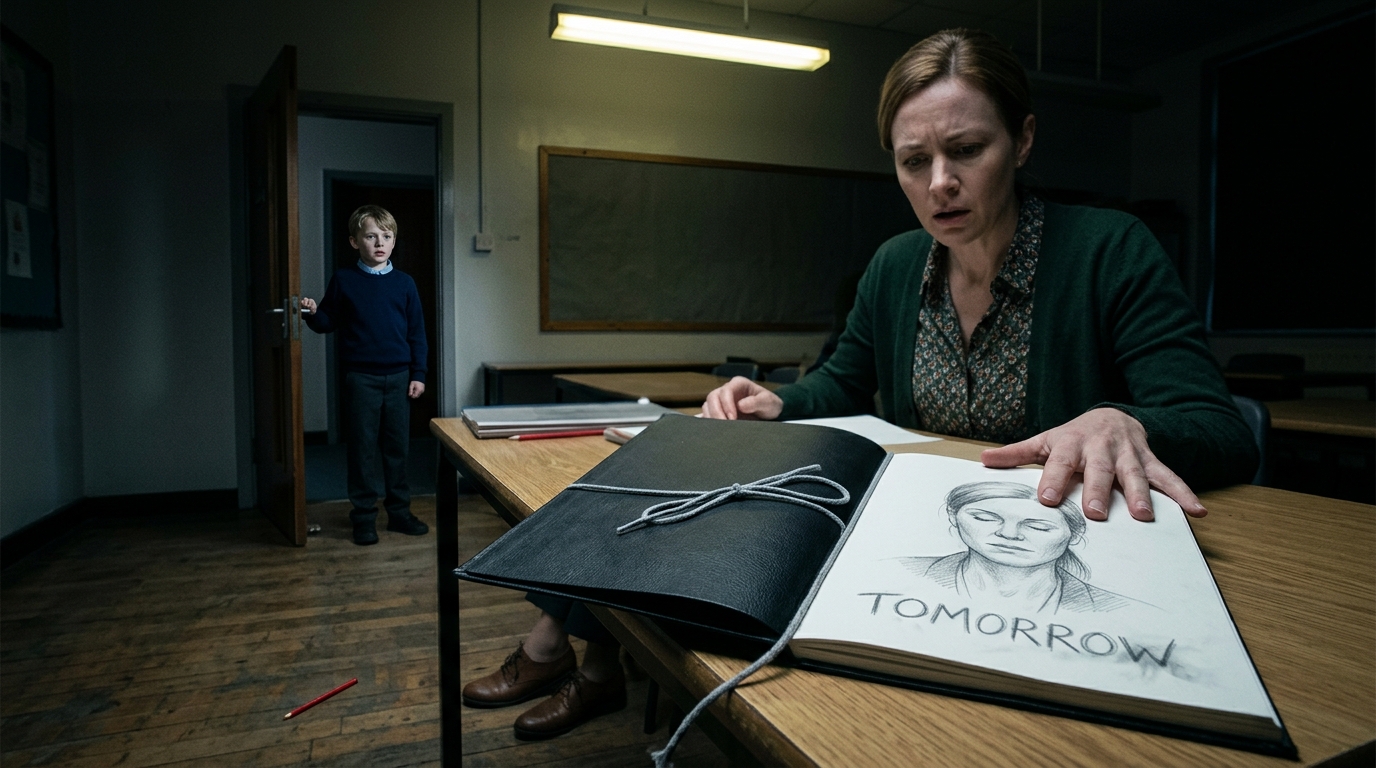
    Liam was crying before I said anything.

    That frightened me more than the notebook.

    More than my portrait on the last page.

    More than the word TOMORROW written beneath my closed eyes.

    Because Liam Vale did not cry.

    Not when other children laughed too loudly.

    Not when the fire alarm malfunctioned and screamed for ten minutes.

    Not when he fell on the playground and blood ran down both knees.

    He only sat there quietly.

    Watching.

    Listening.

    Waiting for something the rest of us could not hear.

    But now he stood in my classroom doorway with tears sliding down his face, and the red pencil lay at my feet like a tiny weapon.

    The black notebook sat open in my hands.

    My own face stared up from the final page.

    Eyes closed.

    Mouth still.

    Tomorrow.

    I heard myself whisper, “Liam, who writes the dates?”

    He shook his head.

    The classroom lights flickered.

    Once.

    Twice.

    The rain outside pressed softly against the windows, blurring the playground into gray shadows.

    “Liam.”

    He backed away one step.

    “I can’t say.”

    “Yes, you can.”

    “No.” His voice cracked. “She’ll get mad.”

    My fingers tightened around the notebook.

    “Who?”

    Liam looked toward the desks.

    Not at me.

    Not at the door.

    At his desk in the back row near the radiator.

    The one where he always sat.

    The one where the notebook usually stayed.

    The one I suddenly realized he never pushed his chair all the way under.

    As if he needed space beneath it.

    My mouth went dry.

    “Liam,” I said carefully, “are you saying someone else draws these?”

    His lips trembled.

    “I don’t draw them.”

    The room went silent.

    I stared at him.

    “What?”

    He held up his hands.

    Small hands.

    Child hands.

    Clean except for graphite stains on the fingertips.

    “I don’t want to,” he whispered. “But when I sleep, my hand moves.”

    A chill crawled slowly up my spine.

    “What do you mean your hand moves?”

    He began crying harder.

    “I wake up and the pictures are there.”

    The notebook pages fluttered in my grip.

    No wind.

    No open window.

    Just paper moving as if something invisible had breathed across it.

    I forced my voice to stay calm.

    “Liam, listen to me. You are not in trouble. But I need you to tell me everything.”

    He looked at me with the exhausted terror of a child who had been waiting too long for an adult to believe him.

    Then he whispered:

    “It’s not my hand.”

    Under The Desk

    I should have called someone immediately.

    The principal.

    The counselor.

    The police.

    Anyone.

    Instead, I walked toward Liam’s desk.

    Slowly.

    Like sudden movement might wake whatever had been sleeping underneath it.

    The classroom had changed.

    It was still my classroom.

    Still the same alphabet border curling near the ceiling.

    Still the same pencil cups.

    Still the same art projects taped along the wall.

    But it felt staged now.

    Like a room built over something rotten.

    Liam grabbed my sleeve before I could get close.

    “Don’t look.”

    His voice was so small I almost stopped.

    Almost.

    “What’s under there?”

    He shook his head violently.

    “Please.”

    I crouched beside his desk.

    The floor was darker beneath it.

    Not shadow exactly.

    Something thicker.

    The radiator clicked softly behind the chair.

    A smell rose from the space below.

    Metallic.

    Wet.

    Old.

    My stomach turned.

    I lowered my head.

    At first, I saw only school supplies.

    A blue pencil case.

    Two crumpled worksheets.

    A broken crayon.

    Then something moved behind the chair leg.

    A hand slid out from beneath the desk.

    Adult.

    Pale.

    Streaked with dark blood.

    Fingers long and thin.

    The nails cracked.

    I fell backward so fast the notebook flew from my hands.

    A scream tore out of me before I could stop it.

    Liam covered his ears and sobbed.

    “I told you!”

    The hand remained there.

    Half under the desk.

    Half reaching into the light.

    The fingers curled slowly against the tile floor.

    Not random.

    Not dead.

    Searching.

    The red pencil at my feet rolled toward it.

    The hand caught the pencil.

    My body stopped working.

    No arm followed.

    No person crawled out.

    Only the hand.

    It dragged the pencil across the floor with slow, deliberate strokes.

    One line.

    Then another.

    Then a shape.

    A rectangle.

    A lid.

    A body inside.

    A coffin.

    The hand was drawing me again.

    The Woman Who Writes The Dates

    I called the police from the hallway while Liam sat in the principal’s office wrapped in a blanket.

    He kept whispering the same sentence.

    “It wasn’t me.”

    Over and over.

    Like if he said it enough times, the adults might believe him before it was too late.

    By the time officers arrived, the classroom was locked.

    The desk was taped off.

    The black notebook sat inside an evidence bag.

    And the hand was gone.

    Of course it was.

    That was the first thing the police did not like.

    The second was the drawing on the floor.

    The coffin.

    My coffin.

    No date beneath it.

    Just the shape.

    Just the promise.

    Detective Marlowe arrived near sunset.

    He was older than the uniformed officers and quieter than the rest of them.

    He did not laugh when I explained.

    He did not call Liam imaginative.

    He did not tell me grief, stress, or exhaustion could make people see things.

    He only stared at the black notebook through the plastic bag and asked one question.

    “Did the boy ever draw in red before?”

    I swallowed.

    “No.”

    Marlowe’s jaw tightened.

    “Then you need to come with me.”

    “Where?”

    He looked toward Liam through the office glass.

    “To his house.”

    Liam’s mother was waiting outside the school when we arrived.

    Pale.

    Nervous.

    Too quick to answer every question.

    She said Liam had nightmares.

    She said he walked in his sleep.

    She said the notebook was a phase.

    She said children love attention.

    But when Detective Marlowe asked about the house, she stopped talking.

    The Vale house sat at the end of Briar Lane, behind dying hedges and a rusted iron fence.

    Old.

    Tall.

    Too many windows.

    The kind of house that looked like it remembered every person who had ever been afraid inside it.

    Marlowe showed me an old file on his phone before we went in.

    A newspaper clipping.

    Twenty-three years earlier, the house had belonged to an artist named Julian Crane.

    Portrait painter.

    Local celebrity.

    Respected.

    Brilliant.

    Beloved.

    Then police found twelve bodies buried beneath his studio.

    Each victim had been drawn before death.

    Each portrait had a date beneath it.

    My stomach went cold.

    “What happened to him?”

    Marlowe looked at the house.

    “He was killed before trial.”

    “How?”

    “Someone cut off his right hand.”

    I could barely breathe.

    “Was it found?”

    Marlowe did not answer.

    He didn’t need to.

    The Artist’s Room

    Liam’s mother cried when police opened the basement studio.

    Not loudly.

    Not from shock.

    From relief.

    Like she had spent years pretending the door did not exist and was grateful someone else finally touched the handle.

    The studio was hidden behind shelves of old paint cans and broken furniture.

    A narrow room beneath the house.

    No windows.

    Brick walls.

    A single chair in the center.

    The floor was stained with old paint.

    At least, I hoped it was paint.

    Portraits covered one entire wall.

    Not recent ones.

    Old ones.

    Faces drawn in charcoal and red pencil.

    Men.

    Women.

    Children.

    All with dates beneath them.

    Some names were written in the corner.

    Some faces had been scratched out violently.

    Marlowe’s flashlight stopped on the final row.

    My breath caught.

    The drawings there were new.

    Mrs. Calder.

    Mr. Collins.

    Mrs. Hart.

    Emma.

    Rachel.

    Me.

    Liam had not drawn these in class.

    These were larger.

    More detailed.

    Older somehow.

    As if the notebook was only a copy of something already decided in this room.

    I stepped closer to my portrait.

    In the notebook, my eyes had been closed.

    Here, they were open.

    Wide.

    Terrified.

    Behind my drawn shoulder was a shadow shaped like a woman.

    Marlowe whispered, “What the hell…”

    Liam stood at the basement door behind us, trembling.

    His mother tried to pull him away, but he shook her off.

    “She makes me bring the book to school,” he whispered.

    I turned.

    “Who makes you?”

    He pointed to the old wooden cabinet near the back wall.

    “The hand lives there.”

    A uniformed officer opened the cabinet.

    Nothing inside but dust, broken frames, and a shallow wooden box.

    Marlowe lifted the box carefully.

    Inside was an old glove.

    Leather.

    Black.

    Stiff with age.

    And a strip of yellowed newspaper wrapped around something long and narrow.

    The detective unfolded it.

    His face went pale.

    It was a police evidence photo.

    Julian Crane’s severed hand.

    Missing from the crime scene twenty-three years earlier.

    On the back of the photograph, someone had written:

    THE HAND FINISHES WHAT THE ARTIST STARTED.

    The basement lights flickered.

    Liam began to sob again.

    Then the portraits on the wall shifted.

    Not all of them.

    Only mine.

    My drawn eyes slowly closed.

    No Date This Time

    Police took Liam and his mother into protective custody that night.

    They told me to stay with a friend.

    They told me not to go home alone.

    They told me the human mind sometimes attaches meaning to fear.

    I nodded.

    I thanked them.

    Then I drove home alone anyway.

    Because adults are stupid too.

    We just call it independence.

    My apartment felt wrong the moment I opened the door.

    Nothing obvious.

    No broken lock.

    No open window.

    No shadow standing in the hallway.

    Just wrong.

    The air smelled faintly of pencil shavings.

    I turned on every light.

    Living room.

    Kitchen.

    Bedroom.

    Bathroom.

    Then I checked beneath the bed like a child.

    Nothing.

    At 11:43 p.m., someone slid a piece of paper under my front door.

    I was standing ten feet away when it happened.

    No knock.

    No footsteps outside.

    Just a slow white rectangle slipping across the floor.

    My body went cold.

    I walked toward it carefully.

    The paper was thick.

    Textured.

    Artist’s paper.

    I turned it over.

    My portrait.

    Again.

    But different this time.

    No date.

    No word.

    No red pencil beneath my face.

    Just me lying inside a coffin.

    Hands folded.

    Eyes closed.

    Flowers around my body.

    A black notebook resting on my chest.

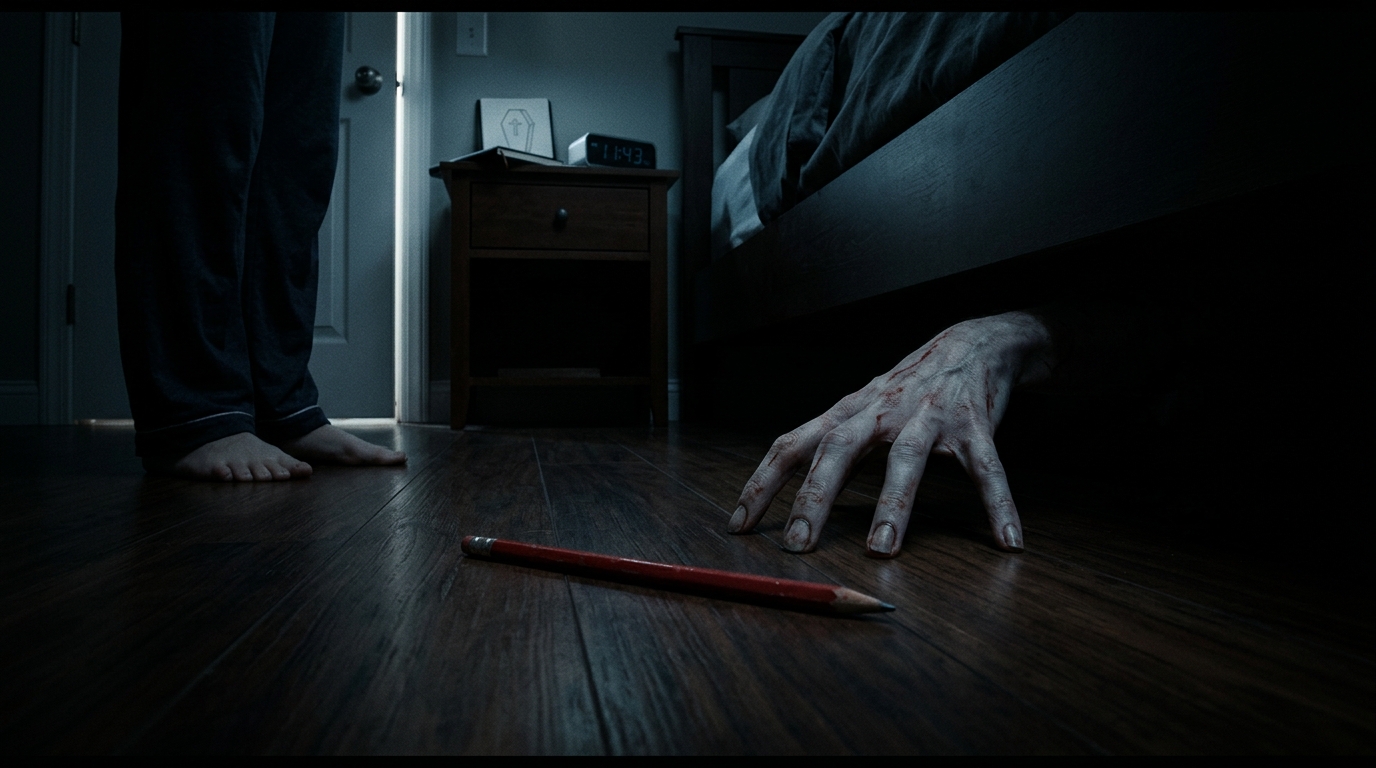
    I could not move.

    Then something scratched softly against the other side of my apartment door.

    Once.

    Twice.

    Three times.

    Like fingernails dragging across wood.

    My phone buzzed violently in my hand.

    Unknown number.

    I answered without thinking.

    For a moment, there was only breathing.

    Then Liam whispered:

    “Ms. Avery?”

    My throat tightened.

    “Liam?”

    He was crying.

    “She says dates were warnings.”

    The scratching at the door stopped.

    Cold spread across my skin.

    “What does that mean?”

    Liam’s voice dropped lower.

    Almost too quiet to hear.

    “If there’s no date…”

    The hallway light outside my apartment flickered.

    I stared at the coffin drawing in my hand.

    “Liam?”

    He began sobbing harder.

    “If there’s no date, it means she’s already inside.”

    The call cut off.

    Behind me, from inside my dark bedroom, a red pencil rolled slowly across the floor.

  • A Quiet Boy Drew Everyone’s Death Date In A Black Notebook. Then I Found My Own Portrait On The Last Page

    A Quiet Boy Drew Everyone’s Death Date In A Black Notebook. Then I Found My Own Portrait On The Last Page

    The Black Notebook

    Children draw strange things.

    Monsters with too many eyes.

    Houses bigger than the sun.

    Families where everyone smiles the same impossible smile.

    As a teacher, you learn not to worry too quickly.

    A dark crayon does not always mean darkness.

    A sad picture does not always mean a sad child.

    At least, that was what I told myself before Liam Vale brought the black notebook to class.

    He was eight years old.

    Quiet.

    Polite.

    Too polite.

    The kind of child who never interrupted, never ran in the hallway, never forgot homework, and never laughed when the others did.

    He sat in the back row near the radiator, always with that same black notebook open on his desk.

    No stickers.

    No name.

    No cartoon cover.

    Just plain black leather, worn at the corners, tied with a thin gray string.

    I first noticed it during quiet reading time.

    Everyone else had picture books.

    Liam had the notebook.

    He was not writing.

    He was drawing.

    Carefully.

    Slowly.

    Like every line mattered.

    I walked past his desk and saw a face on the page.

    Mrs. Calder.

    Our school janitor.

    Gray hair pulled into a bun.

    Round glasses.

    Small mole near her chin.

    It was shockingly accurate.

    Too accurate for an eight-year-old.

    I smiled because that was what teachers do when something scares them gently.

    “That’s very good, Liam.”

    He looked up at me.

    His eyes were calm.

    Not proud.

    Not shy.

    Just calm.

    “Thank you, Ms. Avery.”

    I looked back at the drawing.

    Then I saw the date written beneath it.

    October 17.

    I frowned.

    “What’s that?”

    Liam glanced down at the page.

    “The day.”

    “The day for what?”

    He closed the notebook before I could read anything else.

    His small fingers tied the gray string into a neat knot.

    Then he said:

    “The day she stops coming.”

    The Portraits

    I should have asked more questions then.

    I didn’t.

    Teachers are trained to recognize danger, but we are also trained to explain it away.

    Maybe he meant retirement.

    Maybe he overheard staff talking.

    Maybe children say odd things because their imaginations do not know how to stop at normal doors.

    So I let it go.

    That was my first mistake.

    Two days later, I saw the notebook again.

    This time, Liam was drawing Mr. Collins, the gym teacher.

    Under his portrait was another date.

    November 3.

    The next page showed our principal, Mrs. Hart.

    November 29.

    Another page showed a girl in our class named Emma.

    December 12.

    Every portrait had a date.

    Every face was precise.

    Not cartoonish.

    Not childlike.

    Real.

    Frighteningly real.

    The eyes were the worst part.

    Liam drew eyes like he had seen people in moments they had never shown anyone.

    Mrs. Calder looked tired in her portrait.

    Mr. Collins looked afraid.

    Emma looked like she was about to cry.

    When I reached for the notebook, Liam placed both hands over it.

    Not fast.

    Not panicked.

    Protective.

    “Liam,” I said gently, “may I see your drawings?”

    He shook his head.

    “Why not?”

    “You’ll change them.”

    My stomach tightened.

    “Change what?”

    “The order.”

    A chill moved slowly up my spine.

    Around us, children kept reading quietly.

    Pages turned.

    Pencils tapped.

    Rain touched the classroom windows.

    A completely ordinary morning.

    Except for the little boy in the back row protecting a notebook full of dates.

    I crouched beside his desk.

    “What order, Liam?”

    He looked toward the classroom door.

    Then whispered:

    “The order they leave.”

    October 17

    Mrs. Calder died exactly one week later.

    October 17.

    That morning, she was in the hallway polishing the brass nameplate beside the principal’s office.

    By lunch, she had collapsed near the supply closet.

    By three o’clock, the whole school knew.

    Heart attack.

    Sudden.

    Painless, they said.

    People always say painless when they need death to feel polite.

    I stood in the staff bathroom after dismissal with both hands gripping the sink, staring at my own face in the mirror.

    October 17.

    The date under Liam’s drawing.

    The day she stops coming.

    My mouth went dry.

    No.

    Coincidence.

    It had to be.

    Children make up dates.

    People die.

    The world is cruel enough without magic.

    But then I remembered Mrs. Calder’s portrait.

    The tired eyes.

    The gray hair.

    The tiny mole near her chin.

    And beneath it—

    October 17.

    I went back to my classroom after everyone left.

    The rain had stopped, but the windows were still wet.

    Desks sat empty in perfect rows.

    Children’s drawings of autumn leaves hung along the wall.

    Liam’s desk was clean.

    Too clean.

    No loose crayons.

    No forgotten worksheet.

    No black notebook.

    I searched anyway.

    Desk drawer.

    Reading bin.

    Cubby shelf.

    Nothing.

    Then I saw the corner of black leather beneath the radiator.

    Hidden.

    Or dropped.

    I looked toward the classroom door.

    Empty hallway.

    No footsteps.

    No voices.

    My heart began to pound.

    I picked up the notebook.

    It was cold.

    Not room-cold.

    Cold like something kept outside in winter.

    The gray string untied easily beneath my fingers.

    Too easily.

    Like it had been waiting.

    The Names In The Notebook

    The first page was blank.

    The second was not.

    Mrs. Calder.

    October 17.

    I stared at the portrait until my eyes burned.

    The date had been written in dark red pencil.

    Not crayon.

    Not marker.

    Red pencil.

    The next page showed Mr. Collins.

    November 3.

    Then Mrs. Hart.

    November 29.

    Then Emma.

    December 12.

    More pages followed.

    A cafeteria worker.

    A crossing guard.

    A substitute teacher.

    One of the boys from the fourth grade.

    Dates under every face.

    Some weeks apart.

    Some only days.

    I turned page after page, my breathing growing louder in the empty classroom.

    The portraits became stranger the farther I went.

    Not because the drawings changed.

    Because the people did.

    Some faces I recognized.

    Some I did not.

    A man in a hospital gown.

    A woman holding a cracked phone.

    An old priest.

    A police officer with blood on his collar.

    A baby wrapped in a blue blanket.

    Each one with a date beneath.

    Each date written neatly.

    Patiently.

    Like an appointment.

    Then I reached a page that made my hands go numb.

    My sister.

    Rachel.

    She lived three states away.

    Liam had never met her.

    He had never seen a photo of her.

    I was sure of that.

    Yet there she was.

    Same short dark hair.

    Same scar above her eyebrow from when we were kids.

    Same silver earrings she wore every day.

    Under her portrait was a date.

    January 8.

    I nearly dropped the notebook.

    My breath came too fast now.

    This was not a child’s imagination.

    This was not coincidence.

    This was a list.

    A schedule.

    A map of endings.

    I turned the next page with shaking fingers.

    Blank.

    The next.

    Blank.

    Then I reached the final page.

    And saw myself.

    The Last Page

    For a moment, I could not understand what I was seeing.

    My own face looked back at me from the page.

    Not smiling.

    Not frightened.

    Still.

    Too still.

    Liam had drawn me exactly as I looked that morning.

    Hair pinned loosely.

    Small gold necklace.

    The tired line between my eyebrows I tried to hide from students.

    But there was one detail wrong.

    In the drawing, my eyes were closed.

    Under my portrait was a date.

    Tomorrow.

    Not a month.

    Not a number.

    Not even a proper date.

    Just one word.

    TOMORROW.

    The classroom lights flickered once.

    I stopped breathing.

    Then something moved behind me.

    A soft sound.

    Paper sliding against paper.

    I turned sharply.

    No one there.

    But the notebook pages began turning by themselves.

    Slowly.

    Back to Mrs. Calder.

    Back to the first portrait.

    The red date beneath her face had changed.

    October 17 was now crossed out.

    Beside it, in fresh red pencil, were two words:

    COMPLETED.

    My stomach twisted violently.

    A sound came from the hallway.

    Small footsteps.

    I looked up.

    Liam stood in the classroom doorway.

    His backpack hung from one shoulder.

    His face was pale beneath the fluorescent light.

    He looked at the notebook in my hands.

    Then at me.

    “You weren’t supposed to read the last page yet,” he said.

    My throat tightened.

    “Liam… why am I in this book?”

    He stepped into the classroom slowly.

    The lights flickered again.

    The windows behind him reflected only darkness.

    He did not answer my question.

    Instead, he looked toward the corner behind my desk.

    A corner where nothing stood.

    At least, nothing I could see.

    Then he whispered:

    “She says you can still change it.”

    Cold rushed through my body.

    “Who says?”

    Liam’s eyes filled with tears for the first time since I had known him.

    “The woman who writes the dates.”

    The classroom door slammed shut behind him by itself.

    And from inside the black notebook, a red pencil rolled slowly across the floor toward my feet.

  • My Livestream Audience Saw A Killer Behind Me. But The Police Said The Murder Hadn’t Happened Yet

    My Livestream Audience Saw A Killer Behind Me. But The Police Said The Murder Hadn’t Happened Yet

    The Camera Kept Streaming After I Ran

    I ran before my brain fully understood why.

    Not because of the girl in the chair.

    Not even because of the footsteps downstairs.

    Because millions of people in my livestream chat were screaming about a man standing behind me—

    And I could not see him.

    The hallway blurred as I sprinted through Hollowmere Estate with the flashlight beam shaking wildly across peeling wallpaper and broken doors.

    The child’s laughter still echoed somewhere behind me.

    Or ahead of me.

    I couldn’t tell anymore.

    My livestream headset crackled violently with overlapping donation alerts and screaming comments.

    RUN RUN RUN

    HE’S RIGHT BEHIND YOU

    DON’T LOOK BACK

    The staircase appeared ahead through darkness.

    I nearly slipped reaching it.

    Then my phone rig slammed against the hallway wall and ripped free from my hand.

    The livestream camera hit the floor hard.

    The screen cracked instantly.

    I kept running anyway.

    That detail matters.

    Because the audience saw everything after I disappeared.

    And I didn’t.

    The Man With The Hammer

    I didn’t realize the stream was still active until later.

    Much later.

    Long after the police arrived.

    Long after I saw the timestamps.

    Long after I understood Hollowmere Estate was not haunted.

    At the time, all I knew was fear.

    I ran through the mansion blindly while the camera remained on the upstairs hallway floor still broadcasting live to nearly two hundred thousand viewers.

    The footage survived.

    That was the problem.

    Because according to the stream replay—

    Three seconds after I disappeared around the corner—

    A man stepped into frame behind me.

    Tall.

    Dark coat.

    Heavy boots.

    Face hidden beneath static distortion exactly like the hallway figure from earlier.

    And in his right hand—

    A hammer.

    Not rusty.

    Not old.

    Clean.

    Recently used.

    The viewers saw him clearly.

    I never did.

    The camera captured him stopping beside the child’s bedroom doorway while listening to my footsteps downstairs.

    Then slowly turning his head toward the fallen phone.

    Toward the livestream.

    Toward the audience.

    Thousands of comments exploded instantly.

    OH MY GOD

    HE’S REAL

    CALL THE POLICE

    The man tilted his head strangely at the camera.

    Like he could hear the viewers.

    Then the livestream microphone picked up his voice.

    Low.

    Calm.

    Almost amused.

    “She warned him too early.”

    My blood went cold the first time I heard the replay later.

    Because there was someone else inside the mansion with him.

    A little girl’s voice answered softly from the child’s room.

    “I didn’t want him to die like the others.”

    The hammer scraped slowly against the wallpaper.

    The livestream viewers watched the man begin walking downstairs after me.

    Step.

    Step.

    Step.

    The camera feed shook slightly with each impact of his boots against the wooden staircase.

    Then the stream abruptly glitched.

    Static flooded the screen.

    The viewers lost visual for seven full seconds.

    When the image returned—

    The man was gone.

    And the upstairs hallway was empty again.

    Except for the chair inside the child’s room.

    Still turning slowly toward the camera.

    The Viewers Called The Police

    I burst out of Hollowmere Estate through the rear kitchen door and kept running into the woods behind the property.

    Branches tore at my clothes.

    Mud swallowed my boots.

    My lungs burned violently.

    But I never heard footsteps behind me.

    That terrified me more.

    Predators stay quiet when they already know where you’re going.

    I finally stopped beside the road nearly half a mile from the mansion.

    Rain soaked through my jacket while I struggled to breathe.

    My livestream headset still crackled faintly.

    Disconnected.

    No signal.

    I grabbed my backup phone from my pocket with shaking hands.

    Seventy-three missed calls.

    Thousands of notifications.

    And one message pinned at the top from my moderator:

    POLICE ARE ON THE WAY. DO NOT GO BACK INSIDE.

    My stomach twisted violently.

    Because I hadn’t told anyone the address publicly.

    Not once.

    Then I remembered.

    The livestream GPS tag.

    One viewer had tracked the coordinates from the stream metadata and called emergency services.

    By the time I returned near the property with police lights flashing through the trees, Hollowmere Estate looked completely different.

    Not haunted.

    Investigated.

    Floodlights cut through darkness while officers moved through the mansion shouting room clear between radios.

    Detectives questioned me near an ambulance while another officer replayed the stream footage repeatedly on a tablet.

    The hammer.

    The hallway.

    The voice.

    All of it visible on video.

    One detective looked pale by the third replay.

    “You’re telling me you never saw this guy?”

    “No.”

    “But your audience did.”

    I stared at the footage again.

    The man moved exactly where the livestream predicted before it happened.

    Not edited.

    Not delayed.

    The stream saw him before reality caught up.

    That thought made me feel sick.

    A young officer suddenly ran from the mansion front doors.

    “Detective!”

    Everyone turned.

    The officer looked shaken.

    “You need to see this.”

    The Room Full Of Screens

    The hidden room sat behind the library wall.

    Police only found it because one viewer watching the replay noticed the wallpaper shifting slightly when the hammer man disappeared from camera view.

    A hidden door.

    Behind the bookshelves.

    Classic horror movie architecture.

    Except real hidden rooms smell worse than fiction.

    Dust.

    Electricity.

    Sweat trapped for years.

    The chamber beneath Hollowmere Estate stretched wider than the entire upstairs hallway.

    Concrete walls.

    Old wiring.

    Generators humming softly in darkness.

    And screens.

    Dozens of screens.

    Mounted floor to ceiling.

    Every hallway inside the mansion displayed live camera feeds from hidden angles.

    Bedrooms.

    Staircases.

    Doors.

    Even the child’s room.

    My chest tightened painfully.

    Someone had been watching people inside Hollowmere Estate for years.

    Then I saw the recordings.

    Hundreds of labeled video files.

    Different dates.

    Different streamers.

    Urban explorers.

    Ghost hunters.

    Trespassers.

    Missing persons.

    One detective whispered:

    “Jesus Christ…”

    Many of the files ended abruptly.

    Some ended with screaming.

    Some with static.

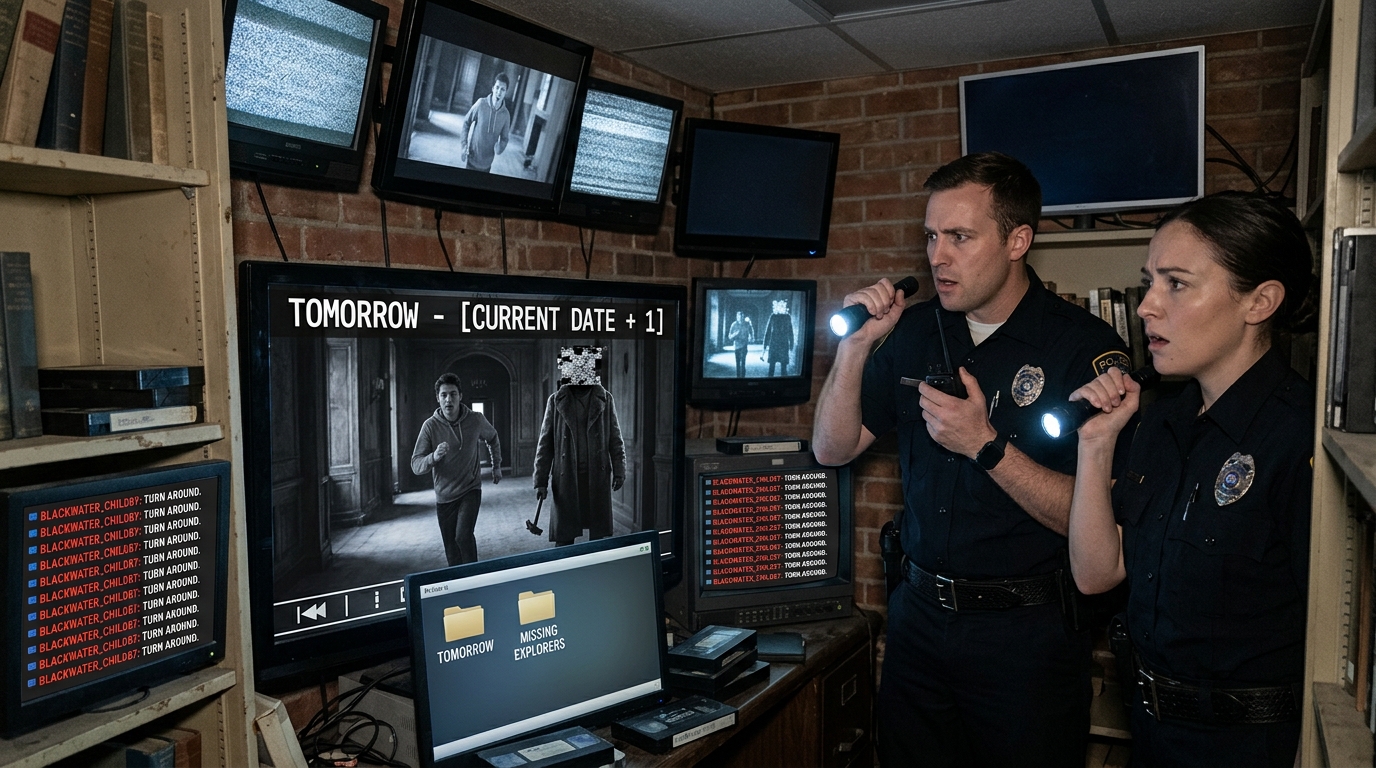
    One folder was labeled:

    TOMORROW.

    Cold spread violently through my body.

    The detective clicked it open slowly.

    Inside sat one video file.

    Timestamped tomorrow’s date.

    The room fell silent.

    “That’s impossible,” someone whispered.

    The detective opened the recording.

    And every person inside the hidden chamber froze.

    Because the footage showed me.

    Running through Hollowmere Estate.

    Exactly like tonight.

    Same clothes.

    Same flashlight.

    Same panic.

    Except this version continued longer than reality had.

    The footage showed me reaching the staircase.

    Falling.

    Turning.

    Then finally seeing the man with the hammer standing directly behind me.

    My blood turned ice cold.

    Because in reality—

    I never turned around.

    The timestamp kept playing.

    Future footage.

    Tomorrow’s date.

    In the recording, the hammer man lifted the weapon slowly while I backed away screaming.

    Then the video froze.

    One final frame.

    The hammer inches from my skull.

    A detective whispered:

    “Who filmed this?”

    Nobody answered.

    Then every screen in the hidden room flickered simultaneously.

    The livestream chat suddenly reopened by itself across every monitor.

    Thousands of comments flooding in live.

    Even though my stream had ended hours earlier.

    One username began spamming the screens repeatedly.

    BLACKWATER_CHILD87.

    HE FINALLY FOUND THE ROOM.

    Again.

    HE’S WATCHING YOU NOW.

    Again.

    TURN AROUND.

    My heartbeat stopped.

    Because the comments weren’t directed at me anymore.

    They were directed at the detectives standing inside the hidden room.

    Slowly—

    Very slowly—

    Everyone turned toward the dark security camera mounted in the upper corner of the chamber.

    The red recording light blinked once.

    Then a speaker crackled softly overhead.

    And the man from the livestream whispered:

    “You weren’t supposed to arrive until tomorrow.”

  • My Livestream Audience Saw A Murder Before It Happened. And They Tried To Warn Me

    My Livestream Audience Saw A Murder Before It Happened. And They Tried To Warn Me

    The Haunted Mansion Stream

    People will watch anything at 2 a.m.

    Ghosts.

    Screaming.

    Abandoned hospitals.

    Fake demons edited with cheap sound effects.

    Fear sells best when people know they’re safe behind a screen.

    That was the entire reason my channel existed.

    Three million followers.

    Night exploration content.

    “Real haunted locations.”

    Most of it was performance.

    Not fake exactly.

    Just exaggerated.

    Long silences.

    Careful camera angles.

    Jump scares.

    The audience wanted adrenaline, not truth.

    Truth is slower.

    Ugier.

    More dangerous.

    I learned that the night I entered Hollowmere Estate.

    The mansion sat abandoned outside Briar County surrounded by dead trees and rusted fencing swallowed by vines. Local rumors claimed an entire family disappeared there twenty years earlier after neighbors reported screaming during a thunderstorm.

    No bodies.

    No arrests.

    Perfect internet content.

    At 11:48 p.m., I started the livestream.

    The chat exploded instantly.

    BRO THIS PLACE IS CURSED

    TURN BACK NOW

    FAKE AS HELL LOL

    DO THE BASEMENT

    I grinned at the camera while rain tapped against broken mansion windows behind me.

    “Tonight,” I told the stream, “we finally find out if Hollowmere deserves its reputation.”

    Thousands of hearts flooded the screen.

    View count climbed rapidly.

    Normal.

    Everything felt normal at first.

    Dust.

    Rotting wallpaper.

    Floorboards groaning beneath my boots.

    The mansion smelled like mold and wet wood.

    Classic abandoned-house atmosphere.

    Perfect for clips.

    Perfect for thumbnails.

    I swept the flashlight down the main hallway dramatically.

    “Guys,” I whispered, “this place genuinely feels wrong.”

    That part was not acting.

    Because the deeper I walked into Hollowmere, the quieter the world became.

    No insects.

    No wind.

    No rain audible inside the walls.

    Just the sound of my own breathing and the soft static hiss from the livestream microphone.

    Then the comments changed.

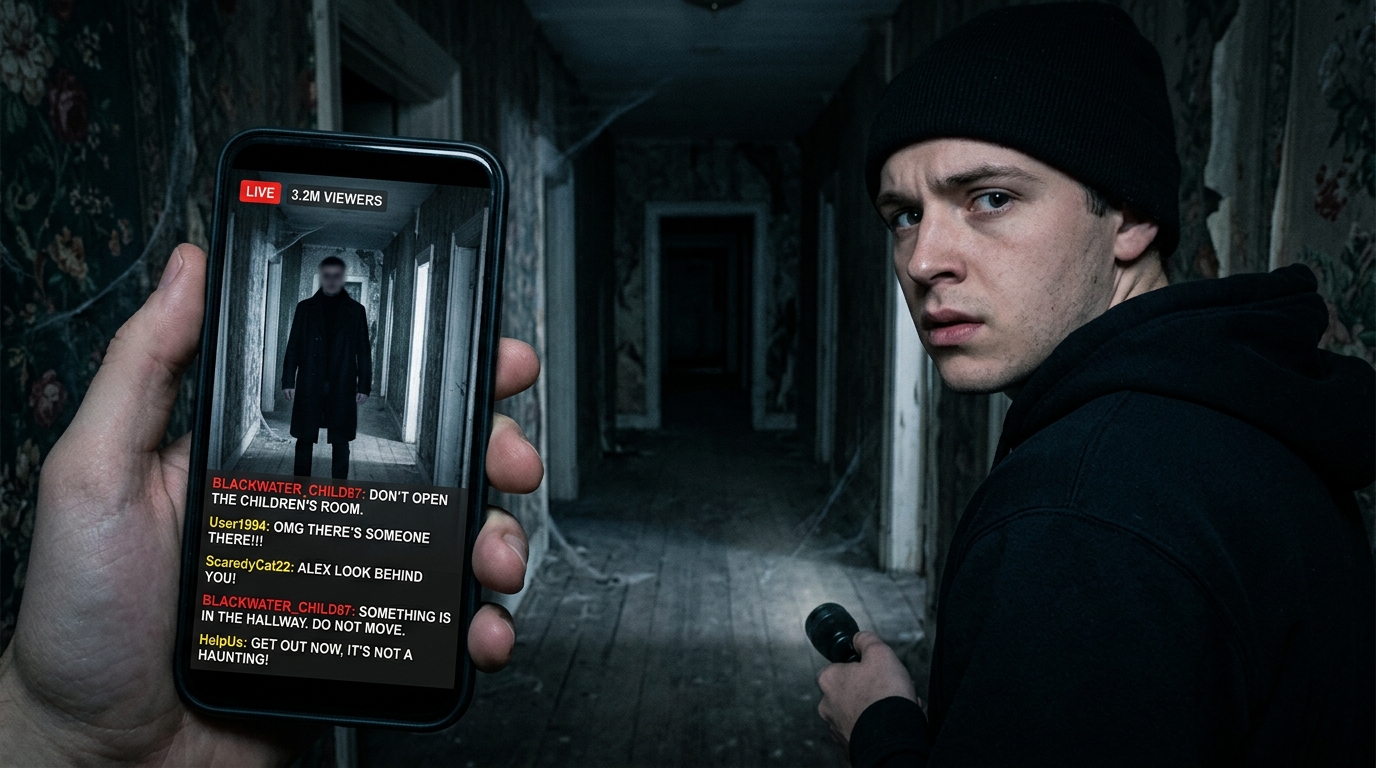
    DON’T OPEN THE CHILDREN’S ROOM

    At first, I thought it was spam bots.

    One username repeated over and over again in the chat.

    BLACKWATER_CHILD87.

    DON’T OPEN THE CHILDREN’S ROOM.

    Again.

    DON’T OPEN THE CHILDREN’S ROOM.

    Again.

    DON’T OPEN THE CHILDREN’S ROOM.

    The same message flooded the screen so aggressively moderators started timing the account out automatically.

    But every time they banned it—

    The account came back.

    Same name.

    Same warning.

    My viewers noticed immediately.

    YO WTF

    THAT ACCOUNT KEEPS COMING BACK

    SCRIPTED?

    DUDE THIS IS ACTUALLY CREEPY

    I laughed nervously into the camera.

    “Okay, somebody in chat is very committed.”

    But my stomach tightened slightly anyway.

    Because there really was a children’s room upstairs.

    I had seen it mentioned in old newspaper archives before the stream.

    Missing daughter.

    Pink bedroom.

    Neighbors heard singing.

    Classic haunted-house mythology.

    Perfect content.

    The spam continued.

    DON’T OPEN THE DOOR.

    SHE IS STILL INSIDE.

    My flashlight beam trembled slightly as I climbed the staircase.

    The mansion groaned softly around me.

    One of the upstairs hallway doors stood at the far end painted pale blue beneath layers of peeling wallpaper.

    Child-sized handprints covered the wall nearby.

    Dark brown.

    Old.

    Probably paint.

    Hopefully paint.

    The livestream numbers skyrocketed.

    Viewers sensed tension immediately.

    OPEN IT BRO

    NOPE NOPE NOPE

    THIS IS WHY WHITE PEOPLE DIE IN HORROR MOVIES

    BLACKWATER_CHILD87 returned again.

    THIS IS YOUR LAST WARNING.

    I stopped outside the bedroom door.

    My heartbeat sounded too loud inside the headset.

    “Alright chat,” I whispered dramatically. “Let’s see what’s inside.”

    Then I grabbed the handle.

    The Chair Facing Away From The Camera

    The door opened slowly.

    The hinges screamed loud enough to make me flinch.

    Dust drifted through the flashlight beam while the camera adjusted focus.

    The room looked strangely untouched compared to the rest of the mansion.

    Children’s wallpaper still clung to the walls beneath years of decay.

    Tiny painted rabbits.

    Clouds.

    Stars.

    A music box sat near the window covered in dust.

    And in the center of the room—

    A small wooden chair.

    Facing away from me.

    My pulse slowed slightly from relief.

    “That’s it?” I laughed nervously. “Guys, you nearly gave me a heart attack over a chair.”

    The chat moved too fast to read suddenly.

    WAIT

    DON’T MOVE

    BRO LOOK AT THE STREAM

    The chair sat perfectly still in front of me.

    Nothing paranormal.

    Nothing dangerous.

    Just old furniture.

    I stepped farther inside.

    The flashlight swept across cracked toys and mold-covered stuffed animals scattered across the floor.

    Then the livestream alerts exploded louder.

    OH MY GOD

    IT’S MOVING

    RUN

    RUN RIGHT NOW

    I frowned.

    “What are you talking about?”

    Because the chair had not moved.

    Not from where I stood.

    I looked directly at it.

    Still facing away.

    Still motionless.

    Then I looked at my livestream preview screen attached beside the camera rig.

    And my blood froze.

    On the livestream—

    The chair was slowly turning.

    Not fast.

    Not violently.

    Slowly.

    One inch at a time toward the camera.

    But inside the actual room, the chair never moved at all.

    My throat tightened instantly.

    I stared at the real chair.

    Then at the livestream feed.

    Real room.

    Still.

    Livestream.

    Turning.

    The viewers spammed messages so quickly the screen became unreadable.

    IT’S LOOKING AT YOU

    DON’T TURN AROUND

    SOMETHING IS BEHIND YOU

    BLACKWATER_CHILD87 posted one final comment.

    YOU’RE SEEING THE ROOM TOO EARLY.

    Cold spread violently through my chest.

    Then the livestream audio picked up something my ears hadn’t heard yet.

    A child laughing softly behind me.

    The Stream Saw It Before I Did

    I spun around instantly.

    Nothing behind me.

    Only darkness.

    Broken wallpaper.

    Rainwater sliding down cracked windows.

    My pulse hammered violently inside my throat.

    “Guys, stop messing around,” I whispered.

    But my voice no longer sounded confident.

    The livestream chat exploded harder.

    NOT THE ROOM

    THE HALLWAY

    LOOK AT THE HALLWAY

    I turned toward the bedroom door.

    The hallway outside remained empty.

    At least in real life.

    But on the livestream screen—

    Someone stood there.

    A tall figure at the end of the hallway.

    Male.

    Dark coat.

    Face blurred by static.

    Watching the doorway.

    Watching me.

    My blood turned to ice.

    Because outside the camera view—

    The hallway was completely empty.

    The livestream was showing things seconds before they appeared.

    I backed away slowly from the doorway.

    The chair on-stream continued turning toward me inch by inch.

    The real chair still never moved.

    Then the livestream audio crackled violently.

    A child’s voice whispered clearly through the speakers:

    “He’s coming upstairs now.”

    Heavy footsteps echoed downstairs immediately after.

    Real footsteps.

    Not from the stream.

    Inside the mansion.

    Slow.

    Measured.

    Coming toward the staircase.

    The livestream comments became unreadable chaos.

    GET OUT

    CALL POLICE

    THERE’S SOMEONE THERE

    BLACKWATER_CHILD87 typed one final message.

    THIS ISN’T A HAUNTING.

    IT’S A MURDER.

    Then the chair in the livestream finished turning completely toward the camera.

    Sitting in it—

    Was a little girl.

    Bleeding from the mouth.

    Smiling directly at me.

    Even though the real chair in front of me was still empty.

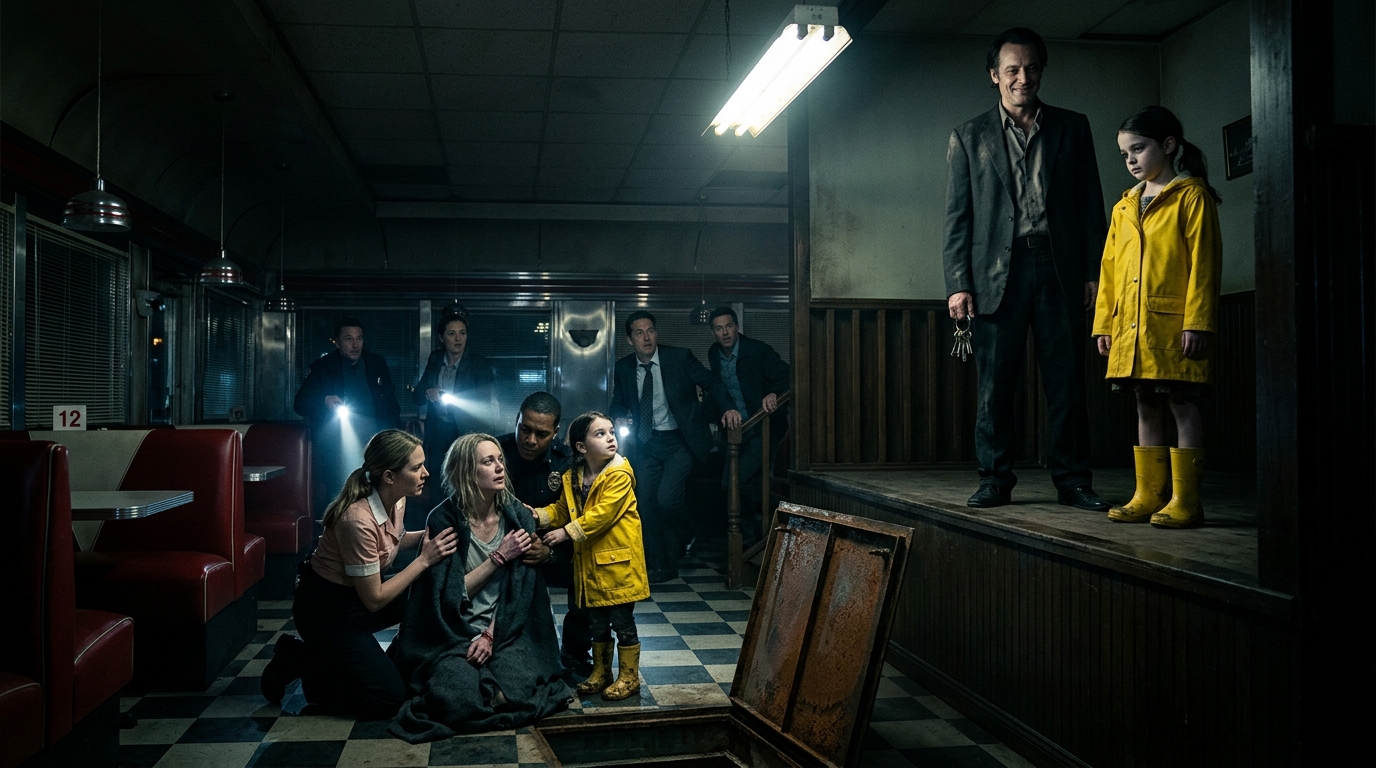
  • We Opened The Floor Beneath Booth 12 And Found A Woman Still Alive Under The Diner

    We Opened The Floor Beneath Booth 12 And Found A Woman Still Alive Under The Diner

    The Scratches Under The Table

    Lily disappeared at exactly midnight.

    Just like every other night.

    One second she sat beneath the flickering neon clock.

    The next, the diner door swung softly shut behind her and rain swallowed the parking lot again.

    I ran outside immediately.

    Empty highway.

    No footsteps.

    No yellow raincoat.

    Nothing.

    Only cold wind and wet asphalt reflecting the diner sign in broken red light.

    My chest tightened painfully.

    Because this time, I knew I had not imagined it.

    The hand beneath the table was real.

    Mud-covered.

    Thin.

    Alive.

    I rushed back inside so fast one of the truckers looked up from his coffee.

    “You okay, sweetheart?”

    I ignored him.

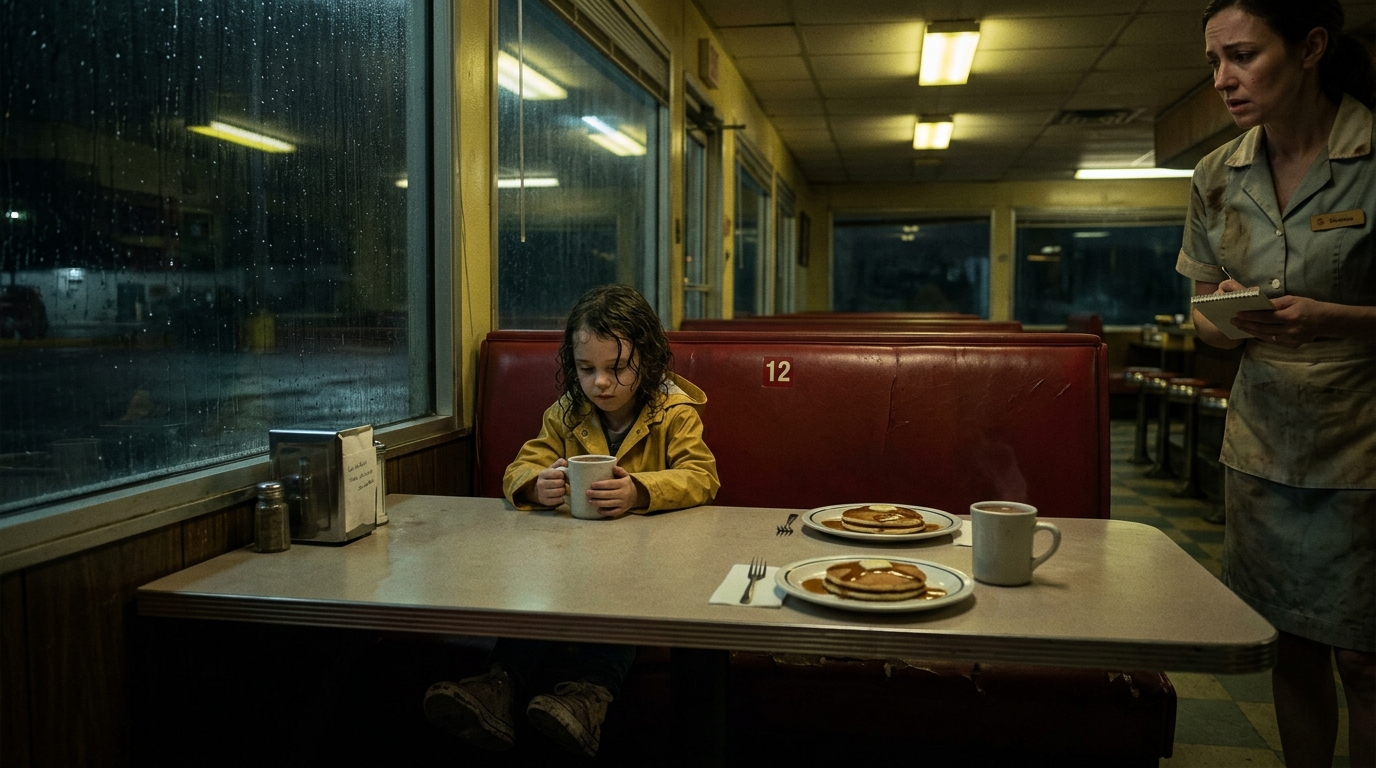
    Booth 12 sat empty now.

    Two untouched pancakes.

    Two cups of hot chocolate.

    One chair slightly pulled back.

    And beneath the table—

    Fresh scratches marked the wooden floorboards.

    Long.

    Uneven.

    Desperate.

    My stomach dropped instantly.

    I crouched slowly.

    The scratches formed lines leading toward the center beneath the booth like fingernails dragging from underneath the floor.

    The smell hit me again.

    Wet earth.

    Rot.

    Human sweat trapped underground too long.

    I touched the wood carefully.

    Cold air seeped upward through tiny cracks between the boards.

    “Oh my God.”

    My voice barely came out.

    I stood so quickly the chair beside me fell backward.

    Frank, the diner owner, stormed from the kitchen immediately.

    “What the hell happened?”

    He stopped when he saw my face.

    Then followed my eyes downward.

    The scratches.

    The cracked floorboards.

    The mud.

    For the first time since I worked there, Frank looked genuinely afraid.

    “Who made those?”

    I swallowed hard.

    “There’s someone under the floor.”

    Silence.

    Then Frank laughed once.

    Too fast.

    Too loud.

    “No.”

    “I saw a hand.”

    Another silence.

    The cooks had stopped moving now.

    Even the truckers were watching.

    Rain hammered harder against the diner windows.

    Frank looked toward booth 12 carefully.

    Then whispered:

    “That’s impossible.”

    But he didn’t sound convinced.

    He sounded terrified.

    The Locked Basement Beneath The Diner

    At 12:41 a.m., Frank brought tools from the storage room.

    Crowbar.

    Flashlights.

    Hammer.

    He kept muttering under his breath while dragging the booth away from the floor.

    “Should’ve sealed it years ago.”

    My pulse jumped instantly.

    I stared at him.

    “What do you mean sealed it?”

    Frank avoided my eyes.

    The wooden floor groaned as we pulled the table aside completely.

    The scratches beneath looked worse now.

    Dozens of them.

    Some old.

    Some fresh enough to still splinter at the edges.

    A trucker near the counter whispered:

    “Jesus…”

    Frank jammed the crowbar between the floorboards roughly.

    “They told me nobody could get down there anymore.”

    Cold spread slowly through my chest.

    “Who told you?”

    No answer.

    He ripped upward hard.

    The board cracked open with a loud snap.

    A wave of cold air rushed upward immediately.

    Not fresh air.

    Underground air.

    Damp.

    Rotting.

    Alive.

    The smell made one waitress gag instantly.

    Beneath the broken boards sat a metal hatch hidden under the diner floor.

    Rust covered the edges.

    A heavy chain wrapped around the handle.

    Locked from the outside.

    My stomach twisted violently.

    Someone had trapped it shut intentionally.

    Frank backed away slowly.

    “No…”

    I stared at him.

    “You knew about this.”

    His face looked pale beneath the kitchen lights.

    “I thought it was abandoned.”

    “What is it?”

    Frank rubbed one trembling hand over his mouth.

    “Old storage cellar from the original diner.”

    My blood turned cold.

    “How long has it been locked?”

    He whispered the answer so softly I almost missed it.

    “Three years.”

    Three years.

    Exactly when Hannah Vale disappeared.

    Every hair on my body rose.

    I looked at the scratches again.

    Not random.

    Not animal marks.

    Human fingernails.

    Trying to claw upward through the floor.

    For years.

    I grabbed the chain violently.

    “It’s locked from the outside!”

    Frank flinched.

    “I didn’t do that.”

    The lock suddenly rattled beneath my hand.

    Everyone froze.

    A weak sound echoed upward through the hatch.

    Knocking.

    Three slow taps.

    The same rhythm Lily used against the table every night.

    My chest tightened painfully.

    Someone was alive down there.

    The Woman Under The Floor

    Frank broke the lock with the hammer on the third strike.

    The chain hit the floor loudly.

    Nobody moved immediately.

    Rain hammered the windows harder.

    The diner lights flickered once.

    Then Frank slowly lifted the hatch.

    Darkness opened beneath us.

    Concrete stairs descended underground.

    And from below—

    A woman began crying.

    Not loudly.

    Weakly.

    The sound barely human from dehydration and fear.

    My flashlight shook violently as I aimed it downward.

    The cellar looked impossibly small.

    Concrete walls.

    Old shelves.

    Water stains.

    And curled against the far wall beneath a blanket—

    A woman.

    Thin enough to look breakable.

    Dark hair hanging over hollow cheeks.

    Bare feet.

    Bruised wrists.

    My knees almost gave out.

    “Hannah,” I whispered.

    She lifted her head slowly toward the light.

    Green eyes.

    Small scar beneath the chin.

    The missing woman from the posters.

    Alive.

    The entire diner went silent behind me.

    Hannah stared upward like she no longer trusted daylight.

    Then she whispered one word:

    “Lily?”

    My throat closed instantly.

    I turned toward the diner entrance.

    The bell above the door jingled softly.

    Lily stood there in the yellow raincoat dripping rainwater onto the tile floor.

    She looked smaller somehow.

    Relieved.

    For the first time since entering the diner, she smiled like a child instead of a ghost.

    “Mommy.”

    Hannah broke completely.

    The sound she made did not even resemble crying anymore.

    It sounded like survival finally collapsing.

    I ran down the stairs immediately.

    The cellar smelled unbearable up close.

    Rotting wood.

    Mold.

    Human sickness.

    Hannah tried standing but her legs failed instantly.

    I caught her before she hit the floor.

    Her body felt terrifyingly light.

    “How long?” I whispered.

    Tears streamed down her face.

    “He kept me here after they declared me missing.”

    Cold flooded my chest.

    “Who?”

    Hannah’s eyes filled with terror instantly.

    “My husband.”

    The Insurance Money

    Police arrived twenty minutes later.

    Sirens painted the diner windows red and blue while paramedics carried Hannah upstairs wrapped in thermal blankets.

    Lily refused to leave her side.

    The little girl held her mother’s hand with both of hers the entire time like letting go might make her disappear again.

    I stood beside the counter shaking so badly I could barely hold the coffee Frank handed me.

    Detectives flooded the diner.

    Photographs.

    Questions.

    Flashlights.

    Evidence markers.

    One officer kept repeating:

    “How did nobody find this place?”

    But I already knew the answer.

    Nobody looked beneath booth 12 because people only notice horrors they expect to exist.

    A detective finally approached Hannah carefully.

    “Mrs. Vale,” he said softly, “can you tell us who locked you down there?”

    Hannah’s face drained instantly.

    She pulled Lily closer.

    Then whispered:

    “Richard.”

    The name meant nothing to me.

    Until Frank suddenly dropped the coffee pot beside the counter.

    It shattered across the tile.

    Everyone looked at him.

    Frank looked horrified.

    “Richard Vale?”

    Hannah started crying again.

    Cold spread slowly through my chest.

    Richard Vale.

    The owner of Moonlight Diner.

    Frank’s business partner.

    Lily’s father.

    The same man who reported his wife missing three years earlier.

    The same man who collected nearly two million dollars in disappearance insurance six months after the search officially ended.

    My stomach twisted violently.

    “He kept her under the diner?”

    Hannah nodded weakly.

    “He said nobody searches places they eat.”

    Silence swallowed the room.

    Then Lily suddenly tugged my sleeve.

    I looked down at her.

    She pointed upward toward the second floor balcony overlooking the diner.

    My blood froze.

    A silhouette stood in the darkness above us.

    Watching.

    Tall.

    Still.

    Male.

    Raincoat black against the shadows.

    One detective shouted:

    “HEY!”

    The figure didn’t move.

    Didn’t run.

    Just stood there looking down at Hannah.

    At Lily.

    At me.

    Then slowly lifted one hand.

    And waved.

    Exactly the way Lily’s mother had described in her missing-person report years earlier.

    The detectives rushed toward the staircase.

    But Lily whispered something that stopped me cold.

    “He’s smiling now.”

    My chest tightened painfully.

    Because from where I stood, the face upstairs remained hidden completely in darkness.

    Nobody should have been able to see his expression.

    Then the second-floor lights flickered on for half a second.

    Long enough for me to finally see him clearly.

    Richard Vale.

    Still smiling.

    Still holding the diner master keys in one hand.

    And beside him—

    Another little girl stood silently in the dark.

    Wearing the same yellow raincoat as Lily.

  • Every Night A Little Girl Ordered Food For Her Mother. Then She Pointed Under The Table

    Every Night A Little Girl Ordered Food For Her Mother. Then She Pointed Under The Table

    Table Number 12

    Night diners fall into two categories.

    The lonely.

    And the dangerous.

    After midnight, it becomes hard to tell which is which.

    I learned that during my second year working at Moonlight Diner, a twenty-four-hour restaurant sitting beside the highway outside Grayford City.

    Truckers.

    Drunks.

    Runaways.

    People avoiding home.

    By 11 p.m., everyone carried secrets heavier than their wallets.

    The diner lights buzzed softly overhead while rain blurred the windows silver. Old music drifted from the kitchen radio. Coffee burned slowly on the warmer beside the register.

    Routine.

    Predictable.

    Until the little girl started coming.

    The first night, I thought someone abandoned her.

    She walked into the diner at exactly 11:03 p.m. wearing a yellow raincoat too big for her tiny body. Wet curls stuck against her cheeks. Mud covered the bottoms of her shoes.

    Eight years old.

    Maybe younger.

    No adult beside her.

    No car outside.

    She walked straight to booth number 12 near the back corner beneath the broken neon clock.

    Then she sat down and waited.

    Not nervous.

    Not scared.

    Like she had done it many times before.

    I grabbed a menu immediately.

    “Hey, sweetheart,” I said gently. “Are your parents coming?”

    She shook her head once.

    “Just my mom.”

    I glanced toward the windows.

    Empty parking lot.

    Rain.

    No headlights.

    No movement.

    The little girl smiled politely.

    “Can we order now?”

    We.

    Something about that word made me uneasy immediately.

    But children say strange things all the time.

    I handed her the menu anyway.

    “What would you like?”

    She looked down seriously.

    Then pointed at the pancakes.

    “One for me.”

    Her finger moved lower.

    “And one for my mommy.”

    I looked at the empty seat across from her.

    Nobody there.

    My stomach tightened slightly.

    “Your mom’s still coming?”

    The girl nodded.

    “She’s already here.”

    Cold moved slowly through my chest.

    I forced a smile.

    “Okay.”

    I wrote two pancake orders.

    And tried not to look at the empty seat while walking away.

    The Chair Across From Her

    The second night, she returned at exactly 11:03 again.

    Same yellow raincoat.

    Same muddy shoes.

    Same booth.

    Table 12.

    Two meals.

    One for her.

    One for her mother.

    Always pancakes.

    Always hot chocolate.

    Two cups.

    Never one.

    I asked the kitchen staff if they recognized her.

    Nobody did.

    That disturbed me.

    Small towns notice unattended children.

    Especially at night.

    But every customer who entered after midnight seemed strangely uninterested in the girl.

    Truckers walked past her booth without looking.

    Customers avoided table 12 automatically.

    Like instinct pushed their eyes away before curiosity could settle.

    By the fourth night, I stopped asking if her mother was coming.

    The little girl always thanked me politely before eating.

    But she never touched the second plate.

    The food sat untouched across from her until exactly midnight.

    Then she whispered softly toward the empty chair:

    “We have to go now.”

    Every night.

    Same words.

    Same time.

    Then she left.

    Alone.

    I tried following her once.

    The moment she stepped outside, the diner lights flickered violently.

    By the time I reached the parking lot, she was gone.

    No footprints.

    No car.

    Nothing.

    Just rain.

    That was when I started noticing the smell.

    Wet earth.

    Rotting leaves.

    Every time she entered the diner, the air changed slightly around booth 12.

    Not enough for customers to complain.

    Enough for me to notice.

    And sometimes—

    Only sometimes—

    The empty seat across from her creaked softly like someone shifting weight.

    The Little Girl At 11:03

    A week later, I finally asked her name.

    “Lily,” she answered while stirring whipped cream into her hot chocolate.

    Her voice sounded older than her face.

    Not deeper.

    Tired.

    Children should not sound tired.

    “And your mom?”

    Lily smiled faintly.

    “She doesn’t like strangers.”

    My eyes drifted toward the untouched pancakes across from her.

    Steam still rose slowly from the plate.

    I swallowed hard.

    “What’s your mom’s name?”

    Lily stopped stirring.

    For one second, the diner became very quiet.

    Too quiet.

    Even the kitchen radio crackled into static.

    Then Lily whispered:

    “She changes names now.”

    A chill crawled up my arms.

    “What does that mean?”

    Lily looked toward the rain-dark windows.

    “She says bad people still look for her.”

    The neon clock above booth 12 flickered.

    11:41 p.m.

    Outside, thunder rolled low across the highway.

    I stared at the empty seat again.

    Something about the shadows beneath the table looked wrong.

    Too dark.

    Too deep.

    Like the light avoided reaching under there.

    Lily suddenly looked back at me.

    “You’re nicer than the last waitress.”

    My stomach tightened.

    “There was another waitress?”

    “She asked too many questions.”

    The way Lily said it made my skin go cold instantly.

    “What happened to her?”

    Lily shrugged.

    “Mom didn’t trust her.”

    A coffee mug shattered in the kitchen suddenly.

    I jumped violently.

    Cooks shouted.

    Normal noise returned to the diner.

    But booth 12 still felt isolated from the rest of the room somehow.

    Like the air around it belonged somewhere else.

    I forced myself to smile again.

    “You shouldn’t be out this late, Lily.”

    “She doesn’t like being alone underground.”

    Every nerve in my body locked.

    “What?”

    Lily took a bite of pancake calmly.

    Then pointed toward the empty seat.

    “She gets scared in small places.”

    My mouth went dry.

    “Lily… where is your mother?”

    The little girl stopped chewing slowly.

    Then looked directly at me.

    Not playful.

    Not smiling.

    Completely serious.

    And whispered:

    “She’s under the table.”

    The Thing Beneath Booth 12

    Every muscle in my body froze.

    The diner lights buzzed softly overhead.

    Rain tapped against the windows.

    A truck passed outside spraying water across the highway.

    Normal sounds.

    Normal world.

    But booth 12 no longer felt connected to it.

    I stared at Lily.

    She stared back calmly.

    Then she pointed again.

    Under the table.

    My pulse hammered violently.

    “Lily,” I whispered carefully, “that’s not funny.”

    “She doesn’t like loud voices.”

    The empty chair creaked softly.

    Not imagination.

    Movement.

    Tiny.

    Real.

    Cold spread slowly through my stomach.

    I looked around the diner instinctively.

    Nobody noticed us.

    A couple argued quietly near the counter.

    Truckers drank coffee beneath flickering televisions.

    The cook cursed inside the kitchen.

    Life continued normally while something impossible waited beneath booth 12.

    Lily leaned closer.

    “She says you remind her of her sister.”

    Every hair on my body rose.

    “What?”

    “She says her sister never stopped looking for her.”

    The smell hit me harder suddenly.

    Wet soil.

    Mud.

    And something underneath it—

    Decay.

    I took one slow step backward.

    The shadows beneath the table shifted.

    My breath stopped instantly.

    Something moved under there.

    Not quickly.

    Slowly.

    Like a body adjusting position in a cramped space.

    The diner lights flickered once.

    Lily looked downward beneath the tablecloth.

    Then nodded gently.

    “She wants to know if you still believe missing people are dead.”

    Ice flooded my chest.

    Because three years earlier, a local woman disappeared from Grayford County after stopping at a roadside diner during heavy rain.

    The story stayed everywhere for months.

    Missing posters.

    Search teams.

    Police interviews.

    I remembered the case because the woman vanished less than five miles from Moonlight Diner.

    And because they never found her body.

    The missing woman’s name was Hannah Vale.

    I still remembered her photograph from the news.

    Dark hair.

    Green eyes.

    Small scar near her chin.

    Lily slowly pushed a folded napkin across the table toward me.

    My fingers trembled as I picked it up.

    Written across the paper in shaky handwriting were four words.

    SHE IS STILL UNDERGROUND.

    The empty chair creaked again.

    Longer this time.

    Then—

    Something pale slid slowly out from beneath the edge of the tablecloth.

    A woman’s hand.

    Mud-covered fingers.

    Wedding ring still attached.

    And from underneath booth 12, a woman’s voice whispered softly:

    “Did they finally send you?”

  • My Wedding Photographer Saw The Photos And Turned White. Then He Told Me My Husband’s Ex Promised To Come Back From The Dead

    My Wedding Photographer Saw The Photos And Turned White. Then He Told Me My Husband’s Ex Promised To Come Back From The Dead

    The Photographer Who Refused To Look Again

    I left the penthouse before sunrise.

    Not because Damien told me to.

    Because something inside that apartment breathed when the lights went out.

    And I knew if I stayed long enough, I would see it clearly.

    Rainwater covered the streets in pale reflections while I drove across the city with trembling hands and the wedding album strapped into the passenger seat like evidence from a crime scene.

    Every red light felt too long.

    Every mirror felt dangerous.

    At 6:12 a.m., I arrived at Vincent Hale Photography Studio.

    The sign still hung crooked above the entrance exactly the way it had during our engagement shoot six months earlier.

    Vincent was old-school.

    No assistants.

    No social media gimmicks.

    Only reputation.

    People said he photographed wealthy weddings because he knew how to “capture truth.”

    That phrase suddenly terrified me.

    The studio lights were already on.

    Vincent opened the door wearing reading glasses and a gray sweater stained with coffee.

    He smiled automatically.

    “Mrs. Vale, I didn’t expect—”

    Then he saw my face.

    The smile vanished immediately.

    “What happened?”

    I held up the album.

    “You took these photos.”

    He nodded slowly.

    “Yes.”

    “Then explain them.”

    Something in my voice made him step aside without another question.

    The studio smelled like old paper and camera chemicals.

    Warm.

    Safe.

    At least at first.

    Vincent placed the album beneath a desk lamp and adjusted his glasses carefully.

    I watched his expression change page by page.

    Confusion.

    Frown.

    Stillness.

    Then fear.

    Real fear.

    By the fourth photograph, the color drained from his face completely.

    “No,” he whispered.

    I felt ice spread through my chest.

    “You see it too.”

    Vincent looked up at me sharply.

    “When did this start?”

    “What do you mean when did this start?”

    He ignored the question and flipped faster through the album.

    Every page made him paler.

    His hands began shaking.

    The final photograph nearly slipped from his fingers.

    “Oh God.”

    The room suddenly felt colder.

    I stared at him.

    “You knew this could happen.”

    Vincent closed the album immediately.

    Too fast.

    Like touching it longer was dangerous.

    “This isn’t the first time.”

    My heartbeat stopped.

    The Bride From The Fire

    Vincent unlocked a cabinet in the back of the studio with trembling hands.

    Inside were dozens of old wedding albums wrapped carefully in black cloth.

    He pulled one out slowly.

    Dust covered the edges.

    No label.

    No names.

    Just age.

    He placed it beside mine.

    “Three years ago,” he whispered.

    The album opened to another wedding.

    Another ballroom.

    Another bride.

    Different couple.

    Different city.

    Same darkness.

    The groom’s face completely blacked out in every photograph.

    I stared in horror.

    “No.”

    Vincent turned another page.

    The bride appeared alone beside a church altar.

    Behind her stood a pale man in a burned suit.

    Half his face melted black.

    Dead eyes staring into the camera.

    My stomach twisted violently.

    “What is this?”

    Vincent swallowed hard.

    “I thought it was corrupted data the first time.” His voice shook. “Then the groom died two weeks later.”

    Cold spread through my body.

    “How?”

    “Fire.”

    My mouth went dry.

    Fire.

    Vivian.

    The burning.

    The photographs.

    Vincent rubbed his hands together nervously.

    “I stopped photographing certain families after that.”

    “What families?”

    He looked toward my wedding album.

    “The Vale family.”

    A chill crawled up my spine.

    “Damien’s family?”

    Vincent nodded slowly.

    “They bring death into photographs.”

    The room went silent.

    Outside, rain tapped softly against the studio windows.

    I forced myself to breathe.

    “This is insane.”

    “I know.”

    “Dead people don’t appear in wedding photos.”

    Vincent looked at me for a long moment.

    Then quietly said:

    “They do when they were promised something.”

    My pulse hammered violently.

    “What promise?”

    He hesitated.

    Then opened a newspaper clipping from beneath the old album.

    Vivian Hart.

    The article showed the burned remains of a lakeside house.

    Not drowning.

    Fire.

    I stared at him.

    “You said she drowned.”

    “That’s what your husband told the public.”

    My chest tightened painfully.

    The article headline read:

    LOCAL WOMAN PRESUMED DEAD AFTER FIRE NEAR BLACKWATER LAKE.

    Vincent pointed toward a smaller paragraph buried beneath the image.

    Witnesses reported hearing a woman screaming before the structure collapsed.

    “She wasn’t found?” I whispered.

    “No body.”

    Every hair on my body rose.

    Vincent leaned closer across the desk.

    “Before the fire,” he whispered carefully, “Vivian came here for an engagement shoot.”

    My breathing slowed dangerously.

    “She told me something strange while Damien was outside taking a phone call.”

    I stared at him.

    “What did she say?”

    Vincent’s face looked genuinely frightened now.

    “She said…” His voice dropped lower. “If he marries another woman, I’ll come back and take him with me.”

    The House Full Of Covered Mirrors

    I drove home shaking.

    Not crying.

    Past crying.

    Fear eventually becomes too large for tears.

    The city looked wrong through rain-covered glass.

    Too empty.

    Too quiet.

    Every reflection in every storefront made me flinch.

    By the time I reached the penthouse building, the storm had stopped completely.

    The silence afterward felt unnatural.

    Like the entire city was holding its breath.

    The lobby receptionist smiled politely when I entered.

    “Good afternoon, Mrs. Vale.”

    Normal.

    Everything stayed horribly normal.

    I stepped into the elevator alone.

    The mirrored walls reflected me from every angle.

    Except for one corner.

    In the far-left reflection, someone else stood behind me.

    Dark hair.

    Black dress.

    Vivian.

    I spun around instantly.

    Nobody there.

    The elevator dinged at my floor.

    I almost ran toward the penthouse door.

    My hands trembled so badly I dropped the keys twice.

    When I finally stepped inside—

    I froze.

    Every mirror in the penthouse had been covered.

    White sheets.

    Black cloth.

    Bedsheets tied over glass.

    Bathroom mirrors hidden.

    Hallway mirrors draped completely.

    Even the mirrored wine cabinet had been covered in dark fabric.

    My stomach dropped instantly.

    “Damien?”

    No answer.

    The apartment smelled faintly like smoke.

    Not fresh smoke.

    Old smoke.

    The kind trapped in walls after a fire.

    I moved slowly through the penthouse.

    Bedroom.

    Kitchen.

    Hallway.

    Empty.

    But every reflective surface was hidden.

    Like someone inside the apartment feared mirrors more than intruders.

    My heartbeat pounded painfully.

    Then I noticed something worse.

    Wet footprints crossed the floor again.

    Bare feet.

    Leading toward the master bathroom.

    I stopped outside the door.

    The final mirror remained uncovered inside.

    Large.

    Floor-to-ceiling.

    Steam clung faintly to the glass.

    Like someone had showered recently.

    “Damien?”

    Silence.

    I stepped inside slowly.

    And pulled the cloth away.

    The Man Missing From The Reflection

    The mirror revealed the bathroom instantly.

    White marble.

    Gold lights.

    Water dripping softly from the sink faucet.

    And me.

    Only me.

    I stared at my reflection breathing hard against the cold glass.

    No Damien.

    No movement behind me.

    Nothing.

    At first, I almost laughed from relief.

    Then I realized something horrifying.

    Damien was standing directly behind me.

    I could feel him.

    Warm breath near my shoulder.

    The faint smell of his cologne.

    The pressure of another body close enough to touch mine.

    But the mirror reflected only me.

    My blood turned to ice.

    Slowly—

    Very slowly—

    A hand appeared on my shoulder from behind.

    Real.

    Solid.

    Male.

    But in the mirror, nothing touched me.

    My reflection stood alone.

    I couldn’t breathe.

    “Selena,” Damien whispered softly behind me.

    I watched the empty space beside my reflection.

    Nothing.

    No husband.

    No shadow.

    No movement.

    Only me standing alone in the bathroom while invisible hands rested against my skin.

    Terror exploded through my chest.

    I spun around violently.

    Damien stood inches away.

    Perfect suit.

    Perfect face.

    Perfect smile.

    Human.

    Except now I understood something unbearable.

    The mirror was not failing to reflect him.

    It was revealing the truth.

    My husband did not exist inside reflections anymore.

    Because whatever came home after Blackwater Lake—

    Wasn’t entirely human.

    Damien lifted one hand slowly toward my face.

    “Please don’t look at me through mirrors,” he whispered.

    Then every covered mirror in the penthouse shattered at the exact same moment.

    And from inside the broken glass—

    A woman’s voice laughed softly.

  • Every Photo From My Wedding Was Perfect Except For One Thing: My Husband’s Face Was Missing

    Every Photo From My Wedding Was Perfect Except For One Thing: My Husband’s Face Was Missing

    The Wedding Album I Should Never Have Opened

    People think the worst part of a wedding is before it happens.

    The stress.

    The planning.

    The family arguments hidden behind champagne smiles.

    They’re wrong.

    The worst part comes afterward.

    When the flowers die.

    When the guests leave.

    When silence finally sits beside you long enough for your instincts to speak.

    Three nights after my wedding, I opened the album alone.

    That detail matters.

    Because if anyone else had been sitting beside me, I might have convinced myself I was imagining things.

    The penthouse still smelled like roses and candle wax from the reception downstairs. White orchids drooped in expensive glass vases. My wedding dress hung near the bedroom window like a pale body suspended in darkness.

    Outside, rain covered the city in silver reflections.

    Inside, I sat barefoot on the living room floor with the wedding album across my lap.

    The cover was ivory leather embossed with gold initials.

    S & D.

    Selena and Damien.

    Perfect.

    Elegant.

    Expensive.

    Everything about the wedding had been designed to look eternal.

    That should have warned me.

    Nothing human is ever designed to last forever unless someone is trying too hard to preserve a lie.

    I opened the album slowly.

    First page.

    The chapel.

    White flowers.

    Crystal chandeliers.

    My father smiling beside me.

    Second page.

    The vows.

    Damien holding my hand.

    Third page.

    The kiss.

    The guests applauding.

    Everything looked beautiful.

    Except for Damien’s face.

    At first, I thought it was lighting.

    A blur.

    A shadow crossing the lens at the wrong moment.

    But the farther I turned through the album, the worse it became.

    In every photograph, I appeared perfectly clear.

    Every guest appeared clear.

    Every candle.

    Every flower.

    Every detail sharp enough to count.

    Except my husband.

    His face was dark.

    Not blurred naturally.

    Covered.

    Like someone had dragged black paint across his features after the photos were printed.

    My stomach tightened slowly.

    I flipped faster.

    Ceremony.

    Reception.

    Dance floor.

    Cake cutting.

    Every image the same.

    Damien’s face swallowed by darkness.

    The Groom With No Face

    I called him immediately.

    No answer.

    That was unusual.

    Damien always answered.

    Always.

    Even during meetings.

    Even in elevators.

    Even once while standing beside a coffin during his grandfather’s funeral.

    Control mattered to him.

    Responsiveness mattered.

    Appearances mattered most.

    I stared at the photographs again while the call rang out into voicemail.

    My fingers shook slightly.

    “Okay,” I whispered to myself. “Printing error.”

    That sounded rational enough.

    The photographer’s software corrupted.

    Ink issue.

    Lighting issue.

    Anything explainable.

    But fear notices details before logic does.

    And one detail kept pulling at me.

    The darkness over Damien’s face wasn’t random.

    It changed shape slightly in every picture.

    Almost like movement.

    Almost alive.

    I grabbed the wedding video tablet from the coffee table and opened the digital gallery.

    The thumbnails loaded slowly.

    My pulse climbed with each image.

    Because the digital files showed the same thing.

    Not printing damage.

    Not ink.

    Every image captured my husband without a face.

    Blackness where his features should have been.

    I zoomed into one photograph taken during our first dance.

    My white dress spun beneath chandelier light while Damien held my waist.

    His face was completely dark.

    But behind him—

    Someone stood near the ballroom doors.

    A woman.

    My breath stopped instantly.

    Long dark hair.

    Pale skin.

    Black dress.

    Watching me.

    Not smiling.

    Not moving.

    Watching.

    I zoomed in harder.

    The image sharpened slightly.

    And my blood turned ice cold.

    I knew her.

    Not personally.

    But from photographs Damien once deleted too quickly when he thought I wasn’t looking.

    Her name was Vivian Hart.

    His ex-girlfriend.

    The woman who supposedly drowned two years earlier during a weekend trip near Blackwater Lake.

    The woman Damien never spoke about unless drunk enough to forget pretending.

    The woman whose death changed him according to his mother.

    I stared at the screen while rain tapped softly against the penthouse windows.

    Vivian stood behind my husband in my wedding photo.

    Looking directly at me.

    And unlike Damien—

    Her face was perfectly clear.

    The Woman Behind The Groom

    I told myself grief does strange things to memory.

    That maybe I only thought it was Vivian because I already knew her face.

    But deep down, I understood something worse immediately.

    No one accidentally recognizes a dead woman.

    Not like that.

    Not from posture.

    Not from eyes.

    Not from the exact silver necklace hanging at her throat.

    The necklace Damien kept hidden inside his desk drawer for almost a year after we started dating.

    He once told me it belonged to “someone important.”

    Then changed the subject so fast it felt rehearsed.

    I zoomed further into the photo.

    Vivian’s expression remained perfectly sharp while the pixels around Damien distorted strangely.

    Almost like the darkness over him reacted to her presence.

    The room suddenly felt colder.

    I checked the timestamp.

    11:43 p.m.

    First dance.

    But Vivian died two years earlier.

    My chest tightened painfully.

    I opened another photograph.

    Cake cutting.

    Same thing.

    Damien faceless.

    Vivian standing farther back near the champagne tower.

    Another photo.

    Reception speech.

    Vivian again.

    Closer.

    Each picture placed her nearer to Damien.

    Nearer to me.

    Watching.

    Waiting.

    My hands shook harder now.

    Then I opened the final photograph in the album.

    The exit shot.

    Damien and I leaving beneath white flowers while guests threw silver confetti into the night air.

    Except this time Vivian stood directly beside him.

    One pale hand resting against his shoulder.

    And for the first time—

    She was smiling.

    Not happily.

    Knowingly.

    A cold wave rolled through my stomach.

    Because I realized something horrifying then.

    Vivian never appeared beside me.

    Only beside Damien.

    Like she wasn’t haunting the marriage.

    She was haunting him.

    The Dead Woman In The Wedding Photos

    I barely slept.

    Every time I closed my eyes, I saw Vivian standing behind Damien with water-dark hair hanging over her shoulders.

    Watching me.

    Not angry.

    Not screaming.

    Waiting.

    At 3:17 a.m., I finally got out of bed and walked back into the living room.

    The wedding album still sat open on the floor where I left it.

    The rain outside had stopped.

    The silence inside the penthouse felt enormous.

    I turned on only one lamp.

    Warm yellow light spilled across the photographs.

    I forced myself to look again.

    Rationally.

    Carefully.

    That was when I noticed another detail.

    Vivian never appeared in mirrors.

    Only photographs.

    Every ballroom mirror in the background reflected guests correctly.

    Tables.

    Candles.

    My dress.

    Even the darkness covering Damien’s face reflected faintly.

    But Vivian did not.

    Like the camera saw her while the room itself refused to.

    My pulse hammered violently.

    Then I noticed something else.

    In every photograph where Vivian appeared, Damien’s body language changed slightly.

    Shoulders tense.

    Hands tighter.

    Smile strained.

    Like some part of him knew.

    I grabbed my phone and searched old articles about Vivian Hart.

    Most were shallow gossip pieces.

    Tragic accident.

    Young socialite drowned.

    Body recovered three days later.

    Private funeral.

    No suspicious circumstances.

    But one detail froze me instantly.

    The article included a photograph taken the week before her death.

    Vivian wore the exact same black dress from my wedding photographs.

    Not similar.

    The same.

    My skin turned ice cold.

    Because no dead woman wears the same dress two years later unless someone never buried her in it.

    A sound moved behind me.

    Soft.

    Wet.

    I turned sharply toward the hallway.

    Nothing there.

    But water dripped slowly across the hardwood floor leading toward the bedroom.

    Drip.

    Drip.

    Drip.

    My mouth went dry.

    The droplets formed footprints.

    Bare feet.

    Leading toward the wedding dress hanging beside the window.

    I backed away slowly.

    Then my phone buzzed violently in my hand.

    Damien.

    Finally.

    I answered immediately.

    “Where are you?”

    Silence.

    Then his voice.

    Low.

    Careful.

    “Selena…”

    Something about the way he said my name made my blood freeze instantly.

    Not loving.

    Afraid.

    “I need you to listen carefully.”

    I stared at the wet footprints crossing the floor.

    “Why is Vivian in our wedding photos?”

    Silence again.

    Longer this time.

    Then Damien whispered:

    “You saw her too?”

    The Face Hidden By Darkness

    The apartment lights flickered once.

    I gripped the phone tighter.

    “Damien,” I whispered, “what’s happening?”

    His breathing sounded uneven now.

    Not like the controlled, polished man I married.

    Like someone finally too exhausted to keep lying.

    “Leave the penthouse.”

    “What?”

    “Now.”

    The urgency in his voice made my stomach twist.

    I looked toward the bedroom doorway.

    The wet footprints ended directly beneath the hanging wedding dress.

    The dress moved slightly.

    No wind.

    No open windows.

    Just movement.

    “Damien,” I said slowly, “why is your face blacked out in every photo?”

    Silence.

    Then:

    “Because she won’t let cameras remember me anymore.”

    Every hair on my body rose.

    “What does that mean?”

    “She’s angry.”

    The lights flickered harder.

    My pulse hammered violently.

    “Stop talking like she’s alive.”

    Another silence.

    Then Damien said something that changed everything.

    “She never drowned.”

    The wedding dress swayed gently beside the window.

    Something moved beneath the fabric.

    Human-shaped.

    My chest tightened painfully.

    “What?”

    “I lied about her death.”

    The room suddenly felt smaller.

    Colder.

    More dangerous.

    “Damien…”

    “She disappeared after Blackwater Lake.” His voice cracked slightly. “But nobody ever found her body.”

    I stared at the photographs spread across the floor.

    Vivian watching us dance.

    Vivian watching us kiss.

    Vivian standing beside my faceless husband like a witness returning to a crime scene.

    “You told everyone she died.”

    “I know.”

    “Why?”

    A sound interrupted him.

    Not from the phone.

    From inside the penthouse.

    A wet cough.

    Close.

    Very close.

    I turned slowly toward the bedroom.

    The wedding dress was no longer hanging still.

    Someone stood behind it.

    Bare feet beneath white fabric.

    Long dark hair visible through the lace.

    My blood turned ice cold.

    “Selena?” Damien’s voice sharpened through the phone. “Get out now.”

    The figure behind the dress lifted one pale hand slowly.

    And pointed toward the hallway closet.

    Then the apartment lights shut off completely.

    Darkness swallowed everything.

    Except one thing.

    The glow of my phone screen reflecting against the wedding photographs.

    In every single picture, Damien’s blacked-out face had changed.

    Now there were scratches across it.

    As if someone inside the image was trying to claw their way out.

    And in the final wedding photo—

    Vivian was no longer standing beside him.

    She was standing behind me.