The Boy Who Wouldn’t Look At His Hands
Liam was crying before I said anything.
That frightened me more than the notebook.
More than my portrait on the last page.
More than the word TOMORROW written beneath my closed eyes.
Because Liam Vale did not cry.
Not when other children laughed too loudly.
Not when the fire alarm malfunctioned and screamed for ten minutes.
Not when he fell on the playground and blood ran down both knees.
He only sat there quietly.
Watching.
Listening.
Waiting for something the rest of us could not hear.
But now he stood in my classroom doorway with tears sliding down his face, and the red pencil lay at my feet like a tiny weapon.
The black notebook sat open in my hands.
My own face stared up from the final page.
Eyes closed.
Mouth still.
Tomorrow.
I heard myself whisper, “Liam, who writes the dates?”
He shook his head.
The classroom lights flickered.
Once.
Twice.
The rain outside pressed softly against the windows, blurring the playground into gray shadows.
“Liam.”
He backed away one step.
“I can’t say.”
“Yes, you can.”
“No.” His voice cracked. “She’ll get mad.”
My fingers tightened around the notebook.
“Who?”
Liam looked toward the desks.
Not at me.
Not at the door.
At his desk in the back row near the radiator.
The one where he always sat.
The one where the notebook usually stayed.
The one I suddenly realized he never pushed his chair all the way under.
As if he needed space beneath it.
My mouth went dry.
“Liam,” I said carefully, “are you saying someone else draws these?”
His lips trembled.
“I don’t draw them.”
The room went silent.
I stared at him.
“What?”
He held up his hands.
Small hands.
Child hands.
Clean except for graphite stains on the fingertips.
“I don’t want to,” he whispered. “But when I sleep, my hand moves.”
A chill crawled slowly up my spine.
“What do you mean your hand moves?”
He began crying harder.
“I wake up and the pictures are there.”
The notebook pages fluttered in my grip.
No wind.
No open window.
Just paper moving as if something invisible had breathed across it.
I forced my voice to stay calm.
“Liam, listen to me. You are not in trouble. But I need you to tell me everything.”
He looked at me with the exhausted terror of a child who had been waiting too long for an adult to believe him.
Then he whispered:
“It’s not my hand.”
Under The Desk
I should have called someone immediately.
The principal.
The counselor.
The police.
Anyone.
Instead, I walked toward Liam’s desk.
Slowly.
Like sudden movement might wake whatever had been sleeping underneath it.
The classroom had changed.
It was still my classroom.
Still the same alphabet border curling near the ceiling.
Still the same pencil cups.
Still the same art projects taped along the wall.
But it felt staged now.
Like a room built over something rotten.
Liam grabbed my sleeve before I could get close.
“Don’t look.”
His voice was so small I almost stopped.
Almost.
“What’s under there?”
He shook his head violently.
“Please.”
I crouched beside his desk.
The floor was darker beneath it.
Not shadow exactly.
Something thicker.
The radiator clicked softly behind the chair.
A smell rose from the space below.
Metallic.
Wet.
Old.
My stomach turned.
I lowered my head.
At first, I saw only school supplies.
A blue pencil case.
Two crumpled worksheets.
A broken crayon.
Then something moved behind the chair leg.
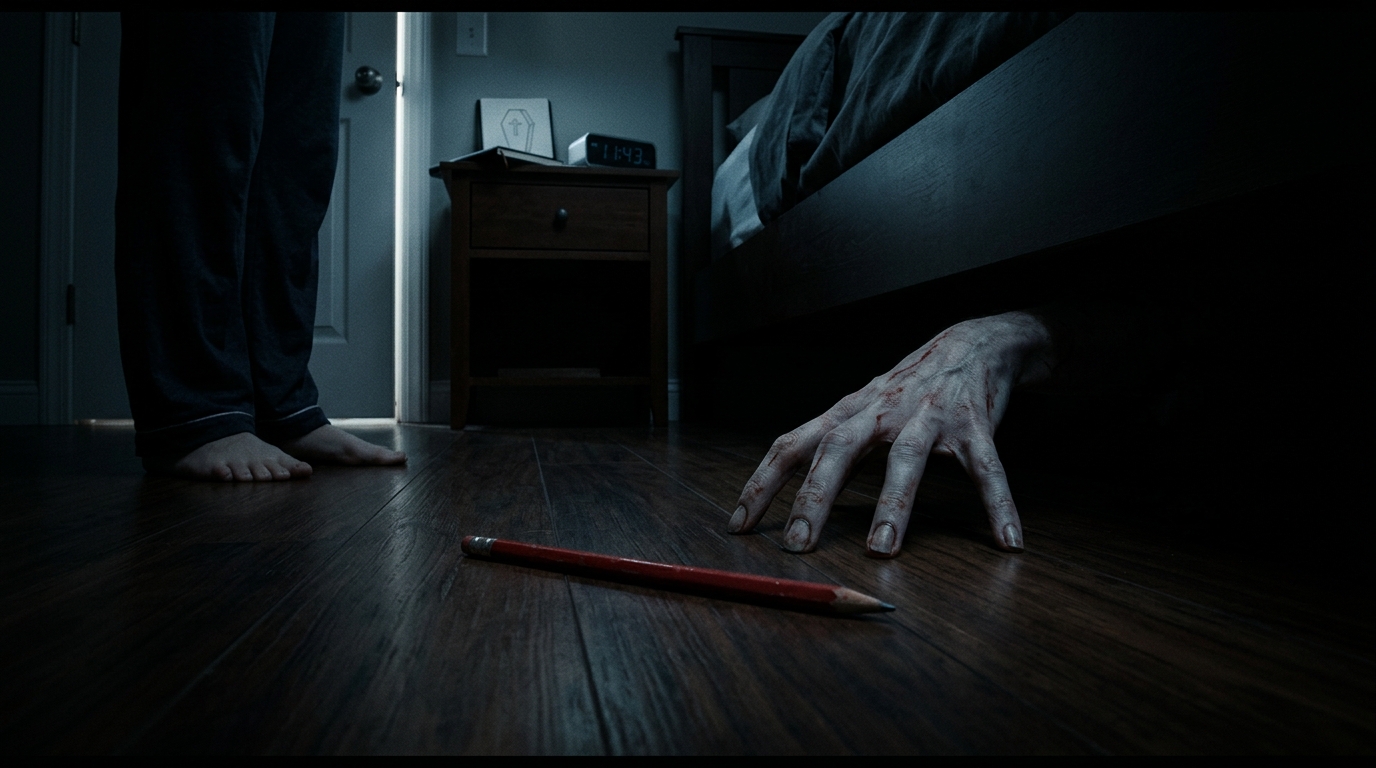
A hand slid out from beneath the desk.
Adult.
Pale.
Streaked with dark blood.
Fingers long and thin.
The nails cracked.
I fell backward so fast the notebook flew from my hands.
A scream tore out of me before I could stop it.
Liam covered his ears and sobbed.
“I told you!”
The hand remained there.
Half under the desk.
Half reaching into the light.
The fingers curled slowly against the tile floor.
Not random.
Not dead.
Searching.
The red pencil at my feet rolled toward it.
The hand caught the pencil.
My body stopped working.
No arm followed.
No person crawled out.
Only the hand.
It dragged the pencil across the floor with slow, deliberate strokes.
One line.
Then another.
Then a shape.
A rectangle.
A lid.
A body inside.
A coffin.
The hand was drawing me again.
The Woman Who Writes The Dates
I called the police from the hallway while Liam sat in the principal’s office wrapped in a blanket.
He kept whispering the same sentence.
“It wasn’t me.”
Over and over.
Like if he said it enough times, the adults might believe him before it was too late.
By the time officers arrived, the classroom was locked.
The desk was taped off.
The black notebook sat inside an evidence bag.
And the hand was gone.
Of course it was.
That was the first thing the police did not like.
The second was the drawing on the floor.
The coffin.
My coffin.
No date beneath it.
Just the shape.
Just the promise.
Detective Marlowe arrived near sunset.
He was older than the uniformed officers and quieter than the rest of them.
He did not laugh when I explained.
He did not call Liam imaginative.
He did not tell me grief, stress, or exhaustion could make people see things.
He only stared at the black notebook through the plastic bag and asked one question.
“Did the boy ever draw in red before?”
I swallowed.
“No.”
Marlowe’s jaw tightened.
“Then you need to come with me.”
“Where?”
He looked toward Liam through the office glass.
“To his house.”
Liam’s mother was waiting outside the school when we arrived.
Pale.
Nervous.
Too quick to answer every question.
She said Liam had nightmares.
She said he walked in his sleep.
She said the notebook was a phase.
She said children love attention.
But when Detective Marlowe asked about the house, she stopped talking.
The Vale house sat at the end of Briar Lane, behind dying hedges and a rusted iron fence.
Old.
Tall.
Too many windows.
The kind of house that looked like it remembered every person who had ever been afraid inside it.
Marlowe showed me an old file on his phone before we went in.
A newspaper clipping.
Twenty-three years earlier, the house had belonged to an artist named Julian Crane.
Portrait painter.
Local celebrity.
Respected.
Brilliant.
Beloved.
Then police found twelve bodies buried beneath his studio.
Each victim had been drawn before death.
Each portrait had a date beneath it.
My stomach went cold.
“What happened to him?”
Marlowe looked at the house.
“He was killed before trial.”
“How?”
“Someone cut off his right hand.”
I could barely breathe.
“Was it found?”
Marlowe did not answer.
He didn’t need to.
The Artist’s Room
Liam’s mother cried when police opened the basement studio.
Not loudly.
Not from shock.
From relief.
Like she had spent years pretending the door did not exist and was grateful someone else finally touched the handle.
The studio was hidden behind shelves of old paint cans and broken furniture.
A narrow room beneath the house.
No windows.
Brick walls.
A single chair in the center.
The floor was stained with old paint.
At least, I hoped it was paint.
Portraits covered one entire wall.
Not recent ones.
Old ones.
Faces drawn in charcoal and red pencil.
Men.
Women.
Children.
All with dates beneath them.
Some names were written in the corner.
Some faces had been scratched out violently.
Marlowe’s flashlight stopped on the final row.
My breath caught.
The drawings there were new.
Mrs. Calder.
Mr. Collins.
Mrs. Hart.
Emma.
Rachel.
Me.
Liam had not drawn these in class.
These were larger.
More detailed.
Older somehow.
As if the notebook was only a copy of something already decided in this room.
I stepped closer to my portrait.
In the notebook, my eyes had been closed.
Here, they were open.
Wide.
Terrified.
Behind my drawn shoulder was a shadow shaped like a woman.
Marlowe whispered, “What the hell…”
Liam stood at the basement door behind us, trembling.
His mother tried to pull him away, but he shook her off.
“She makes me bring the book to school,” he whispered.
I turned.
“Who makes you?”
He pointed to the old wooden cabinet near the back wall.
“The hand lives there.”
A uniformed officer opened the cabinet.
Nothing inside but dust, broken frames, and a shallow wooden box.
Marlowe lifted the box carefully.
Inside was an old glove.
Leather.
Black.
Stiff with age.
And a strip of yellowed newspaper wrapped around something long and narrow.
The detective unfolded it.
His face went pale.
It was a police evidence photo.
Julian Crane’s severed hand.
Missing from the crime scene twenty-three years earlier.
On the back of the photograph, someone had written:
THE HAND FINISHES WHAT THE ARTIST STARTED.
The basement lights flickered.
Liam began to sob again.
Then the portraits on the wall shifted.
Not all of them.
Only mine.
My drawn eyes slowly closed.
No Date This Time
Police took Liam and his mother into protective custody that night.
They told me to stay with a friend.
They told me not to go home alone.
They told me the human mind sometimes attaches meaning to fear.
I nodded.
I thanked them.
Then I drove home alone anyway.
Because adults are stupid too.
We just call it independence.
My apartment felt wrong the moment I opened the door.
Nothing obvious.
No broken lock.
No open window.
No shadow standing in the hallway.
Just wrong.
The air smelled faintly of pencil shavings.
I turned on every light.
Living room.
Kitchen.
Bedroom.
Bathroom.
Then I checked beneath the bed like a child.
Nothing.
At 11:43 p.m., someone slid a piece of paper under my front door.
I was standing ten feet away when it happened.
No knock.
No footsteps outside.
Just a slow white rectangle slipping across the floor.
My body went cold.
I walked toward it carefully.
The paper was thick.
Textured.
Artist’s paper.
I turned it over.
My portrait.
Again.
But different this time.
No date.
No word.
No red pencil beneath my face.
Just me lying inside a coffin.
Hands folded.
Eyes closed.
Flowers around my body.
A black notebook resting on my chest.
I could not move.
Then something scratched softly against the other side of my apartment door.
Once.
Twice.
Three times.
Like fingernails dragging across wood.
My phone buzzed violently in my hand.
Unknown number.
I answered without thinking.
For a moment, there was only breathing.
Then Liam whispered:
“Ms. Avery?”
My throat tightened.
“Liam?”
He was crying.
“She says dates were warnings.”
The scratching at the door stopped.
Cold spread across my skin.
“What does that mean?”
Liam’s voice dropped lower.
Almost too quiet to hear.
“If there’s no date…”
The hallway light outside my apartment flickered.
I stared at the coffin drawing in my hand.
“Liam?”
He began sobbing harder.
“If there’s no date, it means she’s already inside.”
The call cut off.
Behind me, from inside my dark bedroom, a red pencil rolled slowly across the floor.
Leave a Reply