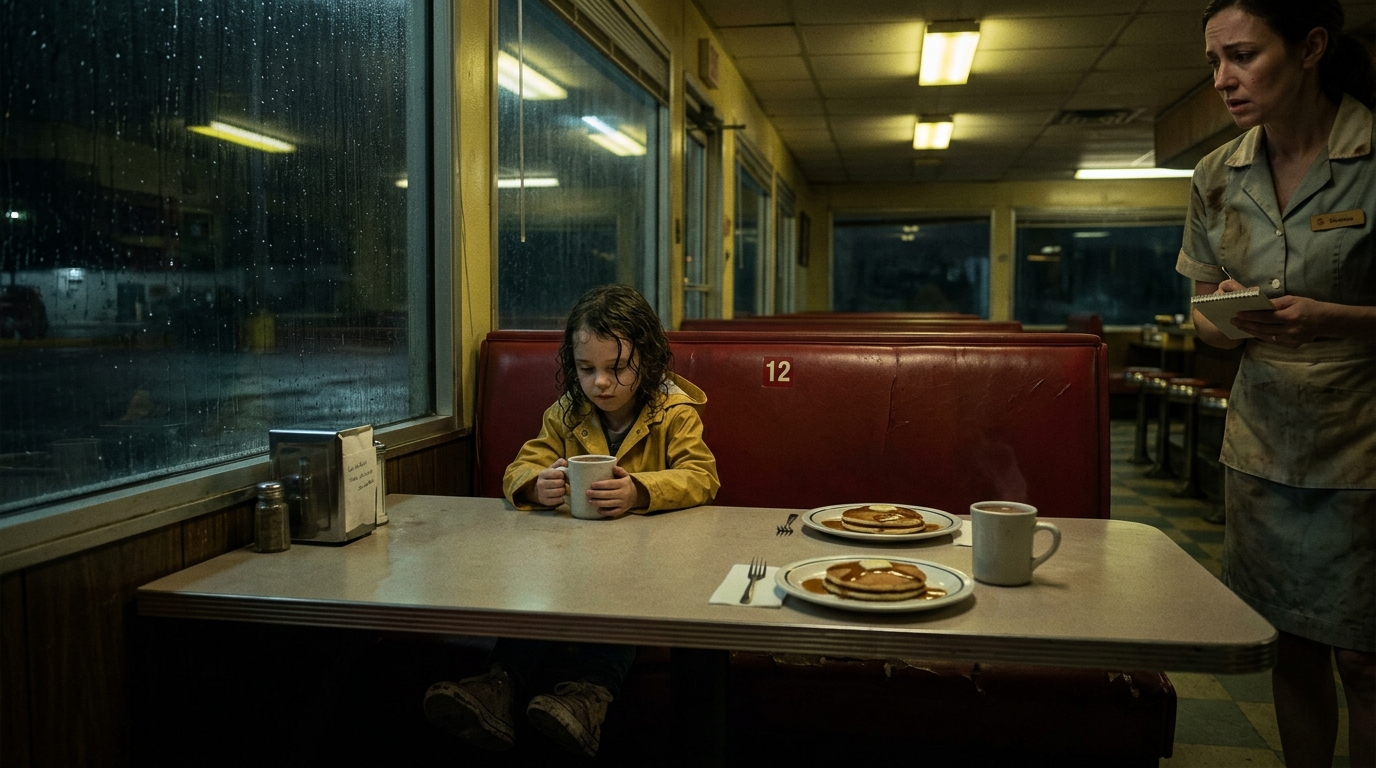
Table Number 12
Night diners fall into two categories.
The lonely.
And the dangerous.
After midnight, it becomes hard to tell which is which.
I learned that during my second year working at Moonlight Diner, a twenty-four-hour restaurant sitting beside the highway outside Grayford City.
Truckers.
Drunks.
Runaways.
People avoiding home.
By 11 p.m., everyone carried secrets heavier than their wallets.
The diner lights buzzed softly overhead while rain blurred the windows silver. Old music drifted from the kitchen radio. Coffee burned slowly on the warmer beside the register.
Routine.
Predictable.
Until the little girl started coming.
The first night, I thought someone abandoned her.
She walked into the diner at exactly 11:03 p.m. wearing a yellow raincoat too big for her tiny body. Wet curls stuck against her cheeks. Mud covered the bottoms of her shoes.
Eight years old.
Maybe younger.
No adult beside her.
No car outside.
She walked straight to booth number 12 near the back corner beneath the broken neon clock.
Then she sat down and waited.
Not nervous.
Not scared.
Like she had done it many times before.
I grabbed a menu immediately.
“Hey, sweetheart,” I said gently. “Are your parents coming?”
She shook her head once.
“Just my mom.”
I glanced toward the windows.
Empty parking lot.
Rain.
No headlights.
No movement.
The little girl smiled politely.
“Can we order now?”
We.
Something about that word made me uneasy immediately.
But children say strange things all the time.
I handed her the menu anyway.
“What would you like?”
She looked down seriously.
Then pointed at the pancakes.
“One for me.”
Her finger moved lower.
“And one for my mommy.”
I looked at the empty seat across from her.
Nobody there.
My stomach tightened slightly.
“Your mom’s still coming?”
The girl nodded.
“She’s already here.”
Cold moved slowly through my chest.
I forced a smile.
“Okay.”
I wrote two pancake orders.
And tried not to look at the empty seat while walking away.
The Chair Across From Her
The second night, she returned at exactly 11:03 again.
Same yellow raincoat.
Same muddy shoes.
Same booth.
Table 12.
Two meals.
One for her.
One for her mother.
Always pancakes.
Always hot chocolate.
Two cups.
Never one.
I asked the kitchen staff if they recognized her.
Nobody did.
That disturbed me.
Small towns notice unattended children.
Especially at night.
But every customer who entered after midnight seemed strangely uninterested in the girl.
Truckers walked past her booth without looking.
Customers avoided table 12 automatically.
Like instinct pushed their eyes away before curiosity could settle.
By the fourth night, I stopped asking if her mother was coming.
The little girl always thanked me politely before eating.
But she never touched the second plate.
The food sat untouched across from her until exactly midnight.
Then she whispered softly toward the empty chair:
“We have to go now.”
Every night.
Same words.
Same time.
Then she left.
Alone.
I tried following her once.
The moment she stepped outside, the diner lights flickered violently.
By the time I reached the parking lot, she was gone.
No footprints.
No car.
Nothing.
Just rain.
That was when I started noticing the smell.
Wet earth.
Rotting leaves.
Every time she entered the diner, the air changed slightly around booth 12.
Not enough for customers to complain.
Enough for me to notice.
And sometimes—
Only sometimes—
The empty seat across from her creaked softly like someone shifting weight.
The Little Girl At 11:03
A week later, I finally asked her name.
“Lily,” she answered while stirring whipped cream into her hot chocolate.
Her voice sounded older than her face.
Not deeper.
Tired.
Children should not sound tired.
“And your mom?”
Lily smiled faintly.
“She doesn’t like strangers.”
My eyes drifted toward the untouched pancakes across from her.
Steam still rose slowly from the plate.
I swallowed hard.
“What’s your mom’s name?”
Lily stopped stirring.
For one second, the diner became very quiet.
Too quiet.
Even the kitchen radio crackled into static.
Then Lily whispered:
“She changes names now.”
A chill crawled up my arms.
“What does that mean?”
Lily looked toward the rain-dark windows.
“She says bad people still look for her.”
The neon clock above booth 12 flickered.
11:41 p.m.
Outside, thunder rolled low across the highway.
I stared at the empty seat again.
Something about the shadows beneath the table looked wrong.
Too dark.
Too deep.
Like the light avoided reaching under there.
Lily suddenly looked back at me.
“You’re nicer than the last waitress.”
My stomach tightened.
“There was another waitress?”
“She asked too many questions.”
The way Lily said it made my skin go cold instantly.
“What happened to her?”
Lily shrugged.
“Mom didn’t trust her.”
A coffee mug shattered in the kitchen suddenly.
I jumped violently.
Cooks shouted.
Normal noise returned to the diner.
But booth 12 still felt isolated from the rest of the room somehow.
Like the air around it belonged somewhere else.
I forced myself to smile again.
“You shouldn’t be out this late, Lily.”
“She doesn’t like being alone underground.”
Every nerve in my body locked.
“What?”
Lily took a bite of pancake calmly.
Then pointed toward the empty seat.
“She gets scared in small places.”
My mouth went dry.
“Lily… where is your mother?”
The little girl stopped chewing slowly.
Then looked directly at me.
Not playful.
Not smiling.
Completely serious.
And whispered:
“She’s under the table.”
The Thing Beneath Booth 12
Every muscle in my body froze.
The diner lights buzzed softly overhead.
Rain tapped against the windows.
A truck passed outside spraying water across the highway.
Normal sounds.
Normal world.
But booth 12 no longer felt connected to it.
I stared at Lily.
She stared back calmly.
Then she pointed again.
Under the table.
My pulse hammered violently.
“Lily,” I whispered carefully, “that’s not funny.”
“She doesn’t like loud voices.”
The empty chair creaked softly.
Not imagination.
Movement.
Tiny.
Real.
Cold spread slowly through my stomach.
I looked around the diner instinctively.
Nobody noticed us.
A couple argued quietly near the counter.
Truckers drank coffee beneath flickering televisions.
The cook cursed inside the kitchen.
Life continued normally while something impossible waited beneath booth 12.
Lily leaned closer.
“She says you remind her of her sister.”
Every hair on my body rose.
“What?”
“She says her sister never stopped looking for her.”
The smell hit me harder suddenly.
Wet soil.
Mud.
And something underneath it—
Decay.
I took one slow step backward.
The shadows beneath the table shifted.
My breath stopped instantly.
Something moved under there.
Not quickly.
Slowly.
Like a body adjusting position in a cramped space.
The diner lights flickered once.
Lily looked downward beneath the tablecloth.
Then nodded gently.
“She wants to know if you still believe missing people are dead.”
Ice flooded my chest.
Because three years earlier, a local woman disappeared from Grayford County after stopping at a roadside diner during heavy rain.
The story stayed everywhere for months.
Missing posters.
Search teams.
Police interviews.
I remembered the case because the woman vanished less than five miles from Moonlight Diner.
And because they never found her body.
The missing woman’s name was Hannah Vale.
I still remembered her photograph from the news.
Dark hair.
Green eyes.
Small scar near her chin.
Lily slowly pushed a folded napkin across the table toward me.
My fingers trembled as I picked it up.
Written across the paper in shaky handwriting were four words.
SHE IS STILL UNDERGROUND.
The empty chair creaked again.
Longer this time.
Then—
Something pale slid slowly out from beneath the edge of the tablecloth.
A woman’s hand.
Mud-covered fingers.
Wedding ring still attached.
And from underneath booth 12, a woman’s voice whispered softly:
“Did they finally send you?”
Leave a Reply