The Drawing On The Classroom Wall
Rain always made children louder.
That morning, the classroom sounded like thirty tiny storms trapped inside one building.
Backpacks hit the floor.
Chairs scraped.
Crayons rolled beneath desks.
Wet shoes squeaked across old tile while gray morning light pressed against the classroom windows.
I stood near the whiteboard holding a stack of drawing paper against my chest, trying to smile through the exhaustion sitting behind my eyes.
“Today,” I told the class, “we’re drawing our families.”
Groans.
Laughter.
One little girl immediately asked if dogs counted as brothers.
Another boy wanted to know if he could draw his Xbox.
Normal.
Comforting.
Children are easiest to love when they are noisy.
It is the quiet ones who stay with you afterward.
Noah Mercer sat alone near the back corner beside the rain-streaked window.
Seven years old.
Thin shoulders.
Dark hair always falling into his eyes.
The kind of child who apologized before speaking, even when he had done nothing wrong.
He rarely played with the others.
Rarely smiled.
And never drew the same thing twice.
Except windows.
Windows appeared in almost every picture he made.
Sometimes open.
Sometimes burning.
Sometimes boarded shut.
Our school counselor once suggested trauma.
His father suggested imagination.
Only one of them looked worried when saying it.
I walked between the desks while the children colored.
Bright stick figures.
Mothers with giant smiles.
Cats larger than houses.
Messy sunshine in yellow spirals.
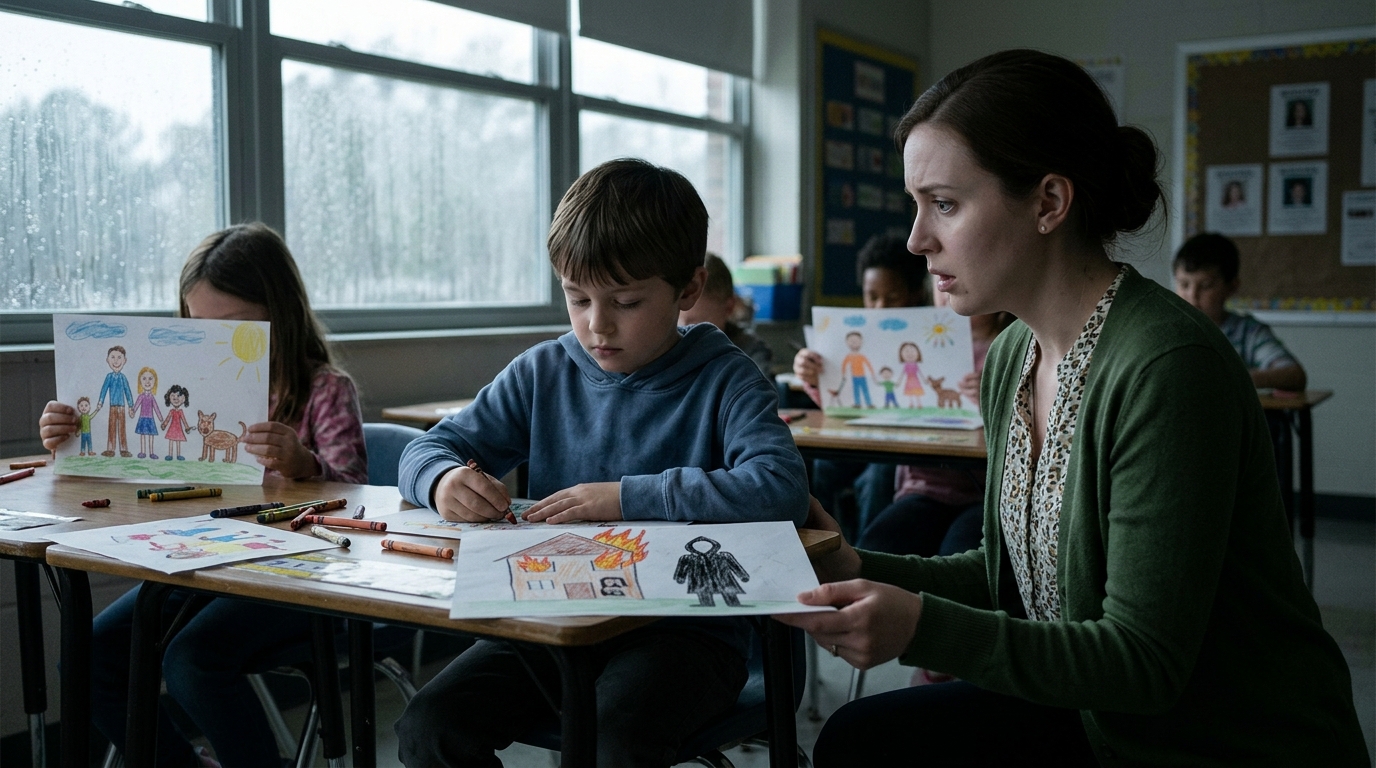
Then I reached Noah’s desk.
And forgot how to breathe.
The Woman In The Burning House
The picture covered the entire page in heavy black crayon.
A house.
On fire.
Orange flames climbed through shattered windows while dark smoke swallowed the roof.
In front of the house stood a man wearing a long black raincoat.
No face.
Just darkness where the features should have been.
And behind the upstairs window—
A woman.
Pale skin.
Dark hair.
Both hands pressed against the glass.
My knees nearly gave out.
Because I knew her.
Not maybe.
Not vaguely.
Knew.
The curve of the mouth.
The mole beneath the left eye.
The silver necklace hanging at her throat.
I had stared at those details in photographs for seven years.
Seven years of missing-person posters.
Seven years of police reports.
Seven years of my mother crying in grocery store parking lots because she thought she saw her daughter in strangers.
The woman in Noah’s drawing was my sister.
Lena.
My older sister vanished seven years earlier after leaving work during a thunderstorm.
Her car was found near the river.
Door open.
Phone still inside.
No body.
No witnesses.
No answers.
Just gone.
And now a seven-year-old boy was drawing her trapped inside a burning house.
My fingers tightened around the edge of his desk.
“Noah…”
He kept coloring calmly.
Red over the windows now.
More fire.
“Who is this?”
He looked up at me slowly.
Not confused.
Not nervous.
Like he had been waiting for me to ask.
“My family,” he said softly.
I pointed toward the woman in the window.
“This woman.”
He stared at the drawing for a moment.
Then shrugged.
“She watches me sleep sometimes.”
The classroom noise disappeared around me.
Not literally.
But my mind stopped hearing it.
“What did you say?”
“She stands outside my window.” Noah switched crayons. “Mostly when it rains.”
Cold spread slowly through my chest.
The other children kept laughing.
Kept drawing.
Kept existing inside a normal morning while something impossible opened quietly beside us.
I crouched beside his desk.
“Noah,” I whispered carefully, “where did you see her?”
He colored the flames darker.
“At my house.”
My mouth went dry.
“When?”
“Every night.”
Every night.
I looked at the drawing again.
The burning house.
The black raincoat.
My sister behind glass.
Then Noah added something new to the picture.
A small figure beside the house.
A child.
Standing in the rain.
Watching.
Watching the woman trapped upstairs.
Watching the man in black.
Watching the fire.
I swallowed hard.
“Who’s that?”
Noah looked at me.
“That’s me.”
Don’t Tell Dad
I should have called the principal immediately.
Or the counselor.
Or someone trained for situations where children casually describe dead women standing outside bedroom windows.
Instead, I kept asking questions.
That was my mistake.
Or maybe it saved my life.
I still don’t know.
“Noah,” I said softly, “did someone tell you to draw this?”
He shook his head.
“Did your dad?”
Another shake.
Children nearby were beginning to notice my voice changing.
One little girl stopped coloring and stared at us openly.
I lowered my tone.
“Then how do you know this woman?”
Noah looked toward the classroom window.
Rainwater slid slowly down the glass behind him.
“She talks to me.”
Every nerve in my body tightened.
“What does she say?”
He thought about it seriously.
Like repeating instructions.
“She says the fire was not an accident.”
My vision blurred for a second.
Because that sentence mattered.
The police never released that detail publicly.
Officially, my sister disappeared.
Unofficially—
There had been fire damage inside the abandoned riverside house where investigators believed she was last seen.
Only immediate family knew.
And one detective who retired three years ago after drinking himself nearly blind.
I stared at Noah.
He was seven.
He had never met my sister.
He should not know anything about fire.
The crayon in his hand snapped suddenly.
The sound made me jump.
Noah looked down at the broken black crayon.
Then whispered quietly:
“She told me not to tell my dad.”
My pulse stopped.
“What?”
His eyes lifted slowly toward mine.
“She gets scared when he comes home.”
The classroom suddenly felt too small.
Too warm.
Too loud.
I forced myself to breathe.
“Noah… why would she be scared of your father?”
He looked confused by the question.
“Because he wears the black coat.”
A cold wave rolled through my stomach.
I looked down at the drawing again.
The faceless man standing outside the burning house.
Long black raincoat.
Hands in pockets.
Watching the flames.
Watching the woman in the window.
My mouth went dry.
“Noah,” I whispered, “where is your father right now?”
He pointed toward the classroom door.
I turned slowly.
And saw him standing outside the glass window of the classroom.
Black raincoat.
Rain dripping from the shoulders.
Watching us.
The Father Outside The Classroom
For one second, I forgot how to move.
The hallway behind him was empty except for pale fluorescent lights reflecting against wet tile.
Parents usually smiled when picking up children.
Or waved awkwardly through the classroom glass.
Noah’s father just stood there.
Still.
Watching.
His hood was lowered enough for me to see dark hair damp against his forehead. Late thirties, maybe early forties. Sharp jaw. Gray eyes.
Too calm.
That was the first thing I noticed.
People carrying umbrellas in storms usually looked irritated.
Cold.
Rushed.
He looked patient.
Like a man who had been waiting a long time for something to happen.
And now it had.
The moment our eyes met, he smiled politely.
Exactly polite enough.
A normal father.
A normal man.
A normal rainy morning.
Except my heart was beating so hard I could barely hear the classroom anymore.
Noah continued coloring quietly beside me.
The black raincoat in the drawing grew darker beneath his crayon.
“Ms. Holloway?”
One of the girls tugged my sleeve.
“Can I use glitter?”
I looked at her blankly.
“What?”
“Glitter.”
Normal.
Everything around me stayed horribly normal.
I stood slowly from Noah’s desk.
Outside the glass, his father lifted one hand in greeting.
A tiny gesture.
Friendly.
My stomach twisted.
Because my sister used to do the same thing.
Small wave.
Two fingers slightly bent.
I had not remembered that in years.
Then Noah spoke behind me.
“She said you would recognize him.”
Every muscle in my body locked.
I turned toward him.
“What?”
Noah looked up from the drawing calmly.
“The window lady.”
The room suddenly felt too bright.
“What did she say exactly?”
He frowned, trying to remember.
“She said…” He paused. “She said the teacher would know the man in the rain.”
My blood went cold.
Because seven years earlier, the detective handling Lena’s case showed me one blurry security image from a gas station camera near the river.
One image.
One man standing beside Lena’s car during heavy rain.
Black coat.
No clear face.
Just gray eyes reflecting light.
The police never identified him.
I never forgot him.
Outside the classroom, Noah’s father tapped lightly on the glass.
Tap.
Tap.
Tap.
Three slow knocks.
The exact same way Lena used to knock on my bedroom door when we were kids.
Not loud.
Not rushed.
A private signal between sisters.
My knees weakened.
No.
No no no.
That was impossible.
The man outside smiled again.
Then pointed toward Noah’s drawing.
Not angrily.
Not confused.
Knowingly.
My throat tightened.
He knew what Noah drew.
Maybe he encouraged it.
Maybe he feared it.
I could not tell which possibility terrified me more.
The classroom bell rang sharply overhead.
Children began jumping from their seats excitedly.
Lunch break.
Chairs scraped.
Backpacks zipped.
Noise exploded across the room again.
And through all of it, Noah’s father never stopped watching me.
The Missing Woman In The Picture
Parents began arriving at the classroom door one by one.
Umbrellas.
Wet coats.
Voices calling children’s names.
The ordinary rhythm of an ordinary school day.
I kept telling myself that.
Ordinary.
But my hands would not stop shaking.
Noah carefully placed his drawing inside a blue folder while the other children rushed toward the hallway.
I crouched beside him again.
“Noah,” I whispered, “has the window lady ever told you her name?”
He nodded once.
My pulse jumped.
“What is it?”
“Lena.”
The room tilted slightly.
Noah continued packing crayons into his bag.
“She said you call her Lena,” he added.
Not “called.”
Call.
Present tense.
My vision blurred.
“Did your father ever talk about her?”
“No.”
“Did he ever show you photos?”
“No.”
“Then how do you know what she looks like?”
Noah looked genuinely confused now.
“Because I see her.”
A shadow fell across the desk.
I looked up.
Noah’s father stood inside the classroom doorway now.
Water dripped slowly from the hem of his black coat onto the tile floor.
Close up, he looked even more familiar.
Not because I knew him.
Because grief did.
There are certain faces that carry old secrets badly.
People who smile while their eyes keep checking exits.
People who stand too still when hearing certain names.
People who spend years pretending not to recognize fear.
“Ms. Holloway,” he said warmly. “Sorry if Noah caused trouble.”
His voice was calm.
Educated.
Controlled.
Noah zipped his backpack without looking at him.
I stood carefully.
“No trouble.”
The father smiled slightly.
“Noah has a vivid imagination.”
My throat tightened at those words.
Exactly what he would say if he already practiced saying them.
His eyes drifted toward the drawing folder in Noah’s hands.
Just for a second.
But I saw it.
Fear.
Real fear.
Not of me.
Of the picture.
Of what the child remembered.
Or repeated.
Or witnessed.
“I’m Daniel Mercer,” he said, extending one hand.
Mercer.
The name struck something inside me instantly.
Not memory.
Recognition.
I had heard it before.
Somewhere connected to Lena’s case.
Something buried beneath years of police interviews and sleepless nights.
I shook his hand automatically.
Cold skin.
Rainwater.
Steady grip.
Then Noah spoke quietly beside us.
“The fire wasn’t supposed to start that fast.”
Daniel’s hand tightened around mine.
Hard.
Too hard.
His smile stayed exactly the same.
But his eyes changed.
Only for a second.
Enough.
“Excuse me?” I whispered.
Noah looked up innocently.
“The window lady told me.”
Silence.
Daniel released my hand slowly.
“Kids say strange things,” he said softly.
But he was no longer looking at me.
He was looking at Noah.
And for the first time since entering the classroom, his son looked afraid of him.
The Drawing Hidden Under The Desk
Daniel guided Noah gently toward the hallway.
Too gently.
Like a man aware people were watching.
Before leaving, he paused beside me one last time.
“If Noah says anything upsetting,” he said quietly, “please understand he has difficulty separating dreams from reality.”
I forced myself to nod.
Then he leaned slightly closer.
Close enough that only I could hear him over the children’s noise.
“Some missing people disappear because they want to.”
My blood froze.
He smiled politely again.
Then left with Noah.
I stood motionless in the middle of the classroom while rain hammered the windows harder outside.
The detective once told me something similar after the case went cold.
Sometimes adults leave voluntarily.
Sometimes families invent mysteries because the truth hurts less than abandonment.
I hated him for saying it then.
I hated hearing it now.
The classroom slowly emptied.
Children disappeared into rainy hallways with parents and umbrellas and ordinary lives.
But Noah’s desk remained near the back window.
Something underneath it caught my eye.
A folded piece of paper.
I walked over slowly and picked it up.
Another drawing.
Smaller.
Different from the burning house.
This one showed a dark basement room.
A woman sitting in the corner.
Long dark hair.
Pale face.
My sister.
Again.
Above her, drawn in shaky black crayon, were five words.
SHE SAYS HE CHANGED HIS NAME.
My heart stopped.
Beneath the drawing, Noah had written something else in uneven child handwriting.
He keeps her downstairs.
I heard footsteps behind me.
I spun around.
Nobody there.
The hallway outside the classroom stood empty now.
Except for rainwater trailing across the floor from Daniel Mercer’s boots.
And beside Noah’s forgotten chair sat one final drawing I had not noticed before.
A family portrait.
Noah.
His father.
And the woman from the window.
Not dead.
Not burned.
Alive.
Standing between them.
Smiling.
But across her throat, Noah had drawn a thick black line.
Then, at the bottom of the page, one sentence circled over and over again until the paper nearly tore:
HE IS NOT MY REAL DAD.
Leave a Reply