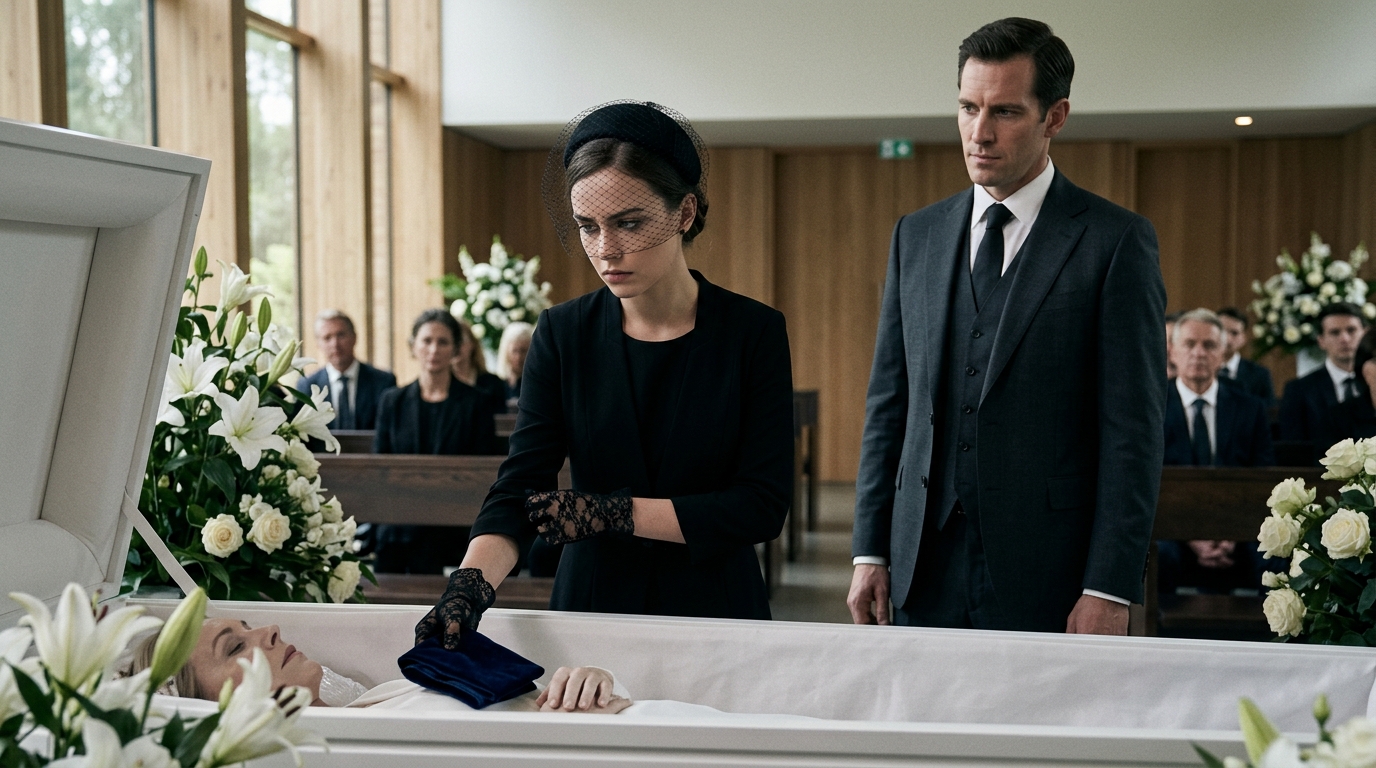
The Funeral With No Real Tears
The first thing I noticed about the funeral was the silence.
Not grief.
Not mourning.
Silence.
The kind that feels rehearsed.
Rain hammered softly against the windows of the funeral home while candles flickered along the walls in uneven lines of gold. The chapel smelled of lilies, wet wool coats, and expensive perfume trying too hard to hide something rotten underneath.
At the center of the room sat a white coffin surrounded by flowers.
Too many flowers.
Rich people always use too many flowers when they want death to look beautiful.
I stood near the back with six strangers dressed in black.
None of us knew the dead woman.
That was the job.
Cry.
Lower your head.
Hold tissues.
Make the room feel loved.
I had been doing funeral work for almost a year by then.
Not because I enjoyed it.
Because grief pays strangely well when rich people are afraid of empty seats.
Some families hire musicians.
Some hire priests.
Some hire fake mourners because silence terrifies them more than death.
The woman who booked us had called three nights earlier.
Private funeral.
Cash payment.
No questions.
The instructions were simple.
Cry often.
Do not speak to the family.
Do not approach the coffin.
Especially do not approach the husband.
That last rule stayed with me.
People only create rules around the things they fear.
I adjusted the sleeves of my black dress and looked toward the front row.
That was where I saw Adrian Vale for the first time.
He stood beside the coffin with one hand resting lightly against the polished wood.
Tall.
Perfect posture.
Dark charcoal suit.
Silver cufflinks.
A wedding ring that caught candlelight every time he moved his fingers.
His wife’s body was six inches away from him.
But his face looked like he was waiting for a business meeting to end.
No tears.
No shaking hands.
No grief.
Just patience.
The priest spoke softly about tragedy.
About love.
About devotion.
Adrian nodded at the right moments.
Too perfectly.
Like a man performing sadness from memory instead of feeling it.
I should have looked away.
I did not.
Maybe because my own father cried harder over dead stray cats than this man did over his wife.
Maybe because rich men with calm faces always make me nervous.
Or maybe because the dead woman looked wrong.
Even from across the room, I could tell something about her body felt unfinished.
Not damaged.
Not peaceful either.
Unfinished.
Like she had been interrupted in the middle of trying to say something.
The Woman In The Coffin
Her name was Elena Vale.
Thirty-four years old.
Philanthropist.
Art collector.
Founder of a children’s foundation.
That was what the funeral pamphlet said.
The photograph beside the coffin showed a woman with dark hair, pale skin, and eyes too intelligent for the smile she wore.
Not beautiful in the soft, harmless way magazines like.
Beautiful in the dangerous way people become when they notice everything.
The kind of woman who made other people uncomfortable by remaining quiet too long.
I stared at the photo while the priest continued speaking.
Then I looked at Adrian again.
He never once looked at the photograph.
Only the guests.
Watching them.
Counting them.
A young server passed through the chapel carrying silver trays of champagne no one touched.
Candles flickered harder every time thunder rolled outside.
The funeral home lights dimmed briefly.
And for one second, I thought I saw Elena’s eyes open inside the coffin.
I froze.
The room returned to normal immediately.
The dead woman lay still beneath white silk.
My heart kept racing anyway.
Beside me, another hired mourner whispered, “You okay?”
I nodded too quickly.
“Just tired.”
That was a lie.
I was unsettled.
There is a difference.
The funeral director approached our row quietly.
“More emotion,” he whispered.
I almost laughed.
More emotion.
As if grief were stage lighting that needed adjustment.
The woman beside me sniffled louder on command.
Another man lowered his head dramatically.
I pressed tissue against my eyes and forced myself to move closer to the coffin.
The closer I got, the colder the room became.
Not temperature.
Something else.
Pressure.
Like the air near Elena Vale carried weight.
Candles reflected against the polished coffin lid.
Rain slid down the chapel windows in silver streaks.
Adrian finally looked directly at me.
His eyes were gray.
Not soft gray.
Storm gray.
Sharp enough to cut through makeup and fake tears and see exactly what a person was pretending to be.
For one terrible second, I thought he somehow knew I did not belong there.
Then he smiled politely.
That scared me more.
Because cruel men are easy to survive once you recognize them.
Polite men take longer.
The Blue Cloth
The priest announced the final viewing.
Guests rose slowly from the pews.
Some approached the coffin genuinely crying.
Others looked relieved the ceremony was almost over.
I moved with the crowd, head lowered, tissue against my face, pretending to mourn a woman whose laugh I had never heard.
That was when I saw her hand.
Elena’s right hand rested against the white lining inside the coffin.
Pale fingers.
Wedding ring still in place.
Nails painted soft ivory.
Beautiful.
Carefully arranged.
Except for one thing.
Something blue was trapped between her fingers.
At first, I thought it was ribbon.
Then I realized she was gripping it.
Not tightly.
But intentionally.
A small strip of dark blue fabric no bigger than two fingers wide.
My pulse quickened.
People hide things with dead bodies sometimes.
Notes.
Jewelry.
Letters.
But dead people do not usually hide things themselves.
I looked toward Adrian.
He was speaking quietly with an older woman near the front row.
Not watching the coffin.
Not watching me.
The funeral director moved toward another family.
Nobody was paying attention.
I should have stepped away.
Instead, I leaned closer to the coffin and lowered my head like I was overcome with grief.
My tears fell onto the white silk lining.
Fake tears.
Real fear.
I whispered, “I’m sorry.”
I do not know why I said that.
Maybe because suddenly the dead woman felt less dead and more trapped.
My fingers brushed against her hand.
Cold.
Too cold.
I slid the fabric gently free from her fingers.
The movement was tiny.
Barely noticeable.
But the moment the cloth left Elena’s hand, the chapel lights flickered again.
Harder this time.
The candles trembled.
One went out completely.
A woman near the back gasped.
I hid the blue cloth inside my sleeve immediately.
Then I looked up.
Adrian was staring directly at me.
Not at the coffin.
Not at the mourners.
Me.
His expression did not change.
But his eyes had.
They no longer looked polite.
They looked calculating.
Like a man mentally rearranging a problem.
My stomach tightened.
I stepped backward slowly into the crowd.
The blue cloth burned against my wrist inside my sleeve.
The priest began the final prayer.
Thunder shook the windows.
And Adrian Vale never looked away from me again.
The Message Hidden In Her Hand
The burial did not happen immediately.
Storm flooding delayed transport to the cemetery, so guests gathered in the reception hall beside the chapel while staff prepared the hearse.
That gave me ten minutes alone.
Ten minutes too many.
I locked myself inside the women’s restroom and pulled the blue cloth from my sleeve.
It was darker than I thought.
Not ribbon.
Fabric torn from clothing.
Expensive fabric.
Maybe silk.
One edge had dried brown stains along the thread.
Blood.
My hands started shaking.
I unfolded the cloth carefully.
At first, I saw nothing.
Then the restroom light flickered overhead.
A line of embroidery caught the light.
Tiny silver stitching.
Words.
Not decorative.
A message.
HE IS NOT MY HUSBAND.
My breath stopped.
I read it again.
HE IS NOT MY HUSBAND.
Not “he killed me.”
Not “help.”
Not “run.”
Something stranger.
Something worse.
The man crying beside the coffin was not her husband.
Then who was he?
And why was he standing in a funeral pretending to be one?
A soft knock hit the restroom door.
I nearly dropped the cloth.
“Naya?”
A woman’s voice.
One of the hired mourners.
“You okay in there?”
“Yes.”
My voice cracked.
I shoved the fabric back into my sleeve and splashed cold water onto my face.
When I looked up at the mirror, my reflection seemed unfamiliar.
Pal er.
Sharper.
Like fear had adjusted my features while I was not looking.
I unlocked the restroom door and stepped back into the hallway.
The reception room beyond was filled with low conversations and the sound of glasses clinking softly.
No one looked grieving anymore.
That disturbed me most.
People stop performing sadness surprisingly quickly once food appears.
I moved toward the side exit.
I wanted air.
Distance.
A taxi.
Anything far from that building.
Then someone touched my elbow.
I froze.
Adrian Vale stood beside me.
Too close.
I had not heard him approach.
Up close, he smelled faintly of cedarwood and rainwater.
Not alcohol.
Not cigarettes.
Nothing messy.
Nothing human enough to comfort me.
His gaze dropped briefly toward my sleeve.
Then back to my face.
“You’re very convincing,” he said softly.
I forced a nervous smile.
“I’m sorry?”
“The crying.” His expression remained calm. “Most people overact.”
Thunder rolled outside.
The hallway lights dimmed again.
I tried to step away.
His fingers tightened slightly around my elbow.
Not enough to bruise.
Enough to remind me he could.
My pulse pounded in my throat.
“I should get back,” I whispered.
He tilted his head.
“You saw something.”
Not a question.
A statement.
I said nothing.
His eyes held mine for a long moment.
Then he leaned closer.
Close enough that only I could hear him.
“You touched something you shouldn’t have touched.”
Ice spread through my stomach.
He knew.
Of course he knew.
I tried pulling my arm free.
He let go immediately.
That frightened me more than if he had resisted.
Because it meant he was confident I was not leaving.
Behind him, guests continued drinking champagne beneath soft music and candlelight.
Nobody noticed us.
Nobody wanted to.
Adrian smiled gently.
The same perfect smile he used beside the coffin.
“Curiosity,” he whispered, “has ruined many women in this family.”
Family.
Not marriage.
Family.
Before I could answer, the funeral home lights went out completely.
Darkness swallowed the hallway.
Someone screamed in the reception room.
Glasses shattered.
Then, from inside the chapel where Elena’s coffin still rested, a woman’s voice whispered clearly through the dark.
“He buried the wrong wife.”
The lights came back on.
Everyone froze.
Adrian’s face had finally changed.
For the first time since I met him, he looked afraid.
And behind him, through the open chapel doors, Elena Vale’s coffin was empty.
Leave a Reply