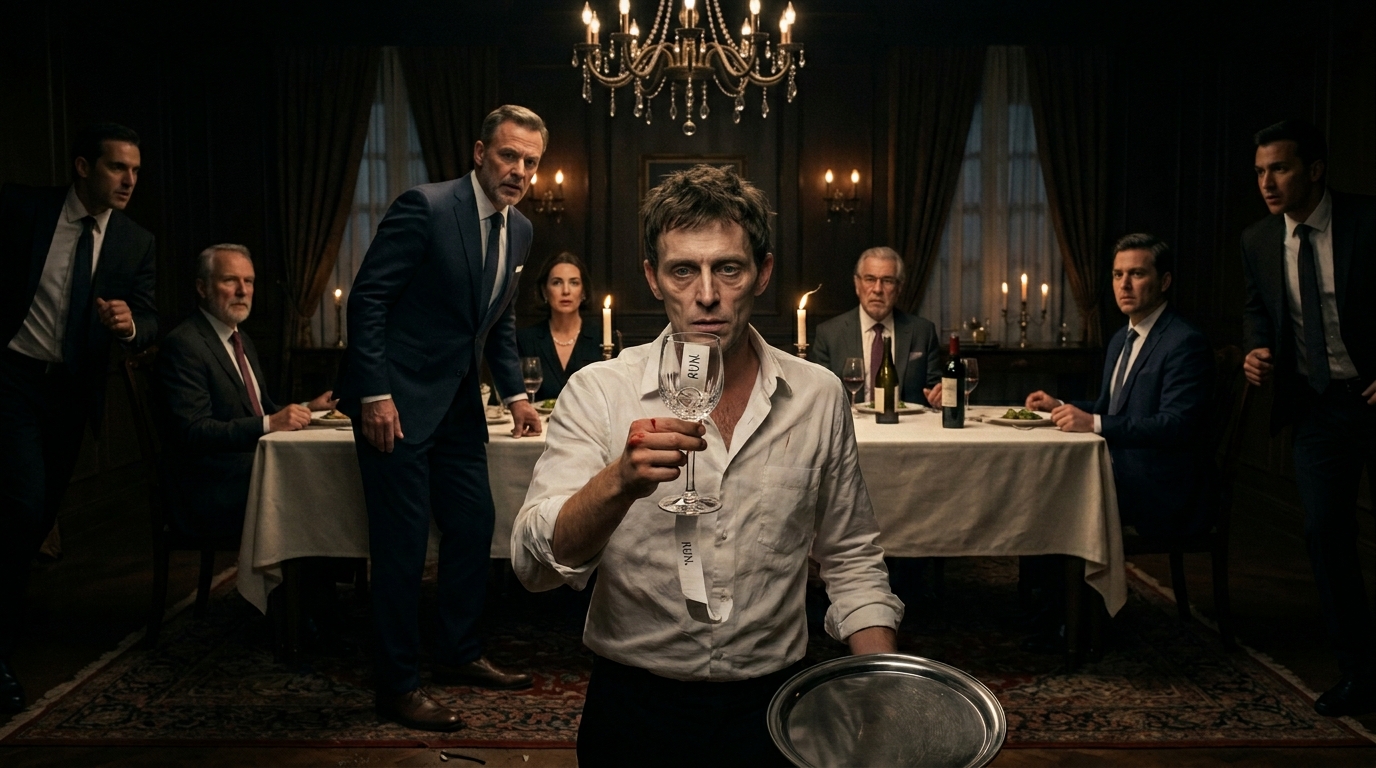
The Glass No One Was Allowed To Touch
The first rule they gave me that night was simple.
Do not speak unless spoken to.
The second rule was stranger.
Do not look too long at the guests.
The third rule made no sense at all.
Do not touch the crystal glass on table 7.
Not refill it.
Not move it.
Not polish it.
Not even if it fell.
Especially if it fell.
That was exactly what Mr. Arden told me in the staff corridor ten minutes before the private dinner began.
He stood in front of us in his black suit, hands clasped behind his back, silver hair combed so tightly it looked painted onto his skull.
Mr. Arden managed Maison Verre like it was not a restaurant.
Like it was a courtroom.
Or a church.
Or a place where people came to confess things before someone buried them.
“There are twenty-six guests tonight,” he said. “All private. All important. You will not ask for names. You will not repeat conversations. Phones stay in lockers. If anyone offers you money for information, you report it to me.”
The other servers nodded.
I nodded too.
I had only worked at Maison Verre for three weeks.
I needed the job.
My rent was late.
My younger sister still thought I was doing fine.
I was not.
So when Mr. Arden pointed toward the dining room and said, “You, Leo, will handle the west side,” I straightened my shoulders like I belonged there.
Then he looked directly at me.
“And table 7.”
Something in his voice changed.
Not louder.
Colder.
I glanced through the cracked staff door.
Table 7 sat in the center of the private dining room beneath a chandelier made from hundreds of thin glass drops. The table was round, dressed in white linen, set for one person only.
One plate.
One folded black napkin.
One knife.
One fork.
And one empty crystal glass.
Two security guards stood behind it.
Not near the entrance.
Not by the guests.
By the glass.
The glass was tall, thin, and perfectly clean. No wine. No water. No candle reflection inside it.
Empty.
But the guards watched it like something alive might crawl out.
I looked back at Mr. Arden.
“Who is sitting there?”
His eyes narrowed.
“No one.”
I laughed because I thought he was joking.
No one else laughed.
Mr. Arden stepped closer.
“Listen carefully. If a guest asks for the glass to be moved, you say you are not authorized. If the glass needs attention, you find me. If anything happens near table 7, you step away.”
“What kind of thing?”
His expression hardened.
“The kind that ends employment.”
I should have taken that seriously.
I did not.
At twenty-three, fear still felt like something adults used to control people beneath them.
By midnight, I understood fear differently.
Fear was not shouting.
Fear was not running.
Fear was a room full of powerful people going silent because a waiter touched an empty glass.
The Private Dinner
The dining room was built to make rich people feel eternal.
Dark green walls.
Gold-framed mirrors.
Marble fireplace.
Low amber lamps that made every face look softer than it deserved.
The air smelled of butter, truffle oil, old money, and lilies from the funeral-sized arrangement near the bar.
That bothered me.
Lilies did not belong at a dinner.
They belonged beside closed caskets.
The guests arrived between 8:15 and 8:40.
One by one.
Men in tailored suits.
Women in diamonds and black silk.
A judge whose face I recognized from the news.
A senator who smiled at no one.
A famous surgeon.
A hotel owner.
A woman with white gloves who never removed them, not even to drink.
They all knew each other.
They also all seemed to hate each other.
That was the first thing I noticed.
They laughed too late.
Smiled too briefly.
Watched one another when they thought no one else was looking.
And every single one of them glanced at table 7 when they entered.
Some only once.
Some could not stop.
No one sat there.
No one spoke to the guards.
No one asked about the empty glass.
I carried champagne along the west side of the room, lowering my eyes the way Mr. Arden instructed.
But I listened.
Servers always listen.
It is one of the few powers we have.
“After tonight, it ends.”
“It should have ended years ago.”
“She should never have kept records.”
“Careful.”
“No one can prove anything now.”
Those were the words I caught in pieces.
Not enough to understand.
Enough to feel the floor beneath the evening was not solid.
At 9:10, the last guest arrived.
He came through the side entrance, not the front.
Everyone stood.
Even the judge.
Even the senator.
Even Mr. Arden.
The man was older, perhaps sixty-five, but age had not made him smaller. He wore a black tuxedo with a white pocket square and a gold signet ring on his right hand.
His hair was thick and silver.
Not gray.
Silver.
The exact shade of moonlight on steel.
He smiled as if every person in the room had already forgiven him for something.
“Mr. Voss,” someone whispered.
Richard Voss.
Even I knew that name.
Real estate.
Hospitals.
Private banks.
Political donations.
The kind of man newspapers called influential because they were too polite to say untouchable.
Voss walked slowly to the head table near the fireplace.
Not table 7.
No one sat at table 7.
The empty glass remained beneath the chandelier, guarded and waiting.
Mr. Voss lifted his own glass, filled with red wine so dark it looked black.
The room settled.
Every conversation died.
He smiled.
“Friends,” he said, “tonight is not a celebration.”
A soft laugh moved through the room.
Nervous.
Obedient.
Voss continued.
“It is a closing.”
The chandelier light trembled in the crystal glass on table 7.
I do not know why I noticed that.
Maybe because the glass was empty, yet it seemed to catch more light than anything else in the room.
“Old stories have followed us too long,” Voss said. “Old mistakes. Old grief. Old names that should have been left where they belonged.”
The woman in white gloves looked down.
The judge closed his eyes.
At the far corner of the room, an elderly woman sat alone near the wall.
I had not noticed her before.
She wore a dark blue dress and a pearl brooch shaped like a bird. Her white hair was pinned at the back of her head. Her hands rested on the table in front of her, untouched by food or drink.
Unlike the others, she did not look at Voss.
She looked at table 7.
No.
Not the table.
The glass.
Her eyes were shining.
Voss raised his wine higher.
“Tonight,” he said, “every old secret will be buried.”
The guests lifted their glasses.
All except the elderly woman.
All except me.
And, of course, the empty glass on table 7.
Table 7
By 10 p.m., the room had grown louder.
Wine helped people lie more comfortably.
The guests laughed now, but too much. Their voices collided under the chandelier. Forks clicked against porcelain. The quartet in the corner played something soft and expensive that nobody listened to.
I moved between tables with practiced invisibility.
Wine.
Water.
Plates.
Napkins.
Smile.
Step back.
Disappear.
That was the rhythm.
Then a man at table 5 dropped his knife.
I bent to pick it up.
When I stood, I saw one of the guards beside table 7 watching me.
Not the guests.
Me.
His face had no expression.
But his hand rested near the inside of his jacket.
I looked away quickly.
“Careful,” another server whispered as I passed.
Her name was Nina. She had been there for four years and knew how to move through wealthy rooms like smoke.
“What is with that glass?” I whispered.
Her face changed.
“Don’t ask.”
“I’m serious.”
“So am I.”
She pushed past me with a tray of oysters.
I followed her into the service station.
“Nina.”
She turned.
Her voice dropped.
“The last waiter who touched table 7 was fired before dessert.”
“For touching a glass?”
“For asking why it was empty.”
My mouth went dry.
“What happened to him?”
She looked toward the dining room.
“His mother still calls the restaurant sometimes.”
Before I could ask what that meant, Mr. Arden appeared behind us.
“Nina. Table 3.”
She left at once.
Mr. Arden’s eyes settled on me.
“Leo.”
“Yes, sir.”
“You are watching too much.”
“I’m working.”
“You are wondering.”
I said nothing.
He stepped closer.
“That is more dangerous.”
For a moment, I thought he might send me home.
Instead, he adjusted the lapel of my jacket with slow, precise fingers.
“You are young,” he said quietly. “So you think secrets want to be found.”
I looked at him.
He smiled without warmth.
“They don’t. Secrets want witnesses to disappear.”
Then he walked away.
I stood there with a tray in my hands, suddenly aware of how far I was from the staff exit.
How thick the dining room doors were.
How many cameras watched the hallway.
I told myself again that I needed the job.
That rich people were dramatic.
That a glass was only a glass.
Another lie.
The Silver Hair
It happened because of a napkin.
A stupid white napkin.
I was clearing dessert plates from table 6 when the woman in white gloves turned suddenly and knocked the folded napkin from my tray.
It slipped from the edge.
Floated down.
And landed beside table 7.
Not on the table.
Near it.
Close enough that both guards looked down.
Close enough that Mr. Arden’s head turned sharply from across the room.
I froze.
The whole dining room seemed to tilt toward me.
The napkin lay on the carpet like a small white flag.
No one spoke.
I waited for one of the guards to pick it up.
They did not.
The woman in white gloves gave me a faint smile.
Not apologetic.
Interested.
Like she had dropped it on purpose.
I bent down slowly.
My fingers reached for the napkin.
That was when I saw inside the glass.
At first, I thought it was a crack.
A thin pale line caught against the bottom curve.
I leaned slightly closer.
Not much.
Just enough.
It was not a crack.
It was hair.
A single strand.
Silver.
Caught at the bottom of the empty crystal glass, stuck to the inside as if it had been placed there when the glass was still wet.
My breath caught.
The hair was the same color as Richard Voss’s.
The same color as the elderly woman’s.
The same color as the old photograph I had once seen in my mother’s bedroom drawer.
My hand stopped above the napkin.
I do not know why I thought of my mother then.
Maybe because she had worked in restaurants too.
Maybe because she had always hated rich dining rooms.
Maybe because she used to say, “If a table is empty, Leo, ask who they removed to make space.”
I had not understood her then.
She died before I was old enough to ask.
The elderly woman in the corner was looking at me.
Tears ran silently down her face.
She shook her head.
Slowly.
Once.
Twice.
Do not.
That was what her eyes said.
Do not touch it.
The room around me blurred.
The guards stood very still.
Mr. Arden was walking toward me.
Richard Voss had stopped speaking mid-sentence.
Everyone was watching now.
I should have picked up the napkin and stepped away.
I should have obeyed every warning I had been given.
But the silver hair at the bottom of the glass seemed to pull at something inside me.
A memory.
Not mine.
Or maybe mine before I knew how to hold it.
My mother crying at the kitchen table.
A newspaper folded in half.
The words private inquest.
A woman’s name crossed out in red pen.
My mother seeing me look and shutting the drawer too fast.
I picked up the napkin.
Then, with my other hand, I touched the glass.
A cold shock ran up my fingers.
Not because crystal is cold.
Because something inside me recognized it.
The glass made a small sound.
A high, thin ring.
Like a wet finger moving around the rim.
But no one had touched the rim.
Only me.
Only the base.
The entire restaurant fell silent.
The quartet stopped playing.
A fork slipped from someone’s hand and struck a plate.
The sound was enormous.
I lifted the glass.
The Room Stopped Breathing
Nobody moved.
Not the guards.
Not Mr. Arden.
Not Richard Voss.
The crystal glass was lighter than I expected.
Too light.
Almost delicate.
Inside the base, the silver hair curled like a tiny question mark.
I held it up without thinking.
The chandelier light passed through the glass and broke across the room in sharp pieces.
The guests stared at me.
Not angry.
Not confused.
Afraid.
That was worse.
I had seen wealthy people annoyed.
Impatient.
Cruel.
I had never seen them afraid of a waiter.
Richard Voss set his wine glass down.
Very carefully.
“Put that down,” he said.
His voice was calm.
Every word controlled.
I looked at him.
Then at the elderly woman.
She was standing now.
Her hands shook against the table.
“Leo,” she whispered.
My blood went cold.
I had not told her my name.
At least, I did not think I had.
Mr. Arden stepped in front of me.
“Give me the glass.”
His hand was out.
Palm up.
His voice was low.
“Now.”
I looked down at the silver hair.
Something was etched into the underside of the base.
Tiny letters.
Too small to see unless the glass was lifted toward the light.
I turned it slightly.
Mr. Arden’s eyes widened.
“Leo.”
But I had already seen it.
A name.
Not a brand.
Not a number.
A name engraved into the crystal.
Mara Vale.
My mouth went dry.
Vale.
The name meant nothing to most people.
But it meant something to me.
Because it was my mother’s maiden name.
Before she married my father.
Before she died.
Before every adult in my family stopped saying her sister’s name.
My mother had a sister.
I had only heard the name once.
In an argument between my parents when I was nine.
Mara.
My aunt.
The woman who “left.”
The woman whose photograph vanished from every album.
The woman my mother cried for in locked rooms.
I looked at the elderly woman.
She was crying openly now.
Richard Voss stood.
The guards stepped forward.
The guests moved back in their chairs as if distance could save them from whatever I had just touched.
“Who is Mara Vale?” I asked.
No one answered.
So I asked louder.
“Who is Mara Vale?”
A woman near the fireplace gasped.
Someone whispered, “God.”
Richard Voss’s face changed.
For the first time that night, the mask slipped.
Not much.
Enough.
“Boy,” he said softly, “you have no idea what you are holding.”
The elderly woman spoke before I could.
“Yes, he does.”
Every head turned toward her.
Her voice trembled, but she did not sit down.
“He just does not know it yet.”
Voss stared at her.
“Beatrice.”
She ignored him.
Her eyes stayed on me.
“Leo,” she said, “look inside the stem.”
My fingers tightened around the glass.
Mr. Arden whispered, “Don’t.”
I looked anyway.
The crystal stem was hollow.
There was something inside it.
A thin rolled piece of paper, no wider than a matchstick, trapped inside the glass like it had been sealed there when the glass was made.
The silver hair was not the secret.
It was the warning that made someone look closer.
I held the glass up higher.
A murmur moved through the room.
Voss’s voice snapped.
“Take it from him.”
The guards rushed forward.
I stepped back.
The elderly woman cried out, “Run!”
But I did not run.
Not yet.
Because at that exact moment, the empty glass filled with sound.
Not wine.
Not water.
Sound.
A woman’s voice, faint and distorted, came from inside the crystal.
“If this is ever touched by blood…”
The room froze.
The voice crackled.
Then continued.
“…then they failed to kill all of us.”
My hand went numb.
Blood.
I looked down.
A thin red line had opened across my thumb where the crystal base had cut me.
One drop of my blood slid down the glass.
The silver hair inside the bottom turned dark.
Then the chandelier above table 7 flickered.
Once.
Twice.
And every candle in the restaurant went out.
The Curse Beneath Table 7
Darkness swallowed the room.
For one second, nobody screamed.
That was how I knew the fear was older than the blackout.
These people had been waiting for this moment.
Dreading it.
Planning against it.
Maybe even praying it would never come.
Then the emergency lights clicked on, bathing everything in dull red.
The restaurant looked different in that light.
Less elegant.
More honest.
Faces turned hollow.
Diamonds looked like teeth.
The guards stopped three feet away from me, as if the glass had drawn a circle they could not cross.
Richard Voss stared at the crystal in my hand.
The elderly woman, Beatrice, stepped out from the corner.
“Leo,” she said, “listen to me carefully.”
Mr. Arden moved between us.
“Madam, sit down.”
She looked at him with a hatred so old it had become calm.
“You helped them once. Do not help them again.”
His face went gray.
I looked at him.
“What does she mean?”
Mr. Arden said nothing.
The voice in the glass returned.
Softer now.
Closer.
“Table 7. Below the floor.”
The room changed.
Not visibly.
But I felt it.
A collective flinch.
Like twenty-six bodies remembering the same burial.
Voss slammed his hand on the table.
“Enough.”
No one moved.
He looked at me.
His voice dropped.
“Leo, you are a waiter. You have made a mistake. Put the glass down, walk out of this room, and I will make sure your life becomes very easy.”
I should have been tempted.
A few hours earlier, I would have been.
Rent paid.
Sister safe.
Debts gone.
A life lifted by one powerful man’s hand.
But he knew my name now.
Beatrice knew my name.
The glass had spoken after my blood touched it.
And the name Mara Vale was engraved under the base like a body refusing to stay buried.
I looked at Voss.
“Who was she?”
His jaw tightened.
“No one.”
Beatrice’s voice broke behind him.
“She was my daughter.”
Silence.
Not ordinary silence.
The kind that pulls all air from a room.
I turned toward her.
“Your daughter?”
Beatrice nodded, tears shining in the red emergency light.
“And your mother’s sister.”
My stomach turned.
My mother had told the truth once, then spent the rest of her life terrified of it.
I looked back at the glass.
At the silver hair.
At the rolled paper in the stem.
At the blood from my thumb sliding toward the engraved name.
“What happened to her?”
Beatrice opened her mouth.
Before she could answer, a loud crack came from beneath table 7.
The floor split.
Not wide.
Not deep.
Just a thin black line running through the marble.
Right under the empty chair.
The guests gasped and pulled back.
One woman started praying.
The guards finally lost their nerve.
Voss looked down at the crack, then at me.
For the first time, Richard Voss looked afraid of something he could not buy.
The glass grew colder in my hand.
The woman’s voice whispered from inside it again.
“Leo.”
I nearly dropped it.
Because this time, the voice did not sound distant.
It sounded like my mother.
Beatrice covered her mouth.
The floor beneath table 7 cracked again.
And from somewhere below the marble, something knocked back.
Three times.
Slowly.
Like a person trapped underneath had heard us.
Every VIP guest turned toward me.
Not like I had broken a rule.
Not like I had touched a glass.
Like I had opened a grave.
Then the rolled paper inside the crystal stem began to uncoil by itself.
A single word appeared against the glass.
RUN.
Leave a Reply