The Buyer Who Never Bargained
Poor artists learn the sound of desperation.
It is not dramatic.
It is not poetic.
It sounds like an empty fridge humming at 2 a.m.
Like rent reminders sliding under your door.
Like refreshing your online shop twelve times in one hour, hoping a stranger somewhere wants your sadness badly enough to pay for it.
That was my life before the buyer appeared.
My name is Elara Voss.
I painted portraits in a studio apartment above a closed laundromat, where the pipes groaned all night and the ceiling leaked whenever it rained.
Most of my work sold for barely enough to buy groceries.
Women crying.
Women looking through windows.
Women with hands pressed against glass.
I never planned to paint sadness forever.
It was simply the only thing people bought.
Then one night, someone purchased three paintings at once.
No message.
No profile picture.
No bargaining.
Full price.
Then an extra payment.
Double.
The buyer’s username was simple.
MIRROR_17.
I thought it was a mistake.
I messaged immediately.
You overpaid.
The reply came less than one minute later.
No.
That was all.
No greeting.
No explanation.
Just no.
The next week, MIRROR_17 bought another painting.
A woman crying in a bathtub full of black water.
Double price again.
Then another.
A woman standing in a burning doorway.
Double price.
Then another.
A girl covering her mouth while looking at someone outside the frame.
Double price.
Always the same kind of painting.
Female face.
Tears.
Fear.
No men.
No landscapes.
No bright colors.
Only women who looked like they had realized something too late.
At first, I told myself not to question money.
That was my first mistake.
Desperate people mistake payment for rescue.
Sometimes it is only a leash.
The Paintings He Chose
After the sixth sale, I started noticing the pattern.
MIRROR_17 never bought finished pieces quickly.
He waited.
Watched.
Then purchased only the paintings where the woman looked directly at the viewer.
Not sad women.
Not beautiful women.
Trapped women.
That word came to me one morning while packaging a canvas.
Trapped.
Every woman he chose looked trapped.
As if they were not crying for themselves.
As if they were trying to warn whoever looked back.
I checked the shipping address after the eighth purchase.
There wasn’t one.
Digital transfer only.
He paid for the artwork, then told me to destroy the original.
Destroy it?
I typed back.
The reply came instantly.
Burn it.
My stomach tightened.
I did not burn it.
I stored the canvas behind my wardrobe and lied.
Done.
The next message arrived three seconds later.
No, you didn’t.
I stared at the screen.
My apartment suddenly felt too quiet.
The radiator clicked once near the window.
Rain slid down the glass.
I looked toward the wardrobe.
The painting leaned behind it, wrapped in brown paper.
Hidden.
Impossible to see from outside.
Another message appeared.
She looks better in the dark.
My breath stopped.
I did not sleep that night.
The next morning, I took the painting outside and burned it in a metal trash bin behind the laundromat.
The smoke smelled wrong.
Not like canvas.
Not like oil paint.
Like hair.
I told myself that was impossible.
I told myself many things that month.
None of them saved me.
The Commission
The request came at 1:13 a.m. on a Tuesday.
I was sitting on the floor surrounded by unpaid bills, eating cold noodles from the container because I had sold my kitchen table two weeks earlier.
My laptop pinged.
New message from MIRROR_17.
Commission.
I stared at the word.
Commissions paid more.
Commissions also gave buyers control.
What kind of painting?
The answer appeared immediately.
A portrait.
Of who?
A pause.
Longer than usual.
Then:
You.
I almost laughed.
Not because it was funny.
Because fear sometimes escapes through the wrong door.
You want me to paint myself?
Yes.
I don’t do self-portraits.
You do now.
I closed the laptop.
For five seconds.
Then opened it again.
A new payment had arrived.
Ten thousand dollars.
My rent debt.
My food.
My electricity.
My life, paused for one month.
All sitting in my account because a stranger wanted my face on canvas.
I should have returned the money.
I should have blocked him.
I should have called someone.
But poverty is persuasive.
It can make a locked door look like opportunity.
I typed:
What should the portrait look like?
The reply came so fast it felt like he had been holding the answer against the screen.
Paint what you feel when you think of me.
My hands went cold.
I looked around my apartment.
The leaking ceiling.
The cracked window.
The unfinished canvases leaning against the wall.
The little mirror above the sink where I avoided looking at myself too long.
What did I feel when I thought of him?
Watched.
That was the first word.
Chosen.
That was the second.
The third arrived much later, when the painting was nearly finished.
Owned.
The Face I Had Never Seen
I started with my own face.
That seemed safe.
A self-portrait is supposed to be simple.
A mirror.
A sketch.
Bone structure.
Light.
Shadow.
But the first line I drew was wrong.
Not my jaw.
Not my eyes.
Not my mouth.
My hand moved before I decided where the pencil should go.
That was not metaphor.
I mean it literally.
My wrist jerked slightly, as if someone had touched the back of my hand.
I pulled away from the canvas.
The room was empty.
Outside, rain tapped against the window.
The radiator hissed.
My laptop screen glowed from the floor.
A new message appeared.
Don’t stop.
I had not heard the notification sound.
I stared at the screen until my vision blurred.
Then I picked up the pencil again.
The portrait formed slowly over the next six hours.
My face first.
Then my shoulders.
Then a background I had not planned.
Gray walls.
No window.
A single lightbulb hanging from the ceiling.
I tried to paint over it.
The gray returned.
I added color.
The canvas swallowed it.
At 4:40 a.m., I realized I was not painting my apartment.
I was painting a room I had never seen.
Small.
Concrete.
Damp.
A metal chair behind me.
Chains hanging from the walls.
My mouth went dry.
I stepped back from the canvas.
The woman in the painting looked like me.
But not exactly.
Thinner.
Paler.
Older by fear.
Her wrists were chained above her head.
One ankle locked to the floor.
Her mouth was open like she had been screaming when someone told her to stay still.
Behind her, scratched into the wall, were tally marks.
Dozens.
Maybe hundreds.
And above them, one word.
MIRROR.
My heart slammed against my ribs.
I dropped the brush.
It struck the floor and rolled beneath my bed.
The laptop pinged again.
Beautiful.
I backed away from the canvas.
My hands were shaking.
I had never shown him the painting.
No photo.
No stream.
No camera.
Nothing.
Another message appeared.
Now paint the door.
The Room In The Painting
There was no door in the painting.
Not yet.
I stood frozen in the center of my apartment, staring at the message until the letters stopped making sense.
Now paint the door.
My phone buzzed on the floor.
Unknown number.
I did not answer.
It stopped.
Then immediately started again.
I let it ring.
The laptop pinged.
Answer.
The phone rang louder.
Not possible.
Phones do not ring louder because strangers command them.
Mine did.
I picked it up with shaking fingers.
For a moment, there was only static.
Then breathing.
Female.
Weak.
Close to the microphone.
“Elara?”
I stopped breathing.
“Who is this?”
The woman cried softly.
A broken sound.
Not theatrical.
Not loud.
Real.
“You painted the room.”
My blood turned cold.
I looked at the canvas.
The chained woman stared back at me with my face.
“What room?”
“The room he keeps us in.”
Us.
The word moved through my body like ice water.
I whispered, “Who are you?”
The line crackled.
A sound came through the background.
Metal dragging across concrete.
Chains.
The woman sucked in a terrified breath.
“He’s coming back.”
“Where are you?”
“I don’t know.”
“What do you mean you don’t know?”
“He moves the room.”
That sentence made no sense.
None of this made sense.
The woman sobbed.
“Listen to me. If he asked you to paint yourself, he’s almost done watching.”
My hands went numb.
“Watching what?”
“You.”
The call distorted.
Then, beneath the static, I heard a man humming.
Softly.
Almost lovingly.
The same melody my father used to hum when cleaning his brushes in the garage.
My father had died when I was nine.
Before I could speak, the woman whispered:
“Don’t paint the door unless you want him to open yours.”
The call ended.
My apartment went silent.
Too silent.
Then someone knocked.
Not on the front door.
On the canvas.
Three slow taps from inside the painting.
The Buyer At The Edge Of The Frame
I fell backward and hit the floor hard enough to knock the breath from my lungs.
The painting stood on the easel.
Still.
Silent.
The woman inside it still chained.
Still screaming.
But now there was something new at the edge of the canvas.
A shadow.
Tall.
Male.
Just outside the painted light.
I crawled backward until my spine hit the kitchen cabinet.
My laptop pinged again.
I told you to paint the door.
My mouth went dry.
I slammed the laptop shut.
A second later, the screen turned on again by itself.
Message after message appeared.
Paint it.
Paint it.
Paint it.
Paint it.
I grabbed the nearest rag and threw it over the canvas.
The knocking stopped.
For exactly five seconds.
Then it came again.
Three taps.
This time from my apartment door.
I froze.
The hallway outside my apartment was dark beneath the crack.
No footsteps.
No voices.
Just one shadow at the bottom of the door.
Someone standing very still on the other side.
My phone buzzed again.
A photo arrived.
No sender name.
I opened it.
My stomach turned violently.
It showed my apartment door from the hallway.
Taken seconds ago.
Then another image arrived.
My window from the fire escape.
Then another.
Me sitting on the floor with the phone in my hand.
Taken from inside my apartment.
I looked up slowly.
Every corner seemed darker than before.
The radiator.
The closet.
The space beneath my bed.
My laptop pinged one last time.
You forgot the most important detail.
The covered canvas shifted beneath the rag.
Not falling.
Moving.
Like someone behind it had lifted their head.
The rag slid down slowly.
The painting had changed again.
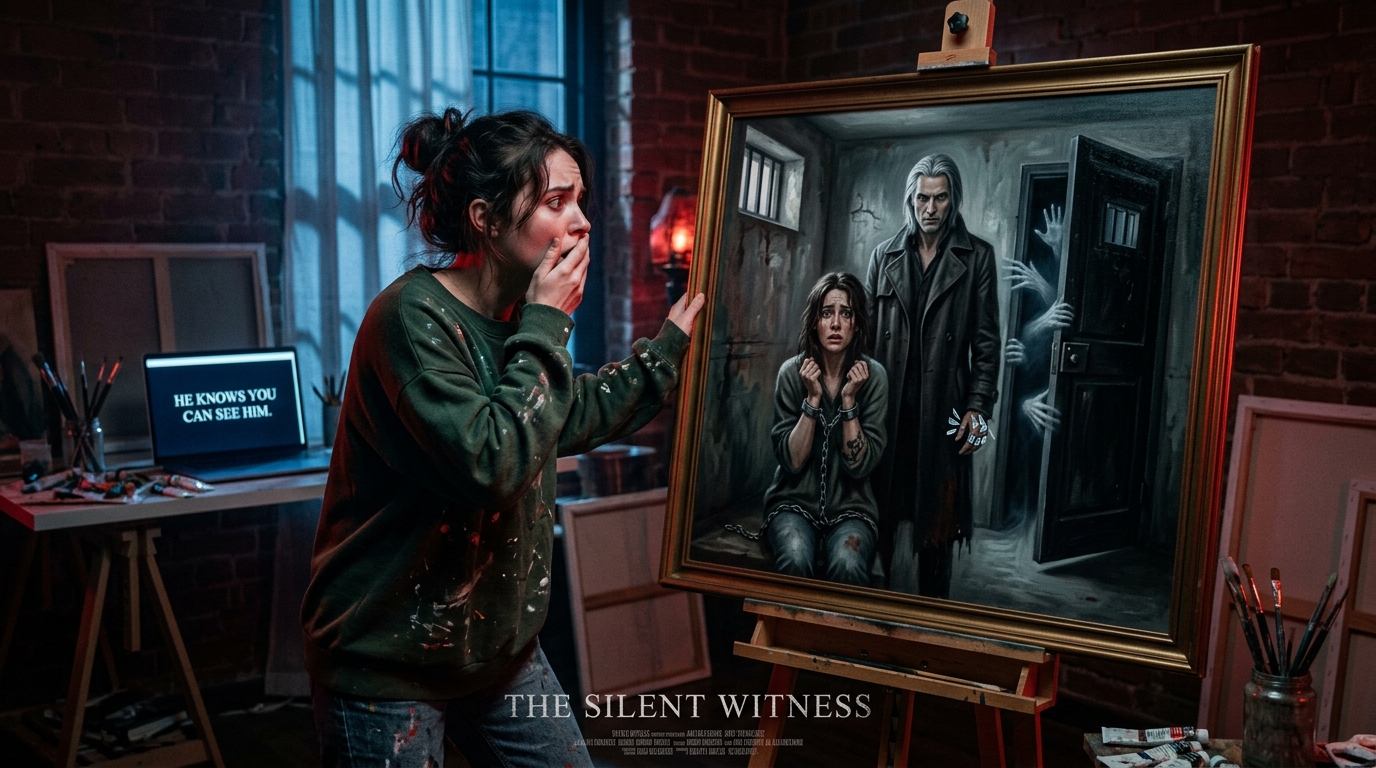
Behind the chained woman with my face, the gray wall now held a door.
Small.
Black.
Half open.
And inside that painted doorway stood a man I had never seen before.
Or thought I hadn’t.
Dark coat.
Silver hair.
A thin smile.
His hand rested against the painted doorframe.
On his finger was a ring shaped like a broken mirror.
The laptop screen went black.
Then white letters appeared.
NOW HE KNOWS YOU CAN SEE HIM.
The knock came again.
From the apartment door.
Three taps.
Then a man’s voice whispered from the hallway:
“Elara, your portrait is finished.”
Leave a Reply