The Name I Wasn’t Supposed To Say
The studio was still live.
That was the first thing I realized after the lights came back.
Not safe.
Not over.
Live.
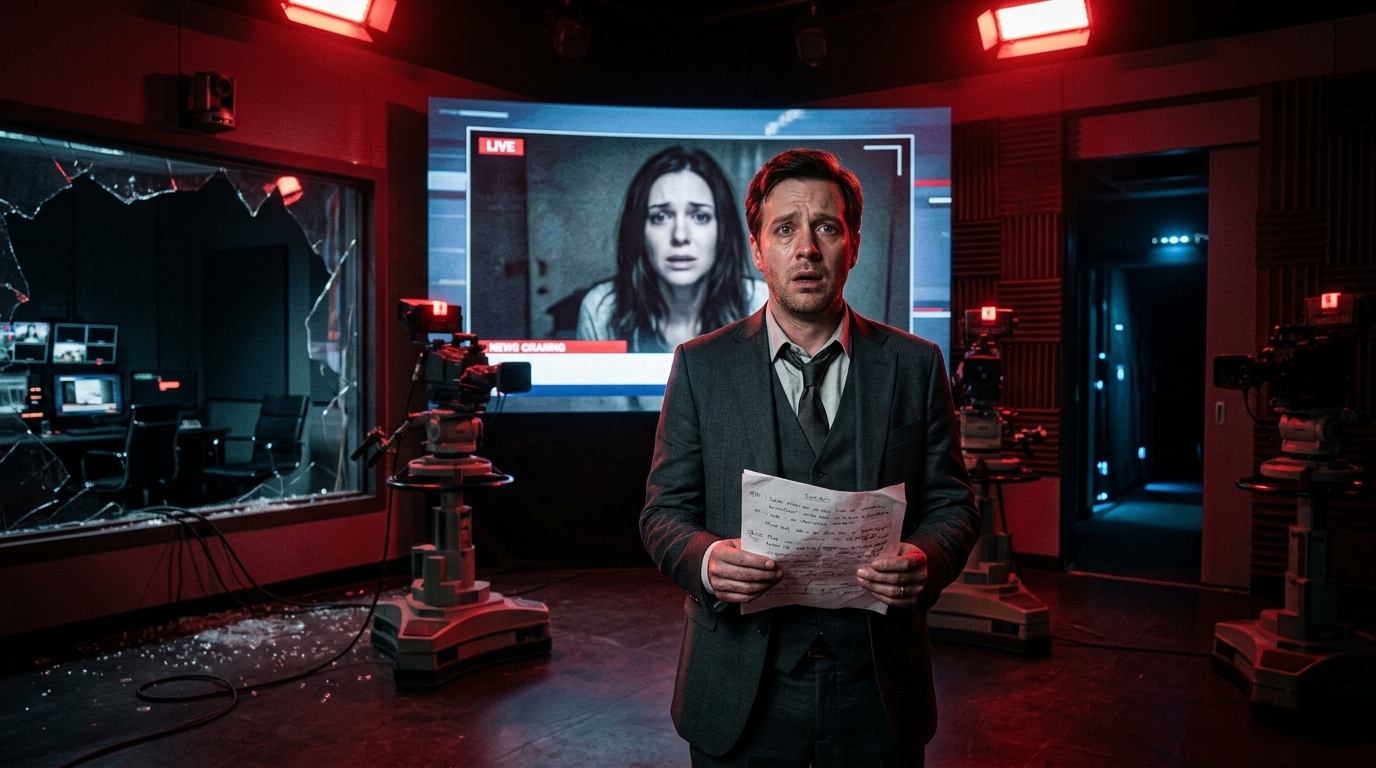
The red emergency lights washed the stage in a color too close to blood. Audience members were crying. Security guards were shouting near the exits. Camera three lay on the floor with its lens cracked, still blinking red.
The fake cameraman was gone.
The person wearing Owen’s face was gone.
But the broadcast had not stopped.
Millions of people were still watching me stand behind the desk with a shaking paper in my hand.
And at the bottom of that paper, in wet black ink, was the new sentence.
SHE IS NOT IN THE BASEMENT ANYMORE.
SHE IS UNDER THE STUDIO.
My mouth went dry.
Under the studio.
Not across town.
Not in some warehouse.
Not hidden in a basement police might raid in an hour.
Here.
Beneath our feet.
While I had been reading her words aloud.
While the audience clapped.
While cameras rolled.
Elena Cross had been somewhere below the stage.
Listening.
Or being watched.
Or dying.
My earpiece crackled.
For one second, I thought it would be her again.
Please.
Keep reading.
Instead, I heard only static.
Then a man’s voice whispered:
“Smile, Marcus.”
Every muscle in my body locked.
It was Owen’s voice.
My director.
The man whose body I had just learned was dead.
I looked toward the control room above the studio floor.
The glass booth was dark.
No silhouettes.
No producers.
No headset lights.
No movement.
Empty.
But Owen’s voice came through my ear again.
“Smile. They can see your face.”
I forced my lips upward.
The audience thought I was trying to calm them.
I was trying not to scream.
The Location Hidden In The Script
I looked down at the paper again.
There were still lines I had not read.
New ones.
They had not been there before.
I know that sounds impossible.
But live television had already stopped obeying reality.
The ink crawled slowly across the page as if someone were writing from the other side.
Marcus, say the address.
I stared.
Then another line appeared beneath it.
Make them hear where I am.
My pulse hammered.
I understood.
Police would be watching by now.
Viewers would be recording.
Someone somewhere would be trying to trace the broadcast, the threat, the missing woman, the name Victor Cross.
But television is chaos in a crisis.
People hear panic.
They miss details.
So I had to make the details impossible to miss.
I lifted my eyes to camera one.
My voice sounded steadier than I felt.
“Elena Cross said she was moved from the Meridian Hall basement.”
A security guard looked at me sharply.
Good.
I continued.
“She said she was taken under Studio 9 at Whitmore Broadcasting Center.”
The audience murmured.
The control booth stayed dark.
My earpiece hissed.
I kept going.
“Studio 9. Whitmore Broadcasting Center. Service level beneath the main stage.”
I repeated each word slowly.
Clearly.
Like a host reading donation totals.
Like a man trying to save a woman without making the kidnapper pull a trigger.
The earpiece crackled again.
This time, Owen’s voice was colder.
“Don’t.”
I swallowed.
“Police should search the lower service tunnels under Studio 9.”
The voice in my ear sharpened.
“Do not try to save her.”
My skin went cold.
Not because of the threat.
Because Owen’s voice was wrong now.
Too clean.
Too close.
Like it was being played from inside my skull.
I looked up toward the control room again.
Still empty.
No director.
No producers.
No one at the switchboard.
Only one camera mounted inside the booth.
Slowly turning by itself.
Toward me.
The Empty Control Room
I should have left the desk.
I should have walked offstage, taken the audience with me, and forced every door in the building open.
But the paper changed again.
One line.
Stay on air or he closes the room.
I stopped breathing.
He.
Victor?
The fake cameraman?
The thing wearing Owen’s face?
The man in my earpiece?
I did not know.
And not knowing meant Elena was the only person who did.
The floor beneath the desk vibrated faintly.
Not from speakers.
Not from camera rails.
From below.
A dull mechanical thud.
Then another.
Like metal doors locking somewhere under the studio.
I gripped the edge of the desk.
The audience was silent now.
No applause sign.
No music.
No charity smiles.
Just hundreds of people staring at me while realizing they were not watching a program anymore.
They were witnesses.
My earpiece whispered again.
“Marcus.”
I forced myself not to react.
“You always wanted real television.”
My chest tightened.
The voice laughed softly.
“Here it is.”
I looked toward the control room monitors above the glass.
They should have shown camera feeds.
Wide shot.
Audience shot.
Stage shot.
Instead, every monitor showed static.
Then one by one, the static cleared.
A dark room appeared.
Concrete walls.
A single hanging bulb.
A woman tied to a metal chair.
Dark hair covering part of her face.
Tape around one wrist.
Blood at her temple.
Elena Cross.
She lifted her head slowly.
And looked directly into the camera.
No.
Directly at me.
The monitor above the empty control room zoomed in on her face.
Her lips moved.
No sound came through the studio speakers.
But I could read the words.
Behind you.
The Room Behind The Stage
I turned too fast.
Nothing behind me.
Only the black curtain at the rear of Studio 9.
The charity banner.
A row of unused chairs.
A prop wall painted to look like marble.
Normal studio pieces.
Fake elegance.
Designed for broadcast.
But Elena stared from the monitor as if she could see beyond what I saw.
Behind you.
I looked again.
At the black curtain.
At the floor beneath it.
At the slight gap near the bottom where cold air moved the fabric inward.
There was a door behind the curtain.
I had worked in that studio for eight years.
I knew every entrance.
Every light rig.
Every emergency exit.
There was not supposed to be a door there.
My earpiece crackled.
“Don’t turn around again.”
I turned anyway.
The curtain shifted.
Just slightly.
The monitor showed Elena shaking her head violently.
Then the camera inside her room moved.
Not on its own.
Someone walked behind her.
Only a hand appeared at first.
Male.
Wearing a silver ring.
The same ring Elena had described.
The hand rested gently on her shoulder.
She closed her eyes in terror.
My voice nearly broke, but I kept speaking to camera one.
“Elena Cross is alive.”
The silver-ringed hand tightened.
Elena gasped silently on the monitor.
I forced myself to continue.
“She is being held inside Whitmore Broadcasting Center. Studio 9. Behind the main stage. Behind the black curtain.”
The studio doors burst open.
Real police this time.
Uniformed officers flooded the aisles.
Audience members screamed and ducked.
Security shouted over one another.
The monitor image of Elena suddenly flickered.
The man’s hand disappeared from her shoulder.
Then a voice came through every speaker in the studio.
Not Owen’s voice now.
Victor Cross.
The grieving husband.
The guest I once interviewed.
The man I had called brave on live television.
“Marcus,” he said calmly, “you should have kept reading.”
The black curtain behind me opened by itself.
The Woman In The Dark Room
A narrow passage waited behind the curtain.
The audience saw it.
The cameras saw it.
The police saw it.
And for one second, nobody moved.
Because the passage did not look newly built.
It looked old.
Concrete.
Steel door.
Wires running along the ceiling.
Hidden behind television sets and charity backdrops for years.
The truth had not been far away.
It had been behind production design.
An officer shouted, “Move!”
Police rushed toward the stage.
I stayed frozen behind the desk.
Not because I wanted to.
Because the monitor changed again.
Elena’s dark room was no longer on screen.
Now the monitor showed the studio.
Live.
From behind me.
From inside the hidden passage.
A camera was watching us from the dark.
The angle showed my back.
The police moving toward the curtain.
The audience crying.
And in the bottom corner of the feed, a timestamp appeared.
LIVE DELAY: 00:07.
Seven seconds.
The broadcast was seven seconds ahead of reality.
My stomach dropped.
On the monitor, I watched an officer enter the hidden passage.
Then a flash.
A gunshot.
The officer fell.
Seven seconds before it happened.
I screamed.
“STOP!”
The officer froze at the edge of the curtain.
Everyone turned toward me.
“Don’t go in!”
The gunshot happened anyway.
But because he had stopped, the bullet hit the stage light above him instead of his chest.
Glass exploded across the floor.
The audience screamed.
The monitor flickered violently.
Victor’s voice came through the speakers again.
Softer now.
Interested.
“You can see it too.”
My blood turned cold.
The paper in my hand changed one final time.
He is using the broadcast delay.
I understood then.
This was not only kidnapping.
Not only murder.
Not only a man watching his own crime on television.
Someone had built the studio into a machine.
A camera system that saw seconds ahead.
A broadcast that could warn or kill depending on who controlled it.
And Elena had used my live show to break into that system.
The monitor switched back to the dark room.
Elena was crying now.
But she was also looking at something off-camera.
Her lips moved again.
Two words.
Not “help me.”
Not “save me.”
She mouthed:
Cut power.
I looked toward the control room.
Empty.
Then toward the stage power box near the left wall.
Too far.
Police were still pinned behind the curtain.
The hidden camera inside the passage turned slowly.
On the monitor, seven seconds ahead, I saw myself running toward the power box.
Then I saw the gunman step from the passage and aim at me.
Seven seconds.
That was all I had.
I lifted the paper toward camera one and read the last line aloud.
“If I die on air, look behind the control room wall.”
Then I ran.
The Broadcast That Saw The Future
The studio exploded into movement.
Police shouted.
Audience members ducked beneath seats.
Cameras swung wildly.
The broadcast stayed live.
I ran toward the power box as the monitor showed the future catching up behind me.
Five seconds.
The gunman stepped out from the passage.
Four seconds.
Silver ring.
Black gloves.
Face hidden beneath a studio headset.
Three seconds.
He lifted the gun.
Two seconds.
I reached the power box.
One second.
I pulled the main breaker.
Darkness swallowed Studio 9.
The gunshot went off in the dark.
I felt heat tear past my shoulder.
Not impact.
Close.
Too close.
Then every monitor died.
Every camera light went black.
For the first time that night, the broadcast ended.
Silence.
Then Elena screamed.
Not from the monitor.
Not from the earpiece.
From behind the studio wall.
Real.
Close.
Alive.
Police flashlights cut through the dark instantly.
Someone tackled the gunman near the curtain.
Officers rushed into the hidden passage.
The audience sobbed in the emergency gloom.
I fell against the wall, clutching my shoulder, heart hammering so hard I thought it might split me open.
Then the control room window above us shattered from the inside.
Everyone looked up.
There had been no one inside.
I was sure of it.
But now a hand pressed against the broken glass.
A woman’s hand.
Bloody.
Trembling.
Elena’s voice crackled through my dead earpiece one last time.
“Marcus…”
I looked toward the control room.
A figure stood behind the shattered glass.
Not Elena.
Owen.
The real Owen.
Alive.
Barely.
His throat bandaged with duct tape.
His hands bound in front of him.
He shook his head violently at me.
Then pointed behind my chair at the host desk.
I turned slowly.
The paper I had been reading was gone.
In its place sat a new sheet.
One sentence.
Written in fresh black ink.
THE NEXT HOST HAS ALREADY BEEN CHOSEN.
Leave a Reply