Blog

  • I Broke Through The Wall Above Floor 16. Behind It, I Found A Hidden Hallway Full Of Cameras Watching Me

    I Broke Through The Wall Above Floor 16. Behind It, I Found A Hidden Hallway Full Of Cameras Watching Me

    The Floor That Was Erased

    I did not go home after the footage.

    That was my third mistake.

    Or maybe by then, mistakes no longer mattered.

    The security office still smelled faintly of wet concrete from the footprints the woman in red left behind. Every few minutes, I caught myself staring at the dark corner near the locked door, expecting her reflection to appear again.

    2:57 a.m.

    Rain hammered the windows thirty floors above the city.

    I sat alone with the archived building files spread across three monitors.

    Project E-17.

    Restricted Medical Research Level.

    The document ended there.

    No names.

    No contractors.

    No explanation why a hidden medical floor once existed inside a luxury office tower.

    Someone had gutted the records carefully.

    That meant fear.

    Powerful people only erase things they cannot afford to deny.

    I kept digging.

    At 3:14 a.m., I found another file buried inside old maintenance blueprints.

    Original Structural Design – Blackthorne Tower.

    Sixteen public floors.

    One restricted sublevel.

    And between floors 16 and the roof—

    A concealed private level labeled simply:

    17.

    My pulse jumped.

    The floor existed physically.

    They just hid it.

    I enlarged the blueprint slowly.

    There.

    A narrow service stairwell ending in a sealed corridor above floor 16.

    No elevator access.

    No public entry.

    Only maintenance routes hidden behind structural walls.

    The hallway connected to three large rooms.

    Conference chamber.

    Observation room.

    Holding area.

    Holding area.

    My stomach tightened instantly.

    That was not office language.

    That was prison language.

    I looked back toward the elevator feed.

    Empty.

    Silent.

    But for one second, I imagined the woman in red still standing there somewhere beyond the walls, waiting eleven years for someone curious enough to keep asking questions.

    Then Glenn’s warning returned to me.

    Don’t let them notice you looking.

    Too late.

    Because somewhere in that building, someone already knew.

    The Wall Above Floor 16

    At 3:42 a.m., I took the maintenance keys from the security locker.

    I told myself I only wanted proof.

    Just enough to convince police.

    Just enough to stop feeling insane.

    That was another lie.

    The truth is simpler.

    Once people glimpse hidden things, they stop wanting safety and start wanting answers.

    The service staircase above floor 16 smelled like dust, rust, and trapped heat. No public lighting existed there. Only dim emergency strips glowed red along the concrete walls.

    Every step echoed too loudly.

    I kept checking behind me.

    Not because I heard footsteps.

    Because silence that deep feels inhabited.

    At the top landing, the stairwell ended at a blank gray wall.

    Concrete.

    Fresh compared to the rest of the structure.

    Sealed intentionally.

    Exactly where the blueprint said floor 17 should begin.

    My flashlight shook slightly in my hand.

    There were scratches near the lower edge of the wall.

    Not construction marks.

    Finger marks.

    Many.

    My mouth went dry.

    Someone had tried getting out.

    I pressed my ear against the concrete.

    Nothing.

    Then—

    A faint electrical hum.

    Very soft.

    Behind the wall.

    Power.

    Something beyond the concrete still had electricity.

    My pulse exploded.

    I backed away slowly and grabbed the emergency fire axe mounted beside the stairwell.

    The metal felt cold against my palms.

    “Okay,” I whispered to nobody.

    Then swung.

    The first strike cracked plaster.

    The second exposed steel mesh beneath the surface.

    The third broke through completely.

    Darkness waited behind the wall.

    Cold air rushed out immediately.

    Not stale.

    Conditioned.

    Ventilated.

    Like hidden rooms were still being maintained.

    I widened the opening enough to squeeze through.

    Then climbed inside.

    And found the seventeenth floor.

    The Hidden Hallway

    The corridor stretched farther than the blueprint showed.

    Long.

    Narrow.

    Windowless.

    Old fluorescent lights flickered weakly overhead, bathing everything in pale green light that made the walls look sick.

    Dust covered the floor.

    But not evenly.

    Some paths were cleaner.

    Used recently.

    My chest tightened.

    At the far end of the hallway stood a heavy steel door slightly ajar.

    Above it, faded silver letters still clung to the wall.

    E-17 OBSERVATION.

    I moved slowly.

    Every sound echoed.

    My breathing.

    My footsteps.

    The distant electrical buzzing somewhere deeper inside the floor.

    Doors lined both sides of the corridor.

    Some locked.

    Some hanging open.

    Inside one room sat rusted hospital beds strapped with leather restraints.

    Another contained filing cabinets stripped completely empty.

    One room still smelled sharply of bleach.

    My flashlight beam shook harder now.

    This was not a forgotten floor.

    It was a cleaned crime scene.

    Then I noticed the cameras.

    Small black security cameras mounted high in every corner.

    Not broken.

    Watching.

    Tiny red recording lights blinked softly in the darkness.

    My stomach dropped.

    Someone still monitored floor 17.

    I turned slowly toward the nearest camera.

    The lens adjusted slightly.

    Tracking me.

    My pulse hammered violently.

    “Who’s there?” I shouted.

    Only silence answered.

    Then a soft female voice echoed faintly through the corridor.

    “Evan.”

    I froze instantly.

    Not from the cameras.

    From the fact she knew my name.

    The voice came from farther down the hallway.

    Weak.

    Hoarse.

    Human.

    I followed it toward the final room at the end.

    The steel door stood partially open.

    Inside, old television monitors covered every wall from floor to ceiling.

    Dozens.

    Maybe hundreds.

    Most displayed dead static.

    A few still showed live security feeds from around Blackthorne Tower.

    Lobby.

    Parking garage.

    Elevators.

    Security office.

    My office.

    The room had been watching the building for years.

    And in the center wall, pinned beneath yellowing newspaper clippings and photographs—

    The woman in red.

    The Woman In The Red Dress

    The photographs showed her over different years.

    Entering buildings.

    Leaving interviews.

    Holding microphones.

    Talking to police officers.

    Standing beside protest signs.

    One clipping finally gave me her name.

    Mara Vane.

    Investigative journalist missing since 2014.

    My blood turned cold.

    Eleven years.

    The article described her disappearance during an investigation into human trafficking tied to wealthy real estate investors.

    Blackthorne Holdings appeared three times in the article.

    Blackthorne Tower’s owners.

    I stepped closer.

    The final photograph on the wall showed Mara wearing the same red dress from the elevator footage.

    Taken inside this building.

    Date stamped eleven years earlier.

    Beneath it, handwritten in black marker:

    IF YOU SEE ME ON CAMERA, I AM STILL ALIVE.

    A sound moved behind me.

    I spun around violently.

    The woman from the elevator stood in the doorway.

    Red dress.

    Bare feet.

    Pale skin.

    Real.

    Not a ghost.

    Not a recording.

    A living woman.

    Older than the photographs now.

    Thinner.

    Eyes hollow from surviving too long underground.

    But alive.

    My throat tightened instantly.

    “Oh my God.”

    She stared at me cautiously like someone who no longer trusted rescue.

    “You broke the wall,” she whispered.

    Her voice sounded damaged from years without conversation.

    I nodded slowly.

    “You’re Mara.”

    A tiny pause.

    Then:

    “You watched the elevator.”

    Not a question.

    I looked at the camera feeds surrounding us.

    “You’ve been using the security system.”

    “The old override network still works at 2:13.”

    2:13.

    My pulse jumped.

    “Why that time?”

    Her expression darkened.

    “That’s when they bring people in.”

    Cold spread through my chest.

    People.

    Not prisoners.

    Not workers.

    People.

    “How long have you been here?”

    “Eleven years.”

    The number hit me physically.

    Eleven years hidden inside a sealed floor above a city full of people.

    Eleven years surviving inside walls while elevators carried businessmen beneath her feet.

    I looked around the room again.

    Food wrappers.

    Water containers.

    Improvised bedding.

    Stacks of handwritten notes.

    She had lived here.

    Not trapped completely.

    Hidden.

    Watching.

    Waiting.

    “For what?” I whispered.

    Mara looked directly into my eyes.

    “For someone stupid enough to keep looking.”

    Then every monitor in the room flickered simultaneously.

    The Man Watching Through The Cameras

    Every screen turned black.

    Not static.

    Black.

    Then one monitor switched back on.

    Parking garage feed.

    Another.

    Lobby camera.

    Another.

    Elevator.

    Until every screen displayed the same image.

    A man sitting inside a dark office.

    Watching me.

    Older.

    Silver hair.

    Perfect suit.

    Hands folded calmly beneath soft yellow light.

    He smiled slightly.

    Not surprised.

    Disappointed.

    Like a teacher watching a student fail an obvious test.

    Mara stepped backward instantly.

    Fear transformed her face.

    Real fear.

    The kind that survives even after eleven years.

    “No,” she whispered.

    The man on the monitors leaned closer toward the camera.

    “Mr. Cole.”

    My blood froze.

    He knew my name.

    “I was wondering how long curiosity would take to reach the seventeenth floor.”

    I stared at the screens.

    “Who are you?”

    He smiled faintly.

    “That depends which decade you ask.”

    The room temperature seemed to drop.

    Mara grabbed my wrist suddenly.

    “We have to leave.”

    But the steel door behind us slammed shut automatically.

    Every monitor flickered again.

    Then new camera feeds appeared.

    Not from the building.

    From underground rooms.

    Cells.

    Beds.

    People.

    Women.

    Children.

    Locked doors.

    My stomach turned violently.

    Blackthorne Tower was never just an office building.

    It was a transit point.

    The silver-haired man watched my reaction calmly.

    “You security guards always imagine elevators move people upward,” he said softly.

    Then the screens changed again.

    This time showing the security office downstairs.

    Glenn sat tied to a chair.

    Blood running down one side of his face.

    Alive.

    Barely.

    My chest tightened.

    The man smiled wider.

    “He tried warning you not to keep watching.”

    Mara whispered, “Evan…”

    But I could not look away from the screens.

    The man folded his hands slowly.

    “Now,” he said, “you may finally understand why floor seventeen was removed from the building plans.”

    One final monitor flickered on.

    Live footage.

    My apartment.

    The camera zoomed slowly toward my bedroom window.

    Someone stood inside the dark room waiting for me to come home.

    Wearing a black raincoat.

    Then every monitor displayed the same message in white letters:

    YOU WERE NEVER SUPPOSED TO FIND HER.

  • Every Night At 2:13 AM, The Elevator Camera Showed A Woman Entering A Floor That Didn’t Exist

    Every Night At 2:13 AM, The Elevator Camera Showed A Woman Entering A Floor That Didn’t Exist

    The Building With Only Sixteen Floors

    Night security changes the way you look at buildings.

    During the day, towers feel alive.

    At night, they feel like machines pretending to sleep.

    I learned that during my third month working security at Blackthorne Tower.

    Sixteen floors.

    Luxury offices.

    Private law firms.

    Empty conference rooms with city lights trapped inside glass walls.

    The kind of building that smelled expensive even after midnight.

    Most nights were boring.

    Drunk executives forgetting keycards.

    Cleaning crews listening to old music through cheap earbuds.

    Coffee gone cold beside security monitors.

    Routine.

    Predictable.

    That was why I noticed the elevator footage.

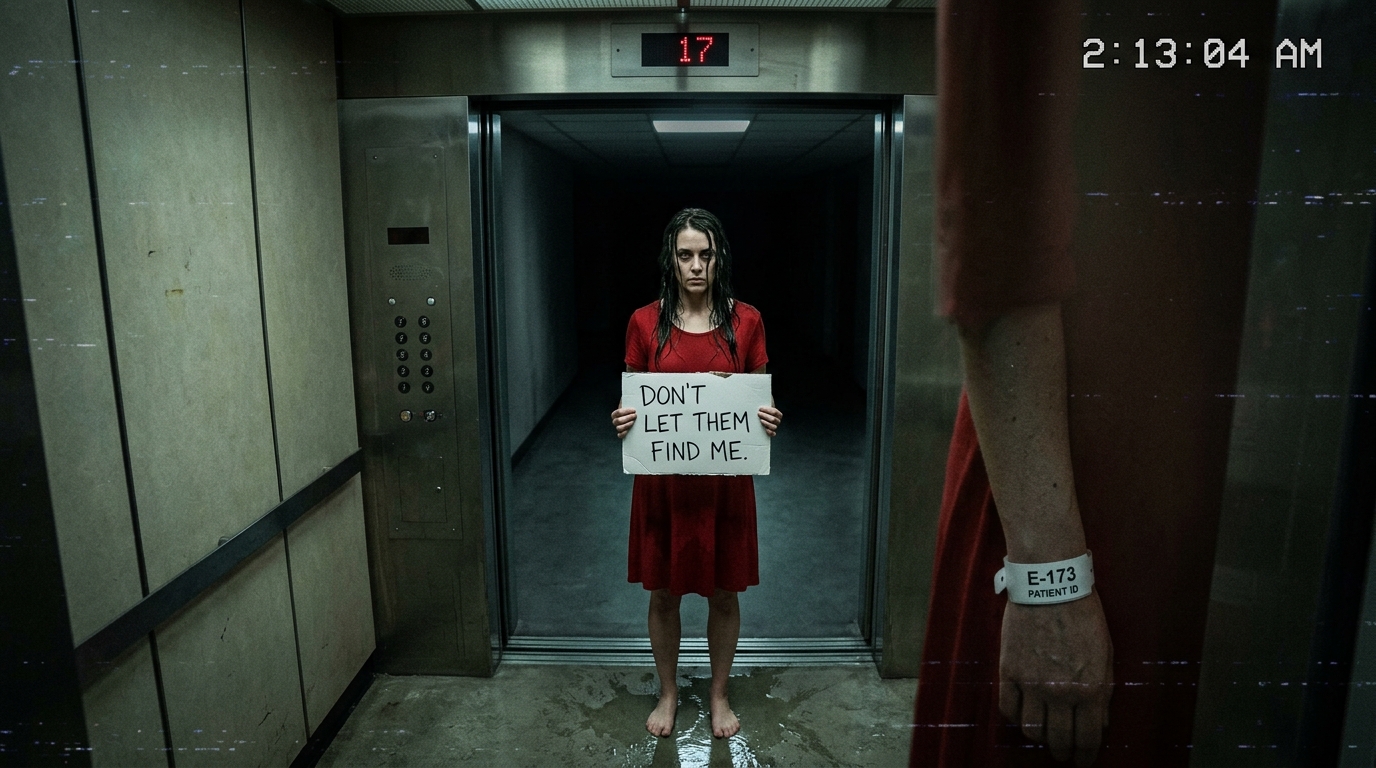
    At exactly 2:13 every morning, the west elevator stopped at the seventeenth floor.

    The problem was simple.

    Blackthorne Tower only had sixteen floors.

    I checked the building schematics myself after the third night.

    No hidden level.

    No maintenance platform.

    No penthouse.

    Nothing.

    Floor buttons inside the elevator ended at 16.

    Yet every night at 2:13 a.m., the elevator doors opened.

    And someone stepped out.

    The first time I saw her, I thought the system glitched.

    The footage crackled slightly.

    Static rolled across the screen.

    Then the elevator doors slid open.

    A woman stood inside.

    Red dress.

    Dark hair.

    Head lowered.

    She stepped forward slowly and disappeared into a hallway the building did not physically have.

    Then the elevator doors closed again.

    No one entered afterward.

    No one came back down.

    I replayed the footage six times that night.

    No editing.

    No timestamp errors.

    No corrupted files.

    At 2:13 a.m., the elevator stopped at floor 17.

    At 2:13 a.m., a woman in red walked out.

    Every single night.

    The Footage Nobody Wanted To Explain

    I reported it after the fifth recording.

    That was my second mistake.

    My supervisor, Glenn, barely looked up from his desk when I brought him the footage.

    “Probably old maintenance data bleeding into the system.”

    “There is no seventeenth floor.”

    “There used to be.”

    That answer froze me instantly.

    “What?”

    Glenn sighed like he regretted speaking.

    “Original construction plans included another level. It was removed before opening.”

    “Removed how?”

    He finally looked at me.

    “Evan.”

    That tone.

    The one older men use before pretending concern is wisdom.

    “You work nights long enough, you start seeing patterns in random things.”

    I stared at him.

    “She appears every night at the exact same time.”

    “So does the coffee machine breaking.”

    “That’s not the same.”

    Glenn rubbed his face tiredly.

    “Listen carefully. Do not start digging into old building stories. It never ends well.”

    Never ends well.

    Not impossible.

    Not fake.

    Not crazy.

    That stayed with me.

    Before leaving, he added one more thing without looking at me.

    “And stop replaying the footage alone.”

    My stomach tightened.

    “Why?”

    Glenn paused at the office door.

    Then said quietly:

    “Because she eventually notices.”

    The room suddenly felt colder.

    He left before I could ask anything else.

    I sat alone in the security office surrounded by glowing monitors and the low electrical hum of a sleeping skyscraper.

    The timestamp on the corner screen read 1:47 a.m.

    Twenty-six minutes until 2:13.

    Outside the security windows, rain slid down the city skyline in silver streaks.

    I looked back at the elevator feed.

    Empty.

    Silent.

    Waiting.

    Then the screen flickered.

    Just once.

    And for one frame—

    The woman appeared standing inside the elevator already looking directly into the camera.

    2:13 A.M.

    I should have walked away.

    That thought returns to me often now.

    But curiosity feels harmless right before it ruins your life.

    At 2:08, I locked the security office door.

    At 2:10, I shut off the radio chatter.

    At 2:11, I positioned every monitor toward the west elevator feed.

    The digital clock on the wall ticked loudly enough to feel hostile.

    2:12.

    Nothing.

    The elevator remained parked at lobby level.

    Empty.

    Then every monitor in the security room flickered simultaneously.

    The lights dimmed.

    Not fully.

    Just enough for shadows to deepen in the corners.

    The elevator began moving.

    No button lights activated.

    No keycard access logged.

    Floor numbers climbed anyway.

    3.

    4.

    5.

    6.

    7.

    8.

    Then the display changed.

    17.

    A floor that did not exist.

    My throat tightened instantly.

    The elevator stopped.

    For three seconds, nothing happened.

    Then the doors opened.

    She stood there.

    Red dress.

    Long dark hair damp against pale shoulders.

    Barefoot.

    Water pooled beneath her feet inside the elevator like she had walked through heavy rain.

    Except it had not rained for hours.

    The timestamp in the corner read exactly 2:13 a.m.

    My pulse hammered violently.

    She stepped inside slowly.

    Not ghostlike.

    Not floating.

    Human.

    That frightened me more.

    Because ghosts belong to stories.

    Human beings belong to evidence.

    The elevator doors closed halfway.

    Then stopped.

    The woman lifted her head suddenly.

    And looked directly into the camera.

    Every muscle in my body locked.

    Not toward the elevator ceiling.

    Not vaguely toward the lens.

    Directly at me.

    Like she knew exactly where the footage was being watched.

    My skin turned ice cold.

    The woman reached slowly into the folds of her red dress.

    Then raised a small white sign toward the camera.

    Black handwritten letters covered the paper.

    DON’T LET THEM FIND ME.

    My breath stopped.

    The lights inside the security office exploded off all at once.

    Darkness swallowed the room.

    The Woman Inside The Camera

    For one terrible second, the entire building went silent.

    No electrical hum.

    No air vents.

    No elevator motors.

    Nothing.

    Then emergency backup lights clicked on in dim red strips along the floor.

    My monitors rebooted one by one.

    Static.

    Static.

    Static.

    Then the elevator feed returned.

    Empty.

    No woman.

    No water.

    No floor 17.

    The elevator sat quietly at lobby level like nothing had happened.

    My heartbeat pounded so hard it hurt.

    I replayed the footage immediately.

    Nothing.

    The file corrupted itself halfway through the recording.

    Every frame after the woman raised the sign dissolved into digital snow.

    Except one image remained frozen at the end.

    The woman staring into the camera.

    Holding the message.

    DON’T LET THEM FIND ME.

    I zoomed in.

    Her face sharpened slightly.

    Dark eyes.

    Wet hair.

    Thin scar near the left side of her mouth.

    And around her wrist—

    A hospital band.

    White plastic.

    Numbers printed across it.

    I enlarged the image again.

    Patient ID: E-173.

    My blood went cold.

    E-173.

    Not random.

    Not a coincidence.

    The missing seventeenth floor.

    I grabbed the building archives immediately.

    Old blueprints.

    Maintenance reports.

    Construction revisions.

    Most files about the removed floor had been deleted.

    Not missing.

    Deleted.

    That difference matters.

    Someone erased them intentionally.

    At 2:41 a.m., I finally found one surviving maintenance document buried in an old backup folder.

    Project E-17.

    Restricted Medical Research Level.

    My stomach tightened.

    Medical research.

    Inside an office tower?

    I kept reading.

    Then the security office door behind me clicked softly.

    I froze.

    I had locked it.

    Slowly, I turned toward the dark glass reflection beside the monitors.

    Someone stood behind me.

    A woman.

    Red dress.

    Water dripping onto the floor.

    I spun around.

    The room was empty.

    But the floor beneath the security office door was wet.

    And written across my final monitor in flickering black letters were five new words.

    SHE KNOWS YOU SAW HER.

    Then the elevator ding echoed softly through the empty building.

    Floor 17 had arrived again.

  • I Followed My Student’s Father Home In The Rain. Behind His House, I Found The Well From Noah’s Drawing

    I Followed My Student’s Father Home In The Rain. Behind His House, I Found The Well From Noah’s Drawing

    The Drawing Of The Well

    I lied to Noah before the final bell.

    That was the first wrong thing I did.

    Or maybe the first necessary thing.

    I crouched beside his desk, forced a smile onto my face, and held up the drawing with shaking fingers.

    “This is very creative,” I told him.

    Noah nodded quietly.

    No pride.

    No excitement.

    Just relief.

    Like he was glad someone finally believed him.

    I took a photo of the drawing while pretending to straighten the paper.

    Then another.

    And another.

    The burning house.

    The woman in the window.

    The man in the black raincoat.

    The sentence written over and over again:

    HE IS NOT MY REAL DAD.

    My hands trembled so badly I almost dropped my phone.

    Noah watched me carefully.

    Not suspicious.

    Worried.

    That frightened me most.

    Children usually fear adults.

    Noah feared what adults failed to notice.

    I sent the images to Detective Marlowe before I could change my mind.

    The same detective who handled Lena’s disappearance seven years ago.

    Retired now.

    Drinking too much.

    Still answering my calls anyway.

    I attached one message.

    The child knows something.

    Three dots appeared immediately.

    Then vanished.

    Then appeared again.

    Finally, one reply:

    Do NOT go near that man alone.

    Too late.

    Because by then, I was already staring at the corner of Noah’s drawing.

    At something I had missed before.

    Behind the burning house.

    Partially hidden beneath black crayon.

    A small circle.

    Stone around the edges.

    Covered with wooden planks.

    A well.

    My breath caught.

    I zoomed in on the picture.

    There were marks around it too.

    Tiny stick figures.

    One standing above.

    One below.

    I turned toward Noah slowly.

    “What’s behind the house?”

    He looked out the rainy classroom window.

    “The hole.”

    “What hole?”

    “The one Daddy keeps locked.”

    Cold spread through my chest.

    “Why does he lock it?”

    Noah answered so softly I almost missed it.

    “So she can’t climb out.”

    Following The Man In The Rain

    I should have waited for police.

    I know that now.

    But grief destroys patience long before it destroys logic.

    By six-thirty that evening, rain drowned the streets in silver while I sat inside my car two blocks from Noah’s house with the windshield fogging beneath my shaking breath.

    I watched Daniel Mercer pull into the driveway in the same black raincoat.

    Same controlled movements.

    Same careful calm.

    Noah climbed out of the passenger seat carrying his dinosaur backpack.

    For one terrible second, he looked toward my car.

    Straight at me.

    I froze.

    Then he slowly lifted one hand.

    Not waving.

    Warning.

    The house sat at the edge of a wooded road outside town.

    Old.

    Two stories.

    White paint peeling beneath years of rain.

    No neighboring homes close enough to hear screaming.

    That realization made my stomach tighten.

    Daniel unlocked the front door.

    Noah disappeared inside first.

    The porch light flickered once.

    Then darkness swallowed the windows.

    I checked my phone again.

    No response from Marlowe.

    I typed quickly:

    At the house now.

    No answer.

    Thunder rolled overhead.

    My chest felt too tight to breathe properly.

    Seven years.

    Seven years of imagining my sister dead.

    River.

    Fire.

    Kidnapping.

    Every possibility except the one Noah drew in black crayon beneath a burning house.

    Still alive.

    The thought terrified me more than death.

    Because surviving that long means suffering that long.

    Rain soaked through my coat as I crossed the street slowly.

    The backyard fence stood partially open.

    Mud swallowed my shoes with every step.

    The property smelled like wet soil, dead leaves, and something metallic underneath.

    I moved past rusted gardening tools and broken flower pots toward the rear of the yard.

    Then I saw it.

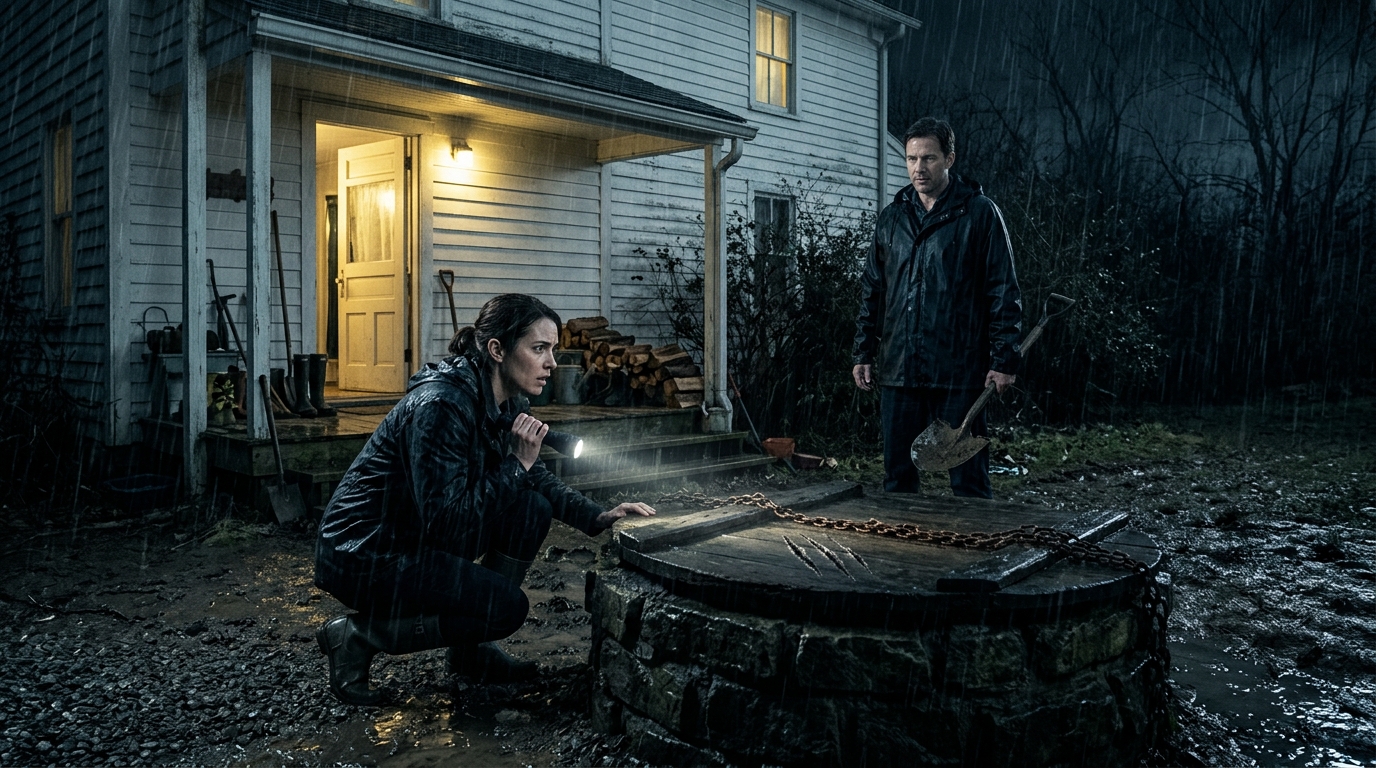
    The well.

    Exactly like the drawing.

    Stone circle.

    Old wood covering the opening.

    Heavy chain wrapped twice around iron hooks.

    Fresh mud around the base.

    Not abandoned.

    Used.

    My pulse exploded.

    I stepped closer carefully.

    The rain softened.

    Or maybe my hearing disappeared.

    Because suddenly all I could hear was my own heartbeat.

    And then—

    A whisper.

    “Teacher.”

    I spun around violently.

    No one behind me.

    The backyard stood empty beneath rain and darkness.

    Then I looked up.

    Second-floor window.

    Noah stood there watching me through the glass.

    Pale face.

    Hands pressed against the window exactly like Lena in the drawing.

    “Don’t open it alone,” he whispered.

    My blood turned cold.

    The Man With The Shovel

    The porch light switched on behind me.

    I turned slowly.

    Daniel Mercer stood near the back door.

    Holding a shovel.

    Rain slid from the edge of his black hood onto the metal blade.

    He did not look surprised to see me.

    That frightened me immediately.

    “You care about your students a little too much, Ms. Holloway.”

    His voice sounded calm.

    Almost amused.

    I stepped backward instinctively.

    The well pressed cold against the back of my legs.

    “I was worried about Noah.”

    He smiled faintly.

    “People usually say they’re worried about children when they’re really curious about adults.”

    Lightning flashed overhead.

    For one second, the shovel blade reflected white light directly into my eyes.

    I remembered another flash.

    Seven years ago.

    Police camera photographs.

    Burned walls.

    Rainwater.

    A blurry man in a dark coat.

    I swallowed hard.

    “Where is my sister?”

    The question escaped before I could stop it.

    Daniel’s expression did not change.

    But his fingers tightened around the shovel handle.

    “I think grief has confused you.”

    “Noah drew her.”

    “Children draw monsters too.”

    “He knew about the fire.”

    That made him pause.

    Tiny.

    Almost invisible.

    Enough.

    Thunder shook the yard.

    Noah appeared again at the upstairs window.

    This time, he looked terrified.

    “Dad,” he whispered through the cracked glass. “Please.”

    Daniel never looked up at him.

    His eyes stayed on me.

    “Lena Holloway disappeared a long time ago.”

    “You knew her.”

    “No.”

    “You know exactly who she is.”

    Rainwater dripped from the edge of his coat steadily onto the mud.

    Drip.

    Drip.

    Drip.

    The same rhythm as blood falling from fingertips.

    “You should leave,” he said quietly.

    The shovel shifted slightly in his hands.

    Not threatening.

    Prepared.

    That was worse.

    I glanced toward the well cover.

    Fresh scratches marked the wood.

    Something underneath had tried to claw upward recently.

    My stomach twisted.

    Daniel noticed where I looked.

    And for the first time—

    He seemed nervous.

    Not about me.

    About the well.

    I lunged toward the chain.

    He moved instantly.

    The shovel slammed into the wooden cover beside my hand hard enough to split the plank.

    I screamed and fell backward into the mud.

    Daniel stood over me breathing harder now.

    Rain poured down his face.

    “You should not have come here.”

    The calmness was cracking.

    Good.

    People become dangerous when angry.

    But they become careless too.

    I scrambled backward through the mud.

    “What’s down there?”

    His silence answered first.

    Then—

    Police sirens exploded through the night.

    The Well Behind The House

    Blue and red lights flashed through the rain-soaked trees.

    Daniel spun toward the road instantly.

    For one second, pure hatred crossed his face.

    Not fear.

    Hatred.

    Like someone had interrupted work before it was finished.

    Noah shouted from the upstairs window:

    “RUN!”

    Daniel grabbed my arm.

    Hard.

    Pain shot through my shoulder.

    “You called them?”

    “I sent pictures.”

    He looked toward the approaching lights.

    Calculating distance.

    Time.

    Escape.

    Then something changed in his eyes.

    Decision.

    He released me suddenly and ran toward the side gate instead of the house.

    Police vehicles screeched onto the muddy roadside moments later.

    Officers poured into the yard shouting commands.

    Someone tackled Daniel near the fence.

    The shovel disappeared into the mud.

    Noah screamed upstairs.

    And I crawled back toward the well.

    The chain was real.

    Heavy.

    Recently locked.

    One officer grabbed my arm.

    “Ma’am, step away.”

    “There’s someone down there!”

    The officer exchanged a quick look with another detective.

    Probably expecting a body.

    So was I.

    God help me, so was I.

    They pulled the wooden planks free one by one.

    Rainwater rushed into the darkness below.

    Then the flashlight beams hit something unexpected.

    Not water.

    Concrete stairs.

    My breath caught.

    The well wasn’t a well.

    It was a hidden entrance.

    One officer whispered, “Jesus Christ.”

    The space beneath the wooden cover descended underground like an old bunker.

    The air rising from below smelled damp.

    Rotten.

    Human.

    Detective Marlowe finally appeared through the rain, soaked and breathing hard.

    He looked older than I remembered.

    More tired.

    But the moment he saw me beside the open well, every trace of exhaustion vanished.

    “You actually came here alone?”

    “I found her drawing.”

    “That’s not an answer.”

    A flashlight beam disappeared down the stairwell.

    Then one officer shouted from below.

    “WE FOUND A ROOM!”

    Everything inside me stopped.

    Marlowe grabbed a flashlight and descended first.

    I followed before anyone could stop me.

    The underground corridor was narrow, lined with old concrete walls stained black by years of moisture.

    There were locks on the outside of every door.

    Outside.

    Not inside.

    The final room stood open at the end.

    A bed.

    Metal sink.

    Shelves stacked with canned food.

    Children’s drawings taped to one wall.

    And sitting in the corner beneath a blanket—

    A woman.

    Thin.

    Pale.

    Long dark hair hanging over hollow cheeks.

    She lifted her face slowly toward the flashlight.

    My knees gave out instantly.

    Lena.

    My sister.

    Alive.

    The Woman Beneath The Ground

    For seven years, I imagined this moment differently.

    I thought I would scream.

    Cry.

    Collapse.

    Instead, I stood frozen in the underground room while my sister stared at me like she no longer trusted her own eyes.

    She looked older.

    Not by years.

    By suffering.

    There are certain kinds of fear that age people faster than time ever could.

    “Lena,” I whispered.

    Her lips parted slightly.

    No sound came out.

    Marlowe moved carefully toward her.

    “It’s okay,” he said softly. “You’re safe now.”

    Lena flinched violently at the word safe.

    Like her body no longer understood what it meant.

    I knelt beside her slowly.

    Her hands trembled beneath the blanket.

    Bruises covered both wrists.

    Not fresh.

    Repeated.

    My throat closed.

    “Lena…”

    Tears blurred my vision.

    She stared at me for several seconds before finally whispering:

    “You got my drawings.”

    Drawings.

    I looked around the room.

    Children’s drawings covered the concrete wall.

    Burning houses.

    Rain.

    Windows.

    Black coats.

    And Noah.

    Every picture had Noah somewhere inside it.

    My heart stopped.

    “He knew,” I whispered.

    Lena nodded weakly.

    “He hears me.”

    I looked at Marlowe.

    Neither of us understood.

    Lena swallowed painfully.

    “The vent beside Noah’s room connects down here.” Her voice cracked. “At night, I talked to him through the pipes because I thought he was the only person who could hear me.”

    My chest tightened so hard it hurt.

    Noah wasn’t seeing ghosts.

    He was hearing a real woman trapped underground.

    Every night.

    For years.

    Marlowe looked sick.

    One officer near the doorway quietly removed his hat.

    Lena’s eyes drifted toward the ceiling.

    Toward the world above us.

    “Daniel said no one would believe a child.”

    My stomach twisted.

    “Who is he really?”

    Fear crossed Lena’s face instantly.

    Real fear.

    Not memory.

    Present fear.

    “He changes names.”

    The room went still.

    “He told me if anyone ever found me…” Her voice shook violently now. “He’d disappear again and take Noah with him.”

    I looked toward the stairs above.

    Police lights still flashed through the rain outside.

    Officers shouted.

    Radios crackled.

    But suddenly none of that felt finished.

    Because men like Daniel Mercer never prepare only one escape.

    Lena grabbed my wrist suddenly.

    Harder than I expected.

    Her eyes locked onto mine.

    “He’s not Noah’s father.”

    Cold spread slowly through my chest.

    “What?”

    Tears filled her eyes.

    “He killed Noah’s real father two years ago.”

    The underground lights flickered.

    Somewhere above us, someone screamed.

    Then every police radio exploded at once.

    “Suspect escaped custody.”

    My blood froze.

    Marlowe turned sharply toward the stairs.

    Rain thundered overhead.

    And from somewhere inside the underground hallway behind us—

    A child whispered:

    “Teacher…”

    We all turned.

    Noah stood barefoot in the darkness.

    Soaking wet.

    Holding the black raincoat in his hands.

    And behind him, deeper in the underground corridor, heavy footsteps echoed slowly toward us.

  • A Quiet Little Boy Drew My Missing Sister In Class. He Said She Still Stood At His Window Every Night

    A Quiet Little Boy Drew My Missing Sister In Class. He Said She Still Stood At His Window Every Night

    The Drawing On The Classroom Wall

    Rain always made children louder.

    That morning, the classroom sounded like thirty tiny storms trapped inside one building.

    Backpacks hit the floor.

    Chairs scraped.

    Crayons rolled beneath desks.

    Wet shoes squeaked across old tile while gray morning light pressed against the classroom windows.

    I stood near the whiteboard holding a stack of drawing paper against my chest, trying to smile through the exhaustion sitting behind my eyes.

    “Today,” I told the class, “we’re drawing our families.”

    Groans.

    Laughter.

    One little girl immediately asked if dogs counted as brothers.

    Another boy wanted to know if he could draw his Xbox.

    Normal.

    Comforting.

    Children are easiest to love when they are noisy.

    It is the quiet ones who stay with you afterward.

    Noah Mercer sat alone near the back corner beside the rain-streaked window.

    Seven years old.

    Thin shoulders.

    Dark hair always falling into his eyes.

    The kind of child who apologized before speaking, even when he had done nothing wrong.

    He rarely played with the others.

    Rarely smiled.

    And never drew the same thing twice.

    Except windows.

    Windows appeared in almost every picture he made.

    Sometimes open.

    Sometimes burning.

    Sometimes boarded shut.

    Our school counselor once suggested trauma.

    His father suggested imagination.

    Only one of them looked worried when saying it.

    I walked between the desks while the children colored.

    Bright stick figures.

    Mothers with giant smiles.

    Cats larger than houses.

    Messy sunshine in yellow spirals.

    Then I reached Noah’s desk.

    And forgot how to breathe.

    The Woman In The Burning House

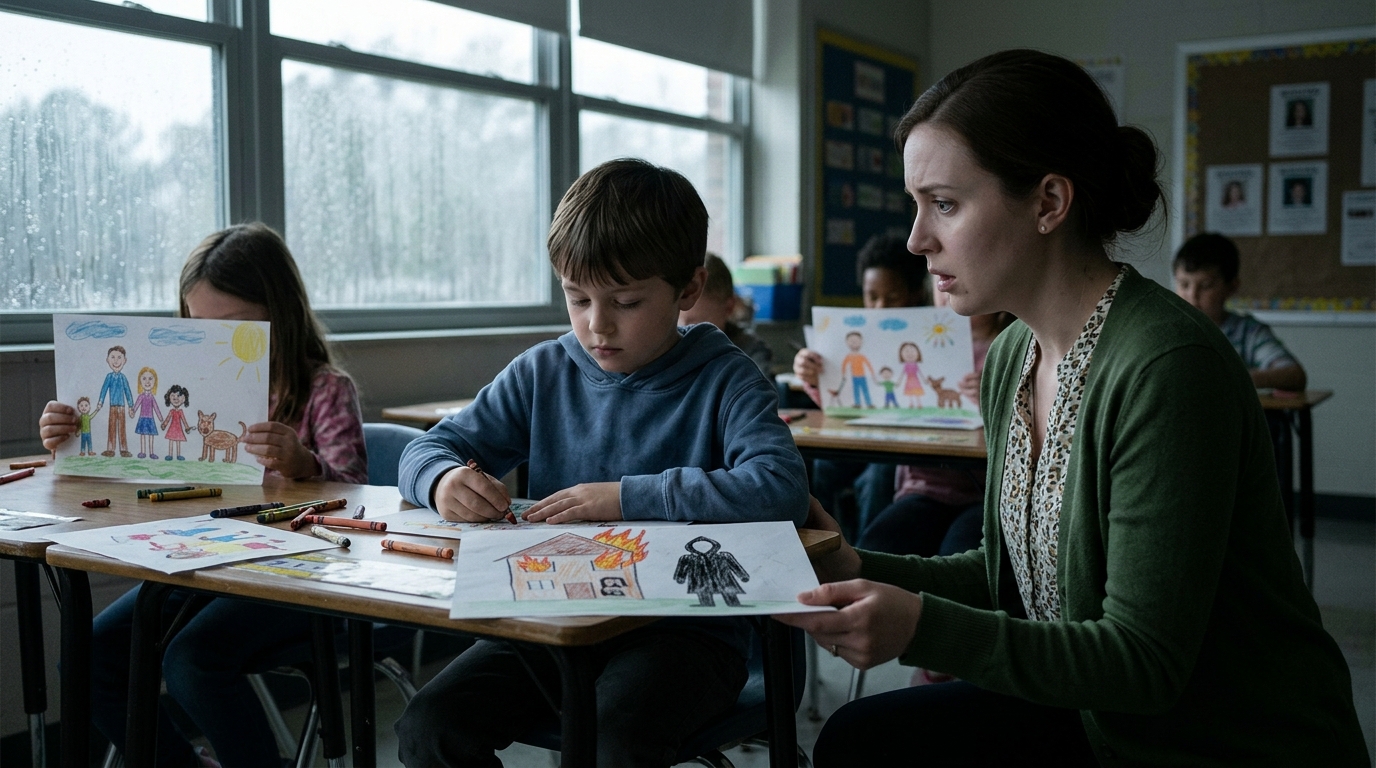
    The picture covered the entire page in heavy black crayon.

    A house.

    On fire.

    Orange flames climbed through shattered windows while dark smoke swallowed the roof.

    In front of the house stood a man wearing a long black raincoat.

    No face.

    Just darkness where the features should have been.

    And behind the upstairs window—

    A woman.

    Pale skin.

    Dark hair.

    Both hands pressed against the glass.

    My knees nearly gave out.

    Because I knew her.

    Not maybe.

    Not vaguely.

    Knew.

    The curve of the mouth.

    The mole beneath the left eye.

    The silver necklace hanging at her throat.

    I had stared at those details in photographs for seven years.

    Seven years of missing-person posters.

    Seven years of police reports.

    Seven years of my mother crying in grocery store parking lots because she thought she saw her daughter in strangers.

    The woman in Noah’s drawing was my sister.

    Lena.

    My older sister vanished seven years earlier after leaving work during a thunderstorm.

    Her car was found near the river.

    Door open.

    Phone still inside.

    No body.

    No witnesses.

    No answers.

    Just gone.

    And now a seven-year-old boy was drawing her trapped inside a burning house.

    My fingers tightened around the edge of his desk.

    “Noah…”

    He kept coloring calmly.

    Red over the windows now.

    More fire.

    “Who is this?”

    He looked up at me slowly.

    Not confused.

    Not nervous.

    Like he had been waiting for me to ask.

    “My family,” he said softly.

    I pointed toward the woman in the window.

    “This woman.”

    He stared at the drawing for a moment.

    Then shrugged.

    “She watches me sleep sometimes.”

    The classroom noise disappeared around me.

    Not literally.

    But my mind stopped hearing it.

    “What did you say?”

    “She stands outside my window.” Noah switched crayons. “Mostly when it rains.”

    Cold spread slowly through my chest.

    The other children kept laughing.

    Kept drawing.

    Kept existing inside a normal morning while something impossible opened quietly beside us.

    I crouched beside his desk.

    “Noah,” I whispered carefully, “where did you see her?”

    He colored the flames darker.

    “At my house.”

    My mouth went dry.

    “When?”

    “Every night.”

    Every night.

    I looked at the drawing again.

    The burning house.

    The black raincoat.

    My sister behind glass.

    Then Noah added something new to the picture.

    A small figure beside the house.

    A child.

    Standing in the rain.

    Watching.

    Watching the woman trapped upstairs.

    Watching the man in black.

    Watching the fire.

    I swallowed hard.

    “Who’s that?”

    Noah looked at me.

    “That’s me.”

    Don’t Tell Dad

    I should have called the principal immediately.

    Or the counselor.

    Or someone trained for situations where children casually describe dead women standing outside bedroom windows.

    Instead, I kept asking questions.

    That was my mistake.

    Or maybe it saved my life.

    I still don’t know.

    “Noah,” I said softly, “did someone tell you to draw this?”

    He shook his head.

    “Did your dad?”

    Another shake.

    Children nearby were beginning to notice my voice changing.

    One little girl stopped coloring and stared at us openly.

    I lowered my tone.

    “Then how do you know this woman?”

    Noah looked toward the classroom window.

    Rainwater slid slowly down the glass behind him.

    “She talks to me.”

    Every nerve in my body tightened.

    “What does she say?”

    He thought about it seriously.

    Like repeating instructions.

    “She says the fire was not an accident.”

    My vision blurred for a second.

    Because that sentence mattered.

    The police never released that detail publicly.

    Officially, my sister disappeared.

    Unofficially—

    There had been fire damage inside the abandoned riverside house where investigators believed she was last seen.

    Only immediate family knew.

    And one detective who retired three years ago after drinking himself nearly blind.

    I stared at Noah.

    He was seven.

    He had never met my sister.

    He should not know anything about fire.

    The crayon in his hand snapped suddenly.

    The sound made me jump.

    Noah looked down at the broken black crayon.

    Then whispered quietly:

    “She told me not to tell my dad.”

    My pulse stopped.

    “What?”

    His eyes lifted slowly toward mine.

    “She gets scared when he comes home.”

    The classroom suddenly felt too small.

    Too warm.

    Too loud.

    I forced myself to breathe.

    “Noah… why would she be scared of your father?”

    He looked confused by the question.

    “Because he wears the black coat.”

    A cold wave rolled through my stomach.

    I looked down at the drawing again.

    The faceless man standing outside the burning house.

    Long black raincoat.

    Hands in pockets.

    Watching the flames.

    Watching the woman in the window.

    My mouth went dry.

    “Noah,” I whispered, “where is your father right now?”

    He pointed toward the classroom door.

    I turned slowly.

    And saw him standing outside the glass window of the classroom.

    Black raincoat.

    Rain dripping from the shoulders.

    Watching us.

    The Father Outside The Classroom

    For one second, I forgot how to move.

    The hallway behind him was empty except for pale fluorescent lights reflecting against wet tile.

    Parents usually smiled when picking up children.

    Or waved awkwardly through the classroom glass.

    Noah’s father just stood there.

    Still.

    Watching.

    His hood was lowered enough for me to see dark hair damp against his forehead. Late thirties, maybe early forties. Sharp jaw. Gray eyes.

    Too calm.

    That was the first thing I noticed.

    People carrying umbrellas in storms usually looked irritated.

    Cold.

    Rushed.

    He looked patient.

    Like a man who had been waiting a long time for something to happen.

    And now it had.

    The moment our eyes met, he smiled politely.

    Exactly polite enough.

    A normal father.

    A normal man.

    A normal rainy morning.

    Except my heart was beating so hard I could barely hear the classroom anymore.

    Noah continued coloring quietly beside me.

    The black raincoat in the drawing grew darker beneath his crayon.

    “Ms. Holloway?”

    One of the girls tugged my sleeve.

    “Can I use glitter?”

    I looked at her blankly.

    “What?”

    “Glitter.”

    Normal.

    Everything around me stayed horribly normal.

    I stood slowly from Noah’s desk.

    Outside the glass, his father lifted one hand in greeting.

    A tiny gesture.

    Friendly.

    My stomach twisted.

    Because my sister used to do the same thing.

    Small wave.

    Two fingers slightly bent.

    I had not remembered that in years.

    Then Noah spoke behind me.

    “She said you would recognize him.”

    Every muscle in my body locked.

    I turned toward him.

    “What?”

    Noah looked up from the drawing calmly.

    “The window lady.”

    The room suddenly felt too bright.

    “What did she say exactly?”

    He frowned, trying to remember.

    “She said…” He paused. “She said the teacher would know the man in the rain.”

    My blood went cold.

    Because seven years earlier, the detective handling Lena’s case showed me one blurry security image from a gas station camera near the river.

    One image.

    One man standing beside Lena’s car during heavy rain.

    Black coat.

    No clear face.

    Just gray eyes reflecting light.

    The police never identified him.

    I never forgot him.

    Outside the classroom, Noah’s father tapped lightly on the glass.

    Tap.

    Tap.

    Tap.

    Three slow knocks.

    The exact same way Lena used to knock on my bedroom door when we were kids.

    Not loud.

    Not rushed.

    A private signal between sisters.

    My knees weakened.

    No.

    No no no.

    That was impossible.

    The man outside smiled again.

    Then pointed toward Noah’s drawing.

    Not angrily.

    Not confused.

    Knowingly.

    My throat tightened.

    He knew what Noah drew.

    Maybe he encouraged it.

    Maybe he feared it.

    I could not tell which possibility terrified me more.

    The classroom bell rang sharply overhead.

    Children began jumping from their seats excitedly.

    Lunch break.

    Chairs scraped.

    Backpacks zipped.

    Noise exploded across the room again.

    And through all of it, Noah’s father never stopped watching me.

    The Missing Woman In The Picture

    Parents began arriving at the classroom door one by one.

    Umbrellas.

    Wet coats.

    Voices calling children’s names.

    The ordinary rhythm of an ordinary school day.

    I kept telling myself that.

    Ordinary.

    But my hands would not stop shaking.

    Noah carefully placed his drawing inside a blue folder while the other children rushed toward the hallway.

    I crouched beside him again.

    “Noah,” I whispered, “has the window lady ever told you her name?”

    He nodded once.

    My pulse jumped.

    “What is it?”

    “Lena.”

    The room tilted slightly.

    Noah continued packing crayons into his bag.

    “She said you call her Lena,” he added.

    Not “called.”

    Call.

    Present tense.

    My vision blurred.

    “Did your father ever talk about her?”

    “No.”

    “Did he ever show you photos?”

    “No.”

    “Then how do you know what she looks like?”

    Noah looked genuinely confused now.

    “Because I see her.”

    A shadow fell across the desk.

    I looked up.

    Noah’s father stood inside the classroom doorway now.

    Water dripped slowly from the hem of his black coat onto the tile floor.

    Close up, he looked even more familiar.

    Not because I knew him.

    Because grief did.

    There are certain faces that carry old secrets badly.

    People who smile while their eyes keep checking exits.

    People who stand too still when hearing certain names.

    People who spend years pretending not to recognize fear.

    “Ms. Holloway,” he said warmly. “Sorry if Noah caused trouble.”

    His voice was calm.

    Educated.

    Controlled.

    Noah zipped his backpack without looking at him.

    I stood carefully.

    “No trouble.”

    The father smiled slightly.

    “Noah has a vivid imagination.”

    My throat tightened at those words.

    Exactly what he would say if he already practiced saying them.

    His eyes drifted toward the drawing folder in Noah’s hands.

    Just for a second.

    But I saw it.

    Fear.

    Real fear.

    Not of me.

    Of the picture.

    Of what the child remembered.

    Or repeated.

    Or witnessed.

    “I’m Daniel Mercer,” he said, extending one hand.

    Mercer.

    The name struck something inside me instantly.

    Not memory.

    Recognition.

    I had heard it before.

    Somewhere connected to Lena’s case.

    Something buried beneath years of police interviews and sleepless nights.

    I shook his hand automatically.

    Cold skin.

    Rainwater.

    Steady grip.

    Then Noah spoke quietly beside us.

    “The fire wasn’t supposed to start that fast.”

    Daniel’s hand tightened around mine.

    Hard.

    Too hard.

    His smile stayed exactly the same.

    But his eyes changed.

    Only for a second.

    Enough.

    “Excuse me?” I whispered.

    Noah looked up innocently.

    “The window lady told me.”

    Silence.

    Daniel released my hand slowly.

    “Kids say strange things,” he said softly.

    But he was no longer looking at me.

    He was looking at Noah.

    And for the first time since entering the classroom, his son looked afraid of him.

    The Drawing Hidden Under The Desk

    Daniel guided Noah gently toward the hallway.

    Too gently.

    Like a man aware people were watching.

    Before leaving, he paused beside me one last time.

    “If Noah says anything upsetting,” he said quietly, “please understand he has difficulty separating dreams from reality.”

    I forced myself to nod.

    Then he leaned slightly closer.

    Close enough that only I could hear him over the children’s noise.

    “Some missing people disappear because they want to.”

    My blood froze.

    He smiled politely again.

    Then left with Noah.

    I stood motionless in the middle of the classroom while rain hammered the windows harder outside.

    The detective once told me something similar after the case went cold.

    Sometimes adults leave voluntarily.

    Sometimes families invent mysteries because the truth hurts less than abandonment.

    I hated him for saying it then.

    I hated hearing it now.

    The classroom slowly emptied.

    Children disappeared into rainy hallways with parents and umbrellas and ordinary lives.

    But Noah’s desk remained near the back window.

    Something underneath it caught my eye.

    A folded piece of paper.

    I walked over slowly and picked it up.

    Another drawing.

    Smaller.

    Different from the burning house.

    This one showed a dark basement room.

    A woman sitting in the corner.

    Long dark hair.

    Pale face.

    My sister.

    Again.

    Above her, drawn in shaky black crayon, were five words.

    SHE SAYS HE CHANGED HIS NAME.

    My heart stopped.

    Beneath the drawing, Noah had written something else in uneven child handwriting.

    He keeps her downstairs.

    I heard footsteps behind me.

    I spun around.

    Nobody there.

    The hallway outside the classroom stood empty now.

    Except for rainwater trailing across the floor from Daniel Mercer’s boots.

    And beside Noah’s forgotten chair sat one final drawing I had not noticed before.

    A family portrait.

    Noah.

    His father.

    And the woman from the window.

    Not dead.

    Not burned.

    Alive.

    Standing between them.

    Smiling.

    But across her throat, Noah had drawn a thick black line.

    Then, at the bottom of the page, one sentence circled over and over again until the paper nearly tore:

    HE IS NOT MY REAL DAD.

  • I Heard Knocking From Inside The Coffin After The Funeral. The Dead Woman Was Still Alive

    I Heard Knocking From Inside The Coffin After The Funeral. The Dead Woman Was Still Alive

    The Hallway Behind The Funeral Home

    I ran before the lights fully came back on.

    Not because I understood what was happening.

    Because instinct screamed louder than logic.

    The hallway behind the funeral chapel was narrow and dim, lined with old framed photographs of smiling families standing beside polished coffins like death was a luxury service instead of an ending.

    Rain hammered the roof overhead.

    My heels slipped against the wet tile floor as I pushed through the side corridor behind the embalming rooms.

    I could still hear people shouting in the reception hall.

    The coffin is empty.

    Where did she go?

    Call security.

    But underneath all the voices, one thought kept repeating inside my head.

    He is not my husband.

    I reached the emergency exit near the storage rooms and finally stopped to breathe.

    My chest hurt.

    My hands were shaking so badly I almost dropped the blue cloth when I pulled it from my sleeve again.

    The embroidery glimmered faintly beneath the flickering hallway light.

    HE IS NOT MY HUSBAND.

    I turned the fabric over.

    At first, I thought the back was blank.

    Then I saw numbers stitched into the seam using nearly invisible black thread.

    417.

    My pulse jumped.

    Not random.

    Not decorative.

    A code.

    I stared at the numbers while thunder rolled outside.

    417.

    Locker.

    Storage.

    Train station.

    Hospital.

    Funeral homes use numbered compartments too.

    I looked down the hallway.

    At the far end sat a row of old brass storage lockers for staff belongings and temporary guest valuables.

    Most were rusted.

    One was newer.

    417.

    My mouth went dry.

    I walked toward it slowly.

    The hallway lights flickered again.

    For one second, I thought I saw a woman standing behind me in the reflection of the glass cabinet beside the lockers.

    Dark hair.

    White dress.

    Pale face.

    I spun around.

    Nobody there.

    When I turned back, locker 0417 stood waiting.

    The brass handle was scratched.

    Fresh scratches.

    Someone had opened it recently.

    I tried the latch.

    Locked.

    Of course.

    Then I remembered Elena’s hand gripping the cloth inside the coffin.

    Not tightly.

    Carefully.

    Like she knew someone desperate enough would keep looking.

    I checked beneath the locker handle.

    Tape.

    A tiny piece.

    Hidden underneath.

    My fingers found a small silver key.

    My heart began pounding harder.

    Who hides a key inside a funeral home?

    Someone who expects to die before they can return for it.

    I unlocked the locker.

    The metal door creaked open slowly.

    Inside was not jewelry.

    Not cash.

    Not sentimental letters.

    It was evidence.

    The Passport In The Locker

    The first thing I saw was a passport.

    Dark blue cover.

    Female photo.

    Elena Vale.

    I pulled it out carefully.

    Her picture looked different from the funeral photograph.

    Less polished.

    More alive.

    There were tiny notes written in pen beside some of the pages.

    Dates.

    Airports.

    Phone numbers.

    And across the spouse section, one line had been slashed violently in red ink.

    ADRIAN VALE.

    Crossed out.

    Below it, handwritten in shaky black letters:

    NOT HIS NAME.

    My skin turned cold.

    I searched the locker faster.

    Inside were more items wrapped in plastic.

    A wedding photograph torn down the middle.

    A hospital bracelet.

    A voice recorder.

    Three envelopes labeled with dates.

    And beneath everything else…

    Another passport.

    Male.

    I opened it.

    The photograph showed a different man.

    Brown hair.

    Soft eyes.

    Same gray suit Adrian had worn at the funeral.

    Same silver cufflinks.

    Same wedding ring.

    But the name was different.

    Daniel Mercer.

    Not Adrian Vale.

    I stared at the photo.

    Then at the funeral pamphlet folded inside my coat pocket.

    Adrian Vale.

    The husband.

    The grieving widower.

    The man standing beside the coffin.

    The man who looked at me like he already knew how I would die.

    Not the same person.

    My stomach twisted.

    The blue cloth trembled in my hand.

    He is not my husband.

    No.

    He wasn’t.

    Because Adrian Vale was not Adrian Vale at all.

    A sound echoed faintly through the hallway.

    Creak.

    Footsteps.

    I slammed the locker shut instinctively and pressed myself into the shadows beside the storage shelves.

    The footsteps passed the corridor entrance slowly.

    Measured.

    Not hurried.

    I held my breath.

    A funeral staff member crossed the hallway carrying candles.

    Not him.

    I waited until the footsteps disappeared before moving again.

    Inside the locker, beneath the passports, sat a folded document stamped with a hospital seal.

    I opened it.

    My hands nearly stopped working.

    Official identification transfer request.

    Emergency facial reconstruction approval.

    Patient name: Daniel Mercer.

    Requested by: Adrian Vale.

    Reason: Vehicular fire damage.

    Attached beneath it was a death certificate.

    For Adrian Vale.

    Dated six years ago.

    The year Elena supposedly married him.

    The man at the funeral had stolen another man’s identity.

    And Elena had known.

    Which meant—

    The coffin.

    The funeral.

    The fake grief.

    This was not mourning.

    This was cleanup.

    The Knocking Inside The Coffin

    I ran back toward the chapel before I fully understood why.

    Maybe because Elena left clues instead of escape plans.

    Maybe because some part of me already knew the funeral was happening too fast.

    Or maybe because dead women do not hide passports unless they are still trying to survive.

    The funeral chapel doors stood half open.

    Most guests had gathered in the reception hall after the blackout.

    Only candlelight remained inside now.

    Soft gold flickering against wet black walls.

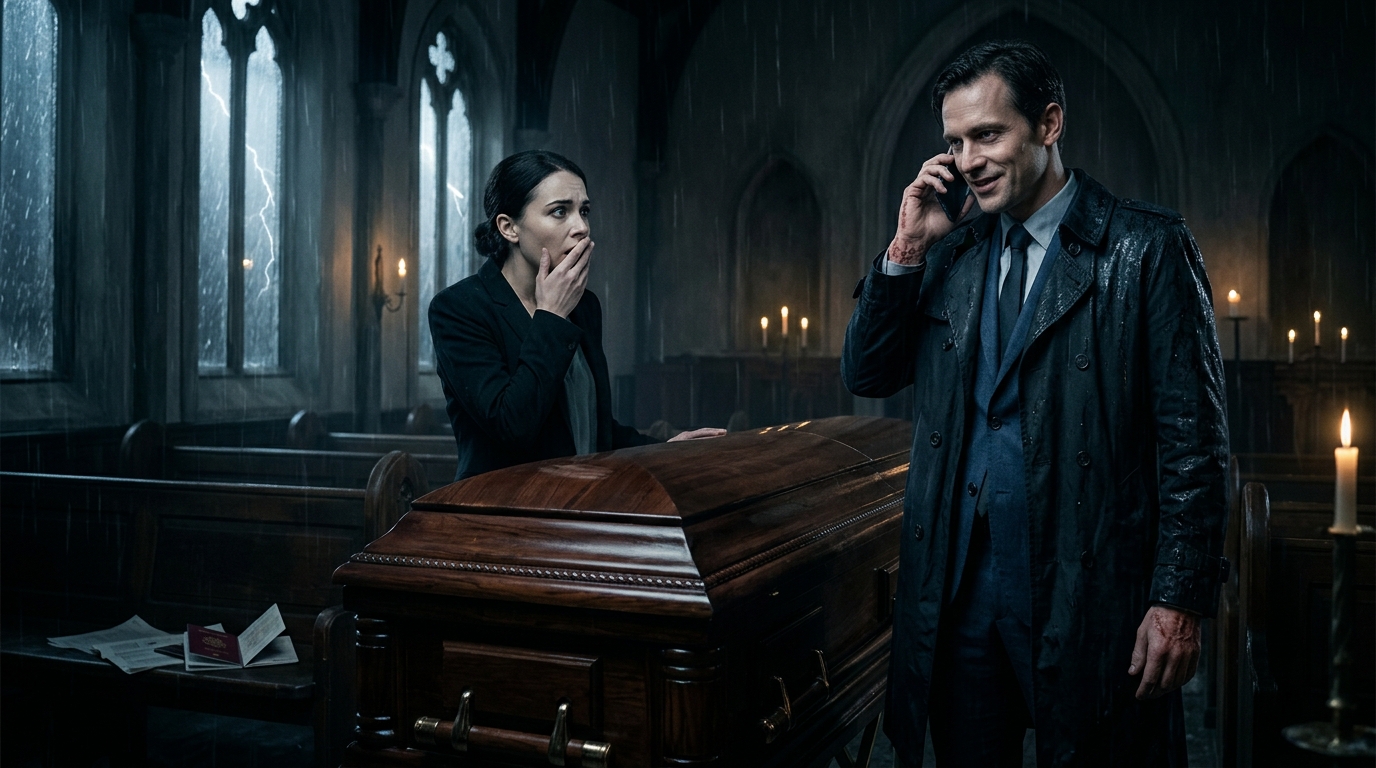
    The coffin sat alone at the center of the room.

    Closed.

    My heart stopped.

    It had been empty.

    I knew it had.

    I had seen it.

    Slowly, I stepped toward it.

    The room smelled different now.

    Not flowers.

    Medicine.

    Sharp.

    Chemical.

    The kind of smell hospitals use to hide fear.

    I looked around.

    No one.

    Rain hammered the stained-glass windows overhead.

    The candles trembled.

    Then I heard it.

    Coc.

    Coc.

    Coc.

    Tiny.

    Weak.

    Coming from inside the coffin.

    Every muscle in my body locked.

    Another knock.

    Three taps.

    Desperate.

    Human.

    My knees nearly gave out.

    “Elena?”

    Silence.

    Then—

    Coc.

    Coc.

    Coc.

    I stumbled toward the coffin.

    My fingers slipped against the polished lid as I tried to open it.

    Heavy.

    Too heavy.

    Locked from the outside.

    My panic exploded.

    “She’s alive,” I whispered.

    Oh God.

    She’s alive.

    I grabbed the silver decorative cross resting beside the flowers and jammed it beneath the lid seam.

    The coffin shifted slightly.

    Inside, something moved weakly.

    A muffled sound.

    Not a ghost.

    Not imagination.

    A living woman buried inside her own funeral.

    I reached for my phone.

    Emergency services.

    Call now.

    My thumb shook against the screen.

    Then the chapel doors slammed shut behind me.

    I froze.

    The lock clicked.

    Slowly.

    Deliberately.

    I turned around.

    Adrian stood at the entrance.

    No umbrella.

    No expression.

    Rainwater dripped from his coat onto the chapel floor.

    In the candlelight, he looked less like a grieving husband and more like a man walking back to finish work he thought was already done.

    My phone slipped slightly in my hand.

    He noticed.

    Of course he did.

    His eyes moved from my face to the half-open coffin.

    Then to the blue cloth still clenched in my fingers.

    Then to the locker key hanging from my wrist.

    He sighed softly.

    Not angry.

    Disappointed.

    “You opened the locker.”

    Not a question.

    I backed away from him instinctively.

    The coffin knocked again behind me.

    Weak.

    Slower now.

    Adrian’s gaze shifted toward it.

    “She should have died two hours ago.”

    Ice flooded my body.

    “You buried her alive.”

    He looked genuinely confused by my tone.

    “As opposed to what?”

    The calmness frightened me more than shouting ever could.

    I lifted my phone.

    “I’m calling an ambulance.”

    “No.” His voice stayed gentle. “You’re calling attention.”

    The coffin moved again.

    A faint choking sound came from inside.

    My chest tightened painfully.

    “She’s alive!”

    “She is inconvenient.”

    I stared at him.

    No human face should stay that calm while saying something like that.

    Adrian stepped closer.

    “You are intelligent, Naya. That is unfortunate.”

    I backed into the coffin.

    Behind me, Elena knocked weakly against the lid.

    Still alive.

    Still fighting.

    Still trapped inches from air.

    “Who are you?” I whispered.

    He smiled faintly.

    “That depends which passport you found.”

    The candle flames bent suddenly as thunder shook the building.

    The stained-glass windows rattled.

    Adrian loosened one cuff slowly.

    The silver cufflink hit the floor with a soft click.

    Beneath his sleeve, along his wrist, ran a pale burn scar shaped almost like melted fingerprints.

    Not old enough to disappear completely.

    Fire damage.

    My eyes widened.

    The hospital reconstruction file.

    The dead Adrian Vale.

    Daniel Mercer.

    The stolen identity.

    He saw me connect it.

    Good.

    He wanted me to.

    “Adrian Vale died six years ago,” I whispered.

    The smile reached his eyes this time.

    “Correct.”

    “Then who are you?”

    He tilted his head slightly.

    “The man Elena married by mistake.”

    The coffin slammed once from inside.

    Harder.

    Elena was running out of time.

    I lunged toward the lid again.

    Adrian moved instantly.

    His hand caught my wrist and shoved me backward against the pews.

    Pain exploded through my shoulder.

    The phone skidded across the chapel floor.

    He crouched beside me calmly.

    Not breathing hard.

    Not angry.

    Just focused.

    “She was never my wife,” he said softly. “She was the only person alive who knew I stole her husband’s identity.”

    My blood turned cold.

    Daniel Mercer.

    The man from the passport.

    The real husband.

    Dead.

    Replaced.

    Buried beneath another man’s name.

    The coffin knocked again.

    Weak now.

    Too weak.

    I looked toward it desperately.

    “Please,” I whispered. “She’s dying.”

    Adrian followed my gaze.

    Then looked back at me.

    “You still think this funeral is about death.”

    His fingers tightened around my wrist.

    “It’s about witnesses.”

    The chapel lights flickered violently.

    One candle blew out.

    Then another.

    The coffin suddenly shook from the inside.

    A choking scream burst through the lid.

    And from somewhere inside Adrian’s coat pocket, a phone began ringing.

    He frowned slightly.

    Annoyed.

    He answered without taking his eyes off me.

    “Yes?”

    Silence.

    Then, for the first time, his expression changed.

    Not fear.

    Shock.

    He turned slowly toward the coffin.

    The voice on the phone shouted loud enough for me to hear:

    “Sir… the real Adrian Vale just walked into the reception hall.”

  • I Was Paid To Cry At A Stranger’s Funeral. Then The Dead Woman Left Me A Message In Her Hand

    I Was Paid To Cry At A Stranger’s Funeral. Then The Dead Woman Left Me A Message In Her Hand

    The Funeral With No Real Tears

    The first thing I noticed about the funeral was the silence.

    Not grief.

    Not mourning.

    Silence.

    The kind that feels rehearsed.

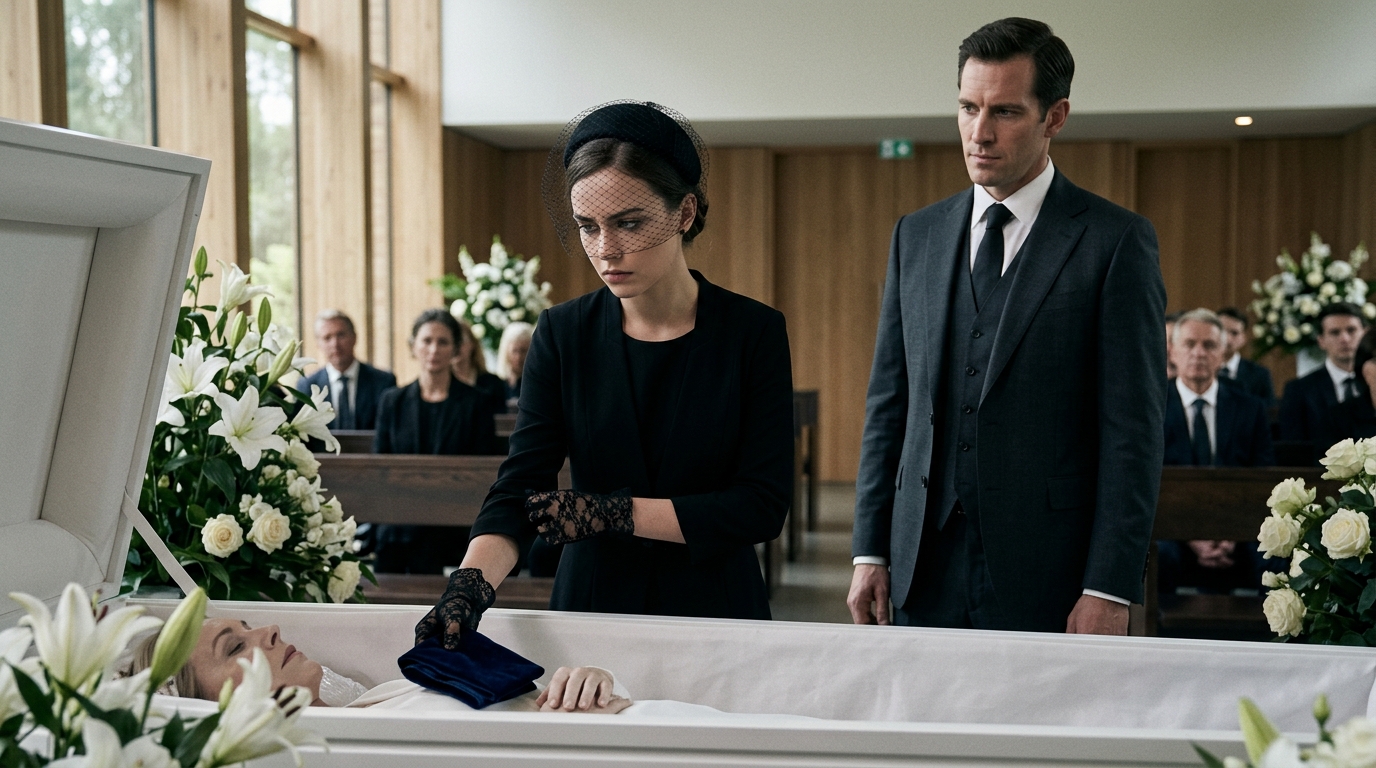
    Rain hammered softly against the windows of the funeral home while candles flickered along the walls in uneven lines of gold. The chapel smelled of lilies, wet wool coats, and expensive perfume trying too hard to hide something rotten underneath.

    At the center of the room sat a white coffin surrounded by flowers.

    Too many flowers.

    Rich people always use too many flowers when they want death to look beautiful.

    I stood near the back with six strangers dressed in black.

    None of us knew the dead woman.

    That was the job.

    Cry.

    Lower your head.

    Hold tissues.

    Make the room feel loved.

    I had been doing funeral work for almost a year by then.

    Not because I enjoyed it.

    Because grief pays strangely well when rich people are afraid of empty seats.

    Some families hire musicians.

    Some hire priests.

    Some hire fake mourners because silence terrifies them more than death.

    The woman who booked us had called three nights earlier.

    Private funeral.

    Cash payment.

    No questions.

    The instructions were simple.

    Cry often.

    Do not speak to the family.

    Do not approach the coffin.

    Especially do not approach the husband.

    That last rule stayed with me.

    People only create rules around the things they fear.

    I adjusted the sleeves of my black dress and looked toward the front row.

    That was where I saw Adrian Vale for the first time.

    He stood beside the coffin with one hand resting lightly against the polished wood.

    Tall.

    Perfect posture.

    Dark charcoal suit.

    Silver cufflinks.

    A wedding ring that caught candlelight every time he moved his fingers.

    His wife’s body was six inches away from him.

    But his face looked like he was waiting for a business meeting to end.

    No tears.

    No shaking hands.

    No grief.

    Just patience.

    The priest spoke softly about tragedy.

    About love.

    About devotion.

    Adrian nodded at the right moments.

    Too perfectly.

    Like a man performing sadness from memory instead of feeling it.

    I should have looked away.

    I did not.

    Maybe because my own father cried harder over dead stray cats than this man did over his wife.

    Maybe because rich men with calm faces always make me nervous.

    Or maybe because the dead woman looked wrong.

    Even from across the room, I could tell something about her body felt unfinished.

    Not damaged.

    Not peaceful either.

    Unfinished.

    Like she had been interrupted in the middle of trying to say something.

    The Woman In The Coffin

    Her name was Elena Vale.

    Thirty-four years old.

    Philanthropist.

    Art collector.

    Founder of a children’s foundation.

    That was what the funeral pamphlet said.

    The photograph beside the coffin showed a woman with dark hair, pale skin, and eyes too intelligent for the smile she wore.

    Not beautiful in the soft, harmless way magazines like.

    Beautiful in the dangerous way people become when they notice everything.

    The kind of woman who made other people uncomfortable by remaining quiet too long.

    I stared at the photo while the priest continued speaking.

    Then I looked at Adrian again.

    He never once looked at the photograph.

    Only the guests.

    Watching them.

    Counting them.

    A young server passed through the chapel carrying silver trays of champagne no one touched.

    Candles flickered harder every time thunder rolled outside.

    The funeral home lights dimmed briefly.

    And for one second, I thought I saw Elena’s eyes open inside the coffin.

    I froze.

    The room returned to normal immediately.

    The dead woman lay still beneath white silk.

    My heart kept racing anyway.

    Beside me, another hired mourner whispered, “You okay?”

    I nodded too quickly.

    “Just tired.”

    That was a lie.

    I was unsettled.

    There is a difference.

    The funeral director approached our row quietly.

    “More emotion,” he whispered.

    I almost laughed.

    More emotion.

    As if grief were stage lighting that needed adjustment.

    The woman beside me sniffled louder on command.

    Another man lowered his head dramatically.

    I pressed tissue against my eyes and forced myself to move closer to the coffin.

    The closer I got, the colder the room became.

    Not temperature.

    Something else.

    Pressure.

    Like the air near Elena Vale carried weight.

    Candles reflected against the polished coffin lid.

    Rain slid down the chapel windows in silver streaks.

    Adrian finally looked directly at me.

    His eyes were gray.

    Not soft gray.

    Storm gray.

    Sharp enough to cut through makeup and fake tears and see exactly what a person was pretending to be.

    For one terrible second, I thought he somehow knew I did not belong there.

    Then he smiled politely.

    That scared me more.

    Because cruel men are easy to survive once you recognize them.

    Polite men take longer.

    The Blue Cloth

    The priest announced the final viewing.

    Guests rose slowly from the pews.

    Some approached the coffin genuinely crying.

    Others looked relieved the ceremony was almost over.

    I moved with the crowd, head lowered, tissue against my face, pretending to mourn a woman whose laugh I had never heard.

    That was when I saw her hand.

    Elena’s right hand rested against the white lining inside the coffin.

    Pale fingers.

    Wedding ring still in place.

    Nails painted soft ivory.

    Beautiful.

    Carefully arranged.

    Except for one thing.

    Something blue was trapped between her fingers.

    At first, I thought it was ribbon.

    Then I realized she was gripping it.

    Not tightly.

    But intentionally.

    A small strip of dark blue fabric no bigger than two fingers wide.

    My pulse quickened.

    People hide things with dead bodies sometimes.

    Notes.

    Jewelry.

    Letters.

    But dead people do not usually hide things themselves.

    I looked toward Adrian.

    He was speaking quietly with an older woman near the front row.

    Not watching the coffin.

    Not watching me.

    The funeral director moved toward another family.

    Nobody was paying attention.

    I should have stepped away.

    Instead, I leaned closer to the coffin and lowered my head like I was overcome with grief.

    My tears fell onto the white silk lining.

    Fake tears.

    Real fear.

    I whispered, “I’m sorry.”

    I do not know why I said that.

    Maybe because suddenly the dead woman felt less dead and more trapped.

    My fingers brushed against her hand.

    Cold.

    Too cold.

    I slid the fabric gently free from her fingers.

    The movement was tiny.

    Barely noticeable.

    But the moment the cloth left Elena’s hand, the chapel lights flickered again.

    Harder this time.

    The candles trembled.

    One went out completely.

    A woman near the back gasped.

    I hid the blue cloth inside my sleeve immediately.

    Then I looked up.

    Adrian was staring directly at me.

    Not at the coffin.

    Not at the mourners.

    Me.

    His expression did not change.

    But his eyes had.

    They no longer looked polite.

    They looked calculating.

    Like a man mentally rearranging a problem.

    My stomach tightened.

    I stepped backward slowly into the crowd.

    The blue cloth burned against my wrist inside my sleeve.

    The priest began the final prayer.

    Thunder shook the windows.

    And Adrian Vale never looked away from me again.

    The Message Hidden In Her Hand

    The burial did not happen immediately.

    Storm flooding delayed transport to the cemetery, so guests gathered in the reception hall beside the chapel while staff prepared the hearse.

    That gave me ten minutes alone.

    Ten minutes too many.

    I locked myself inside the women’s restroom and pulled the blue cloth from my sleeve.

    It was darker than I thought.

    Not ribbon.

    Fabric torn from clothing.

    Expensive fabric.

    Maybe silk.

    One edge had dried brown stains along the thread.

    Blood.

    My hands started shaking.

    I unfolded the cloth carefully.

    At first, I saw nothing.

    Then the restroom light flickered overhead.

    A line of embroidery caught the light.

    Tiny silver stitching.

    Words.

    Not decorative.

    A message.

    HE IS NOT MY HUSBAND.

    My breath stopped.

    I read it again.

    HE IS NOT MY HUSBAND.

    Not “he killed me.”

    Not “help.”

    Not “run.”

    Something stranger.

    Something worse.

    The man crying beside the coffin was not her husband.

    Then who was he?

    And why was he standing in a funeral pretending to be one?

    A soft knock hit the restroom door.

    I nearly dropped the cloth.

    “Naya?”

    A woman’s voice.

    One of the hired mourners.

    “You okay in there?”

    “Yes.”

    My voice cracked.

    I shoved the fabric back into my sleeve and splashed cold water onto my face.

    When I looked up at the mirror, my reflection seemed unfamiliar.

    Pal er.

    Sharper.

    Like fear had adjusted my features while I was not looking.

    I unlocked the restroom door and stepped back into the hallway.

    The reception room beyond was filled with low conversations and the sound of glasses clinking softly.

    No one looked grieving anymore.

    That disturbed me most.

    People stop performing sadness surprisingly quickly once food appears.

    I moved toward the side exit.

    I wanted air.

    Distance.

    A taxi.

    Anything far from that building.

    Then someone touched my elbow.

    I froze.

    Adrian Vale stood beside me.

    Too close.

    I had not heard him approach.

    Up close, he smelled faintly of cedarwood and rainwater.

    Not alcohol.

    Not cigarettes.

    Nothing messy.

    Nothing human enough to comfort me.

    His gaze dropped briefly toward my sleeve.

    Then back to my face.

    “You’re very convincing,” he said softly.

    I forced a nervous smile.

    “I’m sorry?”

    “The crying.” His expression remained calm. “Most people overact.”

    Thunder rolled outside.

    The hallway lights dimmed again.

    I tried to step away.

    His fingers tightened slightly around my elbow.

    Not enough to bruise.

    Enough to remind me he could.

    My pulse pounded in my throat.

    “I should get back,” I whispered.

    He tilted his head.

    “You saw something.”

    Not a question.

    A statement.

    I said nothing.

    His eyes held mine for a long moment.

    Then he leaned closer.

    Close enough that only I could hear him.

    “You touched something you shouldn’t have touched.”

    Ice spread through my stomach.

    He knew.

    Of course he knew.

    I tried pulling my arm free.

    He let go immediately.

    That frightened me more than if he had resisted.

    Because it meant he was confident I was not leaving.

    Behind him, guests continued drinking champagne beneath soft music and candlelight.

    Nobody noticed us.

    Nobody wanted to.

    Adrian smiled gently.

    The same perfect smile he used beside the coffin.

    “Curiosity,” he whispered, “has ruined many women in this family.”

    Family.

    Not marriage.

    Family.

    Before I could answer, the funeral home lights went out completely.

    Darkness swallowed the hallway.

    Someone screamed in the reception room.

    Glasses shattered.

    Then, from inside the chapel where Elena’s coffin still rested, a woman’s voice whispered clearly through the dark.

    “He buried the wrong wife.”

    The lights came back on.

    Everyone froze.

    Adrian’s face had finally changed.

    For the first time since I met him, he looked afraid.

    And behind him, through the open chapel doors, Elena Vale’s coffin was empty.

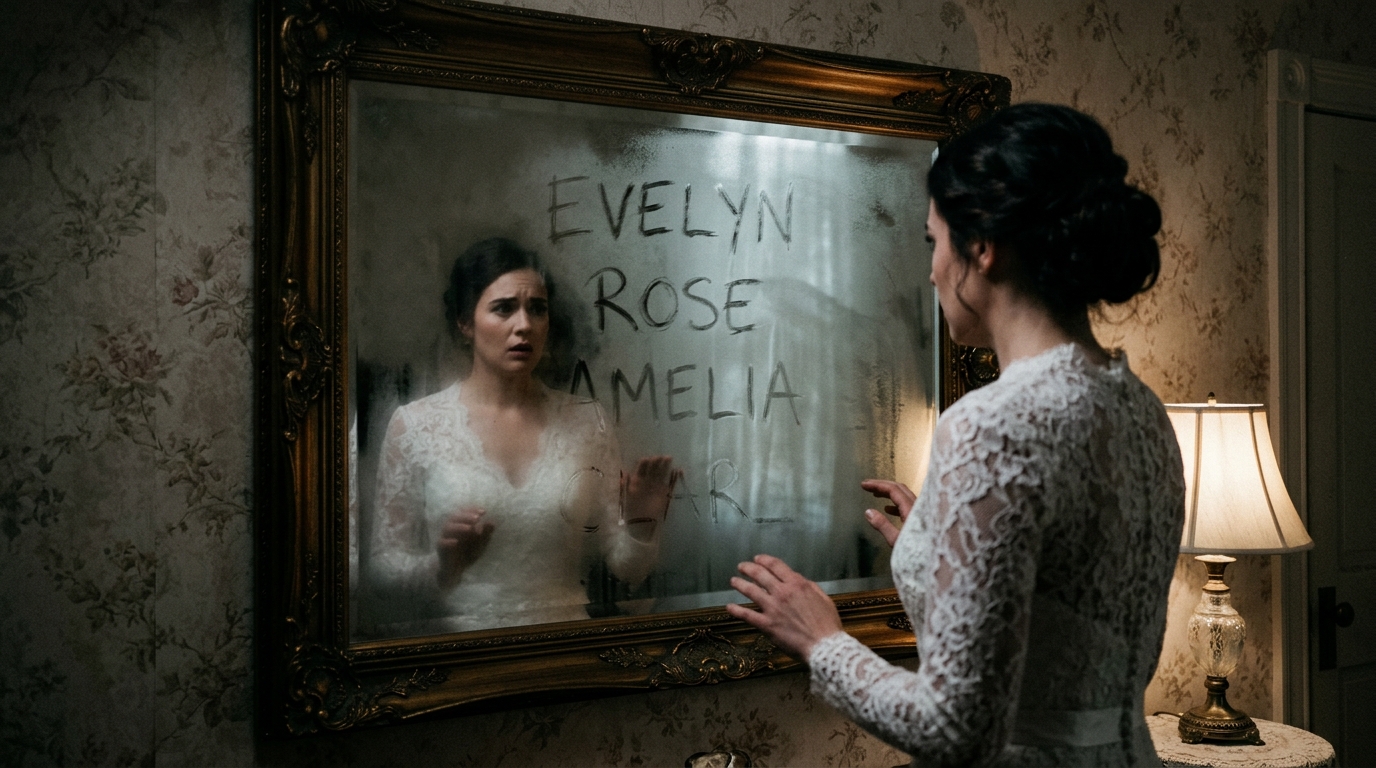
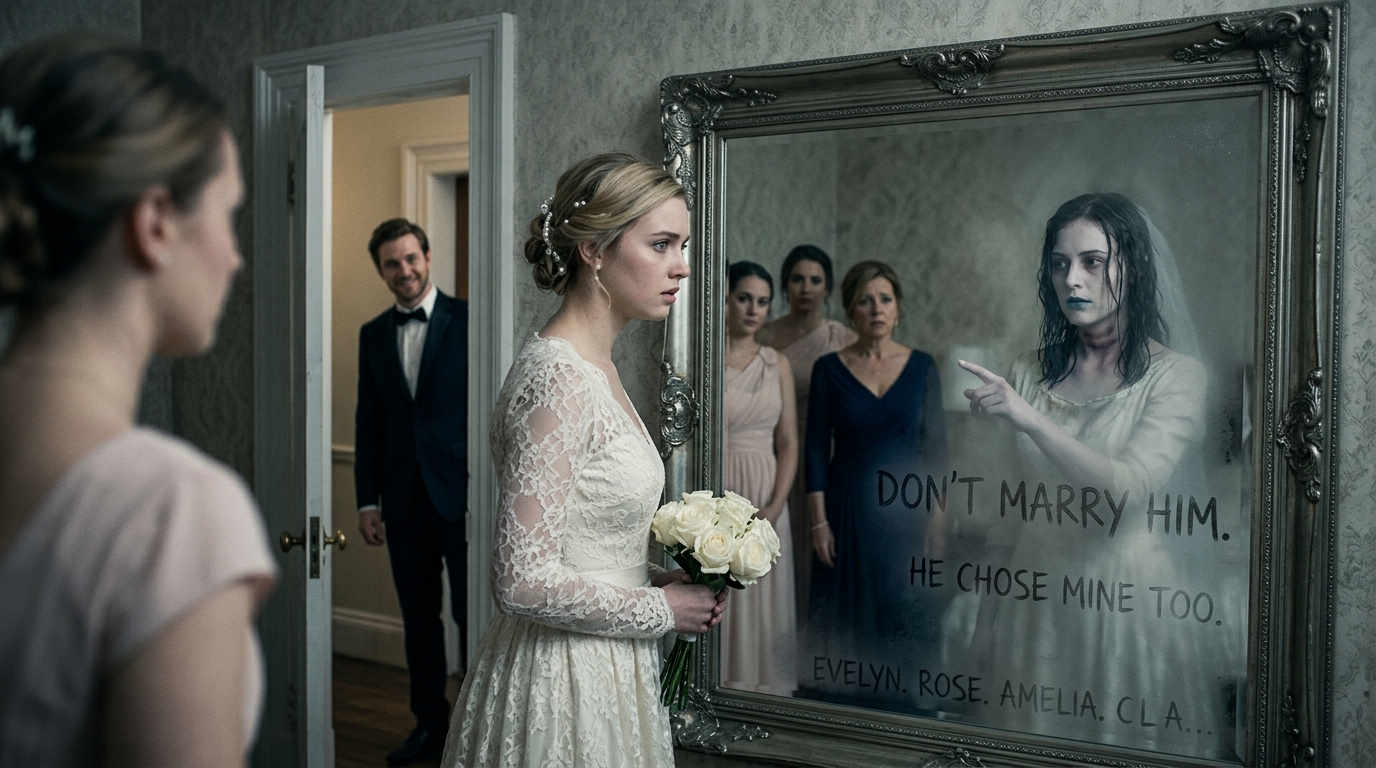
  • I Found Three Dead Brides’ Names Hidden Inside My Wedding Dress. Then A Text Message Said I Was The Fourth

    I Found Three Dead Brides’ Names Hidden Inside My Wedding Dress. Then A Text Message Said I Was The Fourth

    The Door I Locked

    I slammed the bridal room door in Nathaniel’s face.

    For one second, nobody moved.

    Not Olivia.

    Not Maren.

    Not my mother.

    Not me.

    The sound of the lock turning felt louder than the wedding music outside.

    Click.

    A tiny sound.

    A useless sound.

    The kind of sound people make when they want to believe a locked door can stop a man who has already entered their life.

    Nathaniel stood on the other side.

    Silent.

    That scared me more than if he had shouted.

    I pressed my back against the door, both hands shaking so badly the lace sleeves trembled against my skin.

    Outside, the processional music continued.

    Guests were waiting.

    Candles were burning.

    White flowers lined the aisle.

    Somewhere downstairs, people were smiling at a wedding that suddenly felt less like a ceremony and more like an arranged execution.

    Olivia rushed to me.

    “Clara, what are we doing?”

    I looked at the mirror.

    The black wooden frame stood against the wall, cracked through the center, fog still clinging to the glass like breath from someone trapped inside.

    Evelyn.

    Rose.

    Amelia.

    My name had begun to appear beneath theirs.

    C.

    L.

    A.

    Then I had locked the door.

    The letters remained unfinished.

    For now.

    My mother sat on the edge of the sofa, both hands over her mouth, crying in a way I had never seen before.

    Not dramatically.

    Not loudly.

    Quietly.

    Like a woman who had known the ending for years and had still allowed the story to reach the last chapter.

    I turned to her.

    “You knew.”

    She shook her head.

    “No.”

    The lie fell between us.

    Weak.

    Embarrassing.

    I stared at her until her face crumpled.

    “I knew there were rumors.”

    “Rumors?”

    My voice sounded strange.

    Too calm.

    “You saw the mirror. You saw the names. You saw the women behind me.”

    My mother looked toward the glass and flinched.

    “Your father said it was impossible. He said Nathaniel was good for this family.”

    Good for this family.

    Not good for me.

    I almost laughed.

    Then Nathaniel knocked.

    Three gentle taps.

    “Clara.”

    His voice came through the door like warm honey poured over broken glass.

    “Darling, open the door.”

    Olivia grabbed a chair and shoved it under the handle.

    Maren was sobbing near the closet, one hand pressed against the red mark Nathaniel’s fingers had left on her wrist.

    Nathaniel knocked again.

    Still gentle.

    Still patient.

    Still certain.

    “We’re going to be late.”

    I looked down at the wedding dress.

    At the pearl buttons.

    The satin.

    The lace.

    The gown Nathaniel had chosen.

    The gown the mirror said belonged to someone else.

    Then I knew where to start.

    “Help me take it off,” I said.

    The Dress Was Not New

    Olivia stared at me.

    “What?”

    “The dress.” I clawed at the pearl buttons near my ribs. “Get it off.”

    Maren wiped her face and ran to me.

    My mother stood too quickly.

    “Clara, don’t ruin the gown.”

    I turned on her.

    “Ruin the gown?”

    She froze.

    I saw shame flash across her face.

    Good.

    Let it.

    Olivia moved behind me and began undoing the buttons with shaking fingers.

    There were too many of them.

    Pearl after pearl.

    Button after button.

    Each one slipped free with a soft pop, like tiny bones breaking.

    Nathaniel’s voice floated through the door.

    “Clara, your mother is in there, isn’t she?”

    My mother looked at the door.

    “Margaret,” he said softly, “tell her this is hysteria.”

    I stared at my mother.

    She did not answer.

    For the first time that day, she did not obey him.

    The last button came loose.

    Olivia pulled the dress down from my shoulders.

    Cold air struck my skin.

    I stepped out of it and stood in my slip, barefoot on the blue carpet, watching the gown collapse to the floor in a heap of expensive white fabric.

    It looked dead.

    Maren knelt beside it.

    “We need scissors.”

    Olivia grabbed a manicure kit from the vanity.

    Tiny scissors.

    Useless-looking.

    But enough.

    We turned the gown inside out.

    That was when we saw the stains.

    Not outside.

    Inside.

    Along the lining.

    Faint yellow marks near the waist.

    A brownish smudge at the collar seam.

    Thread that had been repaired by hand.

    Twice.

    Olivia looked up slowly.

    “Clara…”

    “What?”

    She swallowed.

    “This isn’t a new dress.”

    The room went silent.

    Even my mother stopped crying.

    Olivia touched the inner seam with two fingers.

    “These stitches are old. Someone altered it. More than once.”

    Maren whispered, “How is that possible? Nathaniel said it was custom.”

    Nathaniel heard his name.

    “Clara,” he called through the door. “I can hear you moving around.”

    Nobody answered him.

    I took the scissors from Olivia and cut into the lining near the left side of the waist.

    My hands were not shaking anymore.

    That frightened me.

    The first slit opened.

    Nothing.

    I cut lower.

    Satin.

    Thread.

    A small hidden pocket.

    My breath stopped.

    I reached inside and pulled out a folded piece of paper.

    Old.

    Thin.

    Soft at the edges from being touched too many times.

    One name was written on it in dark blue ink.

    Evelyn Hart.

    Wedding date: June 14.

    Died: June 13.

    Maren made a sound like she was going to be sick.

    Olivia covered her mouth.

    I cut the other side of the lining.

    Another hidden pocket.

    Another piece of paper.

    Rose Whitcomb.

    Wedding date: September 3.

    Died: September 2.

    My mother whispered, “No.”

    I cut beneath the collar.

    A third pocket.

    A third name.

    Amelia Crane.

    Wedding date: April 21.

    Died: April 20.

    All one day before the wedding.

    All brides.

    All dead.

    All hidden inside the dress I was supposed to wear down the aisle.

    Olivia backed away from the gown.

    Her face was white.

    “Clara,” she whispered, “this is not a wedding dress.”

    The mirror fogged behind us.

    The cracked glass breathed.

    A message appeared slowly.

    NO.

    NOT A DRESS.

    A RECORD.

    The Text Message

    My phone buzzed on the vanity.

    The sound made all of us jump.

    I stared at it.

    Unknown number.

    For a second, I thought it would be Nathaniel.

    Or someone working for him.

    Or something worse.

    Then the screen lit up with a text.

    You are the fourth bride.

    No punctuation.

    No threat.

    No explanation.

    Just a sentence that had been waiting for me to become true.

    Olivia grabbed the phone.

    “Who sent that?”

    I took it from her.

    There was no number.

    No contact.

    No profile photo.

    Just the message.

    Then another came through.

    He always chooses the dress himself.

    My skin went cold.

    A third message appeared.

    Look at the bouquet.

    I turned slowly toward the chair beside the vanity.

    My bridal bouquet lay there, perfect and white.

    Roses.

    Orchids.

    Tiny pearl pins.

    A satin ribbon wrapped tightly around the stems.

    Nathaniel had sent it that morning with a handwritten note.

    For my unforgettable bride.

    I hated that word now.

    Unforgettable.

    Like a promise.

    Or a warning.

    The mirror shifted.

    Inside the glass, Evelyn stood behind me again.

    Not alone.

    Rose and Amelia stood beside her.

    Three dead brides in old white gowns, their throats shadowed with bruises.

    Evelyn raised one hand to her neck.

    Then pointed toward the bouquet.

    Her lips moved.

    This time, I understood without hearing.

    Hurry.

    Nathaniel knocked again.

    Not gentle now.

    Harder.

    “Clara.”

    Olivia stepped toward the door.

    “Go away!”

    Silence.

    Then Nathaniel laughed softly.

    “Olivia, you are making this worse for her.”

    “For her?” Olivia snapped. “Or for you?”

    His voice dropped.

    “Open the door.”

    Maren moved closer to me.

    My mother stood slowly.

    “Clara,” she whispered. “Maybe we should call security.”

    Olivia stared at her.

    “Security works for his family.”

    The truth of that sentence settled over us.

    The Ashford family owned Saint Aurelia House.

    The hotel.

    The chapel.

    The bridal room.

    Maybe even the mirror.

    No.

    I looked back at the glass.

    Not the mirror.

    The mirror did not belong to him.

    Not anymore.

    I picked up the bouquet.

    It was heavier than it should have been.

    The flowers were wrapped too tightly.

    The satin ribbon had been tied in a perfect bow.

    Perfect things were beginning to make me sick.

    I tore at the ribbon.

    It did not come loose.

    Olivia handed me the scissors.

    I cut through the satin.

    The bouquet loosened.

    White petals fell to the carpet.

    A pearl pin rolled under the vanity.

    Then something small and black dropped into my palm.

    A recording device.

    Maren gasped.

    My mother whispered, “What is that?”

    I knew what it was.

    I had used one in college for interviews.

    A micro recorder.

    Still active.

    A red light blinked once.

    Then twice.

    It had been recording us.

    The whole time.

    His Voice In The Flowers

    I pressed play.

    For a moment, there was only static.

    Then Nathaniel’s voice filled the room.

    Not the voice at the door.

    Not warm.

    Not sweet.

    This voice was flat.

    Bored.

    Real.

    “After the ceremony, the transfer clause activates.”

    Another voice answered.

    Older.

    Male.

    His father, maybe.

    “Only if she signs the revised trust before midnight.”

    “She will.”

    “You said that about Amelia.”

    A pause.

    Then Nathaniel laughed.

    My stomach turned.

    “Amelia was sentimental. Clara is lonely. There’s a difference.”

    My mother made a broken sound.

    I looked at her.

    Lonely.

    Was that what he had seen when he met me?

    Not kindness.

    Not love.

    A weakness.

    The recording continued.

    “What about her mother?”

    Nathaniel’s voice again.

    “Margaret wants status more than she wants truth.”

    My mother folded in on herself.

    No one comforted her.

    Not yet.

    We kept listening.

    The older man said, “And if the girl changes her mind?”

    Nathaniel sighed.

    Then came the sentence that removed the last human thing from him.

    “After the wedding, her assets belong to me. If she refuses before then, we repeat the old solution.”

    Maren whispered, “Old solution?”

    The answer came in Nathaniel’s own voice.

    “A dead bride is tragic. A runaway bride is embarrassing. Tragedy gets sympathy.”

    Nobody spoke.

    The recording clicked.

    Then another sound came through.

    A woman crying.

    Not me.

    Not Olivia.

    Someone else.

    A voice faint beneath the static.

    Evelyn.

    “Please. I don’t want to marry him.”

    Then a man’s voice.

    Nathaniel’s voice.

    Younger.

    Sharper.

    “You should have thought of that before you signed.”

    A thud.

    A gasp.

    The recording ended.

    I stared at the device in my hand.

    For a moment, I could not feel my body.

    Nathaniel had recorded himself.

    Or someone had recorded him.

    The bouquet had not been sent to spy on me.

    It had been sent to warn me.

    The mirror fogged again.

    Evelyn raised both hands and pressed them against the glass from the inside.

    Words appeared beneath her palms.

    WE HID IT WHERE HE NEVER LOOKS.

    Olivia whispered, “Where?”

    The three brides in the mirror turned their heads together.

    Their eyes moved to Nathaniel’s reflection.

    Then to the bouquet.

    Then to the dress.

    Then back to me.

    The message changed.

    NOT GHOSTS.

    EVIDENCE.

    That was when I understood.

    The mirror was not haunted.

    Not the way I thought.

    It was a system.

    A hiding place.

    A dead woman’s trap.

    The victims had used the mirror, the dress, the bouquet, anything bridal enough for Nathaniel to ignore after each murder, to leave clues for the next woman.

    For me.

    The mirror had not come to kill me.

    It was trying to keep me alive.

    The Fourth Bride

    Nathaniel hit the door.

    Once.

    Hard.

    The chair under the handle jumped.

    Maren screamed.

    Olivia grabbed the heavy crystal perfume bottle from the vanity and held it like a weapon.

    My mother stood between me and the door.

    Too late.

    But still.

    That mattered.

    “Clara,” Nathaniel said.

    His voice had changed.

    No sweetness.

    No warmth.

    Just the man from the recording.

    “You are confused. Open the door.”

    I looked at the recorder in my hand.

    Then at the notes from the dress.

    Evelyn.

    Rose.

    Amelia.

    All dead one day before their weddings.

    All wearing the same dress.

    All trapped in a story people called tragedy because murder was too inconvenient.

    I turned on my phone camera and started recording.

    “My name is Clara Avery,” I said, my voice shaking but clear. “I am in the bridal room at Saint Aurelia House. Nathaniel Ashford is outside the door. I found three names hidden inside my wedding dress. Evelyn Hart, Rose Whitcomb, and Amelia Crane. Each died one day before her wedding.”

    Olivia moved beside me and held up the recorder.

    “This was hidden in the bouquet,” I continued. “It contains Nathaniel’s voice discussing my assets after marriage.”

    Nathaniel went silent outside the door.

    Good.

    He was listening.

    I walked to the mirror.

    My reflection still was not there.

    But the three dead brides were.

    Evelyn stepped closest to the glass.

    Her bruised throat was dark beneath the veil.

    She lifted one finger and pointed down.

    At the mirror frame.

    The black carved wood with silver vines twisting around it.

    I crouched.

    At the bottom of the frame, beneath one carved leaf, was a tiny screw.

    Loose.

    Olivia saw it too.

    She dropped beside me.

    “Here.”

    We twisted it with the scissors.

    The piece of wood came free.

    Inside was a narrow compartment.

    My heart pounded.

    I reached in.

    And pulled out a flash drive.

    White.

    Covered in old scratches.

    Written on it in red marker were four words.

    FOR THE FOURTH BRIDE.

    My name did not need to be written.

    The room knew.

    The mirror knew.

    Nathaniel knew.

    The door shook again.

    The chair cracked under the pressure.

    Maren sobbed.

    My mother shouted, “Stop it, Nathaniel!”

    His answer came through the wood.

    “She’s mine after the vows.”

    The sentence chilled the room.

    I stood slowly.

    “No,” I said.

    My voice was quiet.

    But everyone heard it.

    “I’m not yours.”

    The mirror flickered.

    For the first time all day, my reflection appeared.

    Not fully.

    Only my eyes.

    Wide.

    Terrified.

    Alive.

    Then Evelyn’s reflection stepped behind me and placed one pale hand over my shoulder.

    The glass fogged.

    One final message appeared.

    SEND IT BEFORE HE ENTERS.

    Olivia grabbed my phone.

    “Where?”

    I looked at the flash drive.

    At the recorder.

    At the notes.

    At the three brides in the mirror.

    Then at my mother.

    “Everyone.”

    The doorframe cracked.

    Nathaniel slammed into it again.

    This time, the chair splintered.

    Olivia plugged the flash drive into the wedding planner’s laptop on the vanity.

    The screen lit up.

    Folders appeared.

    EVELYN.

    ROSE.

    AMELIA.

    CLARA.

    My folder was already there.

    Created three weeks ago.

    Inside were documents Nathaniel had prepared before the wedding.

    Prenup amendments.

    Trust transfer forms.

    Insurance policies.

    Medical waivers.

    And one file titled:

    ACCIDENT PLAN.

    My blood turned cold.

    Before I could open it, the laptop screen went black.

    Then one line appeared in white text.

    UPLOAD COMPLETE.

    Olivia looked at me.

    “I didn’t do that.”

    The mirror cracked louder.

    The three brides turned toward the door.

    Nathaniel stopped hitting it.

    For the first time, he sounded uncertain.

    “Clara?”

    From somewhere outside the bridal room, phones began ringing.

    One.

    Then another.

    Then dozens.

    Guests.

    Staff.

    Family.

    The evidence had gone out.

    The dead brides had learned how to use a wedding against the groom.

    The door handle moved slowly.

    This time, not from Nathaniel.

    From the other side of the room.

    The closet.

    The closet door opened by itself.

    Inside, behind the hanging garment bags, was a narrow service passage.

    Dark.

    Waiting.

    Evelyn’s reflection pointed toward it.

    RUN.

    The bridal room door burst open.

    Nathaniel stepped inside.

    His smile was gone.

    In his hand was the same white rose from his lapel.

    Only now, the stem was stained red.

    He looked at the mirror.

    Then at the open laptop.

    Then at me.

    “What did you send?”

    The three dead brides in the mirror smiled.

    And from the hallway behind Nathaniel, a police siren began to scream.

  • I Looked Into The Bridal Mirror On My Wedding Day. Everyone Had A Reflection Except Me

    I Looked Into The Bridal Mirror On My Wedding Day. Everyone Had A Reflection Except Me

    The Mirror In The Bridal Room

    I was supposed to be the happiest woman in the building.

    That was what everyone kept telling me.

    My mother said it while fixing the pearls in my hair.

    My bridesmaids said it while taking pictures of the dress.

    The wedding planner said it every time she opened the door with another emergency no bride was supposed to notice.

    You look perfect, Clara.

    You’re glowing, Clara.

    This is your day, Clara.

    But the bridal room was too cold.

    Not chilly.

    Cold.

    The kind of cold that sits against your skin like a warning.

    Blue light spilled through the tall windows, washing the white walls, the white roses, the white silk robe on the chair, and the white wedding gown around my body until everything looked less like a wedding and more like a hospital room where someone had tried to hide the blood.

    I stood in the center of the room while three women moved around me.

    My maid of honor, Olivia, zipped the back of my dress.

    My cousin Maren pinned the veil.

    My mother stood behind them, crying softly into a folded tissue.

    The dress was beautiful.

    Too beautiful, maybe.

    Ivory satin.

    Long sleeves.

    A narrow waist.

    Pearl buttons down the spine.

    A train so long it needed its own attendant.

    Nathaniel had chosen it.

    That was the first thing I had not wanted to admit.

    He did not force me.

    Not exactly.

    He only smiled when I tried on the dress I liked and said, “It’s sweet, but not unforgettable.”

    Then he had handed the consultant another gown.

    This gown.

    The one I was wearing now.

    The one that made everyone gasp.

    The one that made me look less like myself.

    Olivia stepped back and clapped both hands over her mouth.

    “Oh my God,” she whispered. “Clara.”

    I looked at her reflection in the mirror.

    She was crying.

    Maren was smiling.

    My mother was pale.

    The mirror was enormous, older than the hotel itself, framed in black carved wood with small silver vines twisting around the edges. It stood against the far wall of the bridal room, tall enough to show every inch of the gown.

    Every bride who married at Saint Aurelia House took a photograph in front of that mirror.

    That was the tradition.

    Nathaniel’s mother had told me so.

    She had said it with a smile that did not reach her eyes.

    “All Ashford brides stand before the mirror before they walk down the aisle.”

    Ashford brides.

    Not women.

    Not daughters.

    Not people.

    Brides.

    I looked toward the mirror and forced myself to breathe.

    The woman in the glass should have looked like me.

    She should have looked nervous.

    Beautiful.

    Alive.

    But for one second, I saw only the room.

    The blue light.

    The bridesmaids.

    The roses.

    The pearl comb in my mother’s hair.

    The silver tray of untouched champagne.

    Everyone was reflected.

    Everyone.

    Except me.

    The Scream Before The Ceremony

    At first, I thought I had blinked wrong.

    That sounds impossible.

    But the mind does strange things when it is trying to protect itself.

    It turns horror into lighting.

    Into stress.

    Into lack of sleep.

    I stared at the mirror and waited for my reflection to appear.

    It did not.

    Olivia’s reflection stood behind where I should have been, both hands hovering near the zipper of my dress.

    Maren’s reflection was beside her, holding three pearl pins.

    My mother’s reflection was near the sofa.

    Even the champagne flutes on the table were there.

    Even the roses.

    Even the little gold clock above the fireplace.

    But the center of the mirror was empty.

    Where I stood, there was only the blue wall behind me.

    A gap in the world shaped like a bride.

    My stomach dropped.

    I lifted my hand.

    In the room, my hand rose.

    In the mirror, nothing did.

    I took one step forward.

    The dress whispered around my feet.

    The mirror showed the carpet shifting under no one.

    That was when Olivia screamed.

    Not a small scream.

    Not a startled laugh.

    A real scream.

    The kind that tears itself out before pride can stop it.

    Maren dropped the pins.

    They scattered across the floor like tiny teeth.

    My mother turned sharply.

    “What? What happened?”

    Olivia pointed at the mirror.

    Her mouth opened and closed, but no words came out.

    I wanted someone to laugh.

    I wanted Maren to say the mirror was old.

    I wanted my mother to walk over, touch the glass, and make everything normal.

    Instead, all three of them stared.

    At the mirror.

    At the empty space.

    At the place where my reflection should have been.

    Then my mother whispered, “No.”

    That word scared me more than Olivia’s scream.

    Because she did not sound confused.

    She sounded like something she had feared for years had finally arrived on time.

    I turned toward her.

    “Mom?”

    She blinked quickly.

    Too quickly.

    “It’s the light.”

    Her voice shook.

    “It’s just the light.”

    Olivia stared at her.

    “Mrs. Avery, that is not the light.”

    My mother looked at her.

    “Don’t.”

    One word.

    Sharp.

    Terrified.

    Olivia went silent.

    I looked from one woman to the other.

    “What do you mean, don’t?”

    No one answered.

    Outside the bridal room, music began to play.

    Soft strings.

    The prelude.

    The ceremony would start in twenty minutes.

    Twenty minutes before I walked down the aisle toward Nathaniel Ashford.

    Nathaniel, who never raised his voice.

    Nathaniel, who remembered my coffee order.

    Nathaniel, who sent white orchids to my office every Friday.

    Nathaniel, who once told me I looked prettiest when I stopped asking so many questions.

    My mouth went dry.

    I turned back to the mirror.

    The empty space waited.

    Don’t Marry Him

    I moved toward the mirror.

    Olivia grabbed my wrist.

    “Clara, don’t.”

    I looked at her hand.

    She let go immediately.

    “I’m sorry,” she whispered. “I just…”

    She could not finish.

    None of us could finish anything in that room.

    I stepped closer.

    The mirror was colder than the rest of the room.

    I could feel it before I touched it.

    A thin chill came off the glass, brushing my face, sliding under the lace at my throat.

    I stood inches away.

    Still nothing.

    No bride.

    No face.

    No white dress.

    Just the reflected room with me missing from it.

    I raised my hand.

    My fingers trembled.

    Then I touched the glass.

    The surface was wet.

    I jerked my hand back.

    A bead of water ran down the mirror from the spot where my fingers had been.

    Then another.

    Then the glass began to fog from the inside.

    Not outside.

    Inside.

    A pale mist spread across the mirror, blooming over the empty space where my body should have been.

    Olivia whispered, “Clara…”

    The fog thickened.

    Something moved behind it.

    A finger.

    Not mine.

    A finger pressing from the other side of the glass.

    It dragged slowly through the mist.

    One line.

    Then another.

    Letters appeared.

    Crooked.

    Uneven.

    Like someone was writing with the last strength left in their hand.

    DON’T MARRY HIM.

    Nobody breathed.

    The music outside continued.

    Soft.

    Elegant.

    Wrong.

    Maren began to cry.

    My mother covered her mouth.

    I stared at the words until they blurred.

    Don’t marry him.

    Not don’t go.

    Not run.

    Him.

    Nathaniel.

    My fiancé.

    The man waiting at the altar in a black tuxedo with a white rose pinned above his heart.

    I stepped back.

    The words stayed on the glass.

    Olivia grabbed her phone from the makeup table.

    “I’m calling someone.”

    My mother snapped, “No.”

    Olivia froze.

    “What?”

    “No calls.”

    “Are you insane?”

    My mother looked at the door like someone might be listening.

    “Keep your voice down.”

    I turned toward her slowly.

    “Why?”

    She would not look at me.

    “Mom.”

    The hallway outside filled with footsteps.

    Then a knock came at the door.

    Three gentle taps.

    The kind of knock that asks permission while knowing it will be granted.

    My mother went pale.

    Olivia whispered, “Who is that?”

    A man’s voice answered from the other side.

    “Clara?”

    Nathaniel.

    My heart jumped.

    Not with love.

    With fear.

    And the moment I recognized that, something inside me cracked.

    The Groom At The Door

    “Clara,” Nathaniel said again.

    His voice was warm.

    Soft.

    Perfect.

    “Are you all right?”

    Nobody moved.

    I looked at the mirror.

    The words were fading now, shrinking back into mist.

    DON’T MARRY HIM.

    My reflection still was not there.

    Olivia stepped in front of me without thinking.

    Like she could hide me from a door.

    My mother wiped her face quickly and forced her voice into something normal.

    “She’s fine, Nathaniel. Just a little emotional.”

    A short silence.

    Then he laughed softly.

    “I’d like to see my bride.”

    Maren whispered, “That’s bad luck.”

    Nathaniel answered through the door.

    “I don’t believe in bad luck.”

    The way he said it made the room colder.

    My mother moved toward the door.

    I caught her arm.

    “Don’t open it.”

    She looked at me.

    For one second, my mother was not the elegant woman in pale blue silk who had helped plan every detail of this wedding.

    She was just a frightened mother.

    Then something closed over her face.

    “We cannot embarrass him.”

    I stared at her.

    Embarrass him.

    Not protect me.

    Not explain the mirror.

    Not ask why my reflection was gone.

    Embarrass him.

    I let go of her arm.

    She opened the door halfway.

    Nathaniel stood in the hallway.

    He looked beautiful.

    That was the worst part.

    Some monsters come with blood on their hands.

    Some come with perfect posture, soft eyes, and a smile every guest wants to believe.

    His dark hair was neatly combed.

    His tuxedo fit like it had been made around his body.

    The white rose on his lapel was fresh.

    His gaze went first to me.

    Then to my mother.

    Then to Olivia.

    Then, briefly, to the mirror.

    Too briefly.

    His smile did not change.

    “Everyone looks terrified,” he said.

    A normal sentence.

    A gentle voice.

    A warning beneath it.

    Olivia’s hand found mine.

    Nathaniel noticed.

    His eyes dropped to our joined fingers.

    His smile sharpened by one invisible degree.

    “Clara,” he said, “may I have a moment?”

    “No,” Olivia said.

    We all looked at her.

    She looked scared of herself for saying it.

    Nathaniel’s eyes moved to her.

    “Olivia, I appreciate your concern, but this is between me and my future wife.”

    Future wife.

    The words pressed against my chest.

    I wanted to speak.

    I wanted to ask him why I had no reflection.

    Why the mirror had warned me.

    Why my mother was shaking.

    Instead, I looked past him.

    Into the mirror.

    And saw the woman behind him.

    The Other Bride

    She was not in the room.

    Not really.

    If I looked through the open door, the hallway behind Nathaniel was empty except for soft carpet, white flowers, and candlelight.

    But in the mirror, she stood directly behind him.

    A bride.

    Another bride.

    Her dress was old-fashioned, with lace sleeves and a high collar, yellowed at the edges as if it had been stored too long in damp darkness.

    Her veil hung crooked over wet hair.

    Her face was pale.

    Her lips were blue.

    And around her throat were bruises.

    Finger-shaped.

    Dark.

    Violent.

    My knees almost gave out.

    The woman in the mirror lifted her eyes to mine.

    She could see me.

    Even though I could not see myself.

    Her mouth opened.

    At first, no sound came.

    Then the mirror fogged around her lips.

    One word appeared.

    FIRST.

    I could not move.

    Nathaniel tilted his head.

    “Clara?”

    His voice was closer now.

    He had stepped into the room.

    In the mirror, the dead bride stepped with him.

    Not walking.

    Following.

    Attached to him like a shadow he had trained himself not to see.

    Olivia squeezed my hand painfully.

    “Clara, what are you looking at?”

    I pointed.

    No one turned at first.

    They followed my finger to the mirror.

    Maren screamed again.

    My mother made a sound so broken I knew she recognized the woman.

    Nathaniel finally looked over his shoulder.

    At the real hallway.

    Empty.

    Then he looked into the mirror.

    For the first time since I met him, his smile disappeared.

    Only for a second.

    But I saw it.

    So did the bride in the mirror.

    She smiled.

    Not happily.

    Triumphantly.

    Nathaniel turned back to me.

    “Old mirrors do strange things.”

    I stared at him.

    “You saw her.”

    “No.”

    “You saw her.”

    His voice lowered.

    “Clara, you are overwhelmed.”

    The dead bride behind him raised one hand.

    Slowly.

    Her fingers were gray.

    The nails broken.

    She pointed to her neck.

    Then to Nathaniel.

    Then to me.

    The bruises around her throat darkened, blooming like ink beneath her skin.

    My breath came too fast.

    “What happened to her?” I whispered.

    Nathaniel’s eyes hardened.

    “To whom?”

    My mother whispered, “Clara, stop.”

    I turned toward her.

    “You know her.”

    She shook her head.

    Too fast.

    “You know her,” I said again.

    My mother began to cry.

    Nathaniel stepped closer.

    “Enough.”

    That one word did not sound like a groom.

    It sounded like a command.

    The mirror cracked.

    A thin line split across the glass between Nathaniel’s reflection and the dead bride’s face.

    Everyone went still.

    Then the bride lifted her hand again.

    This time, she pointed at the pearl buttons down the back of my dress.

    My dress.

    The one Nathaniel chose.

    The one everyone said looked unforgettable.

    The mirror fogged at the bottom.

    Letters appeared again.

    HE CHOSE MINE TOO.

    The Dress That Remembered

    My skin turned cold beneath the lace.

    I reached for the front of the gown as if I could tear it off with my hands.

    Olivia moved fast.

    She stepped between me and Nathaniel.

    “Get out.”

    Nathaniel looked at her like she had slapped him.

    “Excuse me?”

    “I said get out.”

    His gaze shifted to my mother.

    “Margaret, control this.”

    My mother flinched.

    Control this.

    Control Olivia.

    Control me.

    Control the room.

    Control the story.

    How many rooms had he controlled before this one?

    I backed away from him.

    The train of the dress dragged behind me with a soft, heavy sound.

    In the mirror, the dead bride moved with me.

    For the first time, she was not behind Nathaniel.

    She was beside me.

    Not as a reflection.

    As a warning.

    I looked at her face.

    She looked young.

    Younger than me.

    Maybe twenty-two.

    Maybe twenty-three.

    Her eyes were wide with the horror of someone who had understood too late.

    The crack in the mirror widened.

    The bridal room lights flickered blue.

    Outside, the ceremony music changed.

    The processional would begin soon.

    Guests were waiting.

    Flowers were placed.

    The aisle was ready.

    The altar was ready.

    Nathaniel was ready.

    And I was standing in a dress that might have belonged to a dead woman.

    I turned to my mother.

    “What was her name?”

    My mother shook her head.

    “No.”

    “What was her name?”

    Nathaniel said, “Clara.”

    I ignored him.

    My mother pressed the tissue against her mouth.

    I had never seen her look so small.

    “Mom.”

    She closed her eyes.

    And whispered, “Evelyn.”

    The dead bride in the mirror looked at her.

    The room changed.

    Not visibly.

    But I felt it.

    The way you feel the air move when a coffin opens.

    “Evelyn who?” I asked.

    My mother did not answer.

    Nathaniel did.

    “No one important.”

    The mirror shattered.

    Not all of it.

    Just one piece.

    A narrow shard fell from the center and struck the floor at my feet.

    It landed face-up.

    Inside that broken piece, I finally saw my reflection.

    But not as I was.

    Not alive.

    Not standing.

    I was lying on the floor in my wedding dress, eyes open, throat bruised in the exact same shape as the dead bride’s.

    I screamed.

    Olivia pulled me backward.

    Maren ran to the door.

    Nathaniel caught her arm before she reached it.

    “Everyone calm down.”

    The gentleness was gone.

    His fingers tightened around Maren’s wrist.

    She whimpered.

    The dead bride in the mirror turned her head slowly.

    Her eyes fixed on Nathaniel’s hand.

    Then the fog appeared one last time across the cracked glass.

    NOT FIRST.

    NOT LAST.

    My mother sobbed.

    I stared at the words.

    “What does that mean?”

    No one answered.

    Then, from somewhere behind the mirror, a woman knocked.

    Three times.

    Slowly.

    Like she was trapped inside the wall.

    The dead bride lifted one finger to her lips.

    Be quiet.

    A second knock came.

    This time, from inside the closet.

    Olivia and I turned at the same time.

    The closet door was slightly open.

    Darkness waited beyond the white gowns and garment bags.

    I had been in that closet an hour earlier.

    It was empty.

    Now something white lay on the floor inside it.

    A veil.

    Old.

    Wet.

    Yellowed with age.

    My mother whispered, “Clara, don’t.”

    But I was already moving.

    The Bride Who Died Before Me

    I stepped into the closet.

    The air inside smelled wrong.

    Not perfume.

    Not fabric.

    Not flowers.

    River water.

    Dust.

    And something metallic beneath it.

    I reached down and lifted the veil.

    A small object fell from its folds.

    A photograph.

    It landed against my shoe.

    I picked it up with shaking fingers.

    The photo showed a bride standing in front of the same mirror.

    Same black wooden frame.

    Same blue light.

    Same white roses.

    Same gown.

    Her smile was nervous.

    Her eyes looked exactly like the eyes of the woman in the mirror.

    On the back, someone had written:

    Evelyn Hart.

    Wedding morning.

    June 14.

    I turned the photo over again.

    My hands went numb.

    The date was six years ago.

    Not fifty.

    Not a ghost story from some old house.

    Six years.

    I remembered that year.

    Nathaniel had told me he was traveling abroad that summer.

    He said he had spent three months in Italy after his father died.

    He had lied.

    Behind me, Olivia whispered, “Clara.”

    I turned.

    She was standing near the mirror, holding something she had found behind the broken shard.

    A newspaper clipping.

    Old.

    Folded small.

    Hidden inside the frame.

    The headline was faded but readable.

    LOCAL BRIDE FOUND DEAD TWO DAYS BEFORE WEDDING.

    My throat closed.

    Two days before wedding.

    Not after.

    Not years later.

    Before.

    The dead bride had died before she could marry him.

    And now I was wearing her dress.

    Nathaniel stood at the door of the bridal room.

    No longer smiling.

    No longer pretending.

    His hand still held Maren’s wrist.

    Too tight.

    My mother was crying silently.

    The mirror behind him showed the dead bride again.

    Evelyn.

    But she was not alone anymore.

    Behind her stood another woman in a wedding dress.

    And another.

    And another.

    Three brides.

    All pale.

    All bruised.

    All looking at me.

    The glass fogged from the inside.

    This time, the message was not a warning.

    It was a list.

    EVELYN.

    ROSE.

    AMELIA.

    Then a fourth name began to appear.

    Slowly.

    Letter by letter.

    C.

    L.

    A.

    My name.

    Clara.

    The processional music started outside.

    The guests rose.

    Nathaniel looked at me and said softly, “It’s time.”

    In the mirror, Evelyn shook her head.

    And behind the wall, something began scratching from the inside.

  • I Touched The Forbidden Glass At Table 7. Then I Found The Words Hidden In The Bottom: It Was Poison

    I Touched The Forbidden Glass At Table 7. Then I Found The Words Hidden In The Bottom: It Was Poison

    The Word Inside The Glass

    RUN.

    That was the word inside the crystal stem.

    Not written on paper anymore.

    Not exactly.

    It appeared against the glass like the word had been waiting for blood, light, and one stupid waiter who did not know how to obey warnings.

    The red emergency lights flickered over the private dining room.

    Nobody moved.

    Twenty-six VIP guests.

    Two security guards.

    One billionaire.

    One old woman crying in the corner.

    And me.

    A waiter with a bleeding thumb, holding the one object every powerful person in the restaurant had been afraid to touch.

    The glass was cold in my hand.

    Not normal cold.

    Not the kind crystal gets from sitting untouched in an air-conditioned room.

    This cold felt deliberate.

    Like the glass had been kept somewhere underground.

    Like it had learned the temperature of a grave.

    Richard Voss took one step toward me.

    His shoes made no sound on the marble floor.

    That scared me more than if he had shouted.

    He smiled.

    A slow, controlled smile.

    The kind rich men use when they are deciding whether a problem can be bought before it needs to be buried.

    “Leo,” he said softly, “you do not know what you just touched.”

    My mouth was dry.

    I looked at the guards.

    They were watching Voss, waiting for a signal.

    I looked at Mr. Arden.

    His face had turned gray.

    I looked at Beatrice Vale, the elderly woman near the wall.

    She was standing now, one hand pressed to her chest, tears running down her face.

    She was not looking at me.

    She was looking at the glass.

    Like it was a coffin small enough to fit in my hand.

    “I asked you a question,” I said.

    My voice shook.

    I hated that.

    “Who was Mara Vale?”

    Voss’s smile did not change.

    “A dead woman whose name should have stayed dead.”

    Beatrice made a broken sound.

    I turned toward her.

    She whispered, “She was my daughter.”

    The room held its breath.

    Voss’s eyes sharpened.

    “Beatrice.”

    “No.” Her voice trembled, but she did not sit down. “You have spoken for eighteen years. Let the dead speak once.”

    The word dead moved through me strangely.

    Because I had heard it too many times in my own house.

    My father was dead.

    No body.

    No funeral.

    No answers.

    Just dead.

    That was what my mother said when people asked.

    But when she cried at night, she never said dead.

    She said missing.

    I looked down at the glass again.

    The silver hair at the bottom was not loose.

    I saw that now.

    It was sealed inside the crystal.

    Pressed between two layers of glass near the base.

    Beside it was a faint red smear.

    Not wine.

    Not paint.

    Something older.

    Something that had dried before the glass was sealed forever.

    Blood.

    My blood from my thumb slid down the outside of the glass, crossing the hidden red mark inside.

    For one second, both stains aligned.

    Fresh blood over old blood.

    And the crystal rang.

    One clear note.

    Soft.

    Terrible.

    The chandelier above table 7 flickered again.

    Beatrice covered her mouth.

    Voss stopped smiling.

    The Last Drink

    “Put it down,” Voss said.

    Not calm now.

    Still quiet.

    But the softness had left.

    I looked at him.

    “Why?”

    “Because it is private property.”

    I almost laughed.

    That was the first thing he reached for.

    Not danger.

    Not grief.

    Not the dead woman whose name was etched into the glass.

    Property.

    Beatrice took one shaky step forward.

    “That glass belonged to my husband.”

    Everyone turned.

    Her voice cracked on the word husband.

    But she kept going.

    “Arthur Vale drank from it the night he died.”

    The dining room changed.

    The guests did not gasp.

    That would have meant surprise.

    Instead, they looked at one another with the sick recognition of people hearing a secret spoken aloud after years of pretending it was only a rumor.

    Arthur Vale.

    Even I knew that name.

    Vale Meridian Group.

    Hotels.

    Private hospitals.

    Shipping contracts.

    Luxury restaurants.

    Half the buildings downtown still carried his initials somewhere in brass.

    He had died before I was old enough to understand business news.

    Heart failure, the articles said.

    Sudden.

    Tragic.

    Natural.

    My mother had cried when his death was announced.

    I remembered that now.

    I was seven.

    She stood in front of our tiny kitchen television with both hands over her mouth.

    My father turned it off.

    Then they argued in whispers until after midnight.

    The next week, my father disappeared.

    Beatrice pointed at the glass in my hand.

    “That was the last glass he ever touched.”

    Voss gave a small, tired sigh.

    It was almost convincing.

    “Arthur died of a heart attack, Beatrice.”

    She looked at him.

    “No.”

    “His physician confirmed it.”

    “Your physician.”

    “His medical records confirmed it.”

    “Your records.”

    “The family accepted it.”

    “You forced the family to accept it.”

    Voss stepped closer.

    The guards moved with him.

    I stepped back.

    The glass tightened in my hand.

    The cut on my thumb burned.

    Voss glanced at the blood.

    Something passed across his face.

    Not fear.

    Recognition.

    He knew what the blood meant.

    Or whose blood he thought it might be.

    Beatrice saw it too.

    “Leo,” she said. “Look at the bottom again.”

    Mr. Arden whispered, “Madam, please.”

    She ignored him.

    “Use light.”

    I reached into my pocket for my phone.

    Then remembered.

    Phones were locked away before service.

    All except one.

    Nina.

    She had slipped hers into her apron after Mr. Arden turned away earlier. I had seen it. I thought she was reckless.

    Now she was the only reason I had a chance.

    I looked across the dining room.

    Nina stood near the service station, white-faced, holding a tray with both hands.

    “Nina,” I said.

    She knew before I asked.

    Her eyes flicked to Mr. Arden.

    Then to Voss.

    Then to me.

    For one second, I thought she would refuse.

    I would not have blamed her.

    People like us are not trained to be brave in rooms like that.

    We are trained to survive them.

    But Nina reached into her apron and slid her phone across the floor.

    It spun once.

    Twice.

    Stopped near my shoe.

    Voss’s voice turned cold.

    “Do not.”

    I picked it up anyway.

    Not A Heart Attack

    My hand shook as I turned on the flashlight.

    The beam hit the crystal.

    At first, nothing happened.

    Just light splitting into pale lines.

    Then I tilted the glass.

    The silver hair caught the beam.

    The red stain inside the base darkened.

    And beneath both, letters appeared.

    Tiny.

    Almost invisible.

    Etched into the lowest curve of the glass.

    I read them once.

    Then again.

    My stomach turned.

    NOT HEART FAILURE.

    POISON.

    The room broke open.

    Someone gasped.

    A chair scraped backward.

    The judge at table 4 stood too quickly and knocked over his wine.

    A woman near the fireplace whispered, “Oh God.”

    One of the guards reached for me.

    I lifted the glass higher.

    “Everyone saw it.”

    That was not true.

    Not everyone.

    But enough.

    Enough faces had changed.

    Enough mouths had opened.

    Enough fear had escaped before they could swallow it.

    Beatrice let out a sound that was half sob, half prayer.

    “I knew it.”

    Voss turned toward her slowly.

    “You knew nothing.”

    “I knew my husband did not die holding his chest like a man surprised by death.” Her voice grew stronger now. “He died looking at you.”

    The room went still again.

    I looked at Voss.

    His jaw tightened.

    Beatrice stepped forward.

    “You came to our house that night after the dinner. You told me Arthur had agreed to sign the transfer papers. You said his heart had failed during dessert.”

    Her hands shook.

    “But Arthur had called me ten minutes before. He said he had proof. He said if he was not home by midnight, I should find Mara.”

    Mara.

    Her daughter.

    The name on the glass.

    The woman from Part 1 of the secret I had opened without meaning to.

    “What happened to Mara?” I asked.

    Beatrice looked at me.

    Pain passed through her face.

    “My daughter found the first test results.”

    The first.

    My mind caught on that word.

    “The first test results of what?”

    Beatrice opened her mouth.

    Voss cut in.

    “Enough.”

    His voice cracked across the room.

    Not loud.

    Final.

    The guards moved.

    Nina shouted, “Leo!”

    I backed toward table 7.

    The glass rang again.

    The floor beneath the table gave another low crack.

    Everyone froze.

    Even Voss.

    Under the marble, something knocked.

    Once.

    Twice.

    Three times.

    Beatrice stared at the floor.

    “No,” she whispered.

    I looked at her.

    “What is under the table?”

    No one answered.

    So I looked at the glass again.

    At the etched words.

    At the silver hair.

    At the red stain.

    At the small rolled paper trapped in the stem.

    The paper that had shown me RUN.

    Now another word appeared.

    Not on the glass.

    Inside it.

    As if the letters were uncoiling from the paper by themselves.

    VAULT.

    My mouth went dry.

    “Table 7 is above a vault,” I said.

    The reaction was instant.

    The judge sat down hard.

    The woman with white gloves began to cry silently.

    Mr. Arden closed his eyes.

    Richard Voss looked at me like he had just decided I would not leave the restaurant alive.

    The Company He Stole

    Beatrice pointed at Voss.

    Her hand was shaking.

    But it did not fall.

    “You killed my husband.”

    A murmur moved through the room.

    Not denial.

    Not shock.

    Fear.

    Voss smiled again.

    This time, it was empty.

    “Arthur died because his heart was weak.”

    “No.” Beatrice’s voice broke. “You poisoned him because he refused to sign Vale Meridian over to you.”

    Voss looked almost amused.

    “I built that company.”

    “You married into it.”

    The words hit harder than I expected.

    Several guests looked down.

    Beatrice continued.

    “Arthur trusted you. He brought you into the boardroom. Into the family. Into our house.”

    Her voice trembled with disgust.

    “And you repaid him by taking everything.”

    Voss’s eyes narrowed.

    “Careful.”

    “No.” She stepped closer. “You do not get that word anymore.”

    He looked at the guards.

    “Escort Mrs. Vale out.”

    Neither guard moved.

    Because every phone that had been hidden was now out.

    Nina’s.

    A guest’s.

    Another server’s.

    The old rule had broken.

    The room was recording.

    Voss saw it.

    And for the first time, he looked at the guests not as friends, not as allies, but as witnesses.

    That made him dangerous.

    I saw his hand move toward his cuff.

    At first, I thought he was adjusting his sleeve.

    Then the fabric pulled back.

    And I saw the tattoo on his wrist.

    Small.

    Black.

    Almost hidden beneath the cufflink.

    Three vertical lines inside a broken circle.

    My lungs stopped working.

    I knew that symbol.

    I had seen it once when I was twelve.

    In a folder my mother kept inside the locked drawer of her bedroom desk.

    My father’s missing person file.

    She had taken it out on the anniversary of his disappearance and fallen asleep beside it.

    I opened it while she slept because children are cruel with curiosity before they understand grief.

    Inside were police reports.

    Newspaper clippings.

    A grainy security photo from a parking garage.

    And one page marked with red pen.

    Possible mark found on unidentified man seen with Daniel Cross before disappearance.

    Daniel Cross.

    My father.

    The sketch beside that note showed the same tattoo.

    Three vertical lines.

    Broken circle.

    I forgot the room.

    Forgot the glass.

    Forgot Voss.

    For a moment, I was twelve again, standing in my mother’s bedroom with a stolen file in my hands, staring at a symbol that looked like a cage someone had cracked open.

    My mother woke and screamed at me to put it down.

    Not angry.

    Terrified.

    She burned the sketch the next day.

    But I remembered it.

    Children remember what adults try too hard to erase.

    Voss noticed me staring at his wrist.

    His sleeve dropped quickly.

    Too late.

    He knew I had seen.

    I knew he knew.

    “Your tattoo,” I said.

    The room went quiet.

    Beatrice looked from me to Voss.

    “What?”

    I could barely hear my own voice.

    “My father disappeared with a man who had that mark.”

    Voss did not move.

    His face went blank.

    Completely blank.

    Like someone had closed a door behind his eyes.

    “What was your father’s name?” he asked.

    The question sounded casual.

    It was not.

    I should have lied.

    I did not.

    “Daniel Cross.”

    The reaction was small.

    A single muscle moved in Voss’s jaw.

    But Beatrice saw it.

    So did Mr. Arden.

    So did I.

    Voss knew my father.

    My Father’s Name

    Nobody spoke.

    The restaurant seemed to shrink around the name.

    Daniel Cross.

    My father had been a building inspector.

    That was the official version.

    He checked permits.

    Wrote reports.

    Argued with contractors.

    Came home smelling like dust and coffee.

    He disappeared after inspecting a private renovation under Maison Verre.

    That was the part my mother never told anyone.

    But I knew because I had found a receipt in his old jacket.

    Maison Verre.

    Basement access.

    Authorized by V.M.G.

    Vale Meridian Group.

    The same company Arthur Vale had built.

    The same company Voss had stolen.

    The same restaurant where I was standing now, holding a murder weapon disguised as a glass.

    I looked at Beatrice.

    “Did my father work for your company?”

    She stared at me with dawning horror.

    “What was his name again?”

    “Daniel Cross.”

    Her hand flew to her mouth.

    “Oh, God.”

    That was answer enough.

    “What?” I demanded.

    She looked at Voss.

    Then at the cracked floor under table 7.

    Then back at me.

    “Your father was the last man my husband called before he died.”

    The glass nearly slipped from my hand.

    “No.”

    Beatrice nodded, tears spilling again.

    “Arthur said Daniel found something under the restaurant during the renovation.”

    I looked down at the floor.

    The crack beneath table 7 looked darker now.

    Wider.

    The marble was not splitting randomly.

    It was opening along old seams.

    Something had been sealed beneath it.

    Something my father had found.

    Something Arthur Vale died trying to expose.

    Something Mara Vale wrote into a glass before she vanished.

    Voss sighed.

    The sound was quiet.

    Almost bored.

    “You people always do this.”

    He looked around the room.

    “At some point, every family servant, every clerk, every inspector, every grieving widow decides their pain is evidence.”

    He turned back to me.

    “But pain proves nothing.”

    I lifted the glass.

    “This does.”

    Voss smiled.

    “Does it?”

    That was when the lights came back on.

    Not fully.

    Just the chandelier above table 7.

    It burst into cold white light.

    The rest of the restaurant remained red and dim.

    The glass in my hand lit from within.

    The rolled paper inside the stem moved again.

    Letters formed.

    Not one word this time.

    A sentence.

    FLOOR PANEL BELOW THE EMPTY CHAIR.

    I looked at table 7.

    One chair.

    One place setting.

    No guest.

    The empty seat.

    The one they had all been avoiding.

    The one set for a dead man.

    Or a missing witness.

    I stepped toward it.

    Voss’s voice dropped.

    “Leo.”

    I ignored him.

    The guards moved.

    But Beatrice moved faster.

    For an elderly woman, grief gave her sudden strength.

    She stepped between me and them.

    “Touch him,” she said, “and everyone in this room will know you are still cleaning up Richard’s murders.”

    The guards froze.

    One looked at the other.

    Fear is contagious.

    So is guilt.

    I reached the empty chair at table 7.

    My hands were shaking.

    I knelt.

    The floor beneath the chair was marble, but the crack had exposed a thin dark seam.

    A hidden panel.

    I touched it.

    Cold.

    The glass rang in my other hand.

    The seam clicked.

    The panel lifted half an inch.

    Everyone heard it.

    Voss’s face changed completely.

    Not anger.

    Not fear.

    Panic.

    The Evidence Beneath Table 7

    Mr. Arden rushed forward.

    Not to stop me.

    To help.

    That surprised everyone.

    Especially Voss.

    The manager dropped to his knees beside me, slid his fingers under the marble panel, and pulled.

    The piece lifted slowly.

    It was heavier than it looked.

    Beneath it was not dirt.

    Not pipes.

    A metal hatch.

    Old.

    Black.

    Marked with the same symbol as Voss’s tattoo.

    Three vertical lines inside a broken circle.

    I stared at it.

    My father’s file.

    The tattoo.

    The hatch.

    The glass.

    All the pieces snapped together so violently I felt sick.

    “What is this?” I asked.

    Mr. Arden’s voice was hollow.

    “The original wine cellar.”

    “Why is it sealed?”

    He looked at Voss.

    “Because of what they put inside.”

    Voss’s face hardened.

    “Arden.”

    The manager flinched at his own name.

    For a moment, I thought he would fold.

    Then he looked at Beatrice.

    And something inside him broke.

    “I’m tired,” he said.

    The room went silent.

    Voss stared at him.

    Mr. Arden reached into his jacket and pulled out a small brass key.

    His hand shook as he gave it to me.

    “I was night manager when Arthur died,” he whispered. “I was assistant manager when Daniel Cross disappeared.”

    My heartbeat thundered.

    “You knew my father?”

    “I heard him screaming.”

    The words moved through me like a knife.

    “What?”

    Mr. Arden’s eyes filled.

    “I did nothing.”

    I grabbed his collar with my free hand.

    “What did you do to him?”

    “Nothing,” he choked. “That is the sin.”

    Beatrice cried out softly.

    Voss snapped, “Enough.”

    Mr. Arden looked at him.

    “No. It never was.”

    Then he looked at me.

    “Open it.”

    I took the key.

    It fit the hatch.

    Of course it did.

    Everything that night had been waiting.

    The glass.

    The hair.

    The blood.

    The name.

    Me.

    The lock turned with a heavy click.

    The hatch opened.

    Cold air rose from below.

    Not cellar air.

    Not wine.

    Damp stone.

    Metal.

    Rot.

    And something chemical beneath it.

    Like the inside of a hospital.

    There were stairs.

    Narrow.

    Descending into darkness.

    Someone behind me whispered, “No.”

    The voice was female.

    The woman with white gloves.

    She was crying now.

    One glove had come loose.

    On her wrist was a scar shaped like the same broken circle.

    How many of them were marked?

    How many of them had been part of it?

    I looked at Voss.

    “Is my father down there?”

    For once, he did not answer quickly.

    That was worse than anything he could have said.

    Beatrice grabbed my arm.

    “Leo, wait for police.”

    I laughed.

    It came out empty.

    “Police? Half this room probably owns them.”

    Voss’s eyes flicked toward the judge.

    The judge looked away.

    That told me enough.

    I lifted the phone Nina had given me and started recording.

    “My name is Leo Cross,” I said, voice shaking. “I am inside Maison Verre. There is a sealed hatch beneath table 7. Richard Voss is present. Beatrice Vale just identified this glass as the last glass used by Arthur Vale before his death. Hidden writing inside the glass says he was poisoned.”

    Voss took one step toward me.

    I held the glass over the open hatch.

    “If you touch me, I drop it.”

    He stopped.

    Good.

    Powerful men understand leverage better than truth.

    I turned the camera toward the stairs.

    Then I started down.

    The Same Killer

    The temperature dropped with every step.

    The restaurant noise faded behind me.

    Above, people were arguing.

    Beatrice was calling for someone to block the exits.

    Nina was shouting that the livestream was already online.

    Voss was giving orders in a voice that had lost its polish.

    But the deeper I went, the less human the world felt.

    The walls were old stone.

    The stairs were wet.

    At the bottom was a corridor lined with wine racks.

    Most were empty.

    Some still held bottles covered in dust.

    At the far end was a metal door.

    On it was the same symbol.

    Three vertical lines.

    Broken circle.

    My father had followed that symbol.

    Arthur Vale had died because of it.

    Mara Vale had hidden evidence inside the glass because of it.

    And Richard Voss wore it on his wrist.

    Not as decoration.

    As belonging.

    I stepped toward the door.

    The glass in my hand pulsed cold.

    I know how that sounds.

    I know crystal does not pulse.

    But it did.

    Or my blood did.

    Or fear did.

    Something in that cellar wanted me to keep going.

    Behind me, footsteps came down the stairs.

    I spun.

    Beatrice.

    She held the railing with one trembling hand.

    “You shouldn’t be here,” I said.

    “Neither should you.”

    “You knew about this place.”

    She shook her head.

    “I knew Arthur feared it. I knew Mara found something here. I knew your father was hired to inspect a sealed lower level.” Her voice broke. “I did not know they left it intact.”

    “Who are they?”

    She looked at the symbol on the door.

    “The Meridian Circle.”

    The words made my skin crawl.

    “What is that?”

    “A private group formed inside Vale Meridian. Businessmen. Doctors. Judges. Police. Investors.” She swallowed. “Men who believed companies should outlive people. Families. Laws.”

    “And Voss?”

    “He did not create it.”

    She looked toward the stairs.

    “He inherited it.”

    The door at the end of the corridor clicked.

    Both of us froze.

    It opened inward by itself.

    Darkness waited beyond.

    Then a light flickered on.

    A single bulb.

    Swinging.

    Inside was a room.

    Not a wine cellar.

    An archive.

    Metal cabinets lined the walls.

    Old tape recorders.

    Sealed boxes.

    Photographs.

    Medical files.

    Corporate ledgers.

    And on the table in the center, beneath a sheet of dusty plastic, was a brown leather wallet.

    I knew it before I touched it.

    My father’s wallet.

    My mother had described it once when she thought I was asleep.

    Brown leather.

    Cracked corner.

    A photo of me inside.

    I stepped forward slowly.

    The wallet was open.

    Inside was a photograph of my mother holding me as a baby.

    Behind it was another photo.

    My father standing beside Arthur Vale.

    And Mara Vale.

    All three were in this restaurant.

    All three looked afraid.

    Written across the back in my father’s handwriting were six words.

    If I disappear, Voss did it.

    My knees almost gave out.

    Beatrice began to sob.

    I turned the photo over again.

    That was when I saw the final detail.

    On Mara Vale’s wrist was a bracelet marked with the same symbol as the tattoo.

    But it had been crossed out in red ink.

    My father had written one more line beneath the photo.

    Not just Voss.

    The heir.

    I looked at Beatrice.

    “What heir?”

    Before she could answer, the cellar speakers crackled.

    I had not even noticed speakers in the corners.

    Then Richard Voss’s voice filled the room.

    “I told your father the same thing, Leo.”

    Beatrice grabbed my arm.

    The metal door slammed shut behind us.

    Voss continued through the speaker.

    “Some truths are too expensive to let live.”

    A monitor in the archive flickered on.

    Grainy black-and-white footage appeared.

    My father.

    Younger.

    Blood on his shirt.

    Tied to a chair in the very room where I was standing.

    He lifted his head toward the camera.

    His lips moved.

    No sound came at first.

    Then the audio crackled alive.

    “Leo,” my father whispered.

    My heart stopped.

    He was looking into the camera like he knew one day I would be there.

    “If you find this, don’t trust the old woman.”

    I turned slowly toward Beatrice.

    She was crying.

    But she was not surprised.

    Above us, Voss laughed softly through the speakers.

    And behind Beatrice, inside the open cabinet, I saw a file with my name on it.

    LEO CROSS.

    STATUS: ACTIVE WITNESS.
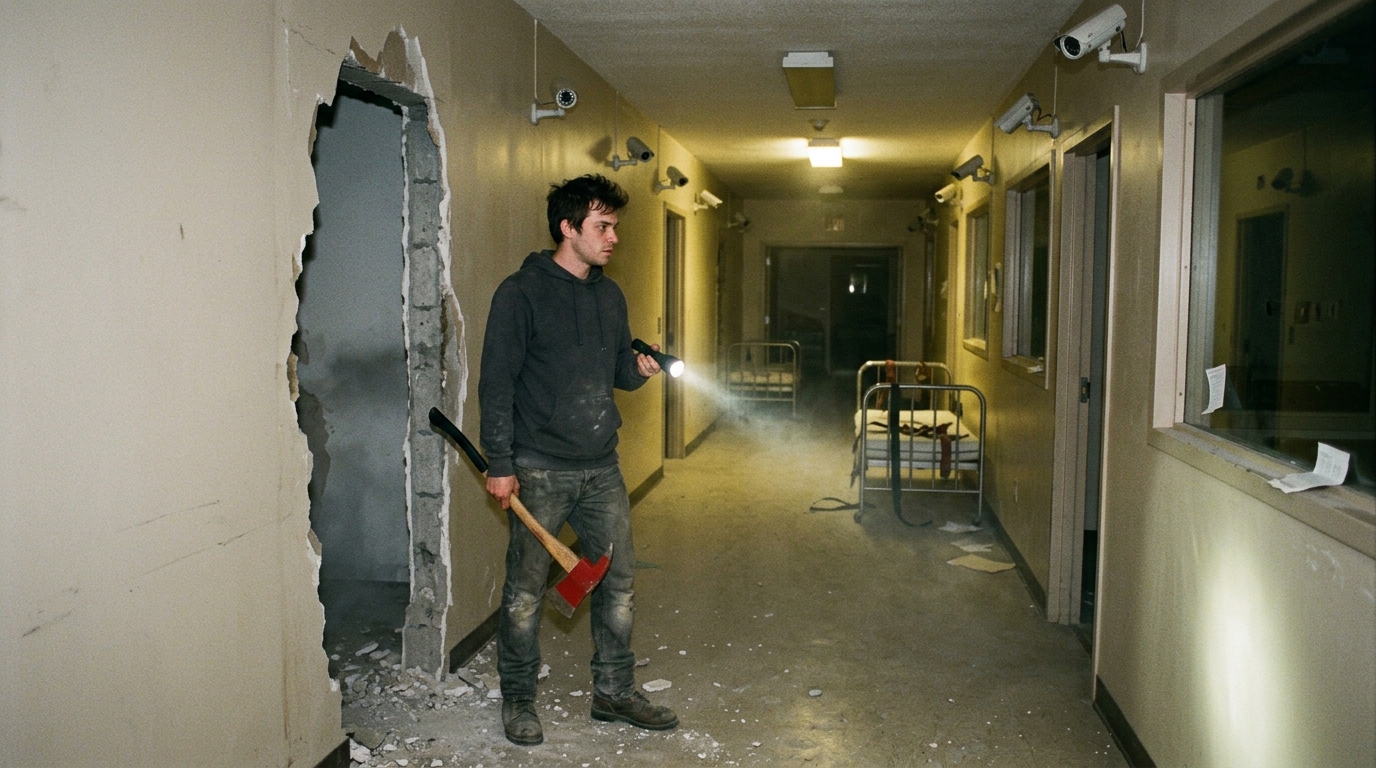
  • I Was Told Never To Touch The Empty Glass On Table 7. When I Picked It Up, Every VIP In The Restaurant Went Silent.

    I Was Told Never To Touch The Empty Glass On Table 7. When I Picked It Up, Every VIP In The Restaurant Went Silent.

    The Glass No One Was Allowed To Touch

    The first rule they gave me that night was simple.

    Do not speak unless spoken to.

    The second rule was stranger.

    Do not look too long at the guests.

    The third rule made no sense at all.

    Do not touch the crystal glass on table 7.

    Not refill it.

    Not move it.

    Not polish it.

    Not even if it fell.

    Especially if it fell.

    That was exactly what Mr. Arden told me in the staff corridor ten minutes before the private dinner began.

    He stood in front of us in his black suit, hands clasped behind his back, silver hair combed so tightly it looked painted onto his skull.

    Mr. Arden managed Maison Verre like it was not a restaurant.

    Like it was a courtroom.

    Or a church.

    Or a place where people came to confess things before someone buried them.

    “There are twenty-six guests tonight,” he said. “All private. All important. You will not ask for names. You will not repeat conversations. Phones stay in lockers. If anyone offers you money for information, you report it to me.”

    The other servers nodded.

    I nodded too.

    I had only worked at Maison Verre for three weeks.

    I needed the job.

    My rent was late.

    My younger sister still thought I was doing fine.

    I was not.

    So when Mr. Arden pointed toward the dining room and said, “You, Leo, will handle the west side,” I straightened my shoulders like I belonged there.

    Then he looked directly at me.

    “And table 7.”

    Something in his voice changed.

    Not louder.

    Colder.

    I glanced through the cracked staff door.

    Table 7 sat in the center of the private dining room beneath a chandelier made from hundreds of thin glass drops. The table was round, dressed in white linen, set for one person only.

    One plate.

    One folded black napkin.

    One knife.

    One fork.

    And one empty crystal glass.

    Two security guards stood behind it.

    Not near the entrance.

    Not by the guests.

    By the glass.

    The glass was tall, thin, and perfectly clean. No wine. No water. No candle reflection inside it.

    Empty.

    But the guards watched it like something alive might crawl out.

    I looked back at Mr. Arden.

    “Who is sitting there?”

    His eyes narrowed.

    “No one.”

    I laughed because I thought he was joking.

    No one else laughed.

    Mr. Arden stepped closer.

    “Listen carefully. If a guest asks for the glass to be moved, you say you are not authorized. If the glass needs attention, you find me. If anything happens near table 7, you step away.”

    “What kind of thing?”

    His expression hardened.

    “The kind that ends employment.”

    I should have taken that seriously.

    I did not.

    At twenty-three, fear still felt like something adults used to control people beneath them.

    By midnight, I understood fear differently.

    Fear was not shouting.

    Fear was not running.

    Fear was a room full of powerful people going silent because a waiter touched an empty glass.

    The Private Dinner

    The dining room was built to make rich people feel eternal.

    Dark green walls.

    Gold-framed mirrors.

    Marble fireplace.

    Low amber lamps that made every face look softer than it deserved.

    The air smelled of butter, truffle oil, old money, and lilies from the funeral-sized arrangement near the bar.

    That bothered me.

    Lilies did not belong at a dinner.

    They belonged beside closed caskets.

    The guests arrived between 8:15 and 8:40.

    One by one.

    Men in tailored suits.

    Women in diamonds and black silk.

    A judge whose face I recognized from the news.

    A senator who smiled at no one.

    A famous surgeon.

    A hotel owner.

    A woman with white gloves who never removed them, not even to drink.

    They all knew each other.

    They also all seemed to hate each other.

    That was the first thing I noticed.

    They laughed too late.

    Smiled too briefly.

    Watched one another when they thought no one else was looking.

    And every single one of them glanced at table 7 when they entered.

    Some only once.

    Some could not stop.

    No one sat there.

    No one spoke to the guards.

    No one asked about the empty glass.

    I carried champagne along the west side of the room, lowering my eyes the way Mr. Arden instructed.

    But I listened.

    Servers always listen.

    It is one of the few powers we have.

    “After tonight, it ends.”

    “It should have ended years ago.”

    “She should never have kept records.”

    “Careful.”

    “No one can prove anything now.”

    Those were the words I caught in pieces.

    Not enough to understand.

    Enough to feel the floor beneath the evening was not solid.

    At 9:10, the last guest arrived.

    He came through the side entrance, not the front.

    Everyone stood.

    Even the judge.

    Even the senator.

    Even Mr. Arden.

    The man was older, perhaps sixty-five, but age had not made him smaller. He wore a black tuxedo with a white pocket square and a gold signet ring on his right hand.

    His hair was thick and silver.

    Not gray.

    Silver.

    The exact shade of moonlight on steel.

    He smiled as if every person in the room had already forgiven him for something.

    “Mr. Voss,” someone whispered.

    Richard Voss.

    Even I knew that name.

    Real estate.

    Hospitals.

    Private banks.

    Political donations.

    The kind of man newspapers called influential because they were too polite to say untouchable.

    Voss walked slowly to the head table near the fireplace.

    Not table 7.

    No one sat at table 7.

    The empty glass remained beneath the chandelier, guarded and waiting.

    Mr. Voss lifted his own glass, filled with red wine so dark it looked black.

    The room settled.

    Every conversation died.

    He smiled.

    “Friends,” he said, “tonight is not a celebration.”

    A soft laugh moved through the room.

    Nervous.

    Obedient.

    Voss continued.

    “It is a closing.”

    The chandelier light trembled in the crystal glass on table 7.

    I do not know why I noticed that.

    Maybe because the glass was empty, yet it seemed to catch more light than anything else in the room.

    “Old stories have followed us too long,” Voss said. “Old mistakes. Old grief. Old names that should have been left where they belonged.”

    The woman in white gloves looked down.

    The judge closed his eyes.

    At the far corner of the room, an elderly woman sat alone near the wall.

    I had not noticed her before.

    She wore a dark blue dress and a pearl brooch shaped like a bird. Her white hair was pinned at the back of her head. Her hands rested on the table in front of her, untouched by food or drink.

    Unlike the others, she did not look at Voss.

    She looked at table 7.

    No.

    Not the table.

    The glass.

    Her eyes were shining.

    Voss raised his wine higher.

    “Tonight,” he said, “every old secret will be buried.”

    The guests lifted their glasses.

    All except the elderly woman.

    All except me.

    And, of course, the empty glass on table 7.

    Table 7

    By 10 p.m., the room had grown louder.

    Wine helped people lie more comfortably.

    The guests laughed now, but too much. Their voices collided under the chandelier. Forks clicked against porcelain. The quartet in the corner played something soft and expensive that nobody listened to.

    I moved between tables with practiced invisibility.

    Wine.

    Water.

    Plates.

    Napkins.

    Smile.

    Step back.

    Disappear.

    That was the rhythm.

    Then a man at table 5 dropped his knife.

    I bent to pick it up.

    When I stood, I saw one of the guards beside table 7 watching me.

    Not the guests.

    Me.

    His face had no expression.

    But his hand rested near the inside of his jacket.

    I looked away quickly.

    “Careful,” another server whispered as I passed.

    Her name was Nina. She had been there for four years and knew how to move through wealthy rooms like smoke.

    “What is with that glass?” I whispered.

    Her face changed.

    “Don’t ask.”

    “I’m serious.”

    “So am I.”

    She pushed past me with a tray of oysters.

    I followed her into the service station.

    “Nina.”

    She turned.

    Her voice dropped.

    “The last waiter who touched table 7 was fired before dessert.”

    “For touching a glass?”

    “For asking why it was empty.”

    My mouth went dry.

    “What happened to him?”

    She looked toward the dining room.

    “His mother still calls the restaurant sometimes.”

    Before I could ask what that meant, Mr. Arden appeared behind us.

    “Nina. Table 3.”

    She left at once.

    Mr. Arden’s eyes settled on me.

    “Leo.”

    “Yes, sir.”

    “You are watching too much.”

    “I’m working.”

    “You are wondering.”

    I said nothing.

    He stepped closer.

    “That is more dangerous.”

    For a moment, I thought he might send me home.

    Instead, he adjusted the lapel of my jacket with slow, precise fingers.

    “You are young,” he said quietly. “So you think secrets want to be found.”

    I looked at him.

    He smiled without warmth.

    “They don’t. Secrets want witnesses to disappear.”

    Then he walked away.

    I stood there with a tray in my hands, suddenly aware of how far I was from the staff exit.

    How thick the dining room doors were.

    How many cameras watched the hallway.

    I told myself again that I needed the job.

    That rich people were dramatic.

    That a glass was only a glass.

    Another lie.

    The Silver Hair

    It happened because of a napkin.

    A stupid white napkin.

    I was clearing dessert plates from table 6 when the woman in white gloves turned suddenly and knocked the folded napkin from my tray.

    It slipped from the edge.

    Floated down.

    And landed beside table 7.

    Not on the table.

    Near it.

    Close enough that both guards looked down.

    Close enough that Mr. Arden’s head turned sharply from across the room.

    I froze.

    The whole dining room seemed to tilt toward me.

    The napkin lay on the carpet like a small white flag.

    No one spoke.

    I waited for one of the guards to pick it up.

    They did not.

    The woman in white gloves gave me a faint smile.

    Not apologetic.

    Interested.

    Like she had dropped it on purpose.

    I bent down slowly.

    My fingers reached for the napkin.

    That was when I saw inside the glass.

    At first, I thought it was a crack.

    A thin pale line caught against the bottom curve.

    I leaned slightly closer.

    Not much.

    Just enough.

    It was not a crack.

    It was hair.

    A single strand.

    Silver.

    Caught at the bottom of the empty crystal glass, stuck to the inside as if it had been placed there when the glass was still wet.

    My breath caught.

    The hair was the same color as Richard Voss’s.

    The same color as the elderly woman’s.

    The same color as the old photograph I had once seen in my mother’s bedroom drawer.

    My hand stopped above the napkin.

    I do not know why I thought of my mother then.

    Maybe because she had worked in restaurants too.

    Maybe because she had always hated rich dining rooms.

    Maybe because she used to say, “If a table is empty, Leo, ask who they removed to make space.”

    I had not understood her then.

    She died before I was old enough to ask.

    The elderly woman in the corner was looking at me.

    Tears ran silently down her face.

    She shook her head.

    Slowly.

    Once.

    Twice.

    Do not.

    That was what her eyes said.

    Do not touch it.

    The room around me blurred.

    The guards stood very still.

    Mr. Arden was walking toward me.

    Richard Voss had stopped speaking mid-sentence.

    Everyone was watching now.

    I should have picked up the napkin and stepped away.

    I should have obeyed every warning I had been given.

    But the silver hair at the bottom of the glass seemed to pull at something inside me.

    A memory.

    Not mine.

    Or maybe mine before I knew how to hold it.

    My mother crying at the kitchen table.

    A newspaper folded in half.

    The words private inquest.

    A woman’s name crossed out in red pen.

    My mother seeing me look and shutting the drawer too fast.

    I picked up the napkin.

    Then, with my other hand, I touched the glass.

    A cold shock ran up my fingers.

    Not because crystal is cold.

    Because something inside me recognized it.

    The glass made a small sound.

    A high, thin ring.

    Like a wet finger moving around the rim.

    But no one had touched the rim.

    Only me.

    Only the base.

    The entire restaurant fell silent.

    The quartet stopped playing.

    A fork slipped from someone’s hand and struck a plate.

    The sound was enormous.

    I lifted the glass.

    The Room Stopped Breathing

    Nobody moved.

    Not the guards.

    Not Mr. Arden.

    Not Richard Voss.

    The crystal glass was lighter than I expected.

    Too light.

    Almost delicate.

    Inside the base, the silver hair curled like a tiny question mark.

    I held it up without thinking.

    The chandelier light passed through the glass and broke across the room in sharp pieces.

    The guests stared at me.

    Not angry.

    Not confused.

    Afraid.

    That was worse.

    I had seen wealthy people annoyed.

    Impatient.

    Cruel.

    I had never seen them afraid of a waiter.

    Richard Voss set his wine glass down.

    Very carefully.

    “Put that down,” he said.

    His voice was calm.

    Every word controlled.

    I looked at him.

    Then at the elderly woman.

    She was standing now.

    Her hands shook against the table.

    “Leo,” she whispered.

    My blood went cold.

    I had not told her my name.

    At least, I did not think I had.

    Mr. Arden stepped in front of me.

    “Give me the glass.”

    His hand was out.

    Palm up.

    His voice was low.

    “Now.”

    I looked down at the silver hair.

    Something was etched into the underside of the base.

    Tiny letters.

    Too small to see unless the glass was lifted toward the light.

    I turned it slightly.

    Mr. Arden’s eyes widened.

    “Leo.”

    But I had already seen it.

    A name.

    Not a brand.

    Not a number.

    A name engraved into the crystal.

    Mara Vale.

    My mouth went dry.

    Vale.

    The name meant nothing to most people.

    But it meant something to me.

    Because it was my mother’s maiden name.

    Before she married my father.

    Before she died.

    Before every adult in my family stopped saying her sister’s name.

    My mother had a sister.

    I had only heard the name once.

    In an argument between my parents when I was nine.

    Mara.

    My aunt.

    The woman who “left.”

    The woman whose photograph vanished from every album.

    The woman my mother cried for in locked rooms.

    I looked at the elderly woman.

    She was crying openly now.

    Richard Voss stood.

    The guards stepped forward.

    The guests moved back in their chairs as if distance could save them from whatever I had just touched.

    “Who is Mara Vale?” I asked.

    No one answered.

    So I asked louder.

    “Who is Mara Vale?”

    A woman near the fireplace gasped.

    Someone whispered, “God.”

    Richard Voss’s face changed.

    For the first time that night, the mask slipped.

    Not much.

    Enough.

    “Boy,” he said softly, “you have no idea what you are holding.”

    The elderly woman spoke before I could.

    “Yes, he does.”

    Every head turned toward her.

    Her voice trembled, but she did not sit down.

    “He just does not know it yet.”

    Voss stared at her.

    “Beatrice.”

    She ignored him.

    Her eyes stayed on me.

    “Leo,” she said, “look inside the stem.”

    My fingers tightened around the glass.

    Mr. Arden whispered, “Don’t.”

    I looked anyway.

    The crystal stem was hollow.

    There was something inside it.

    A thin rolled piece of paper, no wider than a matchstick, trapped inside the glass like it had been sealed there when the glass was made.

    The silver hair was not the secret.

    It was the warning that made someone look closer.

    I held the glass up higher.

    A murmur moved through the room.

    Voss’s voice snapped.

    “Take it from him.”

    The guards rushed forward.

    I stepped back.

    The elderly woman cried out, “Run!”

    But I did not run.

    Not yet.

    Because at that exact moment, the empty glass filled with sound.

    Not wine.

    Not water.

    Sound.

    A woman’s voice, faint and distorted, came from inside the crystal.

    “If this is ever touched by blood…”

    The room froze.

    The voice crackled.

    Then continued.

    “…then they failed to kill all of us.”

    My hand went numb.

    Blood.

    I looked down.

    A thin red line had opened across my thumb where the crystal base had cut me.

    One drop of my blood slid down the glass.

    The silver hair inside the bottom turned dark.

    Then the chandelier above table 7 flickered.

    Once.

    Twice.

    And every candle in the restaurant went out.

    The Curse Beneath Table 7

    Darkness swallowed the room.

    For one second, nobody screamed.

    That was how I knew the fear was older than the blackout.

    These people had been waiting for this moment.

    Dreading it.

    Planning against it.

    Maybe even praying it would never come.

    Then the emergency lights clicked on, bathing everything in dull red.

    The restaurant looked different in that light.

    Less elegant.

    More honest.

    Faces turned hollow.

    Diamonds looked like teeth.

    The guards stopped three feet away from me, as if the glass had drawn a circle they could not cross.

    Richard Voss stared at the crystal in my hand.

    The elderly woman, Beatrice, stepped out from the corner.

    “Leo,” she said, “listen to me carefully.”

    Mr. Arden moved between us.

    “Madam, sit down.”

    She looked at him with a hatred so old it had become calm.

    “You helped them once. Do not help them again.”

    His face went gray.

    I looked at him.

    “What does she mean?”

    Mr. Arden said nothing.

    The voice in the glass returned.

    Softer now.

    Closer.

    “Table 7. Below the floor.”

    The room changed.

    Not visibly.

    But I felt it.

    A collective flinch.

    Like twenty-six bodies remembering the same burial.

    Voss slammed his hand on the table.

    “Enough.”

    No one moved.

    He looked at me.

    His voice dropped.

    “Leo, you are a waiter. You have made a mistake. Put the glass down, walk out of this room, and I will make sure your life becomes very easy.”

    I should have been tempted.

    A few hours earlier, I would have been.

    Rent paid.

    Sister safe.

    Debts gone.

    A life lifted by one powerful man’s hand.

    But he knew my name now.

    Beatrice knew my name.

    The glass had spoken after my blood touched it.

    And the name Mara Vale was engraved under the base like a body refusing to stay buried.

    I looked at Voss.

    “Who was she?”

    His jaw tightened.

    “No one.”

    Beatrice’s voice broke behind him.

    “She was my daughter.”

    Silence.

    Not ordinary silence.

    The kind that pulls all air from a room.

    I turned toward her.

    “Your daughter?”

    Beatrice nodded, tears shining in the red emergency light.

    “And your mother’s sister.”

    My stomach turned.

    My mother had told the truth once, then spent the rest of her life terrified of it.

    I looked back at the glass.

    At the silver hair.

    At the rolled paper in the stem.

    At the blood from my thumb sliding toward the engraved name.

    “What happened to her?”

    Beatrice opened her mouth.

    Before she could answer, a loud crack came from beneath table 7.

    The floor split.

    Not wide.

    Not deep.

    Just a thin black line running through the marble.

    Right under the empty chair.

    The guests gasped and pulled back.

    One woman started praying.

    The guards finally lost their nerve.

    Voss looked down at the crack, then at me.

    For the first time, Richard Voss looked afraid of something he could not buy.

    The glass grew colder in my hand.

    The woman’s voice whispered from inside it again.

    “Leo.”

    I nearly dropped it.

    Because this time, the voice did not sound distant.

    It sounded like my mother.

    Beatrice covered her mouth.

    The floor beneath table 7 cracked again.

    And from somewhere below the marble, something knocked back.

    Three times.

    Slowly.

    Like a person trapped underneath had heard us.

    Every VIP guest turned toward me.

    Not like I had broken a rule.

    Not like I had touched a glass.

    Like I had opened a grave.

    Then the rolled paper inside the crystal stem began to uncoil by itself.

    A single word appeared against the glass.

    RUN.