Blog

  • The Woman In Room 309 Showed Me A Baby Photo. The Bracelet On That Child’s Wrist Was The Same One I Had Worn My Whole Life

    The Woman In Room 309 Showed Me A Baby Photo. The Bracelet On That Child’s Wrist Was The Same One I Had Worn My Whole Life

    The Bracelet I Never Took Off

    I tried to run.

    That was the only thought left in my head.

    Run.

    Not ask another question.

    Not wait for the man outside to step into the room.

    Not stand there holding a card that said I was proof of something I did not understand.

    Just run.

    The bathroom window was too small.

    The door was opening.

    And the mirror above the sink reflected a face I suddenly did not trust anymore.

    Mine.

    Mira Hale.

    If that was even my name.

    Behind me, Evelyn grabbed my wrist and pulled me back into the main room just as the chain snapped loose from the door.

    I almost screamed.

    But she clamped one hand over my mouth.

    “Quiet,” she breathed against my ear. “If you make a sound, he’ll know exactly where you are.”

    The door opened only a few inches.

    Not enough for someone to enter.

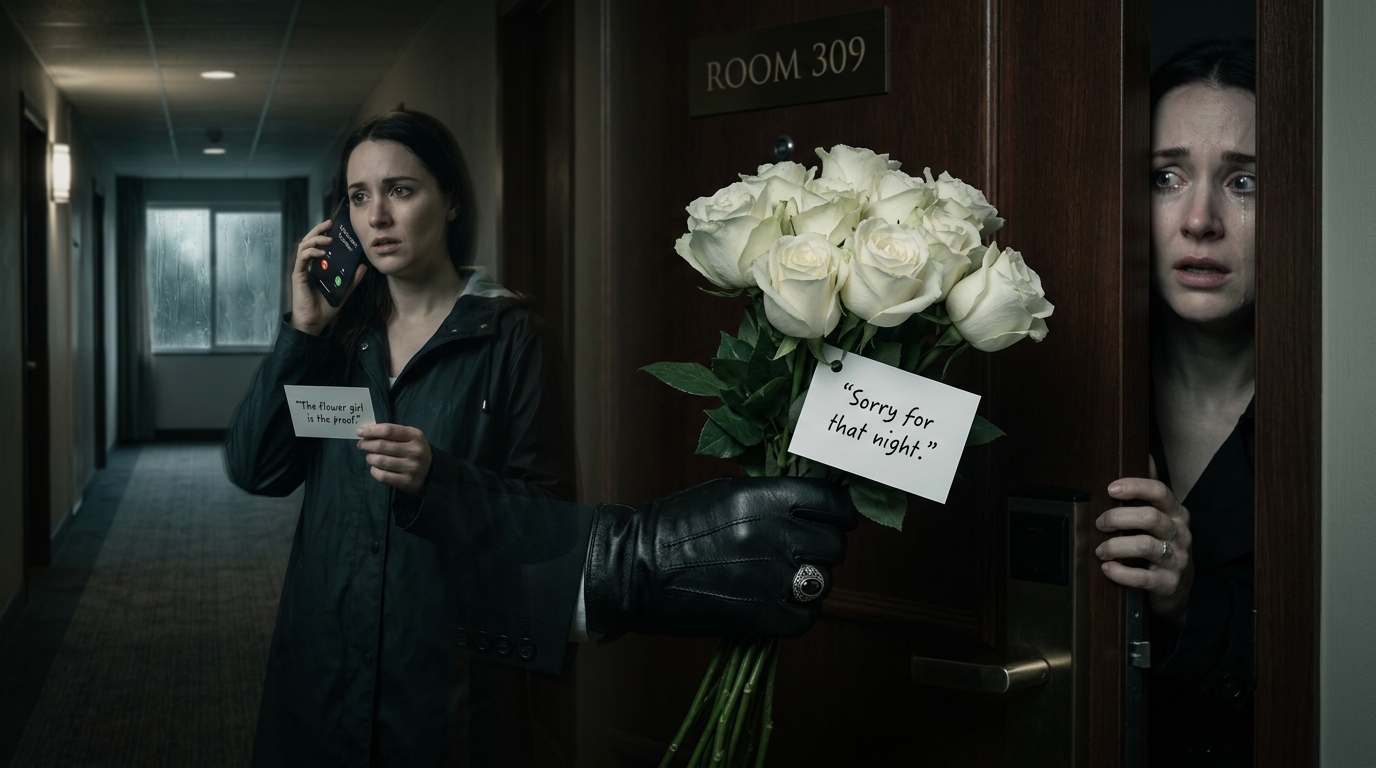
    Enough for a black-gloved hand to reach inside.

    The hand picked up one of the white roses from the bouquet.

    Slowly.

    Carefully.

    Like this was not a break-in.

    Like this was a ritual.

    On the smallest finger was a ring.

    Silver.

    Oval.

    Set with a dark blue stone.

    My mother’s ring.

    I had seen it once in an old photograph hidden inside my aunt Marion’s sewing box. My mother was young in that picture, laughing at someone outside the frame, one hand lifted to shield her eyes from the sun.

    That ring had been on her finger.

    And now it was on the hand of someone standing outside room 309.

    My chest locked.

    Evelyn pulled me backward, one step at a time, toward the wardrobe beside the bed.

    The gloved hand placed the rose back on the table.

    Then the man in the hallway spoke.

    “Mira.”

    My whole body went cold.

    He said my name like he had practiced it.

    Like it belonged to him.

    Evelyn opened the wardrobe and shoved me inside.

    I caught the edge of the door before she could close it.

    “No,” I mouthed.

    Her eyes begged me.

    Please.

    The door to the room pushed wider.

    Evelyn turned away from me, straightened her black dress, and stepped into the center of the room.

    The wardrobe door closed until only a thin crack remained.

    Through it, I saw him enter.

    Gideon Vale.

    My mother’s brother.

    My uncle.

    He was taller than I expected. Older, but not weak. His dark coat was wet from rain, though not one drop had touched his polished shoes. His hair was silver at the temples. His face was calm in the way powerful men are calm when other people panic for them.

    He looked at Evelyn.

    Then at the bouquet.

    Then at the bathroom door.

    He smiled faintly.

    “She was here.”

    Evelyn’s voice shook, but she did not move.

    “You broke into my room.”

    “This hotel belongs to my family.”

    “This room was sealed.”

    “And yet here you are.”

    He picked up the card from the table and turned it over.

    The flower girl is the proof.

    His smile disappeared.

    For the first time, I saw anger break through the calm.

    Not surprise.

    Anger.

    He had not written that message.

    Someone else had.

    Someone who wanted him afraid.

    Evelyn saw it too.

    “You didn’t send the flowers,” she whispered.

    Gideon’s eyes lifted.

    “No.”

    A beat of silence passed.

    Then he said, “But I know who did.”

    My hand moved to my throat.

    I do not know why.

    Maybe because fear makes you search your own body for proof you are still alive.

    My fingers brushed the bracelet on my wrist.

    The silver bracelet I had worn since childhood.

    Thin.

    Old.

    Too simple to be jewelry.

    Marion always told me it belonged to my mother.

    She said I cried whenever she tried to take it off, so she let me keep it.

    I had believed her.

    Of course I had.

    Children believe the people who raise them because the alternative is too large to survive.

    But now, standing inside a hotel wardrobe, hiding from a man who knew my name, I looked down at the bracelet as if seeing it for the first time.

    The silver was scratched.

    The clasp had been repaired twice.

    Inside the band, nearly hidden by age, was a tiny engraving I had traced with my finger a hundred times.

    309.

    I always thought it was a design number.

    A maker’s mark.

    A meaningless accident.

    Now I knew better.

    Nothing in that room was meaningless.

    The Baby In The Photograph

    Gideon walked slowly across the room.

    His footsteps were soft on the carpet.

    Too soft.

    He stopped near the wardrobe.

    I held my breath.

    Through the crack, I saw the side of his coat.

    His gloved hand.

    My mother’s ring.

    The same hand that had touched the rose now hovered inches from the wardrobe handle.

    Evelyn spoke quickly.

    “Do you think she would come to me after all these years?”

    His hand stopped.

    “She came because someone wanted her here.”

    “Then why are you asking me?”

    “Because you always knew more than you admitted.”

    Evelyn laughed once.

    It sounded broken.

    “I admitted exactly what your family paid me to admit.”

    Gideon turned toward her.

    “And you lived because of it.”

    The room went silent.

    That sentence was not a threat.

    It was a reminder.

    He moved away from the wardrobe.

    I let out the smallest breath.

    Evelyn’s eyes flicked toward me through the crack.

    Then she did something I did not expect.

    She walked to the bedside table, opened the bottom drawer, and pulled out an old photograph.

    Not quickly.

    Not secretly.

    She wanted him to see it.

    Gideon’s face changed.

    “Put that away.”

    Evelyn held it tighter.

    “You’re afraid of paper now?”

    “Evelyn.”

    “No.” Her voice hardened. “You do not get to come into this room after eighteen years and speak like you own every memory inside it.”

    He stepped toward her.

    She stepped back.

    The photograph slipped from her hand and landed face-up on the carpet.

    Right in front of the wardrobe.

    I looked down.

    My heart stopped.

    The photo was old, the edges yellowed, the surface scratched from being handled too many times.

    It showed a newborn baby wrapped in a white blanket.

    Tiny face.

    Closed eyes.

    One hand curled near the cheek.

    On the baby’s wrist was a silver bracelet.

    The same bracelet I was wearing.

    Not similar.

    The same.

    Same narrow band.

    Same tiny crescent clasp.

    Same engraved curve catching the light.

    I pressed my hand over my mouth.

    Gideon bent to pick up the photograph.

    Before he could, Evelyn stepped on the edge of it.

    “Don’t touch her.”

    His face tightened.

    “Her?”

    Evelyn’s voice dropped.

    “Yes. Her.”

    That was when I understood.

    They were not talking about the photograph.

    They were talking about me.

    Gideon stared at Evelyn for a long moment.

    Then he smiled.

    It was small.

    Ugly.

    “You have grown sentimental.”

    “And you have grown old pretending murder is inheritance.”

    Murder.

    The word hit the room like glass breaking.

    Gideon’s face went still.

    I felt the blood drain from my body.

    My mother had disappeared.

    That was what Evelyn had said.

    Not died.

    Disappeared.

    But now the word murder sat between them, breathing.

    Gideon picked up the bouquet from the table.

    He ran one gloved finger over the white roses.

    “Who sent them?”

    Evelyn said nothing.

    “Was it Marion?”

    At my aunt’s name, I nearly moved.

    Evelyn did not look toward the wardrobe this time.

    “No.”

    “Liar.”

    “She would never come back here.”

    “She already did once.”

    Evelyn’s face crumpled for half a second.

    Then she hid it.

    But I saw.

    Marion had been back to room 309.

    The woman who raised me had returned to the place where my mother vanished.

    And she had never told me.

    The Woman Who Said She Saved Me

    Gideon left without warning.

    That was what scared me most.

    No shouting.

    No final threat.

    No dramatic order.

    He simply placed one white rose on the floor outside the door, looked once around the room, and said, “Tell her running makes old graves easy to reopen.”

    Then he walked out.

    The door closed softly behind him.

    Evelyn did not move.

    I stayed inside the wardrobe until the hallway outside went completely silent.

    Then I pushed the door open.

    My legs almost failed.

    Evelyn turned.

    For a moment, she looked relieved.

    Then she saw my face.

    The bracelet was in my hand now.

    I had unclasped it for the first time in years.

    The silver band sat against my palm like a small dead thing.

    I held it up.

    “Explain this.”

    Evelyn looked at the bracelet.

    Her whole body seemed to fold under the weight of it.

    “Mira…”

    “No.” My voice broke. “No more Mira like you know me. No more half answers. No more warnings. Explain it.”

    She reached for the photograph on the floor, picked it up carefully, and placed it on the table beside the bouquet.

    Then she sat down.

    Not because she wanted to.

    Because the truth had finally made her old.

    “That photo was taken in this room,” she said.

    I stared at her.

    “No.”

    “Yes.”

    “There’s no hospital equipment.”

    “She didn’t give birth in a hospital.”

    The words moved through me slowly.

    My mother gave birth here.

    In this room.

    Room 309.

    The room I had walked into carrying flowers.

    The room my bracelet had been marked with.

    The room where my life had begun as a secret.

    Evelyn touched the edge of the photograph.

    “Clara came here eighteen years ago because she trusted the hotel more than the hospital. She thought her family controlled the doctors. She thought if she stayed away from them, she could keep you.”

    My mouth felt dry.

    “Keep me from who?”

    Evelyn looked at the door.

    “From the Vales.”

    “My family.”

    “Blood is not always family.”

    I almost laughed.

    It would have sounded like crying.

    “Did Marion know?”

    Evelyn nodded.

    “She helped deliver you.”

    My knees weakened.

    The woman who raised me had been there when I was born.

    Not after.

    Not by accident.

    There.

    In room 309.

    “She was a maid,” Evelyn said. “I was at the front desk. Clara came in through the side entrance at 10:18 p.m. She was already in labor. She begged us not to call anyone.”

    “Why?”

    “Because she said the baby was the only proof she had left.”

    Proof.

    That word again.

    I looked at the card.

    The flower girl is the proof.

    “What did she mean?”

    Evelyn’s eyes filled.

    “Clara had uncovered something about her family. Something tied to the hotel. She said if they took you, they could erase everything.”

    “What thing?”

    “I didn’t know then.”

    “And now?”

    She hesitated.

    That hesitation was enough.

    I stepped toward her.

    “What thing?”

    Before she could answer, the room phone rang.

    The sound ripped through us.

    Evelyn stared at it.

    This time, she answered.

    Her hand shook as she lifted the receiver.

    “Hello?”

    I watched her face change.

    Fear first.

    Then recognition.

    Then something worse than both.

    A man’s voice came through the receiver.

    Low.

    Cold.

    Clear enough that I could hear every word from where I stood.

    “Don’t tell her who killed her mother.”

    Evelyn went white.

    The receiver slipped slightly in her hand.

    My whole body went numb.

    Killed.

    Not vanished.

    Not disappeared.

    Killed.

    I took one step toward the phone.

    “Who is that?”

    Evelyn did not answer.

    The voice continued.

    “And don’t tell her what the baby saw.”

    The line went dead.

    Evelyn stood frozen, the receiver still pressed to her ear.

    I pulled it from her hand and slammed it back into the cradle.

    “What did he mean?”

    She looked at me.

    Her eyes were full of tears.

    And guilt.

    And terror.

    “Mira…”

    “What did I see?”

    Evelyn covered her mouth.

    “What did I see?”

    “You were only hours old.”

    “I don’t care.”

    She shook her head.

    “No one thought you would remember.”

    “Remember what?”

    Evelyn looked at the photograph.

    Then the bracelet.

    Then the white roses.

    When she finally spoke, her voice was so quiet I almost did not hear it.

    “You were in the room when your mother died.”

    The Night Inside Room 309

    The world did not explode.

    That would have been easier.

    Instead, it narrowed.

    The lamp.

    The bed.

    The curtains.

    The roses.

    The photograph.

    Evelyn’s face.

    The bracelet in my hand.

    Everything became too clear.

    Too sharp.

    Like my mind was trying to record the moment because some part of me knew I would never be the same again.

    I sat down slowly.

    “You said she disappeared.”

    “I lied.”

    “Why?”

    “Because murder makes people ask questions. Disappearance makes them get tired.”

    I looked up at her.

    That sentence was too practiced.

    Too old.

    She had said it to herself many times.

    “What happened?”

    Evelyn closed her eyes.

    For a moment, I thought she would refuse.

    Then she began.

    “Clara gave birth at 11:31 p.m. Marion delivered you with towels from the bathroom and hot water from the kettle. I stayed by the door, listening for footsteps. Clara was weak, but she was awake. She held you and kept saying your name.”

    My throat tightened.

    Mira.

    My mother had said my name.

    Not Marion.

    Not a clerk.

    My mother.

    “She put the bracelet on you herself,” Evelyn continued. “Silver. Old. She said it belonged to your father’s family.”

    “My father?”

    “I never met him.”

    “But she knew him?”

    Evelyn nodded.

    “She loved him. That much was obvious.”

    I looked at the bracelet again.

    For the first time, it did not feel like a keepsake.

    It felt like a message.

    “What happened after I was born?”

    Evelyn swallowed.

    “At 11:47, there was a knock at the door.”

    My skin prickled.

    “Gideon?”

    “No.”

    “Then who?”

    She looked toward the roses.

    “The man who sent the flowers.”

    My breath caught.

    “Who is he?”

    Evelyn did not answer directly.

    “He came with a doctor. And two men from hotel security. They said Clara was unstable. They said the baby needed medical care. Clara screamed when they tried to take you.”

    I could almost hear it.

    A woman screaming in this room.

    A newborn crying.

    Rain against the window.

    Footsteps in the hall.

    “And Marion?”

    “She hid in the bathroom with you.”

    I looked toward the bathroom door.

    The mirror.

    The vent.

    The escape route Evelyn had mentioned.

    “She took me through the vent.”

    “Yes.”

    “What about my mother?”

    Evelyn’s voice broke.

    “I stayed with Clara.”

    “Why?”

    “Because she begged me not to leave her alone with them.”

    A silence opened between us.

    I did not want the next answer.

    But I asked anyway.

    “Did you see them kill her?”

    Evelyn covered her face.

    “No.”

    That answer should have relieved me.

    It did not.

    “Then what did you see?”

    She lowered her hands.

    “I saw the blood afterward.”

    My stomach turned.

    Evelyn pointed toward the carpet beside the bed.

    “There was a stain there for years. They replaced everything. Carpet. Mattress. Curtains. But I could still see it every time I passed this floor.”

    I stared at the carpet.

    It was beige.

    Perfect.

    Expensive.

    Clean.

    I hated it.

    “What happened to her body?”

    “I don’t know.”

    “You know something.”

    “I know they carried something out through the service elevator at 12:09 a.m.”

    Something.

    Not someone.

    Something.

    My fingers closed around the bracelet until the edge cut into my palm.

    “And me?”

    “Marion got you out through the old vent into the staff corridor. She took you to the laundry room. She said she would come back for Clara.”

    “But she didn’t.”

    “She couldn’t.”

    “Why?”

    Evelyn looked at me.

    “Because by then, everyone was looking for the baby.”

    Me.

    They were looking for me.

    Not to save me.

    To erase me.

    The Man Who Sent The Flowers

    I stood up.

    “I need to call Marion.”

    Evelyn shook her head.

    “No.”

    “She raised me. She owes me the truth.”

    “She will run.”

    “Then I’ll make her talk before she does.”

    I pulled out my phone.

    My hands were shaking so badly I almost dropped it.

    Marion’s number sat at the top of my favorites.

    Aunt Marion.

    The name looked childish now.

    Like a label someone had pasted over a crime scene.

    I pressed call.

    It rang once.

    Twice.

    Then went straight to voicemail.

    I called again.

    Same thing.

    A cold thought moved through me.

    “What if Gideon already found her?”

    Evelyn did not answer.

    That was answer enough.

    I grabbed my coat.

    “I’m leaving.”

    Evelyn stood.

    “You can’t walk out through the lobby.”

    “Watch me.”

    “They’ll be waiting.”

    “I don’t care.”

    “You should.”

    Her voice snapped this time.

    I turned on her.

    “Why? Because they might kill me too?”

    She flinched.

    Good.

    I wanted her to.

    I wanted someone else to feel even a fraction of what was happening inside me.

    Evelyn walked to the suitcase on the bed and pulled something from beneath a folded black dress.

    A small envelope.

    Old.

    Brown at the edges.

    Sealed with tape that had yellowed over time.

    She held it out.

    “Marion left this with me.”

    I stared at it.

    “When?”

    “Sixteen years ago.”

    “Why didn’t you give it to me?”

    “Because she told me only to give it to you if room 309 ever opened again.”

    My heart pounded.

    I took the envelope.

    On the front, written in uneven blue ink, was my name.

    Mira.

    Not Mira Hale.

    Just Mira.

    I opened it carefully.

    Inside was a folded note.

    And a tiny hospital tag.

    No hospital name.

    No doctor.

    Just a date.

    My birthday.

    Except it was not the birthday I had celebrated my whole life.

    It was three days earlier.

    Ask Marion why she changed your birthday.

    Evelyn’s warning came back to me.

    My hands went cold.

    The note had only five words.

    He took the first photo.

    I looked at Evelyn.

    “What does this mean?”

    She stared at the note as if it had bitten her.

    “He took the photograph of you as a baby.”

    “The man who sent the flowers?”

    She nodded.

    “Why would my mother’s killer take my baby picture?”

    Evelyn’s face twisted.

    “Because he needed proof that you were alive before he sold the lie that you were dead.”

    The room seemed to tilt again.

    The lie.

    The dead baby.

    The sealed room.

    The bracelet.

    The flowers.

    The card.

    The photograph.

    All of it was evidence.

    And I was standing in the middle of it.

    “Tell me his name,” I said.

    Evelyn looked at the door.

    Then at the phone.

    Then at me.

    Her lips trembled.

    “The man who sent the flowers was not a stranger to your mother.”

    I waited.

    “He was supposed to protect her.”

    My heartbeat slowed.

    “What was his name?”

    Evelyn whispered it.

    “Adrian Vale.”

    The name moved through the room like a match struck in the dark.

    Vale.

    Again.

    I stared at her.

    “My mother’s father?”

    Evelyn shook her head.

    “No.”

    “Then who?”

    Before she could answer, my phone buzzed.

    A text message.

    Unknown number.

    No words.

    Just a photo.

    I opened it.

    The image showed Marion sitting in a chair.

    Hands tied.

    Mouth covered.

    Eyes wide with terror.

    Behind her was a wall I recognized.

    Not from my childhood home.

    From the lobby downstairs.

    The Grand Vale Hotel.

    She was in the building.

    Now.

    A second message appeared.

    Bring the bracelet to the ballroom.

    Come alone.

    Evelyn grabbed the edge of the table.

    “No.”

    I looked at the silver bracelet in my palm.

    The engraved number 309 caught the lamplight.

    Then the phone buzzed again.

    This time, it was a voice message.

    I pressed play.

    A man spoke.

    The same cold voice from the room phone.

    “The woman who raised you knows where Clara’s body is.”

    My breath stopped.

    “And you, Mira, are the only living witness to why she died.”

    The message ended.

    Evelyn was crying now.

    “Don’t go.”

    I put the bracelet back on my wrist.

    For eighteen years, I had worn it because I thought it belonged to my mother.

    Now I knew it belonged to the night she was murdered.

    I looked at Evelyn.

    “The person who sent the flowers…”

    She nodded slowly, tears running down her face.

    “Is the same man who took you from this room.”

    “No,” I said.

    My voice sounded calm.

    Too calm.

    “He didn’t take me.”

    I walked to the door.

    “He failed.”

    Evelyn whispered my name.

    I opened the door to room 309 and stepped into the golden hallway.

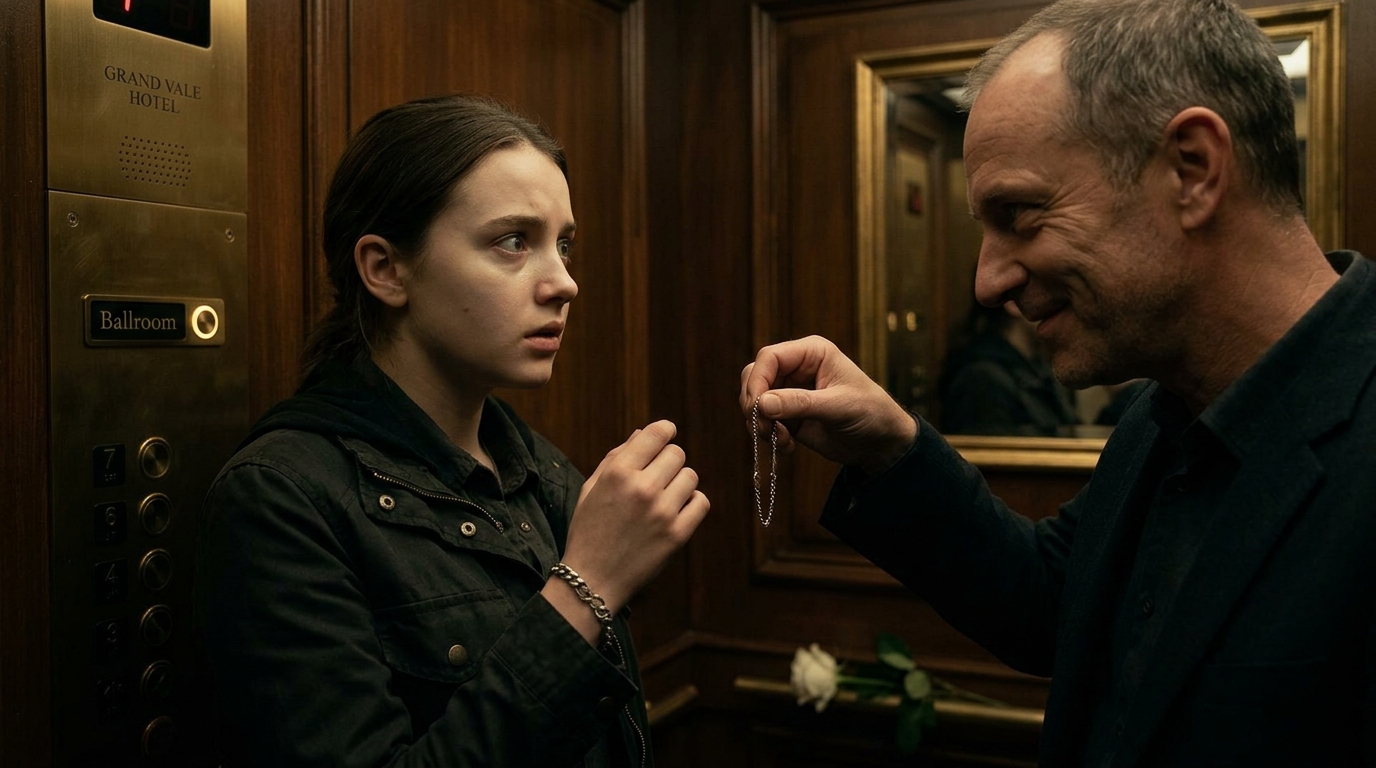
    At the far end, the elevator doors were open.

    Waiting.

    Inside the elevator stood a man in a dark coat.

    His face was hidden by shadow.

    But on his hand, catching the light, was my mother’s ring.

    And in his other hand, he held a second silver bracelet.

    Smaller than mine.

    Made for another baby.

    Another child.

    Another secret.

    The elevator lights flickered.

    The man smiled.

    Then he said, “Hello, Mira.”

    And behind him, from somewhere deep inside the hotel, a woman screamed.
  • I Delivered White Roses To Room 309 At Midnight. The Woman Who Opened The Door Said I Had Been Dead For 18 Years

    I Delivered White Roses To Room 309 At Midnight. The Woman Who Opened The Door Said I Had Been Dead For 18 Years

    The Delivery I Should Have Refused

    I knew something was wrong with the roses before I even touched them.

    White roses are supposed to feel clean.

    Soft.

    Elegant.

    These felt like a warning.

    There were twelve of them, wrapped in black satin ribbon, lying on the counter of the flower shop like they belonged beside a coffin. No baby’s breath. No gold paper. No perfume card. Nothing romantic.

    Just white roses.

    Too white.

    Too still.

    The order came in at 11:42 p.m., seventeen minutes before closing.

    Room 309.

    The Grand Vale Hotel.

    Deliver before midnight.

    No sender name.

    No phone number that worked.

    Only one sentence for the card.

    Sorry for that night.

    I stared at the words longer than I should have.

    Something about them made my stomach tighten.

    Not because they were dramatic.

    Because they sounded unfinished.

    Like the rest of the apology had been buried somewhere.

    My boss had already gone home. The shop was empty except for me, the old refrigerator humming in the back, and the rain tapping against the front window.

    I should have rejected the order.

    I almost did.

    Then I saw the payment.

    Triple fee.

    Paid instantly.

    Rent was due in three days.

    So I wrapped the flowers.

    I printed the card.

    I slipped it inside the bouquet.

    And I told myself rich people did strange things at midnight.

    That was the first lie I told myself that night.

    The second was that I was only delivering flowers.

    Room 309

    The Grand Vale Hotel stood at the end of Arlen Street like it had been built to hide secrets in expensive lighting.

    Gold letters above the entrance.

    Glass doors polished so clean they looked invisible.

    A doorman who looked at my wet shoes before he looked at my face.

    “Delivery?” he asked.

    I held up the bouquet.

    He frowned at the white roses.

    For one second, I thought he was going to stop me.

    Then his expression flattened.

    “Elevator to the third floor. Left corridor.”

    “You know the room?”

    His eyes flicked to mine.

    Too fast.

    Too careful.

    “No,” he said.

    But he did.

    I could feel it.

    The lobby was almost empty. One man sat by the fireplace with a newspaper open in his lap, though his eyes were closed. A woman in a red coat stood near the front desk, pretending to check her phone while watching me in the reflection of the marble wall.

    Everyone looked quiet.

    Not calm.

    Quiet.

    There is a difference.

    When the elevator doors closed, I finally let myself breathe.

    The bouquet was cold against my chest.

    I looked down at the card tucked between the petals.

    Sorry for that night.

    The elevator climbed slowly.

    Too slowly.

    Second floor.

    A soft ding.

    No one got in.

    Third floor.

    The doors opened.

    The hallway stretched in front of me, long and golden, lined with identical doors and low wall lamps that made everything look expensive and sick at the same time.

    The carpet swallowed my footsteps.

    I passed room 303.

    305.

    306.

    Then I stopped.

    309.

    The brass numbers glowed under the light.

    My hand lifted before I was ready.

    I pressed the bell.

    Somewhere behind the door, something moved.

    Not right away.

    First there was silence.

    Then a chair scraped across the floor.

    Slowly.

    Like someone had been waiting all night but was still afraid to answer.

    The lock clicked.

    The door opened only a few inches.

    A woman looked out.

    She was older than my mother would have been.

    Maybe fifty.

    Maybe more.

    She wore a black dress, pearl earrings, and the kind of makeup women put on when they are trying not to look like they have been crying.

    Her eyes dropped to the bouquet.

    Then rose to my face.

    And she went pale.

    Not surprised.

    Not confused.

    Pale.

    Like she had just seen someone climb out of a grave.

    I forced my delivery smile.

    “Flower delivery for room 309.”

    She did not answer.

    Her fingers tightened around the edge of the door.

    I tried again.

    “Ma’am? These are for you.”

    Her lips parted.

    For a moment, no sound came out.

    Then she whispered something so softly I almost missed it.

    “No.”

    I glanced at the room number behind me, then back at her.

    “This is room 309, right?”

    She did not look at the roses anymore.

    She looked at me.

    At my eyes.

    My mouth.

    The small crescent-shaped scar under my left eye.

    The scar my aunt always said came from a childhood fall I was too young to remember.

    The woman took one step back.

    Her voice cracked.

    “That’s impossible.”

    My fingers tightened around the bouquet.

    “What is?”

    She shook her head.

    “No. No, you can’t be here.”

    I should have left then.

    I know that now.

    I should have placed the flowers on the floor, turned around, and walked back to the elevator.

    But when someone looks at you like they recognize a ghost, you do not leave.

    You ask why.

    “Do you know me?” I said.

    The woman covered her mouth.

    Her eyes filled with tears.

    Then she said the sentence that split my life into before and after.

    “You died eighteen years ago.”

    The Woman In Black

    For a few seconds, I forgot how to breathe.

    The hallway lights hummed above us.

    Somewhere far away, the elevator moved.

    The woman stared at me as if she wished she could take the words back and shove them into the dark where they belonged.

    I laughed once.

    It came out wrong.

    Sharp.

    Scared.

    “I think you have me confused with someone else.”

    She did not blink.

    “What is your name?”

    “Mira.”

    Her face changed again.

    Not fear this time.

    Pain.

    “Mira what?”

    I hesitated.

    I do not know why.

    Maybe because my last name had never felt like it belonged to me.

    “Mira Hale.”

    The woman closed her eyes.

    Her shoulders dropped.

    “Hale,” she whispered.

    Like the name hurt.

    I stepped back.

    “Who are you?”

    She reached for the bouquet, then stopped.

    Her hand trembled in the air.

    “I’m sorry.”

    “For what?”

    “For opening the door.”

    That made no sense.

    None of it made sense.

    I held out the roses.

    “Someone sent these to you. There’s a card.”

    At the word card, her eyes sharpened.

    “What does it say?”

    “You haven’t read it?”

    “No.”

    She looked past me, down the corridor.

    Then back into the room.

    Like she expected someone to be standing there.

    “Give it to me.”

    I pulled the envelope from between the roses and handed it to her.

    She opened it with shaking fingers.

    I watched her read the sentence.

    Sorry for that night.

    Her face collapsed.

    Whatever strength she had left drained out of her.

    She pressed the card against her chest and whispered, “He knows.”

    “Who knows?”

    The woman did not answer.

    I looked into the room behind her.

    One lamp was on beside the bed.

    A suitcase lay open on the mattress, half packed. A wine glass sat untouched on the table. The curtains were drawn shut, but I could hear rain hitting the window.

    Something about that room felt staged.

    Like someone had arranged it to look normal in a hurry.

    The woman suddenly grabbed my wrist.

    Her fingers were cold.

    “Come inside.”

    I pulled back.

    “No.”

    “You can’t stand in the hallway.”

    “Let go of me.”

    She glanced behind me again.

    Then she whispered, “They have cameras on this floor.”

    My skin went cold.

    “Who does?”

    The woman tightened her grip.

    “The people who sent you.”

    “I was sent by a customer.”

    “No.” Her voice turned desperate. “You were sent as a message.”

    I should have screamed.

    I should have called security.

    But the way she said it made something inside me go quiet.

    A message.

    Not a delivery.

    Me.

    I stepped into the room.

    The woman shut the door quickly.

    Locked it.

    Bolted it.

    Then slid the chain into place.

    The sound of each lock made my heart beat faster.

    I stood near the door, still holding the roses.

    “Start talking.”

    She turned around slowly.

    “My name is Evelyn Blackwood.”

    The name meant nothing to me.

    It should have.

    I know that now.

    At that moment, it was just a stranger’s name in a hotel room that smelled like rain, perfume, and fear.

    “How do you know me?” I asked.

    Evelyn looked at the card in her hand.

    “I don’t know you.”

    “You just said I died eighteen years ago.”

    She swallowed.

    “I said she died.”

    “No. You said I died.”

    Evelyn’s eyes lifted to mine.

    “Because you have her face.”

    The Card Had A Second Message

    I wanted to be angry.

    Anger would have helped.

    Anger is solid.

    You can hold it.

    Fear is different.

    Fear leaks into everything.

    My hands started to shake, so I set the bouquet on the table before I dropped it.

    “Whose face?” I asked.

    Evelyn pressed her fingers against her lips.

    She was deciding whether to lie again.

    I could see it.

    Adults always think young people do not notice when truth is being rearranged. They are wrong. Children raised around secrets learn the shape of lies early.

    And I had been raised around secrets.

    My mother died in a fire.

    That was the story.

    My father was unknown.

    That was the answer.

    My aunt raised me because she was the only family I had left.

    That was the rule.

    Do not ask too many questions.

    That was the warning.

    Evelyn moved toward the window and pulled the curtain back only an inch.

    Rain ran down the glass in silver lines.

    She looked at the street below.

    Then quickly let the curtain fall.

    “They told me you were dead,” she said.

    My throat tightened.

    “Who told you?”

    “The police.”

    “What police?”

    She laughed softly.

    Not because anything was funny.

    “Police. Doctors. Lawyers. Men with clean shoes and no names. After a while, they all become the same.”

    I stared at her.

    This was not grief.

    This was guilt.

    Old guilt.

    The kind that had lived inside her for so long it knew the furniture.

    “Eighteen years ago,” she said, “a young woman came to this hotel carrying a baby.”

    The room seemed to shrink.

    I did not move.

    “She was terrified. Soaked from rain. Bleeding from one arm. She begged for room 309 because it had access to the service stairs.”

    My eyes went to the door.

    “Who was she?”

    Evelyn looked at me.

    “Clara Vale.”

    The name hit me so hard I almost sat down.

    Clara Vale.

    My mother.

    A name I had seen only on one old document and one blurred photograph in my aunt’s drawer.

    I heard myself say, “No.”

    Evelyn nodded slowly.

    “Yes.”

    “My mother died in an apartment fire.”

    “No.”

    “You don’t know that.”

    “I was there.”

    My mouth went dry.

    The rain sounded louder now.

    Everything did.

    The clock on the nightstand.

    The hum of the lamp.

    My own breathing.

    Evelyn took one step closer.

    “Your mother did not die in that fire. She disappeared from this room.”

    I backed away.

    “No.”

    “She brought you here.”

    “No.”

    “She told me your name.”

    “Stop.”

    “She said if anyone came looking, I should say I had never seen her.”

    “I said stop.”

    My voice cracked on the last word.

    Evelyn stopped.

    For a moment, neither of us spoke.

    Then the room phone rang.

    The sound tore through the silence.

    Once.

    Twice.

    Three times.

    Evelyn did not move.

    I stared at the phone.

    “Answer it.”

    She shook her head.

    “Answer it,” I said again.

    “No.”

    The ringing stopped.

    A second later, my own phone buzzed in my coat pocket.

    Unknown number.

    I looked at Evelyn.

    She looked terrified.

    “Don’t answer,” she whispered.

    I answered.

    There was static first.

    Then breathing.

    Then a man’s voice.

    Calm.

    Almost kind.

    “Mira.”

    I froze.

    Nobody at the hotel knew my name.

    “Who is this?”

    The man ignored me.

    “Has Evelyn read the card?”

    My fingers tightened around the phone.

    Evelyn’s face went white.

    The man continued.

    “Tell her to turn it over.”

    I looked at the card in Evelyn’s hand.

    Slowly, she turned it over.

    There was writing on the back.

    Small.

    Blue ink.

    So faint it looked like it had been hidden beneath the paper fibers until the room light found it.

    Evelyn read it first.

    Her knees almost gave out.

    I took the card from her hand.

    The back said:

    The flower girl is the proof.

    I stared at the words.

    My voice came out empty.

    “What does that mean?”

    The man on the phone answered before Evelyn could.

    “It means they buried the wrong baby.”

    Then the line went dead.

    The Room That Was Sealed

    I do not remember sitting down.

    One moment I was standing near the table with the card in my hand.

    The next, I was on the edge of the bed, staring at the bouquet like the roses had opened a hole beneath me.

    They buried the wrong baby.

    The sentence kept repeating in my head.

    Wrong baby.

    Wrong baby.

    Wrong baby.

    Evelyn stood across from me, one hand over her mouth, eyes fixed on the card.

    I looked up at her.

    “You know what he meant.”

    She closed her eyes.

    “Evelyn.”

    “Yes.”

    “Then say it.”

    She shook her head.

    “If I say it, you can’t unknow it.”

    I almost laughed.

    “My whole life just broke in half. I think we passed that point.”

    She lowered her hand.

    “Room 309 was sealed after your mother vanished.”

    “Sealed by who?”

    “The hotel. Officially.”

    “And unofficially?”

    Her gaze shifted toward the door.

    “By the family who owned the hotel.”

    “The Vales?”

    She flinched.

    My mother’s surname.

    The hotel’s name.

    Grand Vale.

    I had never connected them.

    Why would I?

    Nobody had ever given me enough pieces.

    Evelyn’s voice dropped.

    “Your mother was Clara Vale. She was the youngest daughter of the Vale family. She wasn’t supposed to have a child. Not publicly. Not with the man she loved.”

    “My father?”

    “I don’t know his name.”

    “You’re lying.”

    “I swear I don’t.”

    I wanted to believe she was lying because then there would still be something simple to hate.

    But her fear was too ugly to be fake.

    “What happened that night?” I asked.

    Evelyn looked at the door again.

    “Clara came to me just before midnight. She said her family had found her. She said they were going to take the baby and make her disappear.”

    “Me.”

    Evelyn nodded.

    “She told me your name was Mira. She said if anyone asked, I should say the baby died.”

    My voice went thin.

    “Why would she ask you to say that?”

    “Because a dead child can’t be hunted.”

    I stood up too quickly.

    The room tilted.

    Evelyn reached for me, but I stepped away.

    “No. Don’t touch me.”

    “I’m sorry.”

    “Everyone keeps saying that.”

    “I know.”

    “No, you don’t.” My voice rose. “You knew my mother was here. You knew something happened. You knew I existed.”

    “I thought you were dead.”

    “You just said you lied to protect me.”

    “I lied because they told me the baby died before I could reach the service stairs.”

    The words stopped me.

    Before I could reach the service stairs.

    Evelyn looked toward the bathroom.

    “There was another woman working that night. A maid. She heard screaming from this room. When I came up, the hallway was full of men. Security. Police. A doctor. Clara was gone.”

    “And the baby?”

    “They said the baby was dead.”

    “But you didn’t see a body.”

    She shook her head.

    “No.”

    My chest felt too tight.

    The old story of my life began to rearrange itself.

    The apartment fire.

    The missing photographs.

    My aunt refusing to talk about my mother.

    The scar under my eye.

    The way she always changed the subject when I asked why no one from my mother’s family ever came looking.

    I whispered, “The woman who raised me…”

    Evelyn looked at me.

    “What was her name?”

    “Marion Hale.”

    Evelyn’s expression changed.

    She knew the name.

    That hurt more than if she had not.

    “What?” I asked.

    She turned away.

    “Tell me.”

    Evelyn’s voice was barely audible.

    “Marion Hale was the maid on duty that night.”

    I felt the room drop out from under me.

    My aunt.

    The woman who packed my school lunches.

    The woman who bandaged my knees.

    The woman who cried every year on my birthday and said she was just tired.

    She was not my aunt.

    She was the maid who had been in the hotel the night my mother disappeared.

    I looked at Evelyn.

    “You’re saying she stole me?”

    “No.”

    “Then what are you saying?”

    Evelyn’s eyes filled again.

    “I’m saying she may have saved you.”

    Before I could answer, there was a soft sound from the hallway.

    A footstep.

    Then another.

    Slow.

    Measured.

    Stopping outside room 309.

    Evelyn went rigid.

    The roses sat on the table between us.

    The white petals looked almost blue in the lamplight.

    A shadow moved beneath the door.

    Then came a knock.

    Three taps.

    Polite.

    Patient.

    Evelyn whispered, “They found you.”

    The Name Behind The Door

    I looked at the door.

    Every instinct in my body told me not to breathe.

    Another knock came.

    Three taps again.

    No hurry.

    No force.

    That made it worse.

    People who are afraid pound on doors.

    People who own the building knock softly.

    A man’s voice came from the hallway.

    “Evelyn.”

    She covered her mouth.

    The voice continued.

    “We know she’s with you.”

    My blood turned cold.

    Not because he said she.

    Because he sounded certain.

    Like my whole life had been a file on someone’s desk, waiting to be reopened.

    I backed toward the bathroom.

    Evelyn grabbed the card and shoved it into my hand.

    “Keep this.”

    “What is happening?”

    “If we get separated, find Marion.”

    “My aunt?”

    “Not your aunt.”

    The words cut through me again.

    I shook my head.

    “No. I’m not leaving until you tell me everything.”

    “You don’t have time.”

    The handle moved.

    Locked.

    The chain held.

    The man outside sighed.

    Almost disappointed.

    “Evelyn, don’t make this ugly.”

    She stepped toward the door, but I caught her arm.

    “Who is he?”

    Her face looked carved from fear.

    “Gideon Vale.”

    The name meant nothing to me.

    But it meant everything to her.

    “Your mother’s brother,” she whispered.

    My uncle.

    The word felt impossible.

    I had an uncle.

    A family.

    A bloodline.

    A room.

    A lie.

    My hand tightened around the card until the paper bent.

    Outside, Gideon spoke again.

    “Mira, I know you can hear me.”

    My heart stopped.

    He knew my name.

    Of course he did.

    Everyone seemed to know my name except me.

    His voice softened.

    “You have been told frightening things. Evelyn was never well after that night. Open the door, and I’ll explain who you really are.”

    Evelyn shook her head hard.

    Do not listen.

    I looked at her.

    Then at the bouquet.

    Then at the card.

    The flower girl is the proof.

    My voice trembled.

    “Proof of what?”

    Evelyn looked at me like she had been waiting eighteen years to answer and praying she never had to.

    “Proof that Clara Vale had a daughter.”

    The lock clicked from the outside.

    My stomach dropped.

    Evelyn pulled me toward the bathroom.

    “There’s a service vent behind the mirror. Marion used it that night.”

    I froze.

    “She what?”

    Before Evelyn could answer, Gideon’s voice came through the door one last time.

    “You can stop running now, Mira.”

    The chain snapped.

    The door began to open.

    Evelyn pushed me into the bathroom and whispered the sentence that made every memory I had feel like evidence.

    “Ask Marion why she changed your birthday.”

    Then the door swung inward.

    And the first thing I saw through the crack was not Gideon Vale’s face.

    It was the bouquet of white roses lifting from the table by itself.

    No.

    Not by itself.

    A gloved hand had reached in from the dark.

    And on that hand was my mother’s ring.

  • The Poor Girl Vanished From My Gala. When I Followed The Green Wristband, I Found The Door Beneath Blackwood Forest

    The Poor Girl Vanished From My Gala. When I Followed The Green Wristband, I Found The Door Beneath Blackwood Forest

    The Wristband On The Marble

    The emergency lights painted the ballroom red.

    For several seconds, no one moved.

    The chandeliers were dead. The stage screens were black. The Evermere Foundation banner, moments earlier glowing with soft green light and beautiful lies, hung in darkness behind the podium.

    People were crying.

    Shouting.

    Calling names.

    A woman near the front table clutched a broken champagne glass and stared at her bleeding palm like she did not understand how pain had entered a room like this.

    But I saw only the floor.

    The green wristband lay on the marble at my feet.

    E-17.

    Elodie Vale.

    Dated the day after the fire.

    The day after my daughter was declared impossible to save.

    I picked it up with shaking fingers.

    It was real.

    Old plastic.

    Faded print.

    A tiny barcode worn at the edges.

    For eleven years, I had lived with a sentence.

    No one could have survived.

    Now the wristband said my daughter had survived long enough to be numbered.

    Behind me, someone screamed that a child had been taken.

    Nora.

    The poor girl who had walked into my gala carrying a dead Blue Glasswing.

    The girl who had brought me my daughter’s message.

    The girl who had whispered that Seraphina kept the children under the forest.

    Gone.

    Just like that.

    The butterfly was gone too.

    Only the wristband remained.

    I turned toward my wife.

    Seraphina stood near the stage steps, one hand resting against the railing, her white silk gown still perfect. In the emergency light, her face looked carved from bone.

    She was not crying.

    She was not searching for Nora.

    She was looking at the wristband in my hand.

    Not with fear anymore.

    With calculation.

    “Where is she?” I asked.

    My voice did not sound like my own.

    Seraphina blinked slowly.

    “Who?”

    That one word killed the last part of me that still wanted to misunderstand.

    “Nora.”

    She looked around the room as if seeing the chaos for the first time.

    “Adrian, listen to yourself. A disturbed child interrupted a charity event, caused a panic, and ran away in the blackout.”

    “She was taken.”

    “You were knocked down. You saw nothing.”

    “I heard her scream.”

    “So did everyone,” Seraphina said. “People scream during blackouts.”

    I stared at her.

    For eleven years, I had mistaken her calm for strength.

    Now I understood.

    Calm was just what cruelty looked like when it had practiced in mirrors.

    A reporter pushed through the crowd, phone raised.

    “Mr. Vale, is it true the message on the butterfly said your daughter is alive?”

    Seraphina turned first.

    Her grief face returned instantly.

    Soft eyes.

    Trembling mouth.

    One hand pressed to her chest.

    “I ask everyone to respect our family’s pain tonight,” she said. “My husband has been through an unimaginable trauma. Someone exploited that trauma in a deeply cruel way.”

    I almost laughed.

    Not because it was funny.

    Because she was still performing.

    Even now.

    Even with a dead butterfly, a missing child, a medical wristband, and Elodie’s voice coming through the speakers, Seraphina still believed a calm sentence could bury the truth.

    Maybe it always had.

    A hotel manager rushed toward us with two guards.

    “Mrs. Vale, police are on their way.”

    “No,” Seraphina said.

    The manager stopped.

    His face went blank.

    She said it quietly, but the order landed like a locked door.

    “No police.”

    The reporter heard it.

    So did I.

    Seraphina realized her mistake too late.

    I stepped closer.

    “You don’t get to decide that.”

    She looked at me then.

    Really looked.

    And for the first time in my marriage, I saw hatred without perfume.

    “Adrian,” she whispered, “you have no idea what you are about to open.”

    I held up the wristband.

    “My daughter was alive.”

    Her lips tightened.

    “That is not the same as saved.”

    The sentence struck me harder than any confession.

    Not the same as saved.

    Not denial.

    Not shock.

    Knowledge.

    I stepped back.

    The room seemed to tilt.

    “What did you do to her?”

    Seraphina’s eyes moved past me.

    Toward the far exit.

    The same exit where three men without name tags had been standing before the lights went out.

    It was open now.

    Just a crack.

    Rain blew through it.

    Nora had been dragged that way.

    I started toward it.

    Seraphina grabbed my arm.

    “Don’t follow.”

    I looked down at her hand.

    Then at her face.

    “You don’t touch me again.”

    She released me.

    Slowly.

    Not because she was afraid of me.

    Because too many cameras were still pointed our way.

    I walked toward the exit with the wristband in my fist.

    Behind me, Seraphina called my name.

    Not like a wife.

    Like a warning.

    I did not turn back.

    The Rain Behind The Hotel

    Outside, the service alley smelled of rain, wet concrete, and diesel.

    A black van was pulling away from the loading dock.

    No lights.

    No plates.

    One rear door not fully closed.

    For one second, in the gap, I saw a flash of dark green fabric.

    Nora’s raincoat.

    I ran.

    I had not run in years.

    Not like that.

    Not with fear burning through my lungs and my dress shoes slipping on wet pavement.

    The van turned hard at the end of the alley.

    I reached it too late.

    My hand struck the back door as it swung shut.

    Then it was gone into the rain.

    A security guard rushed out behind me.

    Not one of Seraphina’s men.

    Hotel staff.

    Young.

    Terrified.

    “Sir, are you okay?”

    “Did you see the van?”

    He nodded.

    “Black. No plates.”

    “Where does this alley lead?”

    “Service road. Then west tunnel.”

    “Where after that?”

    He hesitated.

    I grabbed his lapel.

    “Where?”

    “Blackwood access route,” he said. “Foundation vehicles use it for conservation transport.”

    Blackwood.

    The word moved through me like cold water.

    The forest had been sealed for eleven years.

    Officially, it was a protected recovery zone.

    No public access.

    No hiking.

    No media.

    No independent ecological surveys without Evermere approval.

    Seraphina had told me the restrictions were necessary. The soil was unstable. The ecosystem was fragile. The burned area needed time.

    I had signed every protection order she placed in front of me.

    Every land trust renewal.

    Every private security contract.

    Every underground climate archive budget.

    Because I did not want to see the place where my daughter died.

    Because my wife knew I did not want to see it.

    Because grief had made me useful.

    I pulled out my phone.

    No signal.

    Still blocked.

    The guard looked toward the ballroom.

    “They installed temporary signal control for the gala. Security protocol.”

    “Who ordered it?”

    His face answered before his mouth did.

    “Mrs. Vale’s office.”

    Of course.

    I pushed past him and ran toward the parking level.

    My driver, Thomas, stood beside the car, arguing with another guard.

    When he saw my face, he stopped.

    “Mr. Vale?”

    “Keys.”

    He handed them over without asking why.

    That was why I trusted him.

    I slid into the driver’s seat.

    Thomas leaned into the passenger window.

    “Sir, let me drive.”

    “No.”

    “You’ve been hurt.”

    “My daughter is alive.”

    He went still.

    Then his face changed.

    Not disbelief.

    Recognition.

    “What do you know?” I asked.

    His silence was too long.

    “What do you know, Thomas?”

    Rain ran down his face.

    He looked toward the hotel doors.

    Then back at me.

    “Miss Elodie sent me a letter once,” he said.

    The words stopped my heart.

    “When?”

    “Eight years ago.”

    Eight.

    Not eleven.

    Eight.

    I could barely speak.

    “And you never told me?”

    “I tried.”

    His voice broke.

    “I gave it to Mrs. Vale because I thought it was cruel. I thought someone was hurting you. The next day, my son was arrested for possession. Charges disappeared after I signed a nondisclosure agreement.”

    The rain seemed to get louder.

    Seraphina had not only controlled the foundation.

    She had controlled everyone around me.

    Every witness.

    Every doubt.

    Every possible door.

    Thomas reached into his coat and pulled out something wrapped in plastic.

    “I kept the envelope.”

    He handed it to me.

    The paper was warped with age.

    On the front, written in a hand I knew better than my own heartbeat, was one line.

    Dad still doesn’t know where to look.

    I stared at it until the letters blurred.

    Thomas said, “I’m sorry.”

    I wanted to hate him.

    Maybe later I would.

    But that night, hatred was a luxury.

    “Get in,” I said.

    He rounded the car and climbed into the passenger seat.

    “Where are we going?”

    I looked at the service road disappearing into the rain.

    “Blackwood.”

    The Road To Blackwood

    The city ended faster than I remembered.

    Glass towers became warehouses.

    Warehouses became fields.

    Fields became the dark edge of Blackwood Forest.

    The road narrowed beneath dripping trees. Rain hit the windshield so hard the wipers barely kept up. Every few miles, green Evermere signs appeared beside the road.

    Protected Regeneration Zone.

    Authorized Vehicles Only.

    Trespassers Will Be Prosecuted.

    Seraphina had made the forest sound wounded.

    Sacred.

    Too fragile for human feet.

    But the farther we drove, the less it looked like a dead zone.

    Trees grew thick beyond the fence.

    Wet leaves flashed under the headlights.

    Ferns crowded the ditches.

    Vines climbed the old fire signs.

    This was not a forest that had been destroyed beyond recovery.

    This was a forest being hidden.

    At the first gate, a guard stepped out of a booth with a flashlight.

    He recognized the car.

    Then me.

    His expression changed.

    “Mr. Vale,” he said, trying to sound polite. “This area is closed tonight.”

    I lowered the window.

    “Open the gate.”

    “I’m sorry. Mrs. Vale’s orders.”

    I almost smiled.

    Almost.

    “Do you know whose name is on this land deed?”

    He swallowed.

    “The foundation—”

    “My name.”

    “Sir, I have protocols.”

    I held up the green wristband.

    “Did this protocol exist the day after my daughter supposedly died?”

    He looked at the wristband.

    His face went pale.

    Not guilty.

    Afraid.

    Thomas leaned toward the window.

    “Open the gate, son.”

    The guard hesitated.

    Then his radio crackled.

    A woman’s voice came through.

    Static.

    Then Seraphina.

    “Do not allow him past the east gate.”

    The guard’s eyes lifted to mine.

    That was the moment he chose.

    Not between me and Seraphina.

    Between fear and whatever conscience he still had.

    He pressed the button.

    The gate opened.

    “Camera blind spot is two miles ahead,” he whispered. “If you see the white markers, don’t follow the main road.”

    “Why?”

    His throat moved.

    “That’s where they want visitors to go.”

    Before I could ask more, the radio crackled again.

    The guard stepped back.

    “Go.”

    I drove.

    Fast.

    The gate closed behind us.

    Thomas looked at me.

    “Sir, what exactly are we looking for?”

    I thought of Nora’s voice.

    Under the forest.

    I thought of Elodie’s recording.

    Look under the roots.

    “I don’t know yet.”

    That was the truth.

    But the wristband in my pocket felt heavier than any map.

    Two miles later, we saw the white markers.

    Reflective posts lined the main road, guiding vehicles toward the official conservation center.

    A low modern building appeared in the distance, glass and steel, lit warmly through the trees.

    The building from brochures.

    The safe one.

    The lie.

    I turned off the headlights.

    Thomas looked at me.

    I turned the car onto a narrow maintenance path half-hidden by wet branches.

    The tires sank into mud.

    The path descended.

    Not steeply at first.

    Then sharply.

    The forest closed around us.

    Branches scraped the sides of the car like fingernails.

    After half a mile, the path ended at an old stone bridge covered in moss.

    Beyond it stood a metal door built into the side of a hill.

    No sign.

    No windows.

    Just a keypad glowing green in the rain.

    My heart began to pound.

    Thomas whispered, “That wasn’t on any map.”

    I stepped out of the car.

    The forest was loud with rain and insects.

    Alive.

    Too alive for a place declared dead.

    Beside the metal door, roots from an ancient tree twisted down the hill like hands gripping the earth.

    Look under the roots.

    I touched the keypad.

    It asked for a code.

    I tried Elodie’s birthday.

    Red.

    I tried the date of the fire.

    Red.

    I tried E-17.

    Green.

    The lock clicked.

    Behind me, Thomas said, “Mr. Vale.”

    I turned.

    Headlights appeared at the top of the path.

    Three vehicles.

    Coming fast.

    Seraphina had found us.

    The metal door began to open inward.

    Cold air breathed out from beneath the forest.

    And from somewhere deep below, I heard a child crying.

    The Green Rooms

    We slipped inside before the first vehicle reached the bridge.

    Thomas pulled the door shut behind us.

    The lock sealed with a heavy sound that felt final.

    The corridor beyond sloped downward, lit by green emergency strips along the floor. The air smelled of damp concrete, antiseptic, wet soil, and something floral trying too hard to cover rot.

    The walls were not stone.

    They were smooth white panels.

    Modern.

    Expensive.

    Foundation money.

    My money.

    We moved quietly.

    Every few yards, there were cameras mounted near the ceiling. Some had red lights. Some were dark.

    Thomas pointed at one.

    “Active.”

    “How do you know?”

    “My son works private security now,” he whispered. “After the charges disappeared, he wanted to understand who framed him.”

    The corridor ended at a glass observation window.

    Beyond it was a room painted pale green.

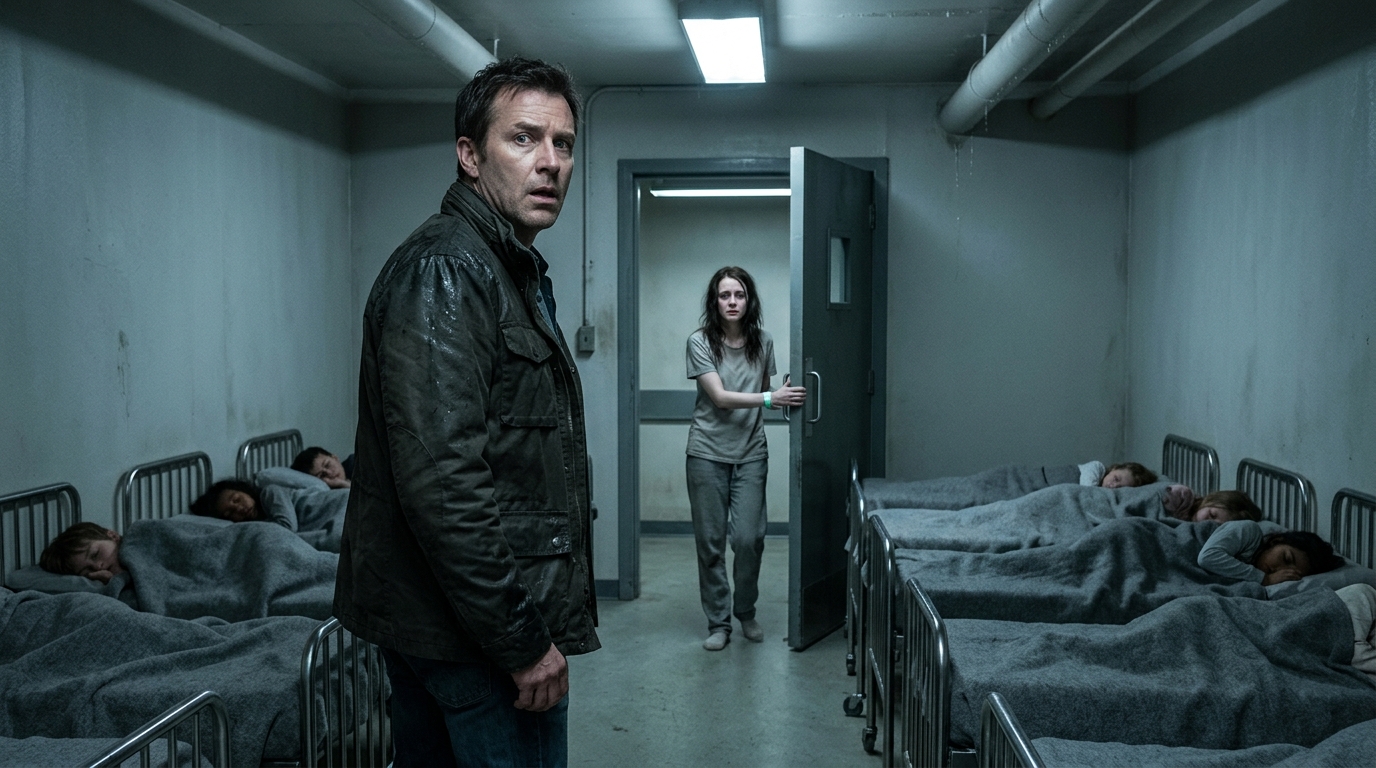
    Inside were beds.

    Small beds.

    Rows of them.

    Children slept beneath gray blankets.

    Some looked six.

    Some older.

    All wore green wristbands.

    I pressed one hand against the glass.

    My stomach turned.

    This was not a climate archive.

    This was not conservation.

    This was a ward.

    A hidden children’s ward under the forest I had spent eleven years funding in my daughter’s name.

    A nurse in a white uniform moved between the beds, checking a tablet.

    No one looked chained.

    That made it worse.

    Captivity does not always need visible locks.

    Sometimes it uses medicine.

    Fear.

    Names taken away.

    A child sat upright in bed near the far wall.

    A boy with shaved hair and hollow eyes.

    He looked toward the window.

    He saw me.

    Then he raised one finger to his lips.

    Quiet.

    Thomas pulled me back.

    Footsteps approached.

    We ducked into a side storage room.

    Through the cracked door, two men passed.

    One of them was carrying the cracked glass specimen box.

    The dead butterfly was inside.

    The other held Nora by the arm.

    She was crying silently.

    My whole body moved before thought could stop me.

    Thomas grabbed my shoulder and held me back.

    “Not yet,” he breathed.

    The men stopped outside the green room.

    Nora looked up.

    For one second, through the crack in the door, her eyes met mine.

    She saw me.

    Hope flashed across her face.

    Then fear swallowed it.

    She shook her head.

    Just once.

    A warning.

    The man holding her opened a door at the end of the hall.

    A sign above it read:

    Memory Reintegration

    Nora began to struggle.

    “No,” she cried. “Please. I delivered it. She said if I delivered it, you had to let me go.”

    The man laughed.

    “Sweetheart, Elodie says a lot of things.”

    The door closed behind them.

    I almost broke Thomas’s grip.

    But then another voice came from the hallway speakers.

    Seraphina.

    Calm.

    Close.

    “Adrian, I know you’re inside.”

    Thomas went still.

    The speaker crackled.

    “You always were predictable once grief made you sentimental.”

    I stepped into the corridor.

    Thomas hissed, “Sir.”

    But I was done hiding from my wife inside the tomb she had built for my daughter.

    A camera turned toward me.

    I looked directly into it.

    “Where is Elodie?”

    Seraphina’s voice softened.

    A performance for an audience of one.

    “She is where she has always been safest.”

    “From whom?”

    A pause.

    Then:

    “From you.”

    The words were so absurd I almost missed the sound behind me.

    A door opening.

    Not the Memory Reintegration room.

    Another door.

    At the far end of the corridor.

    A woman stepped out.

    Thin.

    Pale.

    Hair cut short.

    One hand gripping the frame as if standing cost her everything.

    She wore a green wristband.

    E-17.

    For one impossible second, my mind refused her.

    Because fathers freeze their children at the age they lose them.

    I had spent eleven years remembering Elodie at thirteen.

    But the woman in the doorway was twenty-four.

    Older.

    Hollowed.

    Alive.

    Her eyes found mine.

    And I knew them.

    “Elodie,” I whispered.

    Her mouth trembled.

    “Dad.”

    The corridor disappeared.

    So did the cameras.

    The alarms.

    The years.

    I moved toward her.

    She tried to step forward too, but her knees buckled.

    I caught her before she fell.

    She weighed almost nothing.

    My daughter was alive in my arms.

    Alive.

    Breathing.

    Shaking.

    And then she gripped my jacket with terrifying strength and whispered:

    “You shouldn’t have come yet.”

    I pulled back just enough to see her face.

    “What?”

    Her eyes filled with panic.

    “She wanted you to find me.”

    The blood in my body went cold.

    Behind us, every green light in the corridor turned red.

    Locks slammed shut one after another.

    Seraphina’s voice filled the hallway.

    “Thank you, Adrian. You’ve just opened the only door Elodie never could.”

  • A Poor Girl Brought A Dead Butterfly To My Charity Gala. When The Light Hit Its Wings, I Saw My Dead Daughter’s Message

    A Poor Girl Brought A Dead Butterfly To My Charity Gala. When The Light Hit Its Wings, I Saw My Dead Daughter’s Message

    The Girl At The Glass Doors

    The rain made the ballroom look like a beautiful lie.

    It ran down the glass walls in silver streams, blurring the city lights outside until everything beyond the hotel looked drowned and distant. Inside, the Evermere Grand Ballroom glowed with chandeliers, white orchids, polished marble, and the kind of wealth that knew how to soften its own reflection.

    Every table had crystal glasses.

    Every guest had a name worth printing.

    Every camera was pointed at the stage.

    And behind me, glowing in soft green light, was the banner my wife had approved herself.

    Evermere Foundation Annual Gala

    Saving Lost Children. Protecting Nature.

    I should have hated those words.

    Maybe some part of me did.

    But grief can make a man accept almost anything if it gives him somewhere to put the pain.

    Eleven years earlier, my daughter Elodie disappeared in Blackwood Forest.

    She was thirteen.

    Brilliant.

    Stubborn.

    Wild in the way only children loved too deeply by nature can be wild.

    She collected butterfly wings, argued with university professors twice her age, and once told me that adults only called things extinct when they were tired of searching.

    Then the fire came.

    That was what the report said.

    A lightning strike near the northern ridge.

    A research cabin swallowed by flames.

    A forest burned so completely that rescue teams found nothing but ash, twisted metal, and one damaged wing from the Blue Glasswing, the rare butterfly Elodie had spent her last summer studying.

    No body.

    No backpack.

    No notebook.

    No goodbye.

    Just ash.

    The official report said no one could have survived.

    My wife, Seraphina, repeated that sentence until it became the only truth allowed inside our house.

    No one could have survived.

    No one could have survived.

    No one could have survived.

    So I stopped asking questions.

    That was my first failure as a father.

    On the night of the gala, Seraphina stood beside me in a white silk gown that caught the light like water. Emerald earrings framed her face. Her smile was calm, polished, generous.

    Perfect.

    People always said she carried grief with grace.

    I used to believe them.

    She touched my wrist as the applause faded.

    “Adrian,” she whispered, “they’re ready.”

    I looked out at the donors.

    Senators.

    Tech founders.

    Old family names.

    Reporters from magazines that loved stories about loss as long as the room was beautiful enough.

    I stepped toward the microphone.

    “Eleven years ago,” I began, “our daughter Elodie walked into Blackwood Forest and never came home.”

    The room softened.

    It always did at that part.

    People lowered their eyes. Women touched their pearls. Men looked solemn in the way powerful men do when tragedy costs them nothing.

    “Elodie believed every lost thing deserved to be searched for,” I continued. “Every missing child. Every wounded forest. Every voice too small to survive alone.”

    Seraphina lowered her eyes beside me.

    The cameras loved her.

    Then the glass doors opened at the back of the ballroom.

    A cold line of rain blew across the marble.

    Everyone turned.

    A girl stood in the doorway.

    She could not have been more than eleven.

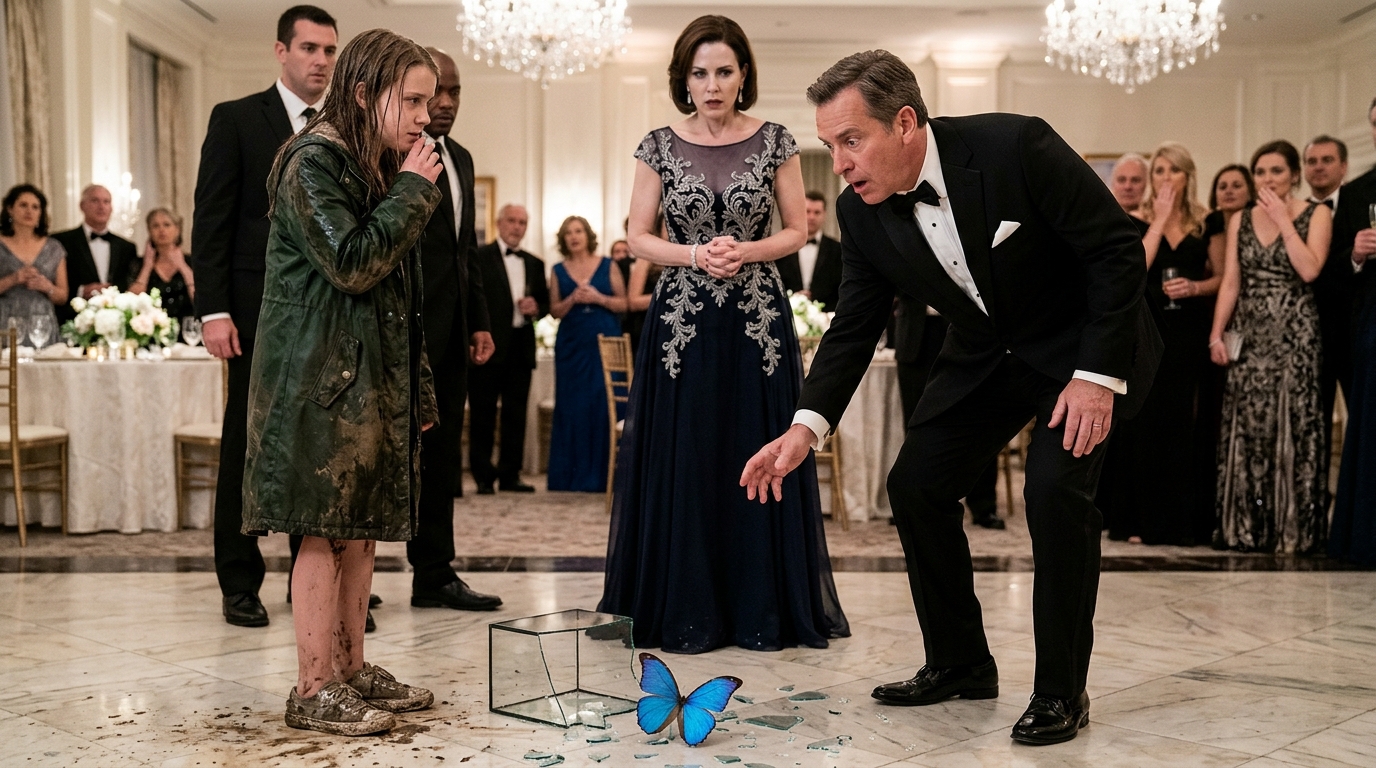
    Her dark green raincoat was soaked through. Mud clung to her shoes and streaked her thin legs. Her hair hung wet against her cheeks. She looked exhausted, frightened, and far too real for a room like that.

    In both hands, she held a small cracked glass box.

    A specimen box.

    The kind Elodie used to keep on her desk.

    My voice stopped.

    The microphone caught the silence.

    The girl looked directly at me.

    Not at the stage.

    Not at the cameras.

    At me.

    Then she lifted the box with trembling hands and said:

    “She said you would recognize the butterfly.”

    The Butterfly In The Broken Box

    The room did not understand her at first.

    That was the worst part.

    They did not hear a warning.

    They saw a poor child interrupting a rich event.

    A woman at table four frowned as if the girl had tracked mud across her reputation. A photographer lowered his camera. A senator’s wife whispered something behind her champagne glass and smiled as if cruelty were a private joke.

    Near the velvet rope, a security guard moved fast.

    Too fast.

    The girl saw him coming and clutched the glass box harder.

    “I need to give it to Mr. Vale,” she said.

    The guard blocked her.

    “You don’t belong here.”

    Her face tightened, but she did not move back.

    “Please. She told me only he would know.”

    “Outside,” the guard said.

    He reached for her arm.

    I stepped away from the podium.

    “Wait.”

    But the ballroom was large.

    The guard either did not hear me, or he heard me and chose another master.

    Seraphina’s voice cut softly through the space beside me.

    “Remove her before the cameras make this ugly.”

    It was not loud.

    It did not need to be.

    The guard grabbed the girl’s arm.

    She cried out.

    The sound went through me with a force I was not prepared for. Maybe because she was a child. Maybe because she was exactly the age Elodie had been the last time she ran into my office holding a butterfly net and told me I worked too much to notice miracles.

    The girl twisted away.

    The glass box slipped.

    It struck the marble floor with a sharp crack.

    Not enough to shatter.

    Enough to open.

    The lid flipped back.

    Something blue and impossibly fragile slid out onto the white stone.

    The ballroom froze.

    It was a butterfly.

    Dead.

    Pinned.

    Preserved.

    Its body was black and thin. Its wings were spread open as though it had fallen out of flight. They were almost transparent, but the veins running through them glowed a deep, impossible blue.

    I forgot the room.

    Forgot the donors.

    Forgot the cameras.

    Forgot my wife’s hand closing around my wrist.

    I walked down from the stage like a man following a ghost.

    The guard released the girl.

    No one told him to.

    He simply understood that something had changed.

    I knelt beside the open box.

    The butterfly was real.

    Not plastic.

    Not jewelry.

    Not a decoration.

    A real specimen.

    My daughter had collected enough for me to know the difference. Elodie had filled our dining table with wing charts, field notes, magnifying lenses, jars of soil, and endless arguments about habitat loss.

    This was a Blue Glasswing.

    Or it should have been impossible.

    Because the Blue Glasswing died with Blackwood Forest.

    That was what the report said.

    That was what Evermere’s memorial wing was built around.

    That was what Seraphina had told every donor, every journalist, every investigator, and every grieving version of me for eleven years.

    I touched the edge of the glass box, careful not to disturb the wings.

    My voice came out low.

    “That species died with my daughter.”

    The girl shook her head.

    Rain dripped from her hair onto the marble.

    “No,” she whispered. “She said it survived where they hid her.”

    A murmur moved through the ballroom.

    Not loud.

    Not yet.

    But enough.

    I looked up at her.

    “What is your name?”

    “Nora.”

    “Who gave you this?”

    Her eyes flicked toward Seraphina.

    Just once.

    But I saw it.

    Seraphina saw it too.

    “My daughter is dead,” I said.

    Nora swallowed.

    “She told me you would say that.”

    The words hit harder than they should have.

    I stood slowly.

    Hope is not gentle when it returns after being buried. It does not knock. It breaks doors. It drags bones from graves. It makes a fool of every careful sentence you used to survive.

    Seraphina moved beside me.

    Her face was composed again.

    Too composed.

    “Adrian,” she said softly, “someone is using your grief. This child has been sent here to hurt us.”

    Nora flinched.

    “It’s not a trick.”

    Seraphina turned to her.

    For the first time that night, the room saw something beneath my wife’s beauty.

    Not grief.

    Control.

    “Little girl,” Seraphina said, “do you understand what happens when children lie to grieving parents?”

    Nora’s chin trembled.

    But she did not look away.

    “She said you would try to make me scared.”

    The room went completely silent.

    I turned to my wife.

    “What does that mean?”

    Seraphina smiled.

    It was a perfect smile.

    And for the first time in eleven years, it made my skin cold.

    “I have no idea.”

    The Message In The Wings

    A photographer shifted near the stage.

    One of the spotlights moved with him.

    The beam crossed the marble floor, slid over the cracked glass box, and passed through the butterfly’s transparent wings.

    Something appeared.

    At first, I thought it was a shadow.

    A trick of the light.

    Tiny dark markings sat inside the blue veins, too small to read from where I stood.

    Then the light sharpened.

    The markings became letters.

    My heart stopped.

    Dad.

    The word was written across the left wing.

    Not ink on top of the wing.

    Inside it.

    As if someone had marked the delicate veins themselves.

    I knelt again.

    The room disappeared.

    I leaned closer, afraid to breathe.

    The second line emerged as the spotlight passed through the right wing.

    I’m still alive.

    Someone gasped behind me.

    Maybe a reporter.

    Maybe me.

    The final line appeared near the lower edge of the wing, faint but clear.

    Don’t trust Mother.

    The ballroom broke.

    Not loudly at first.

    It broke in pieces.

    A glass touched a plate.

    A chair moved.

    A woman whispered, “Oh my God.”

    Phones rose from tables.

    Cameras turned toward Seraphina.

    My wife went white.

    Not pale.

    White.

    The kind of white that does not come from shock.

    The kind that comes when something buried hears footsteps above it.

    I picked up the specimen box with both hands.

    The dead butterfly trembled inside.

    For eleven years, I had held my grief like a loyal thing.

    I had let Seraphina manage the foundation.

    The investigators.

    The memorial events.

    The restricted land around Blackwood.

    The storage of Elodie’s belongings.

    The private files.

    The sealed reports.

    I had thought she was stronger than me.

    Now I wondered whether strength had simply been the better mask.

    I turned toward her.

    “Seraphina.”

    She did not answer.

    Her eyes stayed on the butterfly.

    I held up the box.

    “Why does my dead daughter know I’m here tonight?”

    The question did not sound like mine.

    It sounded like it came from somewhere older.

    Somewhere still standing in Blackwood Forest, calling Elodie’s name into smoke.

    Seraphina’s lips parted.

    Closed.

    Parted again.

    For the first time in years, my wife had no prepared sentence.

    Nora stepped toward me.

    The guard did not stop her now.

    “She said not to let you go home with her,” Nora whispered.

    I looked at the girl.

    “Why?”

    Nora’s eyes filled again.

    “She said your wife keeps the children under the forest.”

    The words made no sense.

    Then they made too much sense.

    Blackwood Forest.

    The protected zone.

    Evermere’s private conservation land.

    The underground climate archive Seraphina once told me was too unstable for visitors.

    The annual funding requests I signed without reading because I could not bear another conversation about that place.

    Under the forest.

    Children.

    My mouth went dry.

    Seraphina moved suddenly.

    Not toward me.

    Toward Nora.

    “Enough.”

    The word cracked through the ballroom.

    The wife who had stood beside me on stage was gone.

    In her place stood someone harder.

    Someone frightened enough to become dangerous.

    Nora stepped back.

    I moved between them.

    Seraphina looked at me with eyes I no longer recognized.

    “Adrian,” she said quietly, “give me the box.”

    I looked at the butterfly.

    At the message in its wings.

    At the tiny impossible proof that my daughter had not disappeared into fire.

    She had been somewhere.

    Alive.

    Writing to me through the body of the creature she loved most.

    “No,” I said.

    Seraphina’s face changed.

    Only for a second.

    But I saw the hatred in it.

    Then she looked past me.

    Toward the security guard.

    Toward the event staff.

    Toward the exits.

    That was when I realized she was not trapped.

    I was.

    The Woman Who Stopped Smiling

    The ballroom doors closed.

    I heard them lock.

    Not loudly.

    Just one soft electronic click after another.

    Click.

    Click.

    Click.

    The donors noticed.

    So did the reporters.

    A nervous sound moved through the room.

    One of the journalists near the stage tried the side exit.

    It did not open.

    “Is this part of the program?” someone asked.

    No one laughed.

    Seraphina lifted one hand slightly.

    A signal.

    Three men I had assumed were hotel security stepped away from the walls. They were not wearing name tags. They were not looking at guests.

    They were looking at Nora.

    The girl saw them and moved closer to me.

    Her breathing quickened.

    “Don’t let them take me back,” she whispered.

    Back.

    The word drove itself into my chest.

    “Back where?” I asked.

    Nora looked at Seraphina.

    Then at me.

    “The green rooms.”

    Seraphina smiled again.

    But this time, no one in the ballroom mistook it for kindness.

    “Children invent stories when they are frightened,” she said.

    Nora shook her head.

    “You told them stories were safer than names.”

    That sentence changed everything.

    Seraphina’s smile vanished.

    The men near the walls began moving.

    Slowly.

    Carefully.

    As if trying not to startle the wealthy animals in the room.

    I raised my voice.

    “No one touches this child.”

    For most of my adult life, that sentence would have been enough.

    Money had made my voice heavy.

    Grief had made it pitied.

    The Vale name had opened doors, closed investigations, moved politicians, and silenced rooms before I entered them.

    But that night, inside the gala my own money paid for, I watched three men ignore me.

    That was when I understood the shape of my marriage.

    Seraphina had not been standing beside my power.

    She had been building her own beneath it.

    A reporter called out, “Mrs. Vale, are you denying the message?”

    Seraphina turned toward him.

    Her face softened so quickly it was terrifying.

    “This is a deeply cruel attack on a family tragedy,” she said. “Please put your phones away. No one here is in danger.”

    Nora laughed once.

    It was not amusement.

    It was disbelief.

    “That’s what they said before they locked the doors underground.”

    The reporter froze.

    Underground.

    The word spread through the guests like cold water.

    I looked at Nora.

    “How many children?”

    Her eyes filled with tears.

    “I don’t know.”

    Seraphina said, “Adrian, stop.”

    “How many?”

    Nora swallowed.

    “I only knew the ones in my hall.”

    My hand tightened around the specimen box.

    “Your hall?”

    She nodded.

    “The sleeping hall.”

    A woman near the front table covered her mouth.

    The donors were beginning to understand that this was no longer an interruption.

    This was evidence.

    Seraphina stepped closer to me.

    Her voice dropped.

    Only I could hear it now.

    “You are embarrassing yourself.”

    I stared at her.

    “You knew where Elodie was.”

    Her eyes sharpened.

    “You don’t know what you’re talking about.”

    “You signed the fire report.”

    “I protected you.”

    “From our daughter?”

    Her face twitched.

    There it was.

    The first crack large enough to see from a distance.

    Nora reached into the pocket of her wet raincoat.

    One of the security men lunged.

    I stepped in front of her, but he was faster than I expected.

    He grabbed her wrist.

    Nora screamed.

    The sound ripped through the ballroom.

    Something inside me snapped.

    I swung the specimen box into the man’s arm.

    Not hard enough to break bone.

    Hard enough to make him release her.

    The box fell again, sliding across the marble.

    The butterfly stayed inside.

    The room erupted.

    Guests stood.

    Reporters shouted.

    A camera flash exploded white across Seraphina’s face.

    And in that flash, I saw what Nora had pulled from her pocket.

    A small green wristband.

    Plastic.

    Medical.

    Marked with a number.

    E-17.

    My daughter’s initials.

    Elodie Vale.

    Nora held it up with shaking fingers.

    “She said this was hers.”

    Seraphina whispered, “You stupid little girl.”

    Everyone heard her.

    The room died again.

    This time, there was no performance left.

    No elegance.

    No grief.

    Only the woman beneath the foundation.

    And she had just shown herself.

    The Forest Beneath The Foundation

    I took the wristband from Nora.

    My fingers barely worked.

    The plastic was old but intact. Faded green. Slightly cracked at the edge. On the inside, written in tiny black letters, was a date.

    The day after the fire.

    My daughter had been alive the day after the fire.

    Alive.

    Registered.

    Numbered.

    Held somewhere.

    The ballroom tilted around me.

    For years, I had imagined Elodie’s final moment as smoke, heat, fear, and then nothing.

    But the wristband offered a worse possibility.

    That my daughter had survived the fire.

    That she had waited for me.

    That she had called for me from a place built with my money.

    I looked at Seraphina.

    “Where is she?”

    Seraphina’s face was calm again, but not because she had control.

    Because she had chosen a new strategy.

    Coldness.

    “Adrian,” she said, “you are unwell.”

    The sentence was so familiar it almost worked.

    Grief makes you unstable.

    Grief makes you imagine signs.

    Grief makes you vulnerable to manipulation.

    I had heard versions of it for eleven years.

    From doctors Seraphina chose.

    From investigators she recommended.

    From board members she invited to dinner.

    From myself.

    Not this time.

    I held up the wristband.

    “This is dated after the fire.”

    Seraphina did not look at it.

    That was answer enough.

    Nora moved beside me.

    “She said if I gave you the butterfly, you would come.”

    “Come where?”

    Nora looked toward the rain-streaked glass walls.

    “Blackwood.”

    Seraphina laughed softly.

    It was the ugliest sound I had ever heard from her.

    “You think I will let you walk into a restricted conservation zone because a dirty child brought you a dead insect?”

    The room heard that too.

    Dirty child.

    Dead insect.

    Every mask was gone now.

    A donor near the front stood slowly.

    “Mrs. Vale,” he said, “open the doors.”

    Seraphina did not even look at him.

    “No.”

    The answer chilled the room.

    A second reporter tried to upload something from her phone.

    “No signal,” she whispered.

    Then another guest checked.

    Then another.

    The phones were dead.

    Not powered off.

    Blocked.

    Seraphina had sealed the ballroom.

    The gala had not become a trap.

    It had always been one.

    Just not for the guests.

    For anyone who brought truth inside.

    A sound came from the stage speakers.

    Low.

    Static.

    Then a child’s voice.

    Not Nora’s.

    Not live.

    Recorded.

    “Dad?”

    My body went still.

    The ballroom went silent.

    The voice crackled through the speakers again.

    Older than the Elodie I remembered.

    But still hers.

    Still my daughter.

    “Dad, if you’re hearing this, Nora made it.”

    My knees almost buckled.

    Seraphina turned toward the sound system, horrified.

    She had not expected this.

    Good.

    For the first time all night, something was happening outside her design.

    Elodie’s voice continued, faint but clear.

    “Don’t follow her alone. Don’t trust the foundation map. The forest above is not the place you need to search.”

    A sharp noise cut through the speakers.

    Then Elodie whispered:

    “Look under the roots.”

    The sound died.

    For one second, no one moved.

    Then all the lights went out.

    The chandeliers.

    The stage screen.

    The green Evermere banner.

    Everything.

    The ballroom dropped into blackness.

    People screamed.

    Glass broke.

    Chairs overturned.

    In the dark, a hand grabbed my sleeve.

    Nora.

    Her voice was right beside me, terrified and breathless.

    “They’re here.”

    “Who?”

    She was crying now.

    “The root keepers.”

    I felt her being pulled away.

    I grabbed for her, but someone struck my shoulder hard enough to send me into a table.

    The specimen box slipped from my hands.

    The butterfly skidded across the floor.

    Somewhere in the darkness, Seraphina’s voice came close to my ear.

    Calm.

    Cold.

    No longer pretending.

    “You should have let her stay dead.”

    Then Nora screamed.

    And when the emergency lights finally flickered on, the girl was gone.

    So was the butterfly.

    Only the green wristband remained on the marble at my feet.

    E-17.

    The proof my daughter had lived after the fire.

    And the first real clue that whatever had taken her was not hidden in the forest.

    It was underneath it.

  • The Janitor’s Son Revealed A Letter From The Missing Student. Then The Principal Whispered: “Don’t Let Her Speak.”

    The Janitor’s Son Revealed A Letter From The Missing Student. Then The Principal Whispered: “Don’t Let Her Speak.”

    The Letter Inside The Cloth Pouch

    The auditorium did not breathe.

    At least, that was how it felt.

    Hundreds of people sat beneath the golden banners of St. Alden Preparatory, but no one moved. No one clapped. No one whispered anymore.

    The polished ceremony had cracked open.

    And inside that crack stood a poor boy in worn shoes.

    Liam.

    The janitor’s son.

    He was still standing near the stage, his face pale, his small hands trembling around the empty cloth pouch. A few moments earlier, the wealthy parents had laughed at him for walking toward the stage.

    Now no one was laughing.

    The golden medal had rolled across the floor and stopped beside my cane.

    I had picked it up.

    I had turned it over.

    And there, engraved on the back, was the name I had spent twenty-three years trying not to say in public because every time I said it, people looked at me like grief had made me unstable.

    Daniel Alden.

    My son.

    My missing son.

    The boy St. Alden claimed had run away.

    The boy the police stopped searching for.

    The boy my own family told me to mourn quietly.

    But the medal in my shaking hand said something different.

    It said Daniel had not vanished without a trace.

    It said someone had kept a piece of him hidden all these years.

    And when I looked at Principal Eleanor Vale, I saw the truth cross her face before she could hide it.

    Fear.

    Not confusion.

    Not sadness.

    Fear.

    I turned back to Liam.

    “Where did you get this?”

    His eyes filled with tears, but he did not lower his head.

    “My mom said my father won it,” he whispered. “Before your school erased his name.”

    The words seemed to strike every wall at once.

    A student gasped.

    A parent murmured, “His father?”

    Principal Vale stepped forward quickly.

    Too quickly.

    “That is enough,” she said, her voice smooth but tight. “This child is upset. Mrs. Rowan has clearly filled his head with old stories.”

    Mrs. Rowan.

    Miriam Rowan.

    The elderly janitor stood near the back entrance beside her cleaning cart. Her gray uniform looked plain against the velvet curtains and polished wood, but in that moment, she was the only person in the room who seemed to understand how dangerous truth could be.

    Her hands were clasped in front of her.

    Her knuckles were white.

    Liam looked back at her.

    Not for permission.

    For courage.

    Then he reached into the cloth pouch again.

    Principal Vale saw the movement.

    Her eyes widened.

    Only for a second.

    But I saw it.

    She had known about the medal.

    Now she was afraid of what came next.

    Liam pulled out a folded letter wrapped in clear plastic.

    Old.

    Yellowed.

    Protected like a relic.

    The room changed again.

    Even the wealthy mother in pearls, the one who had mocked him moments earlier, leaned forward with her lips parted.

    Principal Vale took one step toward the boy.

    “Give that to me.”

    Liam clutched the letter to his chest.

    “No.”

    Her smile returned, but it was no longer elegant.

    It was thin.

    Sharp.

    Dangerous.

    “Liam,” she said quietly, “you are making this much worse for your mother.”

    The boy flinched.

    There it was.

    The threat beneath the manners.

    The same old language powerful people use when they cannot say what they really mean.

    Obey, or we will punish the person you love.

    I stood.

    My cane struck the floor once.

    The sound echoed across the auditorium.

    “Give the letter to me.”

    Principal Vale turned toward me.

    “Mr. Alden, I strongly advise against entertaining this spectacle.”

    I looked at her.

    “You advised me once before.”

    Her face tightened.

    “Excuse me?”

    “The night my son disappeared, you told me Daniel was troubled. You told me he had become unstable. You told me he was embarrassed by his own failures.”

    The auditorium remained silent.

    “I believed you for one hour,” I said. “Then I spent twenty-three years regretting it.”

    Principal Vale said nothing.

    Liam walked toward me.

    Slowly.

    Carefully.

    As if the floor itself might betray him.

    He placed the letter in my hand.

    His fingers were cold.

    I looked down at the plastic.

    There was a name written across the front.

    Dad.

    My knees almost failed.

    Not because of the word.

    Because of the handwriting.

    Daniel’s handwriting.

    The Handwriting Of The Dead

    You think you forget details after twenty-three years.

    You don’t.

    Grief preserves things the living world tries to blur.

    The way your child writes the letter D.

    The pressure of his pen when he is angry.

    The crooked line he makes when he is rushing.

    The careless confidence of someone who believes there will always be more paper, more time, more chances to explain later.

    I knew Daniel’s handwriting before I opened the letter.

    My thumb pressed against the plastic.

    For a moment, I could not move.

    The auditorium disappeared again.

    I saw Daniel at seventeen, sitting at our kitchen island with his sleeves rolled up, scribbling in a notebook while his mother told him not to get ink on the marble.

    I saw him at twelve, writing an apology letter to a teacher he did not believe he owed an apology to.

    I saw him at six, writing his name backward on a birthday card and insisting it looked better that way.

    And then I saw the police officer, twenty-three years ago, sliding a thin folder across a desk and saying, “Mr. Alden, young men leave for many reasons.”

    Young men leave.

    As if my son had walked out of my life like a guest leaving dinner early.

    My hand shook as I opened the plastic.

    The paper inside was fragile, but the words were clear.

    Dad,

    If you ever read this, it means I failed to get out with the proof.

    I stopped breathing.

    A low sound moved through the crowd, but I barely heard it.

    I kept reading.

    They are not just changing grades.

    They are taking scholarship money and burying student complaints before inspections.

    Vale knows.

    The board knows.

    And if I disappear, ask Miriam Rowan where she hid the medal.

    She is the only adult in this school who still has a conscience.

    I read the last line silently.

    Then again.

    Then aloud.

    “If I disappear, ask Miriam Rowan where she hid the medal.”

    The auditorium turned as one body.

    Every eye moved to the back of the room.

    To the janitor.

    Miriam Rowan stood frozen beside her cleaning cart.

    For twenty-three years, she had swept those halls.

    Emptied classroom trash.

    Scrubbed floors after dances.

    Wiped fingerprints from trophy cases that no one ever let her children touch.

    She had been invisible to the people in that room.

    Until my dead son’s letter made her the most important person alive.

    Principal Vale’s voice cut through the silence.

    “Miriam.”

    It was not loud.

    It was worse than loud.

    It was a warning dressed as a name.

    Miriam lowered her eyes.

    I saw the movement and hated myself for how familiar it was.

    Power trains people like her to look down before they are struck.

    Liam turned toward his mother.

    “Mom,” he whispered.

    Principal Vale moved closer to Miriam.

    Not physically.

    With her voice.

    “Miriam, I suggest you think very carefully before you say anything.”

    Miriam’s lips trembled.

    A tear slipped down her cheek.

    The boy took one step toward her.

    “Mom… tell him.”

    Something broke in her then.

    Or maybe something finally mended.

    Miriam slowly raised her head.

    The room waited.

    Principal Vale’s face turned cold.

    “Do not let her speak,” she whispered to a nearby staff member.

    But it was too late.

    Everyone had heard her.

    Everyone had seen the fear.

    And Miriam Rowan, who had been silent for more than two decades, opened her mouth.

    “Daniel never ran away.”

    The Janitor Who Held The Secret

    The sentence did not explode.

    It landed quietly.

    That made it worse.

    Daniel never ran away.

    Five words.

    Enough to destroy twenty-three years of reports, rumors, family arguments, police assumptions, and carefully arranged lies.

    I looked at Miriam.

    “Say it again.”

    She swallowed.

    “Daniel never ran away.”

    A sound left me.

    Not a sob.

    Not a word.

    Something older.

    Something pulled from the part of a father that never stopped standing at the door, waiting for footsteps that never came home.

    Principal Vale snapped, “This is absurd.”

    No one looked at her.

    That was the first time I saw her truly lose control.

    Not because she was shouted down.

    Because she was ignored.

    Miriam stepped forward.

    One step.

    Then another.

    Liam hurried to her side and took her hand.

    Together, they walked down the aisle.

    This time, the parents moved aside.

    The same parents who had whispered about the cleaner’s boy now leaned away as if shame were contagious.

    Miriam stopped in front of me.

    She looked at the medal in my hand.

    Then at the letter.

    Then at me.

    “I’m sorry,” she said.

    “For what?”

    Her face crumpled.

    “For being afraid longer than I was brave.”

    The answer hurt because it was honest.

    I wanted to be angry at her.

    Part of me was.

    But another part remembered what kind of world we had built.

    A world where men like me donated wings to schools and assumed the plaques meant goodness.

    A world where women like Miriam cleaned up after our ceremonies and knew more truth than we ever cared to ask.

    “What happened?” I asked.

    Miriam looked toward Principal Vale.

    Vale stood still near the stage, her jaw tight, her hands clasped in front of her as if posture could still save her.

    “Daniel came to me the night before he disappeared,” Miriam said. “He was scared.”

    “My son was not easily scared.”

    “No,” Miriam said softly. “He wasn’t scared for himself.”

    Her eyes moved to Liam.

    “He was scared for the students no one protected.”

    I closed my fist around the medal.

    Miriam continued.

    “He found files. Scholarship records. Complaints from students. Medical reports. Disciplinary notes that disappeared after certain families made donations.”

    A murmur moved through the auditorium.

    This time, it came from the students.

    Not the parents.

    Some of them looked at the floor.

    Some looked at each other.

    Some looked at Principal Vale.

    Miriam’s voice shook, but she kept going.

    “Daniel said if he took the evidence straight to the board, it would vanish. He said some of them were involved. He asked me to hide the medal because he knew they would search his room. He said the medal had a number scratched inside the clasp.”

    I looked down.

    My hands moved faster than my thoughts.

    I turned the medal toward the light and opened the clasp.

    There, scratched into the inner curve, was a number.

    B-14.

    The same kind of small, coded clue Daniel used to leave in his notebooks.

    “What does it mean?” I asked.

    Miriam said, “Basement archive. Cabinet fourteen.”

    Principal Vale’s lips parted.

    A teacher near the side doors whispered, “There is no basement archive.”

    Miriam looked at her.

    “Yes,” she said. “There is.”

    The room shifted again.

    A school built on reputation had rooms its own teachers did not know existed.

    Principal Vale moved toward the aisle.

    “This ceremony is over.”

    I turned to her.

    “No.”

    Her eyes flashed.

    “You may be a trustee, Mr. Alden, but you do not control an active school event.”

    I held up my son’s letter.

    “No. But my family still owns the land under this school.”

    That silenced her.

    Finally.

    For the first time in twenty-three years, I saw Eleanor Vale understand that power could turn around and face her.

    I looked at Miriam.

    “Take me to the archive.”

    She nodded.

    But Liam tightened his grip on her hand.

    “There’s something else,” he said.

    Miriam closed her eyes.

    “Liam.”

    He looked up at me.

    The poor boy.

    The janitor’s son.

    The child who had walked into a room built to reject him and changed every face inside it.

    “My mom said I should tell you only after you read the letter.”

    I crouched slowly so I could look him in the eyes.

    “What is it?”

    His lower lip trembled.

    He looked at Miriam.

    She nodded once.

    Just once.

    And Liam said the sentence that made the medal feel like it had turned to stone in my hand.

    “She said Daniel Alden was my father.”

    The Boy With Daniel’s Eyes

    No one in that auditorium spoke.

    Not the students.

    Not the parents.

    Not the teachers.

    Not Principal Vale.

    Not me.

    The entire room seemed to fall backward into one impossible silence.

    I looked at Liam.

    Really looked at him.

    The shape of his mouth.

    The stubborn angle of his chin.

    The way he tried not to cry in public.

    And then the eyes.

    I had seen those eyes glare at me across a dinner table.

    Laugh from a bicycle.

    Roll dramatically when I gave advice.

    Close forever in my worst dreams.

    Daniel’s eyes.

    My grandson was standing in front of me in a sweater too big for his shoulders.

    For twenty-three years, I had searched for my son.

    And my son had left behind a child who had been cleaning the edges of my world without me ever seeing him.

    I reached toward Liam, then stopped.

    I had no right to touch him like a discovery.

    He was not evidence.

    He was a boy.

    So I asked, softly, “How old are you?”

    “Nine.”

    Nine.

    The math did not make sense.

    Then I looked at Miriam.

    She understood the question before I asked it.

    “I didn’t know I was pregnant until after Daniel disappeared,” she said.

    Principal Vale let out a sharp laugh.

    Everyone turned.

    It was not amusement.

    It was panic cracking into contempt.

    “You expect people to believe this?” she said. “A janitor claims her son is an Alden after producing a suspicious medal and a convenient letter?”

    Miriam flinched.

    Liam stepped in front of her.

    Small.

    Furious.

    “Don’t talk to my mom like that.”

    Several students gasped.

    Principal Vale looked at him with open disgust.

    “This is exactly what happens when staff forget boundaries.”

    The words struck the room differently now.

    Before, the wealthy parents might have agreed silently.

    Now they heard it.

    Really heard it.

    Staff.

    Boundaries.

    The language of someone who believed people came in categories of value.

    I stood slowly.

    “You will not speak to my grandson that way.”

    The word left my mouth before the law could approve it.

    Grandson.

    Liam stared at me.

    Miriam covered her mouth.

    Principal Vale went still.

    A father knows before a test confirms what the heart has already recognized.

    But I also knew power required paperwork.

    And paperwork had been the weapon used against Daniel.

    So I turned to one of the board members near the stage.

    “Call state police.”

    Principal Vale snapped, “Security.”

    “No,” I said. “State police.”

    The board member did not move.

    I looked at him until he did.

    Then I turned back to Miriam.

    “The archive.”

    She nodded.

    We walked out of the auditorium together.

    Me.

    Miriam.

    Liam.

    And behind us, the room followed.

    Not all of it.

    Only the ones who understood that history was being dragged from behind the walls.

    The hallway outside the auditorium seemed different now.

    The portraits looked less noble.

    The trophies less innocent.

    The marble less clean.

    We passed display cases filled with medals, plaques, debate cups, championship photographs.

    But Daniel’s photograph was missing.

    I stopped in front of the empty space.

    The outline was faint but visible where the frame had once protected the wall from sunlight.

    “What was here?” Liam asked.

    My throat tightened.

    “Your father.”

    He looked at the empty space for a long moment.

    Then he whispered, “They took him down too.”

    Too.

    That word nearly broke me.

    Miriam led us toward the east wing, past the trophy room, past a locked maintenance door, and into a corridor that smelled of dust and old pipes.

    Principal Vale followed at a distance.

    Her heels clicked sharply behind us.

    She had stopped pretending this was a misunderstanding.

    Now she was watching the way cornered people watch exits.

    Miriam removed a small brass key from her uniform pocket.

    Principal Vale said, “Miriam, if you open that door, you will regret it.”

    Miriam paused.

    For one second, fear returned to her face.

    Then Liam slipped his hand into hers.

    She opened the door.

    Behind it was a narrow stairwell leading down.

    No sign.

    No lights except a dim emergency bulb.

    The basement archive.

    The place my son had hidden the rest of the truth.

    And from the look on Eleanor Vale’s face, whatever waited below was not just about Daniel.

    It was about everyone who had ever disappeared inside that beautiful school.

    The Door Beneath The School

    The air grew colder as we descended.

    Each step made the past feel closer.

    At the bottom of the stairs stood a metal door with a keypad and a rusted handle.

    Miriam looked at the medal in my hand.

    “B-14,” she whispered.

    I entered the numbers.

    The keypad beeped once.

    Red.

    Locked.

    Principal Vale exhaled behind us.

    Almost a laugh.

    Almost relief.

    Then Liam stepped forward.

    “Wait.”

    He reached for the medal.

    I handed it to him.

    He turned it over, studying the scratched number inside the clasp. His brow furrowed in the same way Daniel’s had when he was solving something.

    “It’s not B-fourteen,” Liam said. “It’s B-one-four.”

    Miriam looked confused.

    I stared at the medal.

    He was right.

    The scratch was not a dash.

    It was a one.

    B114.

    I entered 1-1-4.

    The lock clicked.

    Behind me, Principal Vale whispered one word.

    “No.”

    The door opened.

    Cold air spilled out.

    Inside was a room the school had spent decades pretending did not exist.

    Metal cabinets lined the walls.

    Boxes were stacked from floor to ceiling.

    Old student files.

    Disciplinary reports.

    Medical complaints.

    Financial ledgers.

    Security tapes.

    Names written on labels yellowed with age.

    A private graveyard made of paper.

    Miriam covered her mouth.

    Liam moved closer to me.

    I stepped inside.

    On the nearest cabinet was a label.

    Alden, Daniel.

    My hands went numb.

    I pulled the drawer open.

    Inside was my son’s life after the school erased him.

    Copies of his reports.

    Letters he had written to board members.

    A photograph of him bruised beneath one eye.

    A security log from the night he disappeared.

    And a sealed envelope marked:

    If Alden asks again.

    Not when.

    If.

    As if the school had expected my grief to exhaust itself eventually.

    I opened the envelope.

    Inside was a single page.

    A statement signed by Eleanor Vale.

    I read the first line.

    Daniel Alden was removed from campus at 11:52 p.m. under board emergency authority.

    Removed.

    Not left.

    Not ran away.

    Removed.

    The room swayed.

    Then a sound came from behind us.

    A phone hitting the floor.

    Principal Vale stood in the doorway, staring at the file.

    Her face was white.

    Not pale.

    White.

    I turned the page.

    The second signature stopped my heart.

    Charles Alden.

    My brother.

    Liam whispered, “What does it say?”

    I could not answer.

    Miriam stepped forward and saw the signature.

    Her face collapsed.

    “She told me the board did it,” she whispered. “She never said your family signed.”

    Principal Vale’s mask finally broke.

    Her voice came out raw.

    “You don’t understand what Daniel was going to destroy.”

    I looked at her.

    “My son was trying to tell the truth.”

    “He was going to ruin all of us.”

    “No,” I said. “You ruined yourselves.”

    A noise rose from above.

    Footsteps.

    Shouting.

    Someone had called police.

    Or security.

    Or both.

    Liam clutched the medal to his chest.

    Miriam stood in front of him.

    And Principal Vale, elegant and cornered, looked at the file cabinet as if it were a loaded gun.

    Then she said something that turned the cold archive colder.

    “Daniel was alive when they took him from this school.”

    I stopped breathing.

    “What did you say?”

    Her eyes filled, but not with remorse.

    With terror.

    “He was alive,” she whispered. “When your brother ordered the car.”

    The footsteps above grew louder.

    Liam looked up at me.

    Miriam began to cry.

    And in my hand, the old file trembled.

    For twenty-three years, I had believed my son vanished from St. Alden Preparatory.

    Now I knew the truth was worse.

    Daniel had not run away.

    Daniel had not disappeared.

    Daniel had been taken.

    And someone in my own family had signed the order.

  • The Janitor’s Son Brought A Golden Medal To The School Ceremony. When The Trustee Read The Name On It, The Principal Turned Pale

    The Janitor’s Son Brought A Golden Medal To The School Ceremony. When The Trustee Read The Name On It, The Principal Turned Pale

    The Boy At The Back Of The Auditorium

    The applause inside St. Alden Preparatory sounded polished.

    Even the clapping felt expensive.

    Parents in tailored coats sat beneath gold banners and velvet curtains while their children stood in perfect navy uniforms near the stage. The annual honors ceremony had always been the school’s proudest tradition. Scholarships were announced. Family names were praised. Donors were thanked as if generosity and power were the same thing.

    I sat in the front row with my cane beside me, watching another year of bright young faces receive medals beneath the crest my father had helped design.

    St. Alden had been part of my family for three generations.

    My grandfather donated the land.

    My father built the west wing.

    My son, Daniel, had once stood on that same stage with a golden medal around his neck and the whole room chanting his name.

    That was before he disappeared.

    Twenty-three years ago.

    The school said he ran away.

    The police said he was troubled.

    My family said grief had made me search too long.

    But I had never believed them.

    A person does not vanish from the most protected private school in the state without someone helping the silence.

    Principal Eleanor Vale stepped to the podium with her usual perfect smile. She wore a navy suit, pearl earrings, and the calm authority of a woman who had never once doubted that the room belonged to her.

    “Ladies and gentlemen,” she said, “today we honor the students who represent the finest values of St. Alden Preparatory.”

    The audience clapped again.

    Then the doors at the back opened.

    At first, no one paid attention.

    A late parent, perhaps.

    A staff member.

    A lost child.

    Then the whispers began.

    I turned.

    A small boy stood beside the janitor’s cleaning cart.

    He was no older than nine. His sweater was too large, faded at the cuffs, and not part of the official uniform. His shoes were worn thin at the toes. His hair was messy in the way children’s hair gets when no one has time to fix it before morning.

    But it was his hands I noticed.

    He clutched a small cloth pouch against his chest like it contained a living thing.

    Behind him stood Mrs. Rowan, the elderly janitor who had cleaned the school halls for as long as I could remember. Her gray uniform looked freshly pressed, but her face was pale. Afraid.

    The boy looked back at her.

    She nodded once.

    Not encouraging him.

    Releasing him.

    He started walking down the aisle.

    The room changed immediately.

    Heads turned.

    Students shifted.

    Parents leaned toward one another, their whispers sharp enough to cut skin.

    A woman in pearls, seated three rows behind me, murmured loudly enough for half the room to hear.

    “Why is the cleaner’s boy walking toward the stage?”

    A few people laughed softly.

    The boy heard.

    His face flushed, but he kept walking.

    That was the first thing that unsettled me.

    Poor children learn early how to disappear in rooms built for wealth. They lower their eyes. They step aside. They apologize for taking up space.

    This boy did none of that.

    He was terrified.

    But he did not stop.

    Principal Vale saw him when he reached the front aisle.

    Her smile froze.

    Only for a moment.

    Only long enough for someone like me to notice.

    Then she stepped down from the stage with graceful speed, cutting him off before he could reach the podium.

    “Liam,” she said, her voice sweet enough for the audience and cold enough for the boy. “This is not your place.”

    The boy swallowed.

    His fingers tightened around the pouch.

    “I need to give something to Mr. Alden.”

    The room went silent.

    My name crossed the auditorium like a match struck in darkness.

    Principal Vale’s eyes flicked toward me.

    Then toward Mrs. Rowan.

    Then back to the boy.

    “Whatever it is,” she said softly, “you can give it to me.”

    Liam shook his head.

    His lips trembled.

    “My mother said only he can see it.”

    Something passed across Eleanor Vale’s face.

    Not anger.

    Fear.

    A thin, fast crack in the polished mask.

    She reached for the pouch.

    Liam pulled back.

    “Give it to me,” she whispered.

    He shook his head again.

    “I promised.”

    Her hand closed around his wrist.

    Not hard enough for the crowd to gasp.

    Hard enough for the boy to flinch.

    The pouch slipped from his fingers.

    It hit the polished wooden floor.

    Something gold slid out.

    The object spun beneath the stage lights, bright as fire, and rolled across the floor until it stopped beside my cane.

    A medal.

    Old.

    Heavy.

    Familiar.

    I bent down slowly and picked it up.

    The moment my fingers touched the engraved edge, the auditorium vanished.

    I was no longer sitting in St. Alden Preparatory.

    I was standing twenty-three years in the past, watching my son grin under the same lights, holding that same medal, saying, “Dad, one day I’ll make this school honest.”

    I turned the medal over.

    The engraving caught the light.

    Daniel Alden.

    Excellence In Moral Courage.

    Class of 2003.

    The air left my lungs.

    No one spoke.

    No one moved.

    Across from me, Eleanor Vale had gone pale.

    Not embarrassed.

    Not confused.

    Pale.

    Like a woman staring at a grave that had just opened.

    I looked at the boy.

    “Where did you get this?”

    Liam’s eyes filled with tears, but he did not look away.

    “My mother said my father won it,” he whispered. “Before your school erased his name.”

    The Medal That Vanished With My Son

    For twenty-three years, I had been told Daniel took nothing with him.

    Not money.

    Not clothes.

    Not the old leather notebook he carried everywhere.

    Not the medal he loved more than any trophy, because it was the only award at St. Alden that had nothing to do with money, rank, or family legacy.

    Moral courage.

    The irony had rotted in me for decades.

    That medal disappeared the same night Daniel did.

    The school claimed it was lost.

    The police treated it like a detail.

    My wife cried until she had no voice left, then died five years later still whispering his name in her sleep.

    But I never forgot the medal.

    And now it was in my hand, warm from the boy’s cloth pouch.

    I stood.

    The auditorium remained frozen around me.

    “Liam,” I said carefully, “who is your mother?”

    He looked toward the back.

    Mrs. Rowan stood beside the cleaning cart, one hand over her mouth, tears sliding silently down her face.

    A janitor.

    An invisible woman in a room that depended on invisibility.

    Eleanor Vale found her voice first.

    “This is highly inappropriate,” she said, turning toward the audience with a strained smile. “Mr. Alden, I apologize. Mrs. Rowan has clearly involved her child in some misunderstanding.”

    “Is it a misunderstanding?” I asked.

    Her smile twitched.

    “Daniel’s disappearance was a painful tragedy for everyone.”

    “For everyone?” I repeated.

    The medal felt heavier in my palm.

    Liam stepped closer to me.

    “My mom said there’s a letter too.”

    Eleanor’s head snapped toward him.

    That was the second thing.

    She did not react like a woman hearing a lie.

    She reacted like a woman hearing the wrong truth at the wrong time.

    “What letter?” I asked.

    Liam reached into the empty pouch with shaking fingers and pulled out a folded piece of paper wrapped in plastic.

    Old.

    Yellowed.

    Protected carefully.

    He handed it to me.

    Mrs. Rowan made a small sound at the back of the room.

    I opened the plastic.

    The letter inside was written in Daniel’s handwriting.

    My son’s handwriting.

    For a moment, the world blurred.

    The hard slant of his D.

    The impatient lines.

    The way he pressed too hard into paper when he was angry.

    Dad,

    If you ever read this, it means I failed to get out with the proof.

    They are not just changing grades.

    They are taking scholarship money and burying student complaints before inspections.

    Vale knows.

    The board knows.

    And if I disappear, ask Miriam Rowan where she hid the medal.

    She is the only adult in this school who still has a conscience.

    I read the last sentence three times.

    Then I looked at Mrs. Rowan.

    Miriam Rowan.

    The janitor.

    The only adult Daniel had trusted.

    The auditorium seemed to tilt around me.

    Principal Vale stepped forward.

    “That paper could have been forged.”

    I looked at her.

    “You recognized it before I opened it.”

    Her mouth closed.

    A murmur spread through the audience.

    Parents who had whispered about the cleaner’s boy were now leaning forward, hungry for scandal but afraid of what it might cost them.

    I turned to Mrs. Rowan.

    “Come here.”

    She did not move.

    Not at first.

    Then Liam ran back to her, took her hand, and led her down the aisle.

    She walked like a woman approaching a sentence.

    When she reached me, she looked smaller than I remembered. Bent by years of floors, trash bins, chemical burns, and other people’s carelessness.

    But her eyes were clear.

    “I’m sorry,” she said.

    Two words.

    Twenty-three years late.

    My chest tightened.

    “For what?”

    She looked at the medal.

    “For surviving.”

    Eleanor Vale said sharply, “Mrs. Rowan, I suggest you stop speaking.”

    Miriam flinched.

    Not from the volume.

    From habit.

    I saw it then.

    The years of being spoken down to.

    Threatened.

    Managed.

    Kept.

    “No,” I said. “She will speak.”

    Miriam looked at me, then at Liam.

    Her son nodded.

    That gave her strength.

    “Daniel came to me the night before he disappeared,” she said. “He was scared, but not for himself. He said they were stealing from the scholarship fund. Poor students were being rejected while donor children received awards they never earned. He found records. Names. Payments.”

    The room stirred.

    A few wealthy parents looked at one another.

    Not shocked.

    Calculating.

    “And the complaints?” I asked.

    Miriam’s lips trembled.

    “Girls who reported teachers. Boys beaten by donor sons. Staff who were fired after asking questions. Your son copied everything.”

    Principal Vale’s face hardened.

    “You were a night cleaner,” she said. “You had no access to administrative records.”

    Miriam looked at her for the first time.

    “No,” she said. “But I had keys.”

    Silence.

    Miriam reached into the pocket of her gray uniform and pulled out a small brass key.

    Old.

    Marked with a strip of red tape.

    Eleanor Vale took one step back.

    A tiny step.

    But the whole room saw it.

    Miriam’s voice shook, but did not break.

    “Daniel gave me the medal and the letter. He said if anything happened, I should wait until someone could protect my child.”

    “Your child?” I asked.

    Her eyes moved to Liam.

    “He was born nine months after Daniel disappeared.”

    The medal slipped in my hand.

    No.

    Not slipped.

    Shifted.

    As if it had become a different object entirely.

    I looked at Liam.

    The dark hair.

    The stubborn chin.

    The eyes that had looked at humiliation and kept walking.

    Daniel’s eyes.

    The boy was staring at me now with a fear no child should have.

    He did not understand the shape of the silence around him.

    But I did.

    “Liam,” I whispered.

    Miriam lowered her head.

    “He is Daniel’s son.”

    The Hallway Behind The Trophy Room

    I do not remember the next few minutes clearly.

    I remember the room exploding into noise.

    Parents standing.

    Students whispering.

    Principal Vale demanding order.

    Someone recording with a phone.

    Someone else saying my son’s name like it had been forbidden.

    I remember Liam taking one step toward me, then stopping, unsure whether he was allowed.

    I wanted to hold him.

    I wanted to run.

    I wanted to break every glass case in that school until the truth fell out bleeding.

    Instead, I said one thing.

    “Take me to where he hid the records.”

    Miriam’s face changed.

    “He told me not to open it unless you came back.”

    “I’m here.”

    Her eyes filled again.

    “I waited too long.”

    “You waited until you could.”

    That was not forgiveness.

    Not yet.

    But it was the closest truth I had.

    Miriam led us out of the auditorium.

    I walked beside her.

    Liam stayed close behind.

    Eleanor Vale followed, along with two board members, three teachers, and half the room pretending they had a right to witness what they had spent years ignoring.

    The trophy hallway stretched along the east wing, lined with glass cabinets full of shining proof that St. Alden rewarded excellence.

    Gold cups.

    Silver plaques.

    Framed photographs of boys with family names carved into buildings.

    Daniel’s photo was gone.

    I stopped when I saw the empty space where it should have been.

    Miriam noticed.

    “They took it down after the investigation closed,” she said.

    “What investigation?”

    She looked at me.

    “The one they never told you about.”

    A coldness moved through me.

    At the end of the hallway stood the old trophy room. It had been renovated twice since Daniel vanished. New lighting. New cabinets. New locks.

    But Miriam walked past the main door and stopped at a narrow service panel hidden behind a floor-length banner.

    She used the brass key.

    The panel clicked open.

    Inside was a maintenance corridor.

    Dusty.

    Unlit.

    Forgotten.

    The air smelled of old wood and metal.

    Liam grabbed his mother’s sleeve.

    “It’s okay,” she whispered to him, though her own voice shook.

    We moved inside.

    The board members complained immediately.

    “This area is unsafe.”

    “We need legal counsel.”

    “We should pause until security arrives.”

    I ignored them.

    Miriam stopped at the wall behind the trophy room. There, beneath a pipe, was a small metal access box.

    She knelt, pushed aside a layer of dust, and revealed a combination lock.

    Her fingers hovered over it.

    “What’s the code?” I asked.

    Miriam closed her eyes.

    “Daniel’s birthday.”

    My throat tightened.

    She entered the numbers.

    The lock opened.

    Inside was a leather notebook.

    A stack of photocopied documents.

    A cassette tape.

    And a photograph.

    Daniel.

    Alive.

    Standing in that very corridor.

    Beside him was Miriam, younger then, frightened but determined.

    And beside them stood Eleanor Vale.

    Not as principal.

    As assistant dean.

    In the photo, Eleanor was holding a folder.

    Daniel was pointing at it.

    His face was furious.

    Eleanor’s face was exactly what it had been in the auditorium when the medal rolled across the floor.

    Afraid.

    I picked up the notebook.

    Daniel’s handwriting filled the pages.

    Names.

    Dates.

    Payments.

    Scholarship diversions.

    Disciplinary files erased after donations.

    Medical complaints suppressed.

    Transfer records falsified.

    And then, on the final page, a sentence circled three times.

    E. Vale met D.R. at north gate, 11:40 p.m.

    D.R.

    Daniel Rowan?

    No.

    I turned to Miriam.

    She shook her head before I asked.

    “Daniel Alden,” she whispered. “He used initials for everyone.”

    Eleanor Vale appeared in the corridor entrance.

    Her face had gone hard in a way that made her look older.

    “You have no idea what you’re touching,” she said.

    I held up the notebook.

    “My son’s handwriting.”

    “You think Daniel was innocent?” she snapped.

    The corridor went silent.

    Miriam stiffened.

    Eleanor stepped closer.

    “He was reckless. Arrogant. He wanted to destroy a school that gave him everything.”

    “He wanted to expose theft.”

    “He wanted attention.”

    “No,” Miriam said.

    Everyone turned.

    Her voice was soft.

    But something in it had changed.

    “He wanted you to stop hurting children.”

    Eleanor’s eyes narrowed.

    Miriam continued.

    “I was there that night.”

    The board members froze.

    Eleanor whispered, “Miriam.”

    “No,” Miriam said. “You have used my poverty to keep me quiet for twenty-three years. Not anymore.”

    She turned to me.

    “Daniel planned to leave through the north gate and bring the files to a reporter. I was supposed to meet him there. But when I arrived, Eleanor was already with him.”

    My heart began to pound.

    “She was crying,” Miriam said. “Begging him not to ruin her. She said the board would blame everything on her. She said her family would disown her. Daniel told her the children mattered more than her career.”

    Eleanor’s lips parted.

    No denial came.

    “Then a car arrived,” Miriam said. “Black. No plates. Two men got out.”

    I could barely breathe.

    “What happened?”

    Miriam looked at Liam.

    Then back at me.

    “They took him.”

    The corridor seemed to shrink.

    All the air gone.

    “All these years,” I said, my voice barely human, “you knew he was taken?”

    Miriam sobbed once.

    “I tried to tell the police. They said I was lying. The next day, Principal Vale showed me security footage of my younger sister stealing medicine from the infirmary. She said if I spoke again, my sister would go to prison and I would lose my job.”

    Eleanor said coldly, “Your sister did steal.”

    “She was diabetic,” Miriam snapped. “She was stealing insulin because St. Alden cut staff insurance.”

    That sentence landed harder than shouting could have.

    I opened the folder.

    On top was a financial ledger.

    At the bottom of the first page was a name I knew better than my own.

    Alden Educational Trust.

    My family’s trust.

    Money meant for scholarship children.

    Money my father donated.

    Money Daniel died trying to protect.

    And beside the ledger were signatures.

    Board signatures.

    Vale’s signature.

    And one more.

    My brother’s.

    Charles Alden.

    The Family Name On The Ledger

    Betrayal has a sound.

    It is not always a scream.

    Sometimes it is paper sliding through old fingers.

    I stared at my brother’s signature until it lost meaning.

    Charles had chaired the Alden Educational Trust after Daniel disappeared. He had stood beside me at the funeral with one hand on my shoulder and said, “We may never know why he left.”

    Why he left.

    Not why he vanished.

    Not who took him.

    Why he left.

    He had known.

    My hand tightened around the ledger.

    Miriam watched my face with terrible pity.

    “There’s more,” she whispered.

    I did not want more.

    But truth does not stop because the heart asks politely.

    She reached into the access box again and pulled out the cassette tape.

    “My husband had a recorder,” she said. “Daniel borrowed it that week. He said no one believed students unless adults heard adults confess.”

    One of the board members backed away.

    Eleanor saw him move and snapped, “No one leaves.”

    I almost laughed.

    She still thought she had authority.

    Miriam handed me the tape.

    “There’s an old media room upstairs,” she said. “The player still works.”

    We went there together.

    By then, security had arrived.

    So had phones.

    So had panic.

    But I was still chairman emeritus of the board, still the largest private donor in St. Alden history, and rich men are obeyed even when they are shaking.

    No one stopped me.

    The media room smelled of dust and plastic. A teacher found the tape player in a cabinet and plugged it in with trembling hands.

    I inserted the cassette.

    Pressed play.

    Static filled the room.

    Then Daniel’s voice came back from the dead.

    “Say it again,” he said.

    My knees nearly gave way.

    I gripped the edge of a desk.

    Eleanor’s younger voice answered, strained and furious.

    “You don’t understand what you’re doing.”

    “I understand exactly,” Daniel said. “You stole scholarship funds. You buried assault complaints. You changed disciplinary records for donor children.”

    “The board approved the reallocations.”

    “And my uncle?”

    Silence on the tape.

    Then Eleanor said, “Charles Alden only wanted to protect the family trust.”

    Daniel laughed bitterly.

    “By stealing from poor kids?”

    “By keeping this school alive.”

    “No,” Daniel said. “By keeping rich parents comfortable.”

    The tape crackled.

    Then another voice entered.

    My brother.

    Charles.

    “Enough, Daniel.”

    A chair scraped.

    Daniel said, “Uncle Charles?”

    Charles sighed.

    “You should have brought this to me privately.”

    “I did.”

    “You brought accusations.”

    “I brought proof.”

    “You brought embarrassment.”

    The room around me had stopped breathing.

    On the tape, Daniel’s voice changed.

    “You knew.”

    Charles said nothing.

    Daniel whispered, “You knew the whole time.”

    Charles answered quietly, “You have no idea what families have to do to survive.”

    Then there was movement.

    Daniel shouted.

    Miriam cried out.

    Eleanor said, “Don’t hurt him.”

    Charles said, “Then he should have stayed quiet.”

    The tape erupted into chaos.

    A blow.

    A fall.

    Footsteps.

    Daniel groaning.

    Then my son’s voice, faint but clear.

    “Dad will find out.”

    Charles answered.

    “No. He’ll grieve. That’s easier.”

    The tape clicked off.

    No one spoke.

    Not the teachers.

    Not the board.

    Not Eleanor.

    Not even Liam, who stood near the doorway, staring at the machine that had just played his father’s final known words.

    I turned to Principal Vale.

    “Where is my brother?”

    She looked ruined now.

    But not repentant.

    “Dead,” she said.

    Charles had died seven years earlier of a heart attack.

    He had taken his secrets underground with him.

    But Eleanor was still here.

    The board was still here.

    The school was still here.

    And somewhere in this building, the machinery that erased Daniel’s name had kept working long after his blood dried.

    I stepped toward her.

    “What happened after the tape ended?”

    She swallowed.

    For the first time, Eleanor Vale looked less like a villain than a coward who had mistaken survival for innocence.

    “They didn’t mean to kill him.”

    The words struck the room like a shot.

    Miriam covered Liam’s ears, but too late.

    My grandson heard.

    My grandson.

    The word tore through me.

    I forced myself to remain standing.

    “Where is he?”

    Eleanor closed her eyes.

    “The old boathouse.”

    My cane hit the floor.

    Once.

    Hard.

    The old boathouse sat on the far edge of campus, near the lake my family had donated with the land.

    It had been closed for renovation after Daniel vanished.

    Then demolished.

    A memorial garden stood there now.

    A garden I had paid for.

    A garden where I had once placed flowers for my missing son, not knowing I was standing above him.

    The Garden Where The Truth Was Buried

    The police arrived before sunset.

    Real police this time.

    Not the retired officers the school had once paid to tidy up scandal.

    State investigators came too, after one of the younger teachers sent the tape to a journalist before the board could stop her.

    By nightfall, St. Alden Preparatory was surrounded by flashing lights.

    The annual honors ceremony never resumed.

    The parents who had laughed at Liam now stood outside in expensive coats, watching cameras gather at the gates.

    Miriam sat in the nurse’s office with her son wrapped in a blanket someone had finally thought to offer.

    I stood in the memorial garden while investigators marked the ground.

    The plaque at the center read:

    To The Courage Of Students Past And Future.

    My son was beneath it.

    I did not cry when they found the first bone.

    Grief that old does not always know how to behave.

    It goes quiet.

    It watches.

    It remembers the child at six with muddy shoes.

    The teenager slamming doors.

    The young man onstage with a medal around his neck.

    The son you failed to save because people with clean hands told you he had chosen to leave.

    When the remains were confirmed two weeks later, the headlines called it a historic scandal.

    They were wrong.

    Scandal was too small a word.

    Scandal was a donor affair.

    A falsified grade.

    A boardroom mistake.

    This was a burial.

    A school had buried a boy to protect its reputation.

    A family had buried the truth to protect its name.

    And a poor woman had carried a golden medal for twenty-three years because she was too powerless to speak and too decent to throw it away.

    Eleanor Vale was arrested first.

    She gave the investigators everything after they showed her the tape. Names. Payments. Cover-ups. The private security company that removed Daniel’s body. The board vote that followed. The falsified runaway report. The quiet settlement accounts.

    Charles Alden could no longer stand trial.

    But his name was removed from every building.

    Every plaque.

    Every scholarship.

    My father’s trust was audited back to the beginning.

    Millions were recovered.

    Not enough.

    Never enough.

    But enough to start telling the truth in numbers the world could understand.

    Miriam Rowan testified before a grand jury.

    She shook the entire time.

    But she did not break.

    When they asked why she had waited so long, she looked at Liam.

    “Because fear is expensive,” she said. “And poor people pay it every day.”

    That sentence appeared in every newspaper the next morning.

    But newspapers did not show the rest.

    They did not show Liam sitting across from me at my kitchen table, touching the edge of Daniel’s medal like he was afraid I might take it from him.

    They did not show Miriam apologizing again and again until I finally told her my son had trusted her for a reason.

    They did not show me opening Daniel’s childhood room for the first time in years and realizing that grief had kept it frozen, while life had quietly continued outside the door.

    The court asked what would happen to Liam.

    Legally, he had a mother.

    Emotionally, he had a father he would never meet.

    Biologically, he had me.

    A grandfather who had spent two decades chasing a ghost while the ghost’s son cleaned floors in the same school that stole his future.

    Miriam refused money at first.

    Pride can be the last possession of people who have lost too much.

    So I did not offer charity.

    I offered restitution.

    Daniel’s estate was reopened.

    Liam was legally recognized as his son.

    Miriam received the protection she should have had twenty-three years earlier.

    And St. Alden Preparatory closed for one year.

    When it reopened, it did not reopen under the same name.

    The board was dissolved.

    The scholarship fund was rebuilt.

    Every hidden complaint file was released to investigators.

    The admissions policy changed.

    Staff received full benefits.

    The memorial garden was removed.

    In its place, we built a small stone courtyard.

    No gold banners.

    No velvet curtains.

    No donor names.

    Just a plaque with Daniel’s words from the tape.

    You cannot teach courage while rewarding silence.

    On the first day of the new school year, Liam stood in that courtyard wearing a uniform that fit.

    Not borrowed.

    Not donated publicly.

    His.

    Miriam stood beside him, no longer in a janitor’s uniform. She had taken a position as student welfare coordinator because she knew better than anyone where invisible children disappeared inside beautiful buildings.

    I walked with my cane to the front of the courtyard.

    Reporters waited beyond the gates, but we kept them out.

    Some moments do not belong to cameras.

    I held the golden medal in my palm.

    For twenty-three years, I thought it was the last thing Daniel lost.

    Now I knew it was the first thing he saved.

    I turned to Liam.

    “This belongs to you.”

    He stared at it.

    “My dad’s?”

    I nodded.

    “Your father earned it for moral courage. Your mother protected it with moral courage. And you brought it into the light with moral courage.”

    His eyes filled.

    He looked at Miriam.

    She nodded.

    Just as she had at the back of the auditorium.

    This time, she was not releasing him into danger.

    She was letting him step into truth.

    Liam took the medal.

    It looked too large in his hand.

    One day, he would grow into it.

    The bell rang across campus.

    Students began moving toward the doors, laughing, nervous, alive.

    For everyone else, it was the beginning of a school year.

    For me, it was the end of a lie.

    I still think about that day in the auditorium.

    The wealthy mother whispering.

    The principal smiling.

    The boy walking alone down the aisle with a cloth pouch pressed to his chest.

    He looked so small under those golden banners.

    But he carried more truth than the entire school could bury.

    And when that medal rolled across the polished floor, it did not just expose a crime.

    It brought my son home.

    It gave my grandson his name.

    And it proved that even the most powerful institutions can still be undone by one child brave enough to walk toward the stage.

  • Hello world!

    Welcome to WordPress. This is your first post. Edit or delete it, then start writing!