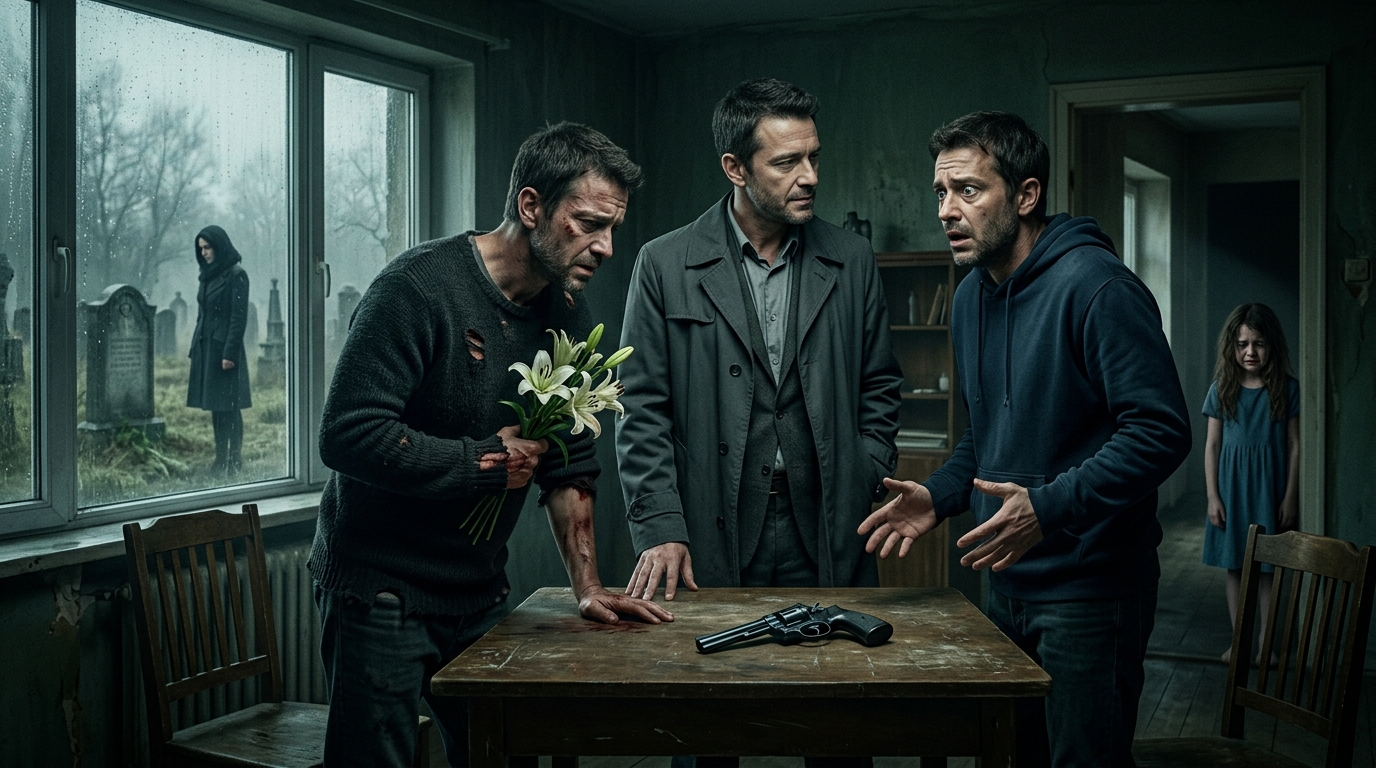
Blog

  • I Verified The Photo Of My Own Future Grave. Then The Man With My Face Said He Came To Stop Me From Pulling The Trigger

    I Verified The Photo Of My Own Future Grave. Then The Man With My Face Said He Came To Stop Me From Pulling The Trigger

    The Grave That Already Existed

    I did not sleep after leaving Room 604.

    That would imply my body still believed in ordinary things.

    Rest.

    Safety.

    Morning.

    Instead, I sat in my office above the pawn shop until sunrise with the photograph of my own grave lying on the desk in front of me.

    ELIAS WARD.

    Beloved husband.

    Beloved father.

    Death date fifteen years from now.

    I stared at the image until the letters stopped looking like letters and began looking like a sentence someone had already passed over my life.

    The woman in the photograph was Clara Voss.

    My client’s wife.

    Or future wife.

    Or something much worse.

    She stood in a cemetery that should not exist yet, holding white flowers over my grave like she had loved me long enough to lose me.

    I called in every favor I had before noon.

    Photo analyst.

    Former police tech.

    A guy named Miles who could tell you whether a shadow was real by the way it bent over concrete.

    I lied to all of them.

    “Old case,” I said.

    “Possible forgery.”

    “Need confirmation.”

    Nobody asked why the dead man in the photograph had my name.

    People in my line of work know when not to ask questions.

    By 4:17 p.m., Miles called back.

    His voice was quiet.

    That was the first bad sign.

    “It’s not edited.”

    I closed my eyes.

    “Check again.”

    “I did.”

    “Check the date metadata.”

    “There is no metadata.”

    “Then it’s fake.”

    “No,” he said. “It’s printed on paper that hasn’t been manufactured yet.”

    My throat went dry.

    “What does that mean?”

    “It means either someone made a very expensive custom fake for no reason, or this photograph shouldn’t exist.”

    I looked at the grave again.

    The stone.

    The flowers.

    Clara’s face.

    Her grief looked too specific to be forged.

    Miles kept talking.

    “And the cemetery?”

    My hand tightened around the phone.

    “What about it?”

    “It exists.”

    “No, it doesn’t.”

    “Elias.”

    His voice dropped.

    “It’s private land now, but the development permits were approved three months ago. The cemetery opens in nine years.”

    I stared at the photo.

    “Where?”

    He gave me the address.

    I wrote it down with a hand that no longer felt like mine.

    Then Miles said one final thing before hanging up.

    “The strangest part isn’t the grave.”

    I swallowed.

    “What is?”

    “The shadow.”

    I looked at the photo again.

    “What shadow?”

    “Behind the tree line. There’s a man watching her.”

    My pulse slowed.

    Miles exhaled softly.

    “I cleaned it up as much as I could.”

    “And?”

    “It’s you.”

    Following Clara

    I took the case because I no longer understood the difference between choice and momentum.

    For one week, I followed Clara Voss.

    Not because I trusted Adrian.

    Not because I believed him.

    Because every time I thought about walking away, the scar on my neck pulsed like something beneath it had started counting down.

    Clara was not having an affair.

    That was obvious by the second night.

    She did not meet lovers.

    She did not slip into hotels.

    She did not send secret messages while smiling at her husband over dinner.

    She moved through the city like someone searching for a door only she could see.

    Every evening at 8:30, she left the Voss residence alone.

    No driver.

    No security.

    Black coat.

    White flowers.

    Same as the future photo.

    She drove past restaurants, apartment towers, churches, and boarded storefronts until the city thinned into warehouse roads and empty lots.

    Then she always stopped at the same place.

    A house.

    Abandoned.

    Two stories.

    Windows boarded.

    Roof sagging.

    Front gate half broken.

    No address number.

    No lights.

    No reason for a wealthy businessman’s wife to stand outside it every night in the rain.

    But she did.

    The first night, she only stood at the gate and cried.

    The second, she unlocked it.

    The third, she went inside.

    I followed.

    Quietly.

    Carefully.

    The kind of careful that keeps private detectives alive.

    The front door had been forced years ago, then repaired from the inside.

    That bothered me.

    Abandoned houses are usually broken from outside.

    This one looked like something had tried to get out.

    Inside, the air smelled of dust, old smoke, and rain trapped in wood.

    Clara moved through the darkness without a flashlight.

    Like she knew every step.

    Like she had walked that hallway in another life.

    I kept my distance.

    She entered a room at the back of the house and closed the door.

    A soft click.

    Lock.

    I waited in the hallway for three minutes.

    Then five.

    Then ten.

    No sound.

    No movement.

    Only the slow drip of water somewhere inside the walls.

    When she finally came out, her face was pale and wet with tears.

    She was holding something.

    A photograph.

    She pressed it to her chest and whispered one sentence into the dark hallway.

    “I’m trying to save him.”

    Then she left.

    She never saw me.

    At least, I thought she didn’t.

    But when I stepped into the room after her, I realized Clara had known I would follow.

    Because the first photograph on the wall was of me entering the house.

    Taken from inside the room.

    Seconds earlier.

    The Room Full Of Me

    The walls were covered with my life.

    Photographs.

    Maps.

    Newspaper clippings.

    Surveillance stills.

    Hospital records.

    Police reports.

    Images of me leaving my office.

    Sleeping in my car.

    Drinking coffee outside the courthouse.

    Bleeding from the neck after the warehouse case that gave me my scar.

    Some photos were recent.

    Some were impossible.

    One showed me fifteen years older, standing in front of a white house with Clara and a little girl between us.

    Another showed me in a hospital bed, gray at the temples, tubes in my arms.

    Another showed the cemetery.

    The same photograph Adrian gave me.

    Clara standing at my grave.

    White flowers.

    Black coat.

    The same grief.

    Only this copy had writing across the bottom in red ink.

    NOT YET.

    My skin went cold.

    I moved closer to the wall.

    At the center hung a timeline.

    My name appeared at the top.

    ELIAS WARD.

    Below it were dates.

    Some past.

    Some future.

    My birth.

    My mother’s death.

    My first arrest as a teenager.

    My first private investigation license.

    The day I got the scar on my neck.

    Then dates that had not happened yet.

    Meeting Clara.

    The birth of a daughter named Lily.

    A house fire.

    A court hearing.

    The grave.

    The death date.

    My mouth went dry.

    Every future event had been crossed out and rewritten multiple times.

    Like someone had tried changing my life and failed.

    Again.

    And again.

    And again.

    On a table beneath the wall sat a file labeled:

    TRIGGER EVENT.

    I opened it with shaking hands.

    Inside was a single photograph.

    Me.

    Standing in a room I did not recognize.

    Holding a gun.

    My face twisted with rage.

    The barrel pointed at someone just outside the frame.

    On the back, one line was written in my own handwriting.

    This is where it always starts.

    I dropped the photograph.

    It landed face-up on the floor.

    The room seemed to tilt around me.

    Then my phone buzzed.

    Unknown number.

    One message.

    GET OUT BEFORE SHE COMES BACK.

    I turned toward the doorway.

    Clara stood there.

    Black coat.

    White flowers.

    Eyes full of terror.

    “You shouldn’t be here,” she whispered.

    Clara Knew My Death

    For a moment, neither of us moved.

    The abandoned house groaned softly around us.

    Rain ticked against boarded windows.

    The photographs of me stared from every wall.

    Clara stepped inside and closed the door behind her.

    Her hands were trembling.

    I noticed the flowers first.

    White lilies.

    Not roses.

    Funeral flowers.

    My funeral flowers.

    “How long have you been following me?” she asked.

    My voice came out rough.

    “How long have you been following me?”

    She looked at the wall.

    Pain moved across her face.

    “Longer than you remember.”

    I almost laughed.

    “You people keep saying that.”

    Her eyes snapped back to me.

    “You people?”

    “The man with my face. You. Whoever built this shrine to my obituary.”

    “It isn’t a shrine.”

    “What is it then?”

    She swallowed.

    “A warning system.”

    I looked around the room.

    “My life on a wall is a warning system?”

    “Your deaths.”

    The plural hit me harder than the word itself.

    Deaths.

    Not death.

    I stepped toward her.

    “Explain.”

    Clara’s eyes filled, but she did not cry.

    Not yet.

    “I’ve seen you die four times.”

    The room became very quiet.

    That kind of quiet again.

    The kind that stands behind truth before it enters.

    “Impossible,” I said.

    She nodded.

    “Yes.”

    “That’s not an explanation.”

    “I know.”

    I grabbed the trigger-event photograph from the floor and held it up.

    “What is this?”

    Clara flinched.

    “Where did you find that?”

    “On the table.”

    She covered her mouth.

    “No.”

    “What?”

    “That means he’s already been here.”

    My pulse jumped.

    “Adrian?”

    She looked toward the door.

    “He isn’t Adrian.”

    “Then what is he?”

    Her voice dropped.

    “The version of you who survived what you did.”

    My grip on the photo loosened.

    The man in Room 604.

    My face.

    My voice.

    My scar.

    The surgical mark beneath his skin.

    The future grave.

    The little girl.

    The warning.

    I forced myself to breathe.

    “What did I do?”

    Clara stared at me like she had been waiting years to answer and dreading the moment it arrived.

    “You pulled the trigger.”

    “At who?”

    She closed her eyes.

    “Me.”

    The Gun On The Table

    I went back to Room 604 the next night.

    That was what Clara told me not to do.

    Naturally, I did it.

    Private detectives survive by mistrusting everyone equally.

    But that night, mistrust felt useless.

    Everyone knew more about my life than I did.

    Clara said I killed her.

    Adrian said he hired me to follow her.

    The photograph said I died fifteen years later.

    The room in the abandoned house said all of it had happened before.

    I needed the man with my face to explain what kind of nightmare had been using my name.

    The Meridian Grand receptionist did not look surprised when I arrived.

    She only slid the keycard across the counter again.

    “Room 604.”

    I stared at her.

    “Do you ever ask questions?”

    Her eyes flicked to mine.

    “Not twice.”

    I took the elevator up alone.

    This time, the mirrored walls did not show only me.

    For half a second, I saw another version of myself standing behind my reflection.

    Older.

    Tired.

    Blood on his shirt.

    Then the elevator dinged.

    Sixth floor.

    The hallway was empty.

    Room 604 was unlocked.

    I stepped inside with my gun already in hand.

    Adrian sat at the same table.

    Same black suit.

    Same face.

    Mine.

    This time, he did not smile.

    On the table between us lay another gun.

    Not mine.

    A revolver.

    Old.

    Polished.

    Loaded.

    He pushed it toward me with two fingers.

    The sound of metal against wood made the room feel suddenly smaller.

    “What is this?” I asked.

    He looked exhausted.

    Not rich.

    Not controlled.

    Exhausted in a way money cannot hide.

    “The weapon you use.”

    “I haven’t used it.”

    “Not yet.”

    I did not touch it.

    Adrian leaned back.

    “Good.”

    The rain pressed against the window behind him.

    He looked older than he had the first night.

    Or maybe I was finally seeing the years beneath his face.

    “I am you,” he said quietly.

    I said nothing.

    “Fifteen years from now.”

    Still nothing.

    “And I came here to stop you from pulling the trigger.”

    The revolver sat between us.

    Heavy.

    Patient.

    Like it had always belonged in the room.

    Fifteen Years From Now

    “You expect me to believe time travel?” I asked.

    Adrian laughed softly.

    It sounded exactly like me.

    That made it worse.

    “No. I expect you to reject it until evidence leaves you no other room.”

    “Convenient.”

    “Very.”

    He unbuttoned his collar.

    Beneath the scar on his neck, the implant-like mark pulsed faintly blue.

    Mine burned in response.

    I grabbed my throat.

    Adrian nodded.

    “That’s how they keep the versions connected.”

    “Who are they?”

    He looked at the window.

    “The people who discovered grief is the easiest door into time.”

    I stared at him.

    “Try again without sounding insane.”

    He turned back to me.

    “Clara built the first loop.”

    That stopped me.

    “No.”

    “Yes.”

    “She’s your wife?”

    “She becomes ours.”

    I hated the softness in his voice when he said that.

    Ours.

    As if I had already shared a life with him.

    As if Clara had already belonged to both of us in different timelines.

    “She was trying to save her daughter,” he said.

    “Our daughter.”

    I saw the photo again.

    The little girl between us.

    Clara’s eyes.

    My scar.

    Lily.

    My throat tightened despite myself.

    “I don’t have a daughter.”

    “You will.”

    “I don’t even know Clara.”

    His eyes darkened.

    “You know her enough to kill her.”

    I slammed my hand on the table.

    “Stop saying that.”

    He did not flinch.

    “You pull the trigger because you believe she betrayed you.”

    “Did she?”

    “No.”

    “Then why would I believe it?”

    “Because I make you.”

    The words froze the room.

    I stared at him.

    “What?”

    Adrian looked at the gun.

    “I was sent back to prevent the trigger event. Instead, every time I interfere, I become the reason it happens.”

    Silence.

    Rain.

    The low hum of the hotel lights.

    My scar pulsing beneath my fingers.

    Adrian continued.

    “In the first timeline, you find Clara in that abandoned house with the photos. You think she has been manipulating your life. You confront her. Someone shoots. She dies.”

    “Someone?”

    His jaw tightened.

    “You.”

    “No.”

    “In the second timeline, I try to warn you. You think I’m the threat. You follow her sooner. You bring the gun. She dies faster.”

    I backed away from the table.

    “In the third?”

    He closed his eyes.

    “Our daughter watches.”

    The room seemed to lose all oxygen.

    “The little girl?”

    He nodded.

    “Lily.”

    “What happens to her?”

    He opened his eyes.

    “She becomes the first person to send me back.”

    The Trigger Event

    I should have called him crazy.

    I wanted to.

    But his grief was too specific.

    Madmen can invent stories.

    They cannot fake grief that knows exact dates.

    Adrian slid a folder across the table.

    I did not open it.

    He said, “Tomorrow night, Clara goes back to the house.”

    “For what?”

    “To burn the room.”

    “The photographs?”

    “The timeline.”

    I frowned.

    “That room is more than photos.”

    “Yes.”

    “What is it?”

    He looked at me carefully.

    “A memory anchor.”

    I hated how little I hated that answer.

    Because standing inside that room, surrounded by my life and my death, I had felt it.

    Not just evidence.

    Not just obsession.

    Something recording possibilities.

    Something waiting for one version to become permanent.

    “Why would Clara build it?”

    “She didn’t build all of it. She found it.”

    “Where?”

    “In the basement.”

    Of course.

    It always came back to basements.

    Buried rooms.

    Hidden floors.

    Places rich people used to hide consequences.

    Adrian touched the revolver.

    Not picking it up.

    Just one finger on the handle.

    “The man who owns that house created the first version. He used it to remove people from outcomes he didn’t like.”

    “Who?”

    Adrian’s mouth tightened.

    “Your client.”

    “You’re my client.”

    “No.”

    The hotel room door behind me clicked softly.

    My body went rigid.

    Adrian looked past me.

    Fear crossed his face.

    Real.

    Immediate.

    I turned.

    The door opened.

    Another man stepped in.

    Same face.

    Mine.

    But older than Adrian.

    Blood soaked through his white shirt.

    His left eye was bruised shut.

    In his hand, he held white lilies.

    Funeral flowers.

    He looked at me first.

    Then at Adrian.

    Then at the revolver on the table.

    “Don’t listen to him,” the bleeding man said.

    My stomach dropped.

    Adrian stood slowly.

    “No.”

    The bleeding man laughed.

    “You never understand in time.”

    I backed away until my shoulder hit the wall.

    Three versions of my face stood in one room.

    Me.

    Adrian.

    The bleeding man.

    The revolver lay on the table between us.

    The bleeding man looked at me and smiled through blood.

    “He didn’t come to stop you from pulling the trigger.”

    Adrian shouted, “Elias, don’t—”

    The bleeding man finished.

    “He came to make sure you aim at Clara instead of him.”

    The Man Who Lied First

    The room shattered into movement.

    Adrian lunged for the revolver.

    The bleeding man grabbed his wrist.

    I drew my own gun before thinking.

    Three weapons.

    Three versions of the same man.

    One hotel room that suddenly felt too small for the timeline.

    “Stop!” I shouted.

    Neither listened.

    Adrian and the bleeding man crashed into the table.

    The revolver spun across the wood and slid toward my hand.

    I caught it instinctively.

    The moment my fingers closed around the grip, the scar on my neck burned white-hot.

    The room vanished.

    I saw Clara.

    Not as a photograph.

    Real.

    Standing in the abandoned house with tears on her face.

    She whispered:

    “Elias, please. That isn’t him.”

    Then the vision changed.

    A little girl hiding under a table.

    Lily.

    Hands over her mouth.

    Watching someone die.

    Then another flash.

    My own grave.

    The date fifteen years from now.

    Then Clara again.

    Blood on her white coat.

    My hand holding the revolver.

    My finger on the trigger.

    I came back to the hotel room gasping.

    Adrian and the bleeding man both stared at me.

    They knew I had seen it.

    The revolver shook in my hand.

    “Who do I shoot?” I whispered.

    Adrian’s face broke.

    “Put it down.”

    The bleeding man smiled.

    “That’s how she dies.”

    A phone rang.

    Not mine.

    Not Adrian’s.

    The sound came from inside the envelope on the table.

    Adrian turned pale.

    “No.”

    The bleeding man’s smile disappeared too.

    That frightened me most.

    I opened the envelope.

    Inside was a small black phone.

    No logo.

    No signal bars.

    Incoming call.

    CLARA VOSS.

    I answered.

    For one second, there was only breathing.

    Then Clara’s voice came through.

    Terrified.

    “Elias, I’m at the house.”

    My grip tightened on the revolver.

    She whispered:

    “He’s already here.”

    The call crackled.

    Then another voice came on.

    My voice.

    But not from either man in the room.

    Older.

    Colder.

    Closer to the phone.

    “Bring the gun,” it said. “Or I kill her before you get the chance.”

    The line went dead.

    The hotel lights flickered.

    When they came back, both future versions of me were looking at the door.

    In the hallway outside Room 604, a child began crying.

    A little girl’s voice.

    Lily.

    “Daddy,” she whispered, “please don’t do it again.”
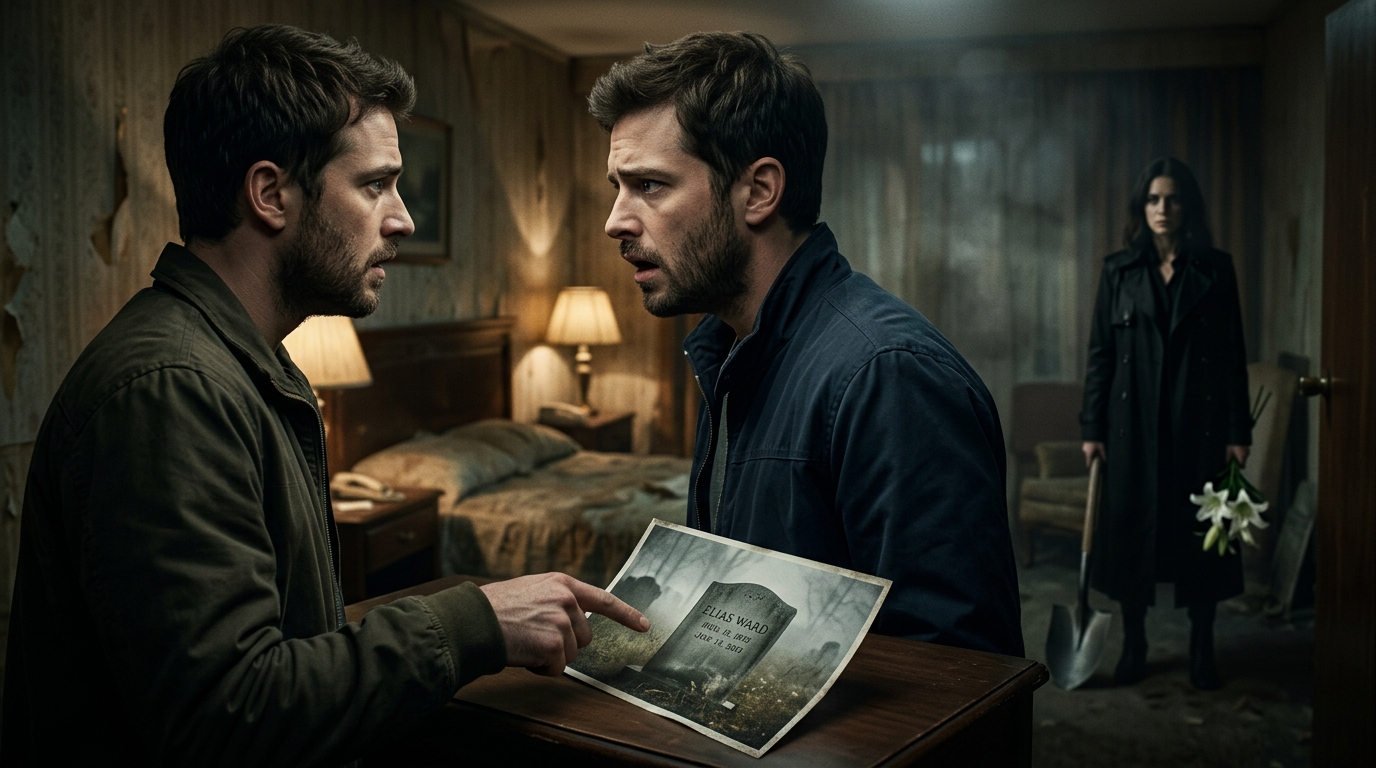
  • A Businessman Hired Me To Follow His Wife. When I Met Him, He Had My Face

    A Businessman Hired Me To Follow His Wife. When I Met Him, He Had My Face

    The Contract That Paid Too Much

    Private detectives learn one rule early.

    If a client offers too much money, they are not buying your time.

    They are buying your silence.

    That was the first thing I thought when the envelope arrived at my office.

    No return address.

    No stamp.

    No courier name.

    Just a black envelope slid under my door sometime between midnight and morning.

    Inside was a contract.

    One page.

    Clean legal language.

    Private surveillance.

    Three nights.

    Subject: wife of a businessman.

    No police involvement.

    No digital records.

    Payment: enough money for me to close my agency for a year.

    I read the number three times.

    Then laughed.

    Not because it was funny.

    Because fear and hunger sound similar when they hit the same place.

    My name is Elias Ward.

    I had been a private investigator for eleven years.

    Cheating spouses.

    Insurance fraud.

    Missing teenagers.

    Corporate leaks.

    The usual dirty laundry of people who wanted truth but not consequences.

    My office sat above a pawn shop, smelled like old coffee and printer dust, and leaked every time it rained.

    That morning, rain had been tapping against the window since dawn.

    My bank account had less than two hundred dollars.

    My landlord had stopped using polite language.

    And my last client still owed me for three weeks of work.

    So when someone offered me a year’s salary to watch one woman for three nights, I should have been suspicious.

    I was.

    I still took the meeting.

    Desperation is not stupidity.

    But it can look exactly like it from a distance.

    At the bottom of the contract was one handwritten line.

    Meet me tonight. 11:30 p.m. Room 604. No cameras.

    No hotel name.

    No signature.

    Only an address printed beneath.

    The Meridian Grand.

    One of the most expensive hotels in the city.

    The kind of place where rich men went when they needed doors that did not ask questions.

    I folded the contract carefully.

    Then noticed something on the back.

    A small smear of dark red near the corner.

    Not ink.

    Blood.

    Room 604

    The Meridian Grand looked like a building designed to make ordinary people feel temporary.

    Gold doors.

    Marble floors.

    A lobby chandelier large enough to crush a family.

    The receptionist did not ask my name when I arrived.

    That bothered me.

    People in expensive hotels always ask names.

    She only looked at my coat, then at my face, and slid a keycard across the counter.

    “Room 604,” she said.

    “I haven’t checked in.”

    “I know.”

    Her voice stayed flat.

    Like she had been instructed not to hear her own answers.

    I took the card.

    The elevator ride felt too slow.

    Mirrored walls reflected me from every angle.

    Dark coat.

    Unshaven jaw.

    Tired eyes.

    And the scar on the left side of my neck.

    A thin white line from an old knife wound.

    Most people did not notice it.

    The ones who did usually looked away quickly.

    The elevator doors opened on the sixth floor.

    The hallway was empty.

    Thick carpet swallowed my footsteps.

    Room 604 waited at the end beneath a dim gold lamp.

    I checked the corridor once.

    No cameras.

    Just like the note promised.

    That should have made me feel safer.

    It did not.

    I knocked twice.

    A man’s voice answered immediately.

    “Come in, Elias.”

    My hand froze on the door handle.

    I had not told anyone at the hotel my first name.

    I opened the door slowly.

    The room inside was dark except for one lamp near the window. Rain streaked down the glass behind heavy curtains. A table sat in the center of the room with two chairs facing each other.

    One chair was empty.

    In the other sat a man in a black suit.

    He looked up.

    And my body forgot how to move.

    The Man With My Face

    The man sitting across from me was me.

    Not similar.

    Not family resemblance.

    Me.

    Same face.

    Same eyes.

    Same mouth.

    Same small break in the nose from a fight outside a bar when I was twenty-six.

    Same scar on the left side of the neck.

    The scar nobody could copy unless they knew exactly where the blade had entered.

    For several seconds, neither of us spoke.

    I heard rain.

    I heard the old hotel heater rattling beneath the window.

    I heard my own heartbeat.

    The man watched me calmly.

    Too calmly.

    Like he had already lived through this moment once and was only waiting for me to catch up.

    I stepped backward.

    He lifted one hand.

    “Don’t leave.”

    His voice stopped me.

    Because it was mine.

    Same tone.

    Same slight rasp from too many cigarettes I kept promising to quit.

    Same tired rhythm.

    Hearing your own voice come from another man’s mouth is not like hearing a recording.

    It is worse.

    Recordings are dead things.

    This voice was alive.

    I reached under my coat for the gun at my belt.

    He smiled faintly.

    “I wouldn’t.”

    “Give me one reason.”

    “Because you hate shooting with your left hand, and your right shoulder still locks when you draw too fast.”

    My blood turned cold.

    Nobody knew that.

    Not my doctor.

    Not my ex-wife.

    Not even my old partner.

    The injury happened during a case I never reported properly.

    I kept my hand near the gun anyway.

    “Who are you?”

    He leaned back slightly.

    “You.”

    “No.”

    His smile faded.

    “Not yet.”

    The room seemed to tighten around those two words.

    Not yet.

    I looked at him again.

    Really looked.

    His suit cost more than my car.

    His hair was cut cleaner than mine.

    His skin looked healthier.

    But the face beneath all that polish was mine.

    Older maybe.

    No.

    Not older.

    More finished.

    Like someone had taken every rough edge from me and replaced it with money.

    He gestured toward the empty chair.

    “Sit down.”

    I did not move.

    He sighed.

    “I know you don’t trust orders.”

    “Then stop giving them.”

    For the first time, something like amusement moved across his face.

    Then he placed a thick envelope on the table.

    “Fine. Look inside.”

    The Wife I Was Paid To Follow

    I approached the table slowly.

    Every instinct in my body screamed trap.

    But curiosity has always been my worst habit.

    I picked up the envelope without sitting.

    Inside were surveillance photographs.

    A woman leaving a courthouse.

    A woman entering an art gallery.

    A woman standing beneath a streetlamp with one hand pressed to her chest.

    She was beautiful in a careful, guarded way.

    Dark hair.

    Pale coat.

    Eyes that seemed to be looking past the camera even though she could not know it was there.

    I flipped to the first document.

    Name: Clara Voss.

    Age: Thirty-six.

    Marital status: Married.

    Husband: Adrian Voss.

    Businessman.

    Real estate.

    Private equity.

    Charity boards.

    Money so old it stopped needing explanation.

    I looked at the man across from me.

    “Adrian Voss?”

    He nodded once.

    I almost laughed.

    “Your file says you want me to follow your wife.”

    “Yes.”

    “Why?”

    “I need to know where she goes after midnight.”

    “Ask her.”

    “I did.”

    “And?”

    “She lied.”

    I looked back at the photos.

    Clara Voss appeared in every image alone.

    No lover.

    No suspicious exchange.

    No secret meeting.

    Just a woman moving through the city like someone carrying invisible weight.

    “This doesn’t look like adultery.”

    “It isn’t.”

    “Then what is it?”

    Adrian Voss folded his hands on the table.

    Our hands.

    Same knuckles.

    Same old scar across the right index finger from my father’s broken bottle when I was fifteen.

    I wanted to look away.

    I couldn’t.

    He said, “My wife visits graves.”

    That answer landed strangely.

    Soft.

    Cold.

    “What graves?”

    “One grave.”

    “Whose?”

    He watched me for a long moment.

    Then said:

    “Yours.”

    The room went silent.

    Rain dragged itself down the window behind him.

    I stared at the envelope in my hand.

    “What did you say?”

    He did not repeat it.

    He only nodded toward the remaining photograph.

    The one I had not looked at yet.

    The one turned face down at the bottom of the envelope.

    The Photograph From Fifteen Years Later

    I knew before touching it that I should not turn it over.

    Some part of the body understands danger before the mind has language.

    My fingers hesitated on the edge of the photograph.

    Adrian watched me.

    Not impatient.

    Not concerned.

    Waiting.

    I turned it over.

    The photograph showed Clara Voss standing in a cemetery beneath a gray sky.

    Her hair was shorter.

    Her face older.

    Still beautiful.

    But changed by grief.

    She wore a black coat and held white flowers against her chest.

    In front of her was a grave.

    The name on the stone was mine.

    ELIAS WARD.

    Beloved husband.

    Beloved father.

    My throat closed.

    I had no children.

    No current wife.

    No grave.

    I forced myself to look lower.

    The birth date was correct.

    My birthday.

    The death date was not.

    It was fifteen years from now.

    Exactly fifteen years.

    Same month.

    Same day.

    My hands went numb.

    The photograph slipped halfway from my fingers.

    Adrian reached out and caught it before it hit the table.

    I jerked backward.

    “Where did you get this?”

    “My wife.”

    “She gave it to you?”

    “No.”

    “Then?”

    “I found it hidden inside a locked drawer in our bedroom.”

    I stared at him.

    “You expect me to believe your wife has a photograph from the future?”

    “I expect you to do what I paid you to do.”

    I laughed once.

    It came out wrong.

    Sharp.

    Almost hysterical.

    “You look like me. You sound like me. You have my scar. You hand me a picture of your wife visiting my future grave, and you think this is a surveillance job?”

    His expression hardened.

    “You always get angry when you’re scared.”

    That stopped me.

    The words were too intimate.

    Too exact.

    “Stop talking like you know me.”

    “I do know you.”

    “No, you don’t.”

    He leaned forward slightly.

    His eyes locked onto mine.

    “I know you still sleep with a chair under your apartment door even though nobody has broken in for eight years.”

    My pulse stopped.

    “I know you keep your mother’s wedding ring in the second drawer of your desk but pretend you sold it.”

    My breath caught.

    “I know you never take cases involving missing children because of what happened in Camden.”

    I grabbed him by the collar before thinking.

    The chair scraped backward.

    The table shifted.

    The lamp flickered.

    Adrian did not fight.

    He only stared up at me with my own eyes.

    “Who are you?” I whispered.

    He answered quietly.

    “The man who survives if you don’t.”

    Clara’s Grave Visits

    I let go of him.

    Not because I wanted to.

    Because my hand had started shaking.

    Adrian straightened his collar slowly.

    “Clara has gone to that cemetery every Thursday for six months.”

    “That cemetery doesn’t exist yet.”

    “It does.”

    “No.”

    “It is private land right now. It becomes a cemetery in nine years.”

    My mouth went dry.

    “How do you know that?”

    “Because I own it.”

    Of course he did.

    Men like Adrian Voss always owned the places where people eventually ended up.

    I looked at the photograph again.

    Clara standing over my future grave.

    White flowers.

    Black coat.

    Tears on her face.

    Something about her grief bothered me.

    Not because it looked fake.

    Because it looked familiar.

    She was not mourning a stranger.

    She was mourning someone she knew.

    Someone she loved.

    I looked at Adrian.

    “Why hire me?”

    “Because she follows you.”

    “No, she doesn’t.”

    “She will.”

    The room seemed to tilt slightly.

    “What does that mean?”

    He opened a second folder and slid it across the table.

    Inside were photos of me.

    Leaving my office.

    Buying cigarettes.

    Standing outside my apartment.

    Sleeping at my desk with one hand near my gun.

    Some taken from close range.

    Too close.

    My stomach turned violently.

    “You’ve had me watched.”

    “No.”

    “Then who took these?”

    “My wife.”

    I froze.

    Adrian tapped one photo.

    Clara’s reflection appeared faintly in a shop window behind me, half hidden beneath a hood.

    My pulse hammered.

    I had never seen her.

    Not once.

    But she had been there.

    Watching me.

    Following me.

    Documenting me.

    And somehow grieving me before I died.

    “She knows me,” I said.

    “Yes.”

    “How?”

    Adrian’s expression darkened.

    “That is what I need you to find out.”

    “You’re her husband.”

    “Not in the way she thinks.”

    The sentence sat between us like a loaded gun.

    I slowly lowered myself into the empty chair across from him.

    “What are you?”

    For the first time, he looked away.

    Only for a second.

    But long enough.

    “Running out of time.”

    The Scar On His Neck

    I looked at his neck.

    The scar matched mine exactly.

    Same angle.

    Same length.

    Same pale ridge against the skin.

    I remembered getting mine.

    A warehouse near the docks.

    A missing accountant.

    A man with a box cutter.

    Blood under my collar.

    Rain outside.

    My old partner shouting my name.

    No one else had been there.

    No one could have copied that scar unless they copied the wound.

    I leaned forward.

    “Show me your scar.”

    He stared at me.

    “I can see it.”

    “Show me.”

    He hesitated.

    That was the first truly human thing he had done.

    Then he loosened his collar and turned his neck toward the light.

    The scar was perfect.

    Too perfect.

    But beneath it, just below the skin, was something I did not have.

    A tiny raised mark.

    Like a surgical port.

    Or an implant.

    My stomach tightened.

    “What is that?”

    He buttoned his collar quickly.

    “Nothing.”

    “You have something under your skin.”

    “So do you.”

    I almost laughed.

    “No, I don’t.”

    Adrian reached into his pocket and pulled out a small black device.

    No logo.

    No buttons.

    He placed it on the table between us.

    It began to blink.

    Once.

    Twice.

    Then it beeped softly.

    A sharp pain lit up beneath the scar on my neck.

    I grabbed my throat and stumbled backward.

    The pain was so sudden I nearly fell.

    Adrian watched me with something like pity.

    “I told you,” he said.

    My fingers pressed against my scar.

    For the first time, I felt it.

    A tiny hard point beneath the skin.

    Something that had never been there.

    Or something I had never noticed because I had been taught not to.

    The black device beeped again.

    The hotel lights dimmed.

    My vision blurred.

    A memory flashed.

    Not mine.

    Or maybe mine from a place I had not lived yet.

    Clara screaming my name.

    A hospital room.

    A machine counting backward.

    Adrian’s face above me.

    My face.

    A voice saying:

    Only one of them can keep the original timeline.

    I slammed my hand against the table.

    “Turn it off.”

    Adrian clicked the device once.

    The pain vanished.

    I stood breathing hard, sweat cold on my back.

    He put the device away.

    “You need to follow Clara tomorrow night.”

    “Why tomorrow?”

    “Because tomorrow she visits your grave again.”

    I stared at him.

    “And what happens then?”

    He looked at the future photograph.

    “She brings a shovel.”

    The Grave With My Name

    I should have walked away.

    Called police.

    Called a doctor.

    Cut the scar open myself in the bathroom mirror.

    Anything.

    Instead, I took the envelope.

    Because some cases do not ask whether you want them.

    They arrive already inside your body.

    Adrian stood as I reached the door.

    “One more thing.”

    I stopped.

    He placed a small photo on the table.

    Not Clara.

    Not the grave.

    Me.

    But different.

    Older.

    Fifteen years older.

    Standing beside Clara Voss in front of a house I did not recognize.

    A little girl stood between us.

    Maybe seven years old.

    She had Clara’s eyes.

    And my scar on her neck.

    My voice barely worked.

    “Who is that?”

    Adrian’s expression changed.

    Pain.

    Real pain.

    “Our daughter.”

    I turned slowly.

    “We don’t have a daughter.”

    “No,” he said. “You do.”

    Before I could answer, my phone rang.

    Unknown number.

    The hotel room seemed to darken around the sound.

    I answered without thinking.

    For a second, there was only wind.

    Then a woman’s voice.

    Clara.

    I knew it before she said anything.

    Not from memory.

    From the photograph.

    From the grief.

    From some place inside me that had already loved her and lost her.

    Her voice shook.

    “Elias?”

    I looked at Adrian.

    His face went pale.

    Clara whispered through the phone:

    “Don’t trust the man with your face.”

    The call ended.

    The room lights flickered once.

    Adrian took a step toward me.

    I backed into the hallway.

    At the far end, the elevator doors stood open.

    Inside stood Clara Voss.

    Black coat.

    White flowers.

    Mud on the hem of her dress.

    She looked directly at me.

    Then at Adrian behind me.

    Her eyes filled with terror.

    And in her hands, beside the flowers, she held a cemetery shovel.

    The elevator lights blinked.

    When they came back on, Clara was gone.

    Only the flowers remained on the elevator floor.

    And attached to them was a small card written in my handwriting.

    Do not let him reach the grave first.

  • I Found My Own File In The Night Train’s Missing Passenger Database. It Said I Would Be Erased Tomorrow At 2:13 A.M

    I Found My Own File In The Night Train’s Missing Passenger Database. It Said I Would Be Erased Tomorrow At 2:13 A.M

    The Numbers Behind My Photograph

    I did not scream when every passenger seat became empty.

    That surprised me.

    Fear does not always come out as sound.

    Sometimes it becomes stillness.

    Sometimes it locks your throat, freezes your hands, and leaves you standing in a moving train with a photograph of your own dead face pressed between your fingers.

    Carriage C was silent.

    Too silent.

    Moments earlier, passengers had been sleeping, murmuring, adjusting blankets, breathing.

    Now every seat was empty.

    No bags.

    No coats.

    No coffee cups.

    No child crying two rows behind me.

    Only blue fabric.

    Dim lights.

    Dark windows.

    And Mr. Vale standing at the far end of the carriage, looking at the black suitcase in my hands.

    My supervisor.

    The man who told me not to make myself part of this.

    The man who knew seat 22 was wrong.

    The man who knew the woman in yellow was not just a ghost in damaged footage.

    He took one slow step toward me.

    “Mara,” he said softly, “give me the photograph.”

    His voice was calm.

    That made my stomach turn.

    I backed away.

    The picture of my body shook in my hand.

    On the front, I was standing beside seat 22.

    Dead.

    On the back, one word was written.

    Tomorrow.

    But now, under the red emergency light, I saw something I had missed before.

    Beneath the word was a line of numbers.

    Small.

    Pressed so hard into the paper that they had almost torn through.

    22-17-0213-309-C.

    My breath caught.

    Not random.

    Seat 22.

    Floor 17?

    2:13.

    309.

    Carriage C.

    Codes.

    Or coordinates.

    Or instructions.

    Mr. Vale saw my eyes move.

    His face changed.

    Only slightly.

    Enough.

    “You were never supposed to turn it over,” he said.

    The lights flickered.

    For one second, the passengers returned.

    All of them.

    Sleeping.

    Breathing.

    Normal.

    Then the lights flickered again.

    Empty.

    My mind cracked around the impossibility.

    Mr. Vale stepped closer.

    “Give it to me, Mara.”

    I closed the suitcase with one hand and held the photograph tighter with the other.

    “What does ‘erased’ mean?”

    He stopped.

    I had not meant to say that word.

    I did not know where it came from.

    But the moment I said it, every carriage light dimmed at once.

    From somewhere above us, the train speaker crackled softly.

    A woman’s voice whispered:

    “He didn’t erase us fast enough.”

    Mr. Vale turned pale.

    Then the passengers returned all at once.

    A man snored near the window.

    A woman adjusted her scarf.

    The child two rows behind me whimpered in her sleep.

    Everything was normal again.

    Except Mr. Vale and I stood facing each other beside the open luggage compartment.

    And he looked terrified.

    Not of me.

    Of what the train had just let me hear.

    The Final Station

    Mr. Vale did not take the photograph from me.

    He tried.

    But the moment his fingers touched the edge, the paper turned cold enough for frost to bloom across his skin.

    He jerked back with a hiss.

    I slipped the photo inside my uniform jacket before he could recover.

    He stared at the pocket where I had hidden it.

    His voice dropped.

    “You have until tomorrow.”

    My stomach tightened.

    “Until what?”

    He looked toward seat 22.

    Empty now.

    Completely empty.

    But I felt someone sitting there.

    Watching.

    Waiting.

    “You should have stayed out of Carriage C,” he said.

    Then he turned and walked away.

    Not quickly.

    Not panicked.

    Controlled.

    That frightened me almost as much as the photograph.

    Because men like Mr. Vale only walk slowly when they still believe the building belongs to them.

    Or the train.

    Or the truth.

    The rest of the journey passed in pieces.

    Passengers asked for coffee.

    A woman complained about the temperature.

    A child lost a stuffed rabbit.

    Normal problems.

    Small problems.

    The kind I used to believe made up my entire job.

    But every time I passed Carriage C, my eyes moved to seat 22.

    Nobody sat there.

    No ticket assigned.

    No coat on the backrest.

    No woman in yellow.

    Still, the seat looked occupied in a way I could not explain.

    The air around it bent slightly.

    Like heat above asphalt.

    Or breath on glass.

    At 5:48 a.m., the Westbound Night Line reached the final station.

    Passengers disembarked beneath pale morning light, dragging suitcases, rubbing eyes, complaining about delays they did not know had saved them from seeing anything real.

    I stood by the exit door and smiled.

    Thank you for traveling.

    Watch your step.

    Have a good morning.

    My mouth said normal things while my body felt like evidence waiting to be collected.

    Mr. Vale stood near the platform exit, speaking quietly with two men in dark coats.

    Not railway staff.

    Not police.

    Private security.

    One of them looked directly at me.

    Then at my jacket pocket.

    The photograph seemed to burn against my ribs.

    I lowered my gaze and stepped off the train with the cleaning crew.

    Instead of going to the staff lounge, I went downstairs.

    To the internal operations room.

    Where old systems went to die.

    The Internal System

    Every railway company has two versions of itself.

    The one passengers see.

    And the one buried beneath locked doors, outdated computers, private databases, maintenance tunnels, and employees who learn not to ask why certain records are missing.

    The operations archive sat beneath Platform 4.

    Gray walls.

    No windows.

    Fluorescent lights that hummed like insects.

    A smell of dust, coffee, and old paper.

    I had access because attendants needed to file passenger incident reports after night shifts.

    Lost luggage.

    Medical emergencies.

    Seat disputes.

    Minor theft.

    Never vanishings.

    Those reports went somewhere else.

    Somewhere I had never seen.

    Until the numbers on the photograph.

    22-17-0213-309-C.

    I sat at the back terminal, the one nobody used because the keyboard stuck and the monitor flickered green in the corners.

    My hands shook as I logged in.

    Employee ID.

    Password.

    Shift code.

    The normal incident system opened.

    I typed the numbers into the search bar.

    Nothing.

    I tried with dashes removed.

    Nothing.

    I tried seat 22.

    Access denied.

    My mouth went dry.

    Not no results.

    Access denied.

    That meant the file existed.

    I looked over my shoulder.

    Empty room.

    Footsteps echoed faintly above from the platform.

    I typed the full sequence again, but this time I entered it into the old command field below the report menu.

    22.17.0213.309.C.

    The screen went black.

    For one long second, I thought I had crashed it.

    Then green letters appeared.

    ARCHIVE ENTRY RECOGNIZED.

    ENTER CLEARANCE PHRASE.

    I stared at the prompt.

    Clearance phrase.

    My heart pounded.

    The photograph inside my jacket felt heavier.

    The woman in yellow had given me numbers.

    But not words.

    I pulled the picture out again.

    Turned it over.

    Tomorrow.

    22-17-0213-309-C.

    Nothing else.

    Then I noticed the ink near the edge of the paper.

    The word Tomorrow had bled slightly through the fibers.

    No.

    Not bled.

    Hidden.

    There were letters under it, visible only when I held the photo against the monitor’s green light.

    I lifted it carefully.

    A second phrase appeared beneath Tomorrow.

    HE SOLD MY SEAT.

    My breath caught.

    I typed it.

    HE SOLD MY SEAT.

    The terminal clicked.

    Not metaphorically.

    Physically.

    A small metal sound came from inside the wall behind the computer.

    Then the screen changed.

    RESTRICTED FOLDER OPENED.

    ERASURE ARCHIVE.

    My blood turned cold.

    The Erasure Archive

    The folder contained hundreds of files.

    No.

    More than hundreds.

    Names filled the screen in endless rows.

    Daniel Price.

    Mark Halen.

    Sofia Reed.

    Evelyn Hart.

    People who had vanished from the Westbound Night Line.

    But also names I did not know.

    Dates going back eighteen years.

    Then twenty.

    Then thirty.

    Passengers.

    Staff.

    Conductors.

    Children.

    Contractors.

    One folder was labeled:

    UNCLAIMED WITNESSES.

    Another:

    TUNNEL INCIDENTS.

    Another:

    SEAT TRANSFERS.

    My hands turned numb.

    I opened Daniel Price’s file first.

    Passenger photo.

    Ticket number.

    Boarding time.

    Carriage assignment.

    Last verified location.

    Then one final line.

    STATUS: ERASED.

    Not missing.

    Not deceased.

    Erased.

    I opened Evelyn Hart’s file.

    Same structure.

    Same final line.

    STATUS: ERASED.

    I opened Sofia Reed.

    STATUS: ERASED.

    Mark Halen.

    STATUS: ERASED.

    The word repeated until it stopped looking like language and started looking like a machine’s idea of murder.

    I scrolled faster.

    Some files included images.

    Security stills.

    Passengers stepping into train corridors.

    People entering tunnels.

    Faces blurred as if their identities were being wiped from the pixels themselves.

    In one image, a man stood beside seat 22 with his hand on the tray table.

    In the next, his face was gone.

    Not blacked out.

    Gone.

    Skin smoothed where eyes and mouth should have been.

    My stomach twisted violently.

    I opened the oldest available file.

    Eighteen years ago.

    Name redacted.

    Carriage C.

    Seat 22.

    Woman in yellow coat.

    Photo attached.

    I clicked it.

    The image loaded slowly.

    And there she was.

    Alive.

    Not the pale, wet woman I saw across the table.

    A real woman.

    Smiling tiredly at a station camera.

    Yellow coat buttoned to her throat.

    Dark hair pinned back.

    One hand resting protectively over her stomach.

    Pregnant.

    My throat tightened.

    The file name was partially corrupted.

    MARA—

    I froze.

    No.

    Not my name.

    Different.

    Older.

    The full name flickered, then sharpened.

    Mara Vale.

    My supervisor’s surname.

    My blood went ice cold.

    The woman in the yellow coat had been Mr. Vale’s wife.

    The First Erased Passenger

    I opened her file.

    Most of it was locked.

    But enough remained.

    Passenger: Mara Vale.

    Seat: 22.

    Destination: Hollowbridge.

    Status before incident: Protective transfer.

    Protective transfer.

    Not passenger.

    Not traveler.

    Something else.

    Attached documents listed emergency orders, custody language, medical notes, and one line that made my heart stop.

    Pregnancy confirmed. Witness must not reach final station.

    I leaned closer to the screen.

    Witness.

    Mara Vale had been a witness.

    To what?

    I scrolled.

    A report fragment appeared.

    Subject reported illegal passenger removals coordinated through tunnel blackout intervals.

    Subject claimed railway staff were selling unregistered persons through route access points.

    Subject carried evidence.

    Then the file glitched.

    All paragraphs below dissolved into blocks of corrupted text.

    Except one sentence.

    Conductor Vale approved seat reassignment.

    My skin prickled.

    Conductor Vale.

    Mr. Vale.

    Her husband.

    He sold my seat after I died.

    The words on the photograph slammed back into me.

    Not metaphor.

    Not grief.

    Fact.

    He had sold her seat.

    Sold her.

    And after she died, seat 22 became the place where the erased returned.

    Or warned.

    Or collected.

    I clicked the next attachment.

    An audio file.

    The terminal speakers crackled.

    A woman’s voice came through.

    Soft.

    Panicked.

    “If this file survives, my husband is not transporting passengers. He is selecting them.”

    A male voice interrupted.

    “Mara, open the door.”

    The woman whispered:

    “He knows I copied the archive.”

    Then a sound.

    A train tunnel.

    Metal scream.

    A baby crying.

    My blood froze.

    A baby.

    Mara Vale’s voice returned, closer now.

    “Seat 22 is not cursed. It’s a ledger. Every name he sells passes through it.”

    The audio cut off.

    I sat frozen in the green light of the archive terminal.

    A ledger.

    Not a ghost seat.

    A transaction record.

    A death trap disguised as furniture.

    Then the terminal opened another file by itself.

    The folder name appeared slowly.

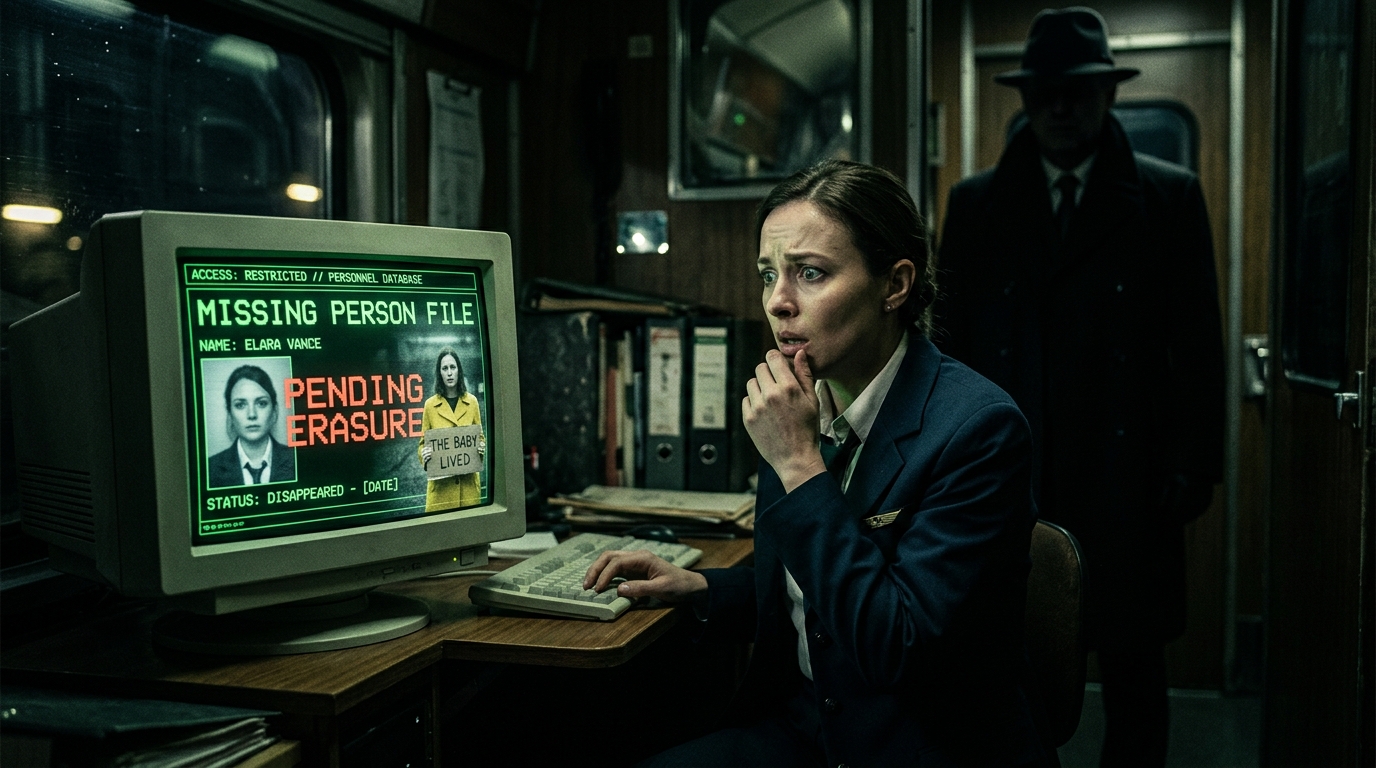
    CURRENT ERASURE QUEUE.

    My File

    There were three names in the current queue.

    Two were locked.

    The third was open.

    MARA ELLIS.

    My photograph filled the screen.

    Employee ID photo.

    Uniform.

    Neutral smile.

    Nothing dramatic.

    Nothing dead.

    Just me.

    Underneath it:

    Role: Senior attendant.

    Incident: Unauthorized access to Seat 22 evidence.

    Risk level: Active witness.

    Status: PENDING ERASURE.

    My heartbeat stopped.

    Below that, a timestamp blinked in red.

    SCHEDULED REMOVAL: 02:13 A.M. TOMORROW.

    I could not move.

    The numbers from the photograph.

    213.

    The same time every disappearance began.

    The same time the woman in yellow appeared.

    The same time the tunnel swallowed the train.

    The screen flickered.

    My profile updated.

    LOCATION: OPERATIONS ARCHIVE.

    My skin turned cold.

    The system knew where I was.

    Another line appeared.

    SUPERVISOR NOTIFIED.

    I stood so fast the chair fell backward.

    The archive room lights flickered.

    The door behind me clicked.

    Locked.

    I ran to it and pulled the handle.

    Nothing.

    My breath came too fast.

    “No. No, no, no.”

    The terminal beeped behind me.

    I turned slowly.

    The system had opened a live security camera feed.

    Operations room.

    Hallway outside.

    Platform stairwell.

    Then Carriage C.

    Seat 22.

    Empty.

    The feed flickered.

    Static crawled across the image.

    Then she appeared.

    The woman in the yellow coat.

    Sitting exactly where she always sat.

    But this time she was not looking out the window.

    She was looking directly into the camera.

    Directly at me.

    Her face was pale.

    Her lips blue.

    Her eyes full of something that was not kindness.

    Not hatred either.

    Recognition.

    She raised one hand slowly.

    In it was another photograph.

    She turned it toward the camera.

    I saw myself sitting at the archive terminal.

    Not dead this time.

    Alive.

    But behind me, in the reflection of the dark monitor, Mr. Vale stood at the locked archive door.

    Holding a conductor’s knife.

    I spun around.

    The door window was empty.

    No one there.

    I looked back at the camera feed.

    The woman in yellow smiled.

    Slowly.

    Then she pressed one finger to her lips.

    Be quiet.

    The terminal printed a new line in red:

    ERASURE CAN BE CANCELLED ONLY BY ORIGINAL SELLER.

    A key turned in the archive door.

    I grabbed the photograph from the desk.

    My file kept blinking on the screen.

    PREPARING ERASURE.

    02:13 A.M. TOMORROW.

    The door opened a few inches.

    Mr. Vale’s voice slipped through the gap.

    “Mara,” he said gently, “you should not have opened my wife’s folder.”

    On the monitor behind me, the woman in yellow was still smiling.

    Then she lifted the sign she had not shown before.

    A white card with six handwritten words.

    HE SOLD ME WHILE I WAS PREGNANT.

    My stomach dropped.

    Because beneath those words, in smaller letters, she had written one more line.

    THE BABY LIVED.

    Mr. Vale stepped into the archive room.

    And every file on the screen changed to the same status.

    ERASING NOW.

  • Every Time Someone Vanished From The Night Train, A Woman In A Yellow Coat Was Seen Sitting In Seat 22

    Every Time Someone Vanished From The Night Train, A Woman In A Yellow Coat Was Seen Sitting In Seat 22

    Seat 22 Was Never Sold

    The first passenger disappeared on a Thursday night.

    That was what the company called it.

    Disappeared.

    Not missing.

    Not taken.

    Not dead.

    Disappeared.

    As if the man had simply misplaced himself somewhere between Carriage B and the sleeping cabins.

    His name was Daniel Price.

    Forty-six.

    Business traveler.

    Boarded the 11:40 night train from Harrow Station with one suitcase, one coffee, and one first-class ticket.

    He never got off.

    His luggage remained under his seat.

    His coat stayed folded on the overhead rack.

    His phone was found charging beside the window.

    But Daniel Price was gone.

    The train did not stop between stations.

    The doors never opened.

    The cameras showed no one leaving.

    And still, by morning, seat 14 was empty.

    I was working that night.

    My name is Mara Ellis, and I had been a senior attendant on the Westbound Night Line for five years.

    I knew every sound that train made.

    The brake hiss before tunnels.

    The metal groan near mile marker 82.

    The little rattle in the coffee trolley that maintenance kept promising to fix.

    Night trains have personalities if you work them long enough.

    They also have secrets.

    After Daniel Price vanished, management told us not to panic the passengers.

    After the second disappearance, they told us not to speak to reporters.

    After the third, they stopped using the word disappearance at all.

    They called them “unverified passenger exits.”

    That was when I knew they were afraid.

    Because companies only rename things they cannot control.

    But the cameras showed something they could not rename.

    Every time someone vanished, one person appeared on the footage.

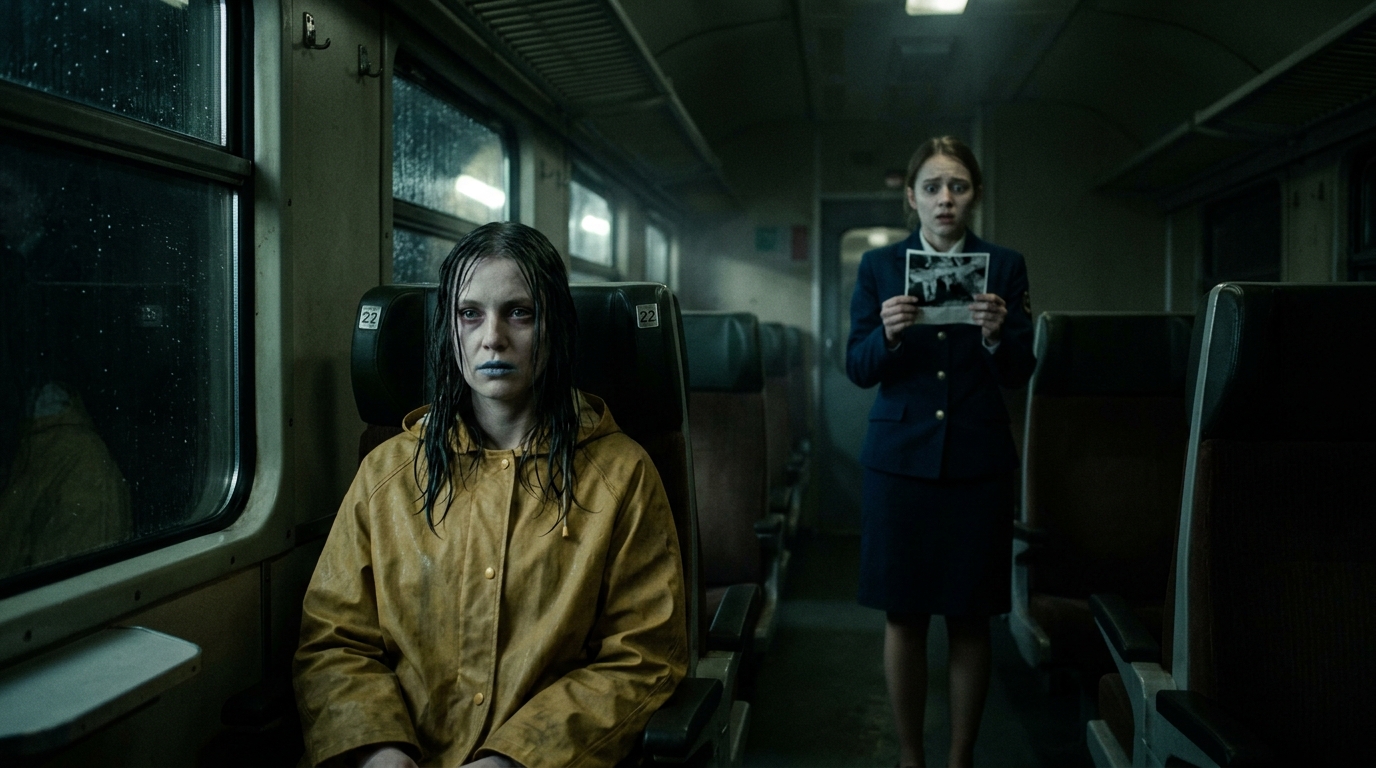
    A woman in a yellow coat.

    Sitting in seat 22.

    The problem was simple.

    Seat 22 was never sold.

    The Woman In The Yellow Coat

    At first, I thought it was a booking error.

    Trains have errors.

    Overlapping tickets.

    Ghost reservations.

    System bugs.

    Old passenger records that refuse to clear properly.

    But seat 22 was different.

    It was not unavailable.

    It was not blocked.

    It was not reserved.

    It simply did not exist in the ticketing system.

    On the seating chart, Carriage C went from seat 20 to seat 24.

    No 21.

    No 22.

    No 23.

    A design change from years ago, according to engineering records.

    Three seats removed after a carriage renovation.

    Except the physical seat remained there.

    I saw it every night.

    Blue fabric.

    Small metal tray table.

    Window to the left.

    Seat number 22 printed above it in faded white paint.

    Passengers asked about it sometimes.

    “Why can’t I book that seat?”

    I always gave the answer management taught us.

    “Maintenance hold.”

    That was a lie.

    No one repaired it.

    No one cleaned it.

    No one sat there.

    Except her.

    The woman in the yellow coat appeared only on camera footage.

    Never when I walked through the carriage.

    Never when passengers boarded.

    Never when tickets were checked.

    But after every disappearance, security reviewed the recordings.

    And there she was.

    Yellow coat.

    Dark hair.

    Hands folded neatly in her lap.

    Face turned toward the window.

    Seat 22.

    Always alone.

    Always still.

    Then one night, the camera captured her doing something new.

    She turned her head.

    Not toward the missing passenger.

    Not toward the aisle.

    Toward the camera.

    Then she lifted one hand and pointed directly at me.

    I was watching the footage in the security room when it happened.

    My supervisor paused the video immediately.

    Nobody spoke.

    On the screen, the woman in yellow pointed toward the camera with a pale hand.

    Then the footage glitched.

    When it returned, she was gone.

    My supervisor cleared his throat.

    “Video corruption.”

    I looked at him.

    “She pointed at me.”

    He closed the laptop.

    “No, she didn’t.”

    That was the first time I understood something.

    Everyone on that train knew seat 22 was wrong.

    They were just waiting for someone else to be brave enough to say it.

    The Passenger List

    The fourth disappearance happened three weeks later.

    A woman this time.

    Evelyn Hart.

    Traveling alone.

    Booked cabin 6.

    She asked me for tea at 12:17 a.m. and told me she hated tunnels.

    I smiled and said the Westbound Line only passed through one long tunnel before dawn.

    She laughed nervously.

    “That’s one too many.”

    At 2:09 a.m., the train entered Hollowbridge Tunnel.

    At 2:13, the carriage lights flickered.

    At 2:16, we exited.

    Evelyn Hart was gone.

    Her tea sat untouched.

    Her cabin door was locked from the inside.

    The window did not open.

    Her purse remained on the bed.

    But the camera in Carriage C showed the woman in yellow sitting in seat 22 again.

    This time, something lay on the tray table in front of her.

    A photograph.

    The security footage was too grainy to see it clearly.

    But I could tell it was a face.

    A woman’s face.

    My supervisor stopped the video before anyone could zoom in.

    “We send this to central,” he said.

    “No,” I said.

    He stared at me.

    “What?”

    “I want to see the photo.”

    “You want a lot of things that are above your job.”

    I looked at the frozen screen.

    Yellow coat.

    Seat 22.

    Photograph on the tray.

    The woman’s head turned slightly toward the aisle, as if she were waiting for someone to sit opposite her.

    Maybe for me.

    I said, “People are vanishing.”

    My supervisor’s jaw tightened.

    “People vanish everywhere.”

    “Not from locked trains.”

    He leaned closer.

    His voice dropped.

    “Do not make yourself part of this.”

    That sentence stayed with me.

    Not “do not investigate.”

    Not “stay safe.”

    Do not make yourself part of this.

    As if the train chose people.

    As if attention was an invitation.

    That night, I checked the passenger logs from every disappearance.

    Daniel Price.

    Mark Halen.

    Sofia Reed.

    Evelyn Hart.

    Different ages.

    Different tickets.

    Different destinations.

    But one detail connected them.

    All four had been assigned seats or cabins within two carriages of seat 22.

    And all four vanished after the train passed through Hollowbridge Tunnel.

    I went deeper into the archive.

    Old incident reports.

    Renovation files.

    Carriage replacement logs.

    Buried inside a maintenance folder, I found a file from eighteen years earlier.

    Accident report.

    Carriage C.

    Seat 22.

    Passenger deceased before arrival.

    Name redacted.

    My hands went cold.

    The woman in the yellow coat had not started with the disappearances.

    She had started with a death.

    I Sat Across From Her

    I decided to wait for her.

    That sounds foolish now.

    It was foolish then too.

    But after you watch enough people disappear while management calls it scheduling noise, fear starts to feel like complicity.

    That night, I changed my shift route.

    At 1:57 a.m., I told the junior attendant I would inspect Carriage C alone.

    At 2:05, I walked through the sleeping car.

    At 2:09, the announcement chimed softly overhead.

    Approaching Hollowbridge Tunnel.

    Passengers shifted in their seats.

    Some slept.

    Some stared into phones.

    Some looked out at the rain sliding sideways across the windows.

    Seat 22 stood empty beneath the dim carriage light.

    The blue fabric looked darker than the surrounding seats.

    Older.

    Like the rest of the carriage had moved on and seat 22 had refused.

    I stood in the aisle.

    My heart beat so hard I could hear it.

    Then the tunnel swallowed the train.

    Darkness pressed against the windows instantly.

    The carriage lights flickered.

    Once.

    Twice.

    On the third flicker, she appeared.

    Not gradually.

    Not like someone walking from another carriage.

    One moment seat 22 was empty.

    The next, the woman in the yellow coat sat there.

    Hands folded.

    Hair damp.

    Face lowered.

    My breath stopped.

    She looked real.

    That was what terrified me most.

    Not transparent.

    Not glowing.

    Not ghostly.

    Real.

    Rainwater dripped from the hem of her yellow coat onto the train floor.

    Inside a sealed carriage.

    Inside a tunnel.

    I should have run.

    Instead, I sat across from her.

    The seat opposite 22 was cold.

    Colder than metal should be.

    For several seconds, neither of us moved.

    The train roared through the tunnel around us.

    Dark windows.

    Flickering lights.

    Sleeping passengers who did not wake.

    I whispered, “Who are you?”

    The woman did not answer.

    Her face remained hidden beneath wet strands of hair.

    Then she lifted one hand slowly and placed something on the small table between us.

    A photograph.

    My fingers went numb before I even saw it clearly.

    Because some part of me already knew.

    It was a picture of me.

    Not from years ago.

    Not from staff records.

    From that night.

    I was wearing the same uniform.

    Same name badge.

    Same silver hair clip.

    In the photograph, I stood in Carriage C beside seat 22.

    But I was not alive.

    My eyes were open.

    My face was pale.

    My mouth slightly parted like I had tried to speak at the moment death arrived.

    I could not breathe.

    I turned the photograph over.

    There was one word written on the back.

    Tomorrow.

    The Photo From Tomorrow

    The train lights flickered harder.

    I looked up from the photograph.

    The woman in yellow was staring at me now.

    Her face was pale.

    Her lips almost blue.

    There was a faint bruise around her throat, hidden beneath the collar of the coat.

    For one second, I thought she might speak.

    Instead, she pointed toward the end of the carriage.

    Toward the door leading to the luggage compartment.

    The same door passengers were not allowed to use during tunnel crossings.

    My voice shook.

    “What’s there?”

    She lowered her hand.

    Then pressed one finger to the photograph of me.

    Tomorrow.

    I felt cold spread from my hands into my chest.

    “Am I going to disappear?”

    The woman’s eyes filled with tears.

    She shook her head once.

    Slowly.

    Not disappear.

    Worse.

    The train began to slow inside the tunnel.

    That was impossible.

    The Westbound Night Line never slowed in Hollowbridge.

    Not unless something blocked the track.

    The lights went out completely.

    For three seconds, there was only darkness and the scream of metal wheels against rails.

    Then emergency red lights clicked on.

    The seat in front of me was empty.

    The woman in the yellow coat was gone.

    Only the photograph remained on the table.

    My photograph.

    My death.

    Tomorrow.

    A child two rows behind me began crying in her sleep.

    Someone in the carriage murmured.

    The train exited the tunnel with a violent shudder.

    Normal lights returned.

    Passengers stirred.

    No one seemed to have seen her.

    No one except me.

    I grabbed the photograph and stood too quickly.

    My knees almost failed.

    At the far end of Carriage C, the luggage compartment door was slightly open.

    It had been locked earlier.

    I knew because I had checked it.

    A strip of yellow fabric was caught in the hinge.

    I walked toward it slowly.

    Every instinct told me not to.

    Every breath told me to run.

    But the photograph in my hand felt heavier with each step.

    Tomorrow.

    I reached the door and pulled it open.

    The luggage compartment smelled of dust, cold iron, and old rain.

    On the floor sat a small black suitcase.

    No passenger tag.

    No lock.

    No dust.

    I knelt and opened it.

    Inside was another photograph.

    This one showed the woman in the yellow coat.

    Alive.

    Smiling.

    Standing beside a man in a conductor’s uniform eighteen years earlier.

    On the back, written in the same handwriting as my photo, were six words:

    He sold my seat after I died.

    The train loudspeaker crackled overhead.

    A voice whispered through the entire carriage.

    Not the driver.

    Not the announcement system.

    A woman’s voice.

    “If you see seat 22, he has already chosen you.”

    I turned slowly toward the aisle.

    At the opposite end of the carriage stood the conductor.

    Mr. Vale.

    My supervisor.

    The man who told me not to make myself part of this.

    He was staring at the suitcase.

    Then at the photograph in my hand.

    Then at me.

    His expression was not surprised.

    It was disappointed.

    And behind him, every passenger seat in Carriage C was suddenly empty.

  • I Found My Paintings Inside An Abandoned Mansion. Every Woman I Painted Was A Real Missing Person

    I Found My Paintings Inside An Abandoned Mansion. Every Woman I Painted Was A Real Missing Person

    The Address That Shouldn’t Exist

    I found the delivery address by accident.

    At least, that was what I told myself at first.

    Accidents feel kinder than traps.

    After the man knocked on my apartment door, I did not answer.

    I sat on the floor until sunrise with a kitchen knife in one hand and my eyes fixed on the covered canvas.

    The knocking stopped after the third tap.

    No footsteps left the hallway.

    No elevator door opened.

    No voice called again.

    Just silence.

    The kind that waits for you to feel foolish.

    At 7:16 a.m., I finally crawled toward the door and looked through the peephole.

    Empty hallway.

    No man.

    No shadow.

    No silver-haired buyer standing outside with a broken mirror ring.

    Only one envelope on the floor.

    Black.

    Sealed with red wax.

    My name was written across it in handwriting I recognized.

    Not because I had seen it before.

    Because I had painted it.

    That sounds impossible.

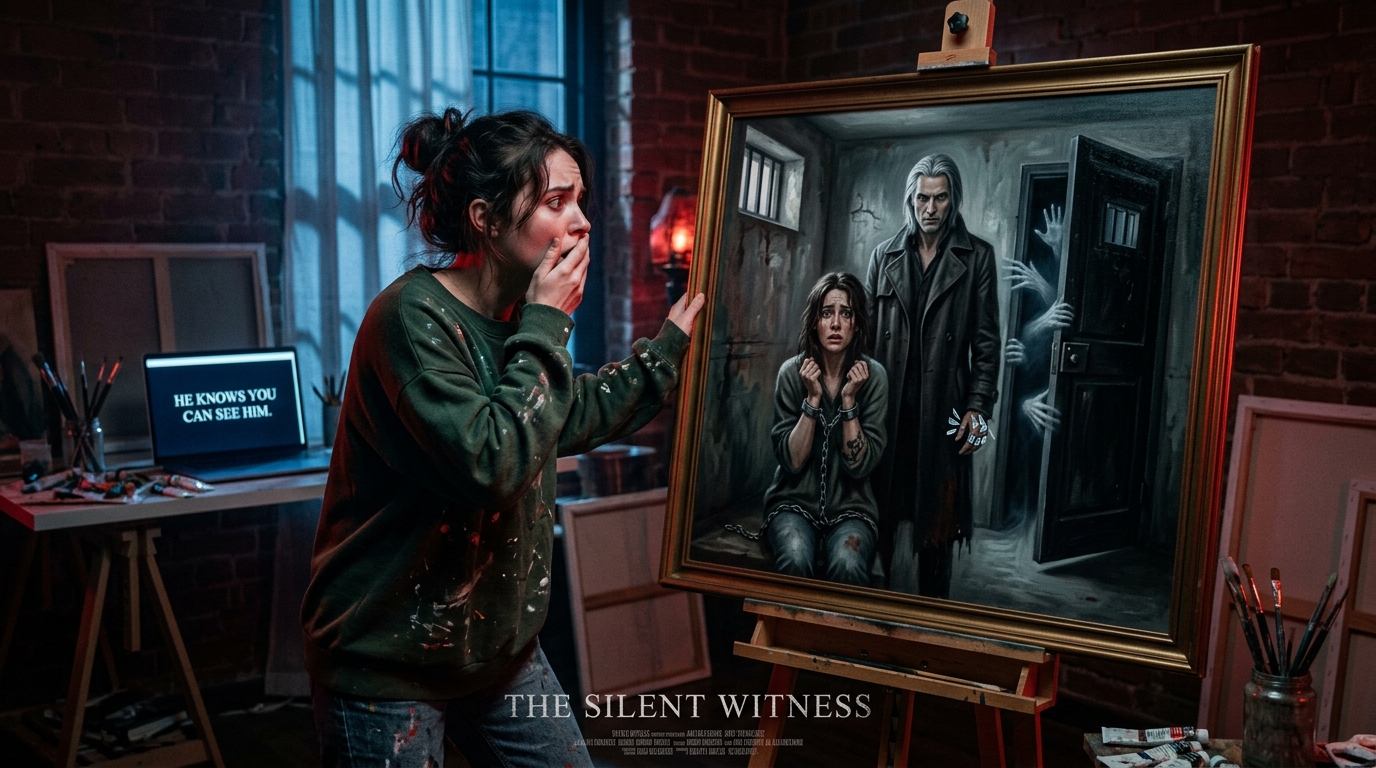
    But the letters curved exactly like the scratches on the wall inside my self-portrait.

    The same uneven pressure.

    The same desperate slant.

    ELARA.

    Inside the envelope was a receipt.

    Not from my online shop.

    A shipping receipt.

    Fourteen paintings.

    Delivered over seven months.

    All to the same address.

    17 Blackwater Lane.

    I stared at it for a long time.

    Because I had never shipped anything there.

    MIRROR_17 never gave a physical address.

    He paid for digital files.

    He ordered me to destroy originals.

    He should not have had deliveries.

    Unless someone else had been collecting what I thought I burned.

    Unless the burned canvases were never the real transaction.

    Unless the paintings were not products.

    They were evidence.

    I searched the address online.

    Nothing came up at first.

    Then an old property record.

    Blackwater House.

    Abandoned since 2009.

    Fire damage.

    Foreclosure.

    No current owner listed.

    One photo showed a huge decaying mansion surrounded by trees, its windows boarded, its roof sagging beneath years of rain.

    I recognized it before I knew why.

    Not from life.

    From the painting.

    The gray room.

    The chains.

    The black door.

    Somewhere beneath that ruined house was the room I had painted without ever seeing it.

    And someone under the concrete floor had just told me:

    Finally.

    Blackwater House

    I went at dusk because fear is stupid.

    It waits until the worst possible hour and calls itself courage.

    Blackwater Lane sat beyond the edge of the city, past old factories, dead streetlights, and a narrow road swallowed by trees.

    My taxi driver refused to turn into the driveway.

    “House is condemned,” he said.

    “I’ll be quick.”

    He looked at me through the rearview mirror.

    “People say that before becoming news.”

    I paid cash.

    He did not offer to wait.

    Blackwater House rose behind an iron gate covered in vines.

    The mansion looked larger in person.

    Not grand.

    Hungry.

    Windows stared through broken boards. Rainwater dripped from cracked gutters even though the sky had stopped raining hours earlier. Dead leaves covered the stone steps like old paper.

    I stood outside with my phone flashlight trembling in one hand and the shipping receipt in the other.

    17 Blackwater Lane.

    The address was real.

    Which meant the buyer was real.

    Or had been.

    The front door was unlocked.

    That should have made me leave.

    Instead, I stepped inside.

    The air smelled of mold, ashes, and something sour beneath the floorboards.

    My flashlight cut across a wide entrance hall with peeling wallpaper and a chandelier hanging low from a broken ceiling.

    Dust covered everything.

    Except the footprints.

    Fresh.

    Leading deeper into the house.

    My breathing grew louder.

    I followed them past the staircase, through a dining room with no table, into a long corridor lined with closed doors.

    At the end of the hallway, pale light leaked through a cracked frame.

    I pushed the door open.

    And saw my paintings.

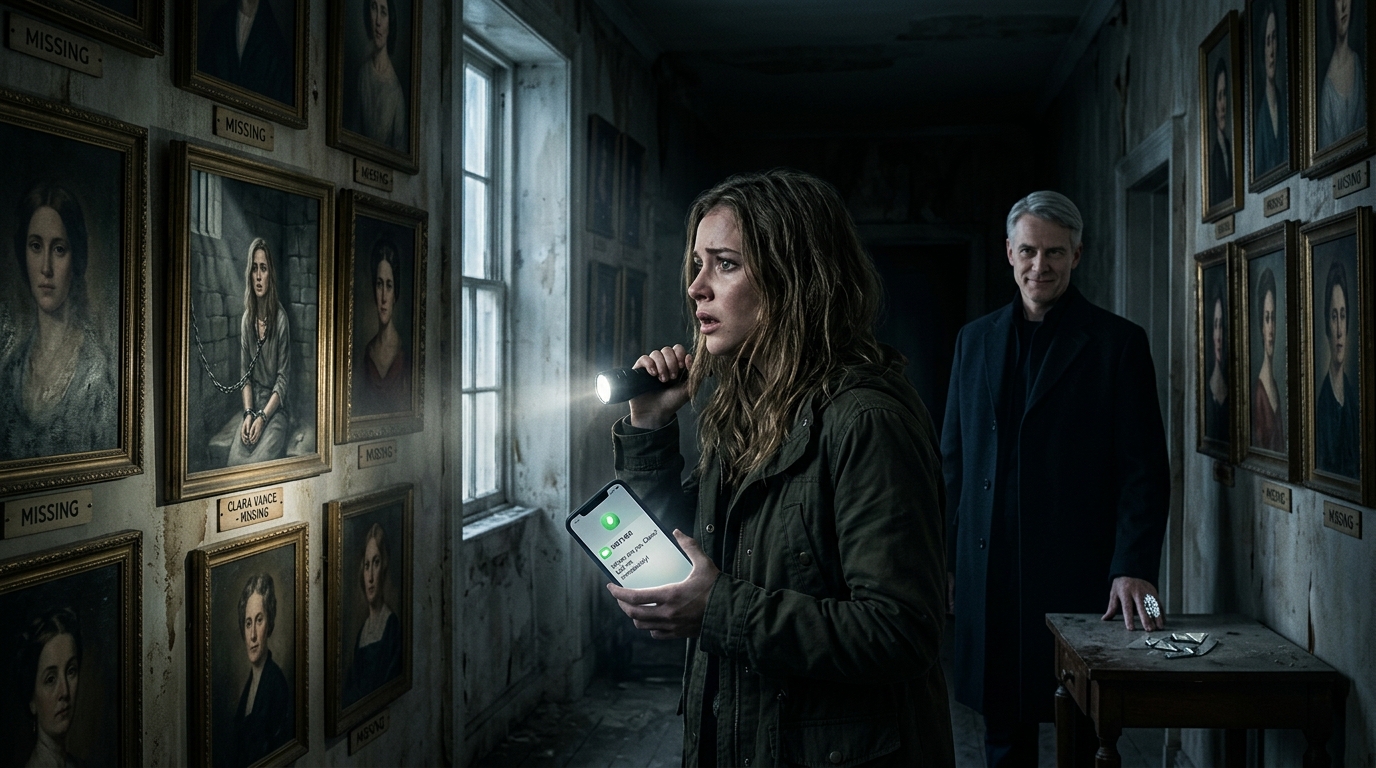
    The Gallery Of Crying Women

    They covered every wall.

    Dozens of them.

    Not fourteen.

    Dozens.

    Some mine.

    Some older.

    Some painted in styles I did not recognize.

    Women crying.

    Women behind glass.

    Women in water.

    Women holding hands over their mouths.

    Women looking toward something outside the frame.

    The room felt less like a gallery and more like a witness lineup.

    I stepped closer to the first painting.

    A woman with red hair crying beside a bathtub.

    Mine.

    Sold four months ago.

    I remembered burning the canvas.

    I remembered watching smoke rise behind the laundromat.

    Yet here it was.

    Untouched.

    Framed.

    Beneath it was a small brass plate.

    MARA HOLT.

    MISSING: MARCH 12, 2018.

    My throat tightened.

    I moved to the next.

    A woman at a window with tears on her cheeks.

    Mine.

    Bought by MIRROR_17.

    Beneath it:

    ELISE VAUGHN.

    MISSING: JULY 4, 2020.

    Another.

    A woman in a burning doorway.

    Beneath it:

    NORA FELL.

    MISSING: NOVEMBER 19, 2016.

    My stomach turned violently.

    These were not characters.

    They were real women.

    I pulled out my phone and searched the names.

    Mara Holt.

    Missing teacher.

    Elise Vaughn.

    Missing nurse.

    Nora Fell.

    Missing musician.

    Every face matched.

    Every painting I had created from “feeling” had been a portrait of a woman who disappeared before I ever painted her.

    I backed away from the wall.

    “No.”

    My voice sounded tiny inside the ruined mansion.

    A painting near the corner caught my eye.

    It was my latest self-portrait.

    The chained woman with my face.

    The gray room.

    The black door.

    The word MIRROR scratched into the wall.

    But the brass plate beneath it was blank.

    No name.

    No missing date.

    Just empty metal waiting to be engraved.

    My phone buzzed.

    Unknown number.

    A message appeared.

    You found the others.

    My hands went cold.

    Another message came through.

    Now find me.

    The Buyer Was One Of Them

    I typed with shaking fingers.

    Who are you?

    The reply came almost instantly.

    The first one.

    I looked around the gallery.

    The first painting.

    Not mine.

    An older canvas hung above the fireplace, darker and more detailed than all the rest.

    A woman in a red dress stood inside a concrete room, one wrist chained to the wall, one hand pressed to her throat.

    Her face was turned toward the viewer.

    Crying.

    But not helpless.

    Angry.

    Alive.

    The brass plate beneath it read:

    VIVIAN LARK.

    MISSING: JANUARY 17, 2013.

    I searched the name.

    The page loaded slowly.

    Journalist.

    Investigated missing women connected to private art auctions.

    Disappeared after attending an estate viewing at Blackwater House.

    Presumed dead.

    No body recovered.

    A photo appeared.

    Vivian Lark smiled beside a newspaper building, holding a camera bag over one shoulder.

    She had the same eyes as the woman in the painting.

    And the same ring on her finger.

    A broken mirror.

    My phone buzzed again.

    He made me paint the first room.

    My breath stopped.

    Another message.

    Then he made others paint us.

    I looked at the walls again.

    Different styles.

    Different signatures.

    Different years.

    Painters.

    Artists.

    Witnesses.

    Somewhere, other desperate artists had been paid too much by someone they never met.

    Somewhere, they painted women they thought they invented.

    Somewhere, they destroyed originals and believed the smoke ended the story.

    My latest message appeared.

    Most of them stopped answering.

    I stared at it.

    “Because he killed them?”

    The phone buzzed.

    Because they finished their portraits.

    The room seemed to tilt around me.

    My blank brass plate waited beneath my painting.

    My name not yet engraved.

    My missing date not yet chosen.

    I stepped backward toward the hallway.

    Then music began playing from somewhere below the house.

    A phone ringtone.

    Soft.

    Muffled.

    Vibrating through the floor.

    My screen lit up with a map.

    No street.

    No building plan.

    Just a red dot blinking beneath me.

    Basement level.

    The Basement Beneath The Gallery

    The basement door was hidden behind the fireplace.

    I found it because the ringtone grew louder when I stepped near the hearth.

    The brick panel opened inward when I pressed the broken mirror symbol carved into the mantle.

    A staircase descended into darkness.

    Cold air rose from below.

    Damp.

    Metallic.

    Human.

    I should have called police before going down.

    I know that.

    But I had already learned something terrible.

    The police had probably been called before.

    By Vivian.

    By Mara.

    By Elise.

    By every woman whose portrait hung upstairs.

    And yet the gallery remained.

    The house remained.

    The room remained.

    I turned on my phone camera and began recording.

    “My name is Elara Voss,” I whispered. “I am inside Blackwater House. There are paintings upstairs of women listed as missing. I am going into the basement.”

    My voice trembled.

    Good.

    Let anyone watching hear it.

    Let fear become evidence.

    The stairs ended in a narrow concrete hallway.

    The walls were wet.

    Pipes ran overhead.

    At the far end stood a black door.

    The same door from my painting.

    Half open.

    I stopped breathing.

    The ringtone came from behind it.

    One buzz.

    Then another.

    I pushed the door slowly.

    The room inside was exactly as I had painted it.

    Gray walls.

    Single hanging bulb.

    Metal chair.

    Chains fixed into the concrete.

    Tally marks scratched into one wall.

    Dozens.

    Hundreds.

    And above them, carved deep:

    MIRROR.

    My stomach twisted.

    My painting had not been imagination.

    It had been memory.

    Not mine.

    Someone else’s.

    Transferred through brushstrokes.

    Or through whatever nightmare MIRROR_17 had used to reach me.

    The phone vibrated again.

    Not mine.

    A second phone.

    Somewhere in the room.

    I followed the sound to the center of the floor.

    Concrete.

    Cracked.

    Dark stains near the drain.

    The vibration came from underneath.

    My screen showed a new message.

    Finally, you painted the correct room where I was locked.

    I looked down at the floor.

    The sender was MIRROR_17.

    The phone was beneath the concrete.

    Not on the floor.

    Not hidden behind a pipe.

    Under it.

    Buried.

    My throat closed.

    “Vivian?”

    The room lights flickered.

    A reply appeared.

    Not Vivian.

    I froze.

    Another message came through.

    Vivian was the first portrait.

    I was the first buyer.

    Cold spread through me.

    I stared at the phone.

    “Then who are you?”

    The screen remained dark for several seconds.

    Then:

    The one he buried before he started collecting faces.

    The concrete beneath my feet buzzed again.

    The phone below the floor rang.

    Old.

    Muffled.

    Desperate.

    I knelt and pressed my ear to the concrete.

    Under the ringtone, I heard something else.

    A voice.

    Female.

    Weak.

    Not electronic.

    Not recorded.

    Alive.

    “Help me.”

    The Woman Under The Concrete

    I grabbed a rusted metal bar from the corner and slammed it into the concrete.

    Once.

    Twice.

    Three times.

    The floor cracked slightly.

    Not enough.

    The voice under the floor coughed.

    My phone buzzed again.

    Don’t break the wrong place.

    A new image appeared on the screen.

    A diagram of the basement floor.

    Red X near the drain.

    Blue line showing a hollow channel beneath the concrete.

    There was space under there.

    A crawl chamber.

    A sealed cell.

    Not a grave.

    Not yet.

    I moved to the drain and struck the concrete again.

    The first piece broke loose.

    Then another.

    Cold air rushed upward.

    Stale.

    Rotten.

    A hand shot through the gap.

    I screamed and fell backward.

    The hand was thin.

    Pale.

    Fingernails broken.

    But it moved.

    Alive.

    I crawled forward.

    “I’m here. I’m here.”

    The woman beneath the floor grabbed my wrist with desperate strength.

    Her voice scraped upward through the crack.

    “He sent you?”

    “No.”

    “Did he make you paint?”

    “Yes.”

    The hand tightened.

    “Then he’s already chosen you.”

    My eyes filled with tears.

    “Who are you?”

    A pause.

    Then the woman whispered:

    “MIRROR_17.”

    My whole body went cold.

    The mysterious buyer.

    The person who paid double.

    The person who ordered crying women.

    The person who sent me here.

    Not a killer.

    Not a collector.

    A prisoner.

    Buried under the room she made me paint.

    The woman beneath the concrete sobbed softly.

    “I kept buying the paintings so someone would finally see us.”

    My chest hurt.

    “How?”

    “There’s a signal line under the floor. Old phone. He forgot it was here.” She coughed violently. “I learned to send messages when the house system wakes at night.”

    “Who is he?”

    The woman did not answer immediately.

    Above us, the mansion creaked.

    Footsteps.

    Slow.

    Heavy.

    Crossing the gallery floor overhead.

    My blood froze.

    The woman under the concrete whispered:

    “He’s home.”

    My phone screen changed.

    No message now.

    A live camera feed appeared.

    The gallery upstairs.

    A man walked slowly between the paintings.

    Dark coat.

    Silver hair.

    Thin smile.

    Broken mirror ring.

    The man from my painting.

    He stopped in front of my self-portrait.

    Then looked directly into the hidden camera.

    Into my phone.

    Into me.

    His lips moved.

    A second later, the basement speaker crackled.

    “Elara,” he said warmly, “you weren’t supposed to meet the buyer before I framed you.”

    The Unfinished Portrait

    The basement door slammed shut.

    I ran to it immediately.

    Locked.

    Of course.

    The woman beneath the floor gripped my wrist harder through the broken concrete.

    “Listen to me.”

    Footsteps sounded above.

    Slow.

    Patient.

    Coming toward the basement stairs.

    My phone camera still showed him moving through the house.

    He held something in one hand.

    A brass plate.

    Blank.

    For my painting.

    The woman under the floor gasped.

    “If he hangs your plate, the room will take you next.”

    “What does that mean?”

    “He doesn’t kill all of them in the room.” Her voice shook violently. “Some he sells. Some he hides. Some he turns into paintings.”

    I stared at the self-portrait on my phone screen.

    The chained woman with my face.

    The room.

    The door.

    The blank plate.

    My throat tightened.

    “How do I stop him?”

    The woman coughed again.

    Blood speckled the edge of the crack.

    “You need the first painting.”

    “Vivian?”

    “No.” She sounded weaker now. “Before Vivian.”

    The footsteps reached the basement door.

    I backed away.

    The handle moved once.

    Then stopped.

    The man outside chuckled softly.

    Not impatient.

    Enjoying this.

    My phone buzzed one final time.

    A file opened.

    A photo.

    Old.

    Taken inside this same basement.

    A young girl sat chained to the wall holding a paintbrush.

    Maybe thirteen.

    Maybe fourteen.

    Her face was familiar in a way that made my stomach twist.

    Dark eyes.

    Sharp cheekbones.

    Same small scar near the lower lip.

    Mine.

    No.

    Not mine.

    My mother’s.

    The woman beneath the concrete whispered:

    “He made your mother paint the first one.”

    The basement door unlocked.

    Click.

    Slow.

    Final.

    The man’s voice came through the wood.

    “Open the door, Elara.”

    The phone screen changed to a new message.

    This one was not from MIRROR_17.

    It came from a saved contact I had never seen before.

    MOTHER.

    The message said:

    Don’t let him finish your eyes.

    Then the door opened.

  • A Stranger Paid Double For Every Painting I Sold. Then He Asked Me To Paint Myself Locked In Chains

    A Stranger Paid Double For Every Painting I Sold. Then He Asked Me To Paint Myself Locked In Chains

    The Buyer Who Never Bargained

    Poor artists learn the sound of desperation.

    It is not dramatic.

    It is not poetic.

    It sounds like an empty fridge humming at 2 a.m.

    Like rent reminders sliding under your door.

    Like refreshing your online shop twelve times in one hour, hoping a stranger somewhere wants your sadness badly enough to pay for it.

    That was my life before the buyer appeared.

    My name is Elara Voss.

    I painted portraits in a studio apartment above a closed laundromat, where the pipes groaned all night and the ceiling leaked whenever it rained.

    Most of my work sold for barely enough to buy groceries.

    Women crying.

    Women looking through windows.

    Women with hands pressed against glass.

    I never planned to paint sadness forever.

    It was simply the only thing people bought.

    Then one night, someone purchased three paintings at once.

    No message.

    No profile picture.

    No bargaining.

    Full price.

    Then an extra payment.

    Double.

    The buyer’s username was simple.

    MIRROR_17.

    I thought it was a mistake.

    I messaged immediately.

    You overpaid.

    The reply came less than one minute later.

    No.

    That was all.

    No greeting.

    No explanation.

    Just no.

    The next week, MIRROR_17 bought another painting.

    A woman crying in a bathtub full of black water.

    Double price again.

    Then another.

    A woman standing in a burning doorway.

    Double price.

    Then another.

    A girl covering her mouth while looking at someone outside the frame.

    Double price.

    Always the same kind of painting.

    Female face.

    Tears.

    Fear.

    No men.

    No landscapes.

    No bright colors.

    Only women who looked like they had realized something too late.

    At first, I told myself not to question money.

    That was my first mistake.

    Desperate people mistake payment for rescue.

    Sometimes it is only a leash.

    The Paintings He Chose

    After the sixth sale, I started noticing the pattern.

    MIRROR_17 never bought finished pieces quickly.

    He waited.

    Watched.

    Then purchased only the paintings where the woman looked directly at the viewer.

    Not sad women.

    Not beautiful women.

    Trapped women.

    That word came to me one morning while packaging a canvas.

    Trapped.

    Every woman he chose looked trapped.

    As if they were not crying for themselves.

    As if they were trying to warn whoever looked back.

    I checked the shipping address after the eighth purchase.

    There wasn’t one.

    Digital transfer only.

    He paid for the artwork, then told me to destroy the original.

    Destroy it?

    I typed back.

    The reply came instantly.

    Burn it.

    My stomach tightened.

    I did not burn it.

    I stored the canvas behind my wardrobe and lied.

    Done.

    The next message arrived three seconds later.

    No, you didn’t.

    I stared at the screen.

    My apartment suddenly felt too quiet.

    The radiator clicked once near the window.

    Rain slid down the glass.

    I looked toward the wardrobe.

    The painting leaned behind it, wrapped in brown paper.

    Hidden.

    Impossible to see from outside.

    Another message appeared.

    She looks better in the dark.

    My breath stopped.

    I did not sleep that night.

    The next morning, I took the painting outside and burned it in a metal trash bin behind the laundromat.

    The smoke smelled wrong.

    Not like canvas.

    Not like oil paint.

    Like hair.

    I told myself that was impossible.

    I told myself many things that month.

    None of them saved me.

    The Commission

    The request came at 1:13 a.m. on a Tuesday.

    I was sitting on the floor surrounded by unpaid bills, eating cold noodles from the container because I had sold my kitchen table two weeks earlier.

    My laptop pinged.

    New message from MIRROR_17.

    Commission.

    I stared at the word.

    Commissions paid more.

    Commissions also gave buyers control.

    What kind of painting?

    The answer appeared immediately.

    A portrait.

    Of who?

    A pause.

    Longer than usual.

    Then:

    You.

    I almost laughed.

    Not because it was funny.

    Because fear sometimes escapes through the wrong door.

    You want me to paint myself?

    Yes.

    I don’t do self-portraits.

    You do now.

    I closed the laptop.

    For five seconds.

    Then opened it again.

    A new payment had arrived.

    Ten thousand dollars.

    My rent debt.

    My food.

    My electricity.

    My life, paused for one month.

    All sitting in my account because a stranger wanted my face on canvas.

    I should have returned the money.

    I should have blocked him.

    I should have called someone.

    But poverty is persuasive.

    It can make a locked door look like opportunity.

    I typed:

    What should the portrait look like?

    The reply came so fast it felt like he had been holding the answer against the screen.

    Paint what you feel when you think of me.

    My hands went cold.

    I looked around my apartment.

    The leaking ceiling.

    The cracked window.

    The unfinished canvases leaning against the wall.

    The little mirror above the sink where I avoided looking at myself too long.

    What did I feel when I thought of him?

    Watched.

    That was the first word.

    Chosen.

    That was the second.

    The third arrived much later, when the painting was nearly finished.

    Owned.

    The Face I Had Never Seen

    I started with my own face.

    That seemed safe.

    A self-portrait is supposed to be simple.

    A mirror.

    A sketch.

    Bone structure.

    Light.

    Shadow.

    But the first line I drew was wrong.

    Not my jaw.

    Not my eyes.

    Not my mouth.

    My hand moved before I decided where the pencil should go.

    That was not metaphor.

    I mean it literally.

    My wrist jerked slightly, as if someone had touched the back of my hand.

    I pulled away from the canvas.

    The room was empty.

    Outside, rain tapped against the window.

    The radiator hissed.

    My laptop screen glowed from the floor.

    A new message appeared.

    Don’t stop.

    I had not heard the notification sound.

    I stared at the screen until my vision blurred.

    Then I picked up the pencil again.

    The portrait formed slowly over the next six hours.

    My face first.

    Then my shoulders.

    Then a background I had not planned.

    Gray walls.

    No window.

    A single lightbulb hanging from the ceiling.

    I tried to paint over it.

    The gray returned.

    I added color.

    The canvas swallowed it.

    At 4:40 a.m., I realized I was not painting my apartment.

    I was painting a room I had never seen.

    Small.

    Concrete.

    Damp.

    A metal chair behind me.

    Chains hanging from the walls.

    My mouth went dry.

    I stepped back from the canvas.

    The woman in the painting looked like me.

    But not exactly.

    Thinner.

    Paler.

    Older by fear.

    Her wrists were chained above her head.

    One ankle locked to the floor.

    Her mouth was open like she had been screaming when someone told her to stay still.

    Behind her, scratched into the wall, were tally marks.

    Dozens.

    Maybe hundreds.

    And above them, one word.

    MIRROR.

    My heart slammed against my ribs.

    I dropped the brush.

    It struck the floor and rolled beneath my bed.

    The laptop pinged again.

    Beautiful.

    I backed away from the canvas.

    My hands were shaking.

    I had never shown him the painting.

    No photo.

    No stream.

    No camera.

    Nothing.

    Another message appeared.

    Now paint the door.

    The Room In The Painting

    There was no door in the painting.

    Not yet.

    I stood frozen in the center of my apartment, staring at the message until the letters stopped making sense.

    Now paint the door.

    My phone buzzed on the floor.

    Unknown number.

    I did not answer.

    It stopped.

    Then immediately started again.

    I let it ring.

    The laptop pinged.

    Answer.

    The phone rang louder.

    Not possible.

    Phones do not ring louder because strangers command them.

    Mine did.

    I picked it up with shaking fingers.

    For a moment, there was only static.

    Then breathing.

    Female.

    Weak.

    Close to the microphone.

    “Elara?”

    I stopped breathing.

    “Who is this?”

    The woman cried softly.

    A broken sound.

    Not theatrical.

    Not loud.

    Real.

    “You painted the room.”

    My blood turned cold.

    I looked at the canvas.

    The chained woman stared back at me with my face.

    “What room?”

    “The room he keeps us in.”

    Us.

    The word moved through my body like ice water.

    I whispered, “Who are you?”

    The line crackled.

    A sound came through the background.

    Metal dragging across concrete.

    Chains.

    The woman sucked in a terrified breath.

    “He’s coming back.”

    “Where are you?”

    “I don’t know.”

    “What do you mean you don’t know?”

    “He moves the room.”

    That sentence made no sense.

    None of this made sense.

    The woman sobbed.

    “Listen to me. If he asked you to paint yourself, he’s almost done watching.”

    My hands went numb.

    “Watching what?”

    “You.”

    The call distorted.

    Then, beneath the static, I heard a man humming.

    Softly.

    Almost lovingly.

    The same melody my father used to hum when cleaning his brushes in the garage.

    My father had died when I was nine.

    Before I could speak, the woman whispered:

    “Don’t paint the door unless you want him to open yours.”

    The call ended.

    My apartment went silent.

    Too silent.

    Then someone knocked.

    Not on the front door.

    On the canvas.

    Three slow taps from inside the painting.

    The Buyer At The Edge Of The Frame

    I fell backward and hit the floor hard enough to knock the breath from my lungs.

    The painting stood on the easel.

    Still.

    Silent.

    The woman inside it still chained.

    Still screaming.

    But now there was something new at the edge of the canvas.

    A shadow.

    Tall.

    Male.

    Just outside the painted light.

    I crawled backward until my spine hit the kitchen cabinet.

    My laptop pinged again.

    I told you to paint the door.

    My mouth went dry.

    I slammed the laptop shut.

    A second later, the screen turned on again by itself.

    Message after message appeared.

    Paint it.

    Paint it.

    Paint it.

    Paint it.

    I grabbed the nearest rag and threw it over the canvas.

    The knocking stopped.

    For exactly five seconds.

    Then it came again.

    Three taps.

    This time from my apartment door.

    I froze.

    The hallway outside my apartment was dark beneath the crack.

    No footsteps.

    No voices.

    Just one shadow at the bottom of the door.

    Someone standing very still on the other side.

    My phone buzzed again.

    A photo arrived.

    No sender name.

    I opened it.

    My stomach turned violently.

    It showed my apartment door from the hallway.

    Taken seconds ago.

    Then another image arrived.

    My window from the fire escape.

    Then another.

    Me sitting on the floor with the phone in my hand.

    Taken from inside my apartment.

    I looked up slowly.

    Every corner seemed darker than before.

    The radiator.

    The closet.

    The space beneath my bed.

    My laptop pinged one last time.

    You forgot the most important detail.

    The covered canvas shifted beneath the rag.

    Not falling.

    Moving.

    Like someone behind it had lifted their head.

    The rag slid down slowly.

    The painting had changed again.

    Behind the chained woman with my face, the gray wall now held a door.

    Small.

    Black.

    Half open.

    And inside that painted doorway stood a man I had never seen before.

    Or thought I hadn’t.

    Dark coat.

    Silver hair.

    A thin smile.

    His hand rested against the painted doorframe.

    On his finger was a ring shaped like a broken mirror.

    The laptop screen went black.

    Then white letters appeared.

    NOW HE KNOWS YOU CAN SEE HIM.

    The knock came again.

    From the apartment door.

    Three taps.

    Then a man’s voice whispered from the hallway:

    “Elara, your portrait is finished.”

  • I Tried To Save A Kidnapped Woman During A Live Broadcast. Then I Saw Her On The Monitor Behind My Studio

    I Tried To Save A Kidnapped Woman During A Live Broadcast. Then I Saw Her On The Monitor Behind My Studio

    The Name I Wasn’t Supposed To Say

    The studio was still live.

    That was the first thing I realized after the lights came back.

    Not safe.

    Not over.

    Live.

    The red emergency lights washed the stage in a color too close to blood. Audience members were crying. Security guards were shouting near the exits. Camera three lay on the floor with its lens cracked, still blinking red.

    The fake cameraman was gone.

    The person wearing Owen’s face was gone.

    But the broadcast had not stopped.

    Millions of people were still watching me stand behind the desk with a shaking paper in my hand.

    And at the bottom of that paper, in wet black ink, was the new sentence.

    SHE IS NOT IN THE BASEMENT ANYMORE.

    SHE IS UNDER THE STUDIO.

    My mouth went dry.

    Under the studio.

    Not across town.

    Not in some warehouse.

    Not hidden in a basement police might raid in an hour.

    Here.

    Beneath our feet.

    While I had been reading her words aloud.

    While the audience clapped.

    While cameras rolled.

    Elena Cross had been somewhere below the stage.

    Listening.

    Or being watched.

    Or dying.

    My earpiece crackled.

    For one second, I thought it would be her again.

    Please.

    Keep reading.

    Instead, I heard only static.

    Then a man’s voice whispered:

    “Smile, Marcus.”

    Every muscle in my body locked.

    It was Owen’s voice.

    My director.

    The man whose body I had just learned was dead.

    I looked toward the control room above the studio floor.

    The glass booth was dark.

    No silhouettes.

    No producers.

    No headset lights.

    No movement.

    Empty.

    But Owen’s voice came through my ear again.

    “Smile. They can see your face.”

    I forced my lips upward.

    The audience thought I was trying to calm them.

    I was trying not to scream.

    The Location Hidden In The Script

    I looked down at the paper again.

    There were still lines I had not read.

    New ones.

    They had not been there before.

    I know that sounds impossible.

    But live television had already stopped obeying reality.

    The ink crawled slowly across the page as if someone were writing from the other side.

    Marcus, say the address.

    I stared.

    Then another line appeared beneath it.

    Make them hear where I am.

    My pulse hammered.

    I understood.

    Police would be watching by now.

    Viewers would be recording.

    Someone somewhere would be trying to trace the broadcast, the threat, the missing woman, the name Victor Cross.

    But television is chaos in a crisis.

    People hear panic.

    They miss details.

    So I had to make the details impossible to miss.

    I lifted my eyes to camera one.

    My voice sounded steadier than I felt.

    “Elena Cross said she was moved from the Meridian Hall basement.”

    A security guard looked at me sharply.

    Good.

    I continued.

    “She said she was taken under Studio 9 at Whitmore Broadcasting Center.”

    The audience murmured.

    The control booth stayed dark.

    My earpiece hissed.

    I kept going.

    “Studio 9. Whitmore Broadcasting Center. Service level beneath the main stage.”

    I repeated each word slowly.

    Clearly.

    Like a host reading donation totals.

    Like a man trying to save a woman without making the kidnapper pull a trigger.

    The earpiece crackled again.

    This time, Owen’s voice was colder.

    “Don’t.”

    I swallowed.

    “Police should search the lower service tunnels under Studio 9.”

    The voice in my ear sharpened.

    “Do not try to save her.”

    My skin went cold.

    Not because of the threat.

    Because Owen’s voice was wrong now.

    Too clean.

    Too close.

    Like it was being played from inside my skull.

    I looked up toward the control room again.

    Still empty.

    No director.

    No producers.

    No one at the switchboard.

    Only one camera mounted inside the booth.

    Slowly turning by itself.

    Toward me.

    The Empty Control Room

    I should have left the desk.

    I should have walked offstage, taken the audience with me, and forced every door in the building open.

    But the paper changed again.

    One line.

    Stay on air or he closes the room.

    I stopped breathing.

    He.

    Victor?

    The fake cameraman?

    The thing wearing Owen’s face?

    The man in my earpiece?

    I did not know.

    And not knowing meant Elena was the only person who did.

    The floor beneath the desk vibrated faintly.

    Not from speakers.

    Not from camera rails.

    From below.

    A dull mechanical thud.

    Then another.

    Like metal doors locking somewhere under the studio.

    I gripped the edge of the desk.

    The audience was silent now.

    No applause sign.

    No music.

    No charity smiles.

    Just hundreds of people staring at me while realizing they were not watching a program anymore.

    They were witnesses.

    My earpiece whispered again.

    “Marcus.”

    I forced myself not to react.

    “You always wanted real television.”

    My chest tightened.

    The voice laughed softly.

    “Here it is.”

    I looked toward the control room monitors above the glass.

    They should have shown camera feeds.

    Wide shot.

    Audience shot.

    Stage shot.

    Instead, every monitor showed static.

    Then one by one, the static cleared.

    A dark room appeared.

    Concrete walls.

    A single hanging bulb.

    A woman tied to a metal chair.

    Dark hair covering part of her face.

    Tape around one wrist.

    Blood at her temple.

    Elena Cross.

    She lifted her head slowly.

    And looked directly into the camera.

    No.

    Directly at me.

    The monitor above the empty control room zoomed in on her face.

    Her lips moved.

    No sound came through the studio speakers.

    But I could read the words.

    Behind you.

    The Room Behind The Stage

    I turned too fast.

    Nothing behind me.

    Only the black curtain at the rear of Studio 9.

    The charity banner.

    A row of unused chairs.

    A prop wall painted to look like marble.

    Normal studio pieces.

    Fake elegance.

    Designed for broadcast.

    But Elena stared from the monitor as if she could see beyond what I saw.

    Behind you.

    I looked again.

    At the black curtain.

    At the floor beneath it.

    At the slight gap near the bottom where cold air moved the fabric inward.

    There was a door behind the curtain.

    I had worked in that studio for eight years.

    I knew every entrance.

    Every light rig.

    Every emergency exit.

    There was not supposed to be a door there.

    My earpiece crackled.

    “Don’t turn around again.”

    I turned anyway.

    The curtain shifted.

    Just slightly.

    The monitor showed Elena shaking her head violently.

    Then the camera inside her room moved.

    Not on its own.

    Someone walked behind her.

    Only a hand appeared at first.

    Male.

    Wearing a silver ring.

    The same ring Elena had described.

    The hand rested gently on her shoulder.

    She closed her eyes in terror.

    My voice nearly broke, but I kept speaking to camera one.

    “Elena Cross is alive.”

    The silver-ringed hand tightened.

    Elena gasped silently on the monitor.

    I forced myself to continue.

    “She is being held inside Whitmore Broadcasting Center. Studio 9. Behind the main stage. Behind the black curtain.”

    The studio doors burst open.

    Real police this time.

    Uniformed officers flooded the aisles.

    Audience members screamed and ducked.

    Security shouted over one another.

    The monitor image of Elena suddenly flickered.

    The man’s hand disappeared from her shoulder.

    Then a voice came through every speaker in the studio.

    Not Owen’s voice now.

    Victor Cross.

    The grieving husband.

    The guest I once interviewed.

    The man I had called brave on live television.

    “Marcus,” he said calmly, “you should have kept reading.”

    The black curtain behind me opened by itself.

    The Woman In The Dark Room

    A narrow passage waited behind the curtain.

    The audience saw it.

    The cameras saw it.

    The police saw it.

    And for one second, nobody moved.

    Because the passage did not look newly built.

    It looked old.

    Concrete.

    Steel door.

    Wires running along the ceiling.

    Hidden behind television sets and charity backdrops for years.

    The truth had not been far away.

    It had been behind production design.

    An officer shouted, “Move!”

    Police rushed toward the stage.

    I stayed frozen behind the desk.

    Not because I wanted to.

    Because the monitor changed again.

    Elena’s dark room was no longer on screen.

    Now the monitor showed the studio.

    Live.

    From behind me.

    From inside the hidden passage.

    A camera was watching us from the dark.

    The angle showed my back.

    The police moving toward the curtain.

    The audience crying.

    And in the bottom corner of the feed, a timestamp appeared.

    LIVE DELAY: 00:07.

    Seven seconds.

    The broadcast was seven seconds ahead of reality.

    My stomach dropped.

    On the monitor, I watched an officer enter the hidden passage.

    Then a flash.

    A gunshot.

    The officer fell.

    Seven seconds before it happened.

    I screamed.

    “STOP!”

    The officer froze at the edge of the curtain.

    Everyone turned toward me.

    “Don’t go in!”

    The gunshot happened anyway.

    But because he had stopped, the bullet hit the stage light above him instead of his chest.

    Glass exploded across the floor.

    The audience screamed.

    The monitor flickered violently.

    Victor’s voice came through the speakers again.

    Softer now.

    Interested.

    “You can see it too.”

    My blood turned cold.

    The paper in my hand changed one final time.

    He is using the broadcast delay.

    I understood then.

    This was not only kidnapping.

    Not only murder.

    Not only a man watching his own crime on television.

    Someone had built the studio into a machine.

    A camera system that saw seconds ahead.

    A broadcast that could warn or kill depending on who controlled it.

    And Elena had used my live show to break into that system.

    The monitor switched back to the dark room.

    Elena was crying now.

    But she was also looking at something off-camera.

    Her lips moved again.

    Two words.

    Not “help me.”

    Not “save me.”

    She mouthed:

    Cut power.

    I looked toward the control room.

    Empty.

    Then toward the stage power box near the left wall.

    Too far.

    Police were still pinned behind the curtain.

    The hidden camera inside the passage turned slowly.

    On the monitor, seven seconds ahead, I saw myself running toward the power box.

    Then I saw the gunman step from the passage and aim at me.

    Seven seconds.

    That was all I had.

    I lifted the paper toward camera one and read the last line aloud.

    “If I die on air, look behind the control room wall.”

    Then I ran.

    The Broadcast That Saw The Future

    The studio exploded into movement.

    Police shouted.

    Audience members ducked beneath seats.

    Cameras swung wildly.

    The broadcast stayed live.

    I ran toward the power box as the monitor showed the future catching up behind me.

    Five seconds.

    The gunman stepped out from the passage.

    Four seconds.

    Silver ring.

    Black gloves.

    Face hidden beneath a studio headset.

    Three seconds.

    He lifted the gun.

    Two seconds.

    I reached the power box.

    One second.

    I pulled the main breaker.

    Darkness swallowed Studio 9.

    The gunshot went off in the dark.

    I felt heat tear past my shoulder.

    Not impact.

    Close.

    Too close.

    Then every monitor died.

    Every camera light went black.

    For the first time that night, the broadcast ended.

    Silence.

    Then Elena screamed.

    Not from the monitor.

    Not from the earpiece.

    From behind the studio wall.

    Real.

    Close.

    Alive.

    Police flashlights cut through the dark instantly.

    Someone tackled the gunman near the curtain.

    Officers rushed into the hidden passage.

    The audience sobbed in the emergency gloom.

    I fell against the wall, clutching my shoulder, heart hammering so hard I thought it might split me open.

    Then the control room window above us shattered from the inside.

    Everyone looked up.

    There had been no one inside.

    I was sure of it.

    But now a hand pressed against the broken glass.

    A woman’s hand.

    Bloody.

    Trembling.

    Elena’s voice crackled through my dead earpiece one last time.

    “Marcus…”

    I looked toward the control room.

    A figure stood behind the shattered glass.

    Not Elena.

    Owen.

    The real Owen.

    Alive.

    Barely.

    His throat bandaged with duct tape.

    His hands bound in front of him.

    He shook his head violently at me.

    Then pointed behind my chair at the host desk.

    I turned slowly.

    The paper I had been reading was gone.

    In its place sat a new sheet.

    One sentence.

    Written in fresh black ink.

    THE NEXT HOST HAS ALREADY BEEN CHOSEN.

  • I Was Handed A Script During A Live Broadcast. Then I Realized I Was Reading A Kidnapped Woman’s Cry For Help

    I Was Handed A Script During A Live Broadcast. Then I Realized I Was Reading A Kidnapped Woman’s Cry For Help

    The Paper Before The Broadcast

    Live television teaches you how to smile while panicking.

    A broken teleprompter.

    A guest who forgets their own name.

    A producer screaming into your earpiece.

    A camera light dying thirty seconds before air.

    You learn to stay calm because millions of people mistake calm for truth.

    That night, I was supposed to host a charity broadcast.

    Simple.

    Elegant.

    Safe.

    At least, that was what they told me.

    The studio was freezing beneath the lights. Cameras stood like black animals around the stage. Crew members moved quickly in headsets, whispering into microphones and checking cables.

    The audience sat beyond the lights, clapping whenever the floor manager lifted his hand.

    Everything looked normal.

    Too normal.

    I stood behind the main desk, adjusting my cufflinks while the makeup artist powdered my forehead for the third time.

    “Big night, Marcus,” she said.

    “Don’t remind me.”

    She smiled.

    I smiled back.

    That was my job.

    Marcus Vale.

    Prime-time host.

    Calm voice.

    Clean suit.

    Trusted face.

    The kind of man people let into their living rooms because he never looked frightened.

    Then my director, Owen Shaw, walked toward me holding a folded piece of paper.

    He was pale.

    Not tired.

    Pale.

    His hand trembled slightly when he placed the paper on my desk.

    “What’s this?” I asked.

    “Late change.”

    I frowned.

    “The teleprompter already has the opening.”

    “Read this instead.”

    He leaned closer.

    His breath smelled faintly of coffee and something metallic.

    Blood.

    Or maybe I imagined that later.

    The countdown began overhead.

    Sixty seconds.

    I unfolded the paper.

    Only one sentence was written at the top.

    READ EXACTLY AS WRITTEN.

    I looked up.

    “Owen, what is this?”

    He did not answer.

    The floor manager raised one hand.

    Thirty seconds.

    Owen stepped back into the darkness behind camera two.

    His eyes stayed on me.

    Not like a director watching his host.

    Like a man waiting to see if a bomb would go off.

    The Opening Line

    The red light on camera one blinked on.

    We were live.

    Music swelled.

    The audience applauded.

    I smiled into the lens.

    “Good evening, and welcome to the Whitmore Foundation Benefit Broadcast.”

    The words sounded normal.

    My voice sounded normal.

    Nothing inside me felt normal.

    I glanced down at the paper.

    The first line was simple enough.

    Tonight, we gather not only to raise money, but to listen.

    Fine.

    A little dramatic.

    Charity shows love dramatic.

    I read it.

    The teleprompter froze behind the camera.

    That was the first thing that went wrong.

    The second was my earpiece.

    Usually, producers talked nonstop during live broadcasts.

    Slow down.

    Smile.

    Camera three.

    Stretch thirty seconds.

    That night, my earpiece went silent.

    Completely silent.

    I continued reading.

    Some voices are ignored because they come from places no one wants to look.

    That line was strange.

    Too sharp.

    Too specific.

    I glanced toward Owen.

    He stood with both hands at his sides, staring at me.

    I looked back at the paper.

    My smile began to feel stiff.

    Some women disappear twice. Once from the world. Once from the records.

    The audience quieted slightly.

    They thought it was part of the program.

    Of course they did.

    Live television can make anything look intentional if the lighting is good enough.

    I turned the page over.

    There was more writing on the back.

    Smaller.

    Messier.

    Not printed.

    Handwritten.

    My stomach tightened.

    I read the next line before fully understanding it.

    My name is Elena Cross, and if you are hearing this, I am still alive.

    The studio went completely silent.

    The Words That Weren’t A Script

    For one second, my mind refused to process the sentence.

    Elena Cross.

    The name meant something.

    I had heard it before.

    A missing businesswoman.

    A local case.

    Three weeks of headlines.

    Then nothing.

    The official story was that she fled the country after a financial scandal.

    The tabloids called her unstable.

    The police called her voluntarily missing.

    Her husband cried on morning television and begged her to come home.

    I interviewed him.

    That memory hit me so hard I almost stopped reading.

    But the paper continued.

    Do not believe my husband. I did not run. I was taken from the parking garage beneath Meridian Hall on October 9 at 11:42 p.m.

    My mouth went dry.

    The audience shifted in their seats.

    Someone laughed nervously.

    The camera stayed on me.

    I looked toward the control booth.

    Behind the glass, producers were moving frantically now.

    One woman held both hands over her mouth.

    Another was shouting into a headset I could not hear.

    Owen remained still.

    Too still.

    I looked down again.

    If Marcus Vale stops reading, they will kill me before the next commercial break.

    My blood turned to ice.

    The paper shook in my hands.

    The sentence contained my name.

    Not “the host.”

    Not “whoever reads this.”

    Marcus Vale.

    Me.

    The red light on camera one burned like an eye.

    I wanted to stop.

    I wanted to tear off my earpiece and ask who had written this.

    I wanted to tell the audience this was not part of the program.

    Instead, I kept reading.

    Because somewhere, if the words were true, a woman was alive only as long as my voice was.

    The Woman On The Other Side Of The Broadcast

    The next lines became harder to read.

    I am underground.

    There is a concrete wall behind me.

    A pipe above my head.

    A camera in the corner.

    They moved me when the police searched the warehouse.

    They knew the police were coming before the warrant was signed.

    My throat tightened.

    The audience was no longer clapping.

    No one was smiling.

    People in the front row stared at me with the frozen faces of those waiting for someone else to decide whether fear is real.

    I heard static in my earpiece.

    Then a voice whispered:

    “Keep reading.”

    Not my producer.

    Not Owen.

    A woman.

    Weak.

    Breathless.

    I almost looked down.

    But the voice whispered again.

    “Please.”

    My fingers tightened around the paper.

    I read faster.

    There are three men. One wears a silver ring. One has a burn scar on his left hand. One is standing inside the studio tonight.

    The room changed.

    Not visibly.

    But I felt it.

    A pulse of fear moving through the audience.

    A cameraman slowly lowered his shoulder.

    The sound technician froze near the stage wall.

    Owen finally moved.

    One step forward.

    Then stopped.

    The paper continued.

    Do not turn off the broadcast. Do not cut to commercial. The man in the studio will run if the lights go out.

    The control booth erupted.

    I saw one producer reach for a switch.

    Another grabbed his wrist.

    My mouth was dry as dust now.

    I looked toward the studio exits.

    Security guards stood by the doors.

    Had they been there before?

    I could not remember.

    I read the next line.

    He told me no one would believe a woman who had already been declared a liar.

    I swallowed hard.

    The cameras kept rolling.

    Millions of people were watching.

    And for the first time in my career, I understood the horror of being trusted.

    If I read the words, I might expose a crime.

    If I stopped, I might help finish one.

    The Man In The Studio

    The paper changed halfway down the page.

    The handwriting became messier.

    Angrier.

    Like Elena had written the last part in a hurry.

    Marcus, look at camera three.

    My heart stopped.

    I looked up slowly.

    Camera three stood near the left side of the studio.

    Behind it was a cameraman I did not recognize.

    That was impossible.

    I knew every crew member on my live set.

    We worked together five nights a week.

    Birthdays.

    Divorces.

    Staff holidays.

    Bad coffee.

    You notice strangers in television studios because strangers do not know where to stand.

    This man stood exactly where a professional would.

    But I had never seen his face before.

    He wore a black headset.

    Gray shirt.

    Press badge turned inward.

    His left hand rested on the camera handle.

    On that hand was a silver ring.

    My stomach dropped.

    The ring.

    One of the men.

    I looked back at the paper.

    Do not let him know you saw the ring.

    Too late.

    The cameraman smiled.

    Just slightly.

    My mouth went numb.

    The studio lights burned hot against my face, but my body felt cold all over.

    The fake cameraman lifted one finger to his lips.

    Be quiet.

    I forced myself to keep reading.

    He is not alone.

    The man who handed you this page is already dead.

    The words blurred.

    I stopped breathing.

    Owen.

    I looked toward my director.

    He still stood beside camera two.

    Pale.

    Silent.

    Watching.

    But now I noticed what the lights had hidden before.

    His shirt collar was too high.

    His tie was tied badly.

    And beneath his right ear, a dark red line disappeared under the makeup at his neck.

    My hands began to shake violently.

    The Owen standing in the studio was not breathing.

    Not normally.

    His chest did not rise.

    His eyes did not blink.

    Then the earpiece crackled again.

    The woman’s voice whispered:

    “That is not Owen.”

    Read Exactly As Written

    I wanted to scream.

    Instead, I smiled.

    A host’s smile.

    A trained smile.

    The kind that says nothing is wrong while every survival instinct in your body is clawing toward the exits.

    The audience watched me.

    The cameras watched me.

    The fake cameraman watched me.

    And something wearing my director’s face watched me from the edge of the lights.

    I read the final paragraph.

    If this message reaches air, then the person who smuggled it into the studio is dead.

    My voice nearly broke.

    His name is Owen Shaw.

    He found the place where they moved me.

    He copied the access codes.

    He was killed before the broadcast.

    But he left this page where only Marcus would look.

    I glanced toward the thing pretending to be Owen.

    Its face did not change.

    The paper continued.

    Marcus, the next sentence is not for the audience.

    I froze.

    The studio lights hummed.

    The fake cameraman’s hand tightened on camera three.

    The audience waited.

    I looked at the final line.

    Then my blood turned cold.

    Because it was not a plea.

    It was an instruction.

    Say his name.

    Below that, written in block letters, was a name I knew too well.

    A name I had spoken warmly on television three weeks earlier.

    A name the public trusted because I had helped make him look heartbroken.

    Victor Cross.

    Elena’s husband.

    The grieving man.

    The liar.

    The man who cried on my show while his wife was still alive underground.

    I lifted my eyes toward camera one.

    My mouth opened.

    Every light in the studio suddenly flickered.

    The fake cameraman moved.

    Fast.

    Security shouted.

    The audience screamed.

    But I had already started reading.

    “Victor Cross…”

    The studio plunged into darkness.

    For three seconds, there was nothing.

    No lights.

    No cameras.

    No sound except my own heartbeat.

    Then the backup power snapped on.

    Red emergency lights flooded the stage.

    Camera three was on the floor.

    The fake cameraman was gone.

    The thing wearing Owen’s face was gone too.

    Only the paper remained in my hand.

    Except now there was a new line written at the bottom.

    Fresh ink.

    Still wet.

    SHE IS NOT IN THE BASEMENT ANYMORE.

    SHE IS UNDER THE STUDIO.

  • I Took The Future Murder Phone To The Police. A Week Later, The Missing Woman’s Blood Was Beside The Same Phone In The Basement

    I Took The Future Murder Phone To The Police. A Week Later, The Missing Woman’s Blood Was Beside The Same Phone In The Basement

    The Police Didn’t Believe The Call

    The police station smelled like burned coffee and old disappointment.

    I sat under fluorescent lights at 4:18 a.m. with the black phone wrapped in a microfiber cloth on the table in front of me.

    No brand.

    No serial number.

    No SIM tray.

    No charging port.

    No explanation.

    Detective Harris stared at it like I had brought him a magic trick.

    “So,” he said slowly, “you received a phone call from next week.”

    I heard how it sounded.

    I hated how it sounded.

    “Yes.”

    “And during this call, a girl told you she was being murdered.”

    “She said they were killing her in a basement.”

    “And then you heard gunshots.”

    “Yes.”

    He looked at the younger officer beside him.

    The officer looked down immediately.

    Trying not to smile.

    I leaned forward.

    “I recorded it.”

    Detective Harris sighed.

    “We listened to the file.”

    “Then you heard her.”

    “We heard static. A woman crying. Two loud noises.”

    “Gunshots.”

    “Possible gunshots.”

    My hands curled into fists under the table.

    “The timestamp shows next Tuesday.”

    He tapped his pen once against the report.

    “Phones can be modified.”

    “This phone can’t even be opened.”

    “Anything can be modified.”

    “You don’t understand. It doesn’t have a normal battery. It doesn’t connect to any network. It shouldn’t be able to ring.”

    Harris leaned back.

    He was tired.

    Not cruel.

    That made it worse.

    Cruel people are easier to hate.

    Tired people simply become walls.

    “Mr. Vane,” he said, “do you have any reason to believe someone is targeting you?”

    I laughed once.

    It came out broken.

    “Yes.”

    “Who?”

    I looked at the phone.

    “I don’t know yet.”

    The younger officer finally spoke.

    “You said the red dot on the map was under your repair shop.”

    “Yes.”

    “We checked.”

    My stomach tightened.

    “And?”

    “No basement.”

    I already knew what he would say.

    That didn’t stop the cold from moving through my chest.

    “We searched the building record too,” Harris added. “No lower level. No cellar. No access shaft.”

    “There was knocking under my workbench.”

    “Old pipes.”

    “It knocked three times.”

    “Old pipes knock.”

    I stared at him.

    “Old pipes don’t call you by name.”

    Silence.

    For the first time, Harris looked uncomfortable.

    Then the black phone lit up on the table.

    Both officers froze.

    The screen showed one sentence.

    HE WON’T BELIEVE UNTIL SHE’S GONE.

    Detective Harris stood so fast his chair scraped backward.

    The younger officer whispered, “What the hell?”

    Then the screen went black.

    I looked at Harris.

    “Do you believe me now?”

    He swallowed.

    For one second, I thought he would say yes.

    Instead, he reached for an evidence bag.

    “We’re keeping the device.”

    I pulled it back instantly.

    “No.”

    “Mr. Vane—”

    “No. The recording said they wanted me to bring the phone back to them.”

    “And who is they?”

    I looked at the dead black screen.

    “That’s what I’m trying to find out.”

    Harris stared at me for a long time.

    Then he said something I did not understand until a week later.

    “Be careful with warnings that tell you where to stand.”

    The Week Before The Murder

    For six days, nothing happened.

    That was the worst part.

    No calls.

    No map.

    No knocking.

    No new messages.

    The phone stayed black on my workbench like an animal pretending to sleep.

    I barely left the shop.

    Marcus came by twice.

    The first time, he brought food.

    The second time, he brought a signal jammer, three hard drives, and a look on his face I did not like.

    “This thing isn’t transmitting,” he said after four hours of testing.

    “That’s good?”

    “No.”

    He stared at the black phone.

    “It means whatever it’s doing doesn’t need a signal.”

    I rubbed my eyes.

    “That’s not possible.”

    “You keep saying that like the phone cares.”

    Marcus pulled up the recovered audio file on his laptop.

    The girl crying.

    The basement.

    The gunshots.

    The men talking afterward.

    He replayed one section again and again.

    Make sure he finds the basement before the girl does.

    I hated that sentence most.

    Before the girl does.

    Like the victim was walking toward her own murder and someone wanted me to arrive first.

    Or too late.

    Marcus paused the audio.

    “There’s background noise.”

    “I heard trains.”

    “Not only trains.”

    He isolated the lower frequencies.

    A low mechanical hum filled the speakers.

    Then a repeating sound.

    Three tones.

    Soft.

    Electronic.

    Marcus looked at me.

    “Elevator chime.”

    My pulse jumped.

    “You sure?”

    “Very.”

    He opened a city map and layered train lines under downtown buildings.

    Only one location matched both underground rail vibration and a basement with elevator access within two blocks of my shop.

    Meridian Exchange Tower.

    A luxury office building.

    Private banking.

    Law firms.

    A tech incubator on the upper floors.

    And underground storage levels not shown on public plans.

    I stared at the name.

    Meridian.

    The word appeared in my memory from old repair tickets.

    Rich clients.

    Locked phones.

    Encrypted devices.

    People who paid cash and never gave real names.

    Marcus looked at the unknown phone.

    “If she’s calling from next Tuesday, we still have time.”

    That should have comforted me.

    It did not.

    Because the phone chose me before the crime happened.

    And I kept wondering why.

    The Woman Who Disappeared

    Next Tuesday arrived like a bad verdict.

    I woke up at 6:03 a.m. on the floor behind my counter because I had stopped going home two nights earlier.

    The black phone sat on the workbench.

    Silent.

    Dead.

    I spent the entire morning watching local news, police feeds, traffic alerts, anything that might mention a basement, a shooting, a girl, a woman.

    Nothing.

    At 2:17 p.m., Detective Harris called.

    His voice sounded different.

    Not official.

    Not skeptical.

    Afraid.

    “Caleb.”

    I sat up instantly.

    “What happened?”

    “A woman was reported missing this morning.”

    My stomach dropped.

    “Who?”

    “Vivian Cole. Thirty-two. Founder of Cole Biotech. Last seen entering Meridian Exchange Tower at 8:10 p.m. last night.”

    The room tilted slightly.

    “Basement?”

    A pause.

    “She had a private meeting scheduled in a lower conference level.”

    My mouth went dry.

    “I told you.”

    “I know.”

    “No, Detective. You didn’t believe me.”

    “I know.”

    The silence between us filled with everything he should have done earlier.

    “What did the building cameras show?” I asked.

    “Nothing after she entered the elevator.”

    “Convenient.”

    “Yes.”

    That answer frightened me.

    Because he no longer sounded doubtful.

    He sounded involved.

    “Where are you?” Harris asked.

    “At my shop.”

    “Stay there. Do not go to Meridian Tower.”

    I looked at the black phone.

    Its screen lit up slowly.

    No sound.

    No vibration.

    Just pale white letters appearing one by one.

    HE IS TOO LATE.

    Then the map opened again.

    The red dot blinked beneath Meridian Exchange Tower.

    I whispered, “I’m going.”

    “Caleb, listen to me—”

    The line cut.

    The black phone displayed a countdown.

    00:47:12.

    Forty-seven minutes.

    Until what, I did not know.

    Until the call.

    Until the murder.

    Until I became part of the recording I had already heard.

    I grabbed my coat.

    Then the phone showed one final message.

    BRING ME HOME.

    The Basement At Meridian Tower

    Meridian Exchange Tower looked normal from the outside.

    That was what made it worse.

    Glass walls.

    Polished lobby.

    Security guards with earpieces.

    A coffee kiosk selling overpriced pastries to people who still believed the world was structured.

    I walked in with the black phone hidden inside my jacket.

    The countdown continued silently on the screen.

    00:31:44.

    The lobby elevator required a keycard for lower levels.

    I did not have one.

    The phone solved that.

    The moment I stepped near the elevator, the panel flashed.

    The doors opened.

    Nobody inside.

    The security guard at the front desk looked up.

    “Sir?”

    I stepped in.

    The doors closed before he could move.

    The elevator display showed B1.

    Then B2.

    Then B3.

    Then blank.

    The car kept descending.

    My ears popped.

    The air grew colder.

    The phone screen changed.

    DON’T SPEAK WHEN THE DOORS OPEN.

    My throat tightened.

    The elevator stopped.

    The doors opened into darkness.

    Not total darkness.

    Red emergency strips lined the floor.

    Concrete hallway.

    Exposed pipes.

    Distant hum of trains beneath the city.

    The same sound from the call.

    My hands began shaking.

    I stepped out.

    The elevator doors closed behind me.

    No signal.

    No exit sign.

    No cameras visible.

    That meant the cameras were hidden.

    The corridor smelled of bleach.

    Fresh bleach.

    That was never good.

    The countdown read:

    00:18:09.

    I followed the red dot on the phone.

    Left turn.

    Metal door.

    Another hallway.

    A stairwell going down farther than the public building should have allowed.

    At the bottom, I found the red door.

    Exactly like the girl described.

    Concrete.

    Pipes.

    Red door.

    I could hear my own heartbeat.

    Then I saw the blood.

    A thin trail running beneath the door and across the floor toward a drain.

    Fresh.

    Dark.

    Too much.

    My stomach turned violently.

    I pushed the door open.

    The Same Phone Beside The Blood

    The basement room was not large.

    That made it worse.

    Small rooms hold violence differently.

    Concrete walls.

    One metal chair.

    Plastic sheeting taped along the floor.

    A table with surgical lights above it.

    And a pool of blood near the drain.

    No body.

    No girl.

    No Vivian Cole.

    Just blood.

    And beside it—

    A phone.

    Black.

    No logo.

    No port.

    No serial number.

    Identical to the one in my hand.

    I stopped breathing.

    My phone vibrated.

    The phone on the floor lit up at the same time.

    Both screens showed the same countdown.

    00:03:00.

    Three minutes.

    I stepped closer carefully.

    The second phone was cracked in the corner.

    The same crack I had caused when I dropped it after hearing the gunshot last week.

    My skin turned ice cold.

    No.

    Impossible.

    I looked down at the phone in my hand.

    Then the phone on the floor.

    Same device.

    Same damage.

    Same impossible weight.

    A loop.

    Or a warning.

    Or evidence that time had already decided where I belonged.

    The countdown hit:

    00:02:13.

    A speaker crackled somewhere in the room.

    A man’s voice said, “He made it.”

    Another voice answered, “Too early?”

    “No. Exactly when he was supposed to.”

    My blood froze.

    The voices from the recording.

    I spun toward the corner.

    No one there.

    Only a camera hidden behind a ventilation grate.

    Watching.

    My phone screen changed.

    PLACE THE PHONES TOGETHER.

    I shook my head.

    “No.”

    The speaker crackled again.

    The first man laughed softly.

    “He always says no the first time.”

    Always.

    My mouth went dry.

    How many times had this happened?

    The phone on the floor began ringing.

    Old rotary bell sound.

    Loud.

    Metallic.

    Wrong.

    My phone rang too.

    Same sound.

    Both screens showed an incoming call.

    Caller name:

    CALEB VANE.

    My name.

    My number.

    My blood went cold.

    I backed away.

    The ringing grew louder.

    The speakers crackled.

    The man’s voice whispered:

    “Answer yourself.”

    The Call From Me

    I did not want to answer.

    Every instinct in my body screamed not to touch the screen.

    But the countdown had vanished.

    The phones kept ringing.

    And somewhere beyond the red door, I heard a woman moan.

    Alive.

    Weak.

    Vivian.

    I answered.

    At first, there was only static.

    Then breathing.

    Mine.

    Not guessed.

    Not similar.

    Mine.

    I know my own panic.

    My own throat.

    My own voice when fear strips it bare.

    “Caleb,” my voice whispered through the phone.

    I could not move.

    The version of me on the call was crying.

    “Don’t trust the police.”

    My heart slammed against my ribs.

    “What?”

    The other me breathed fast, like he was running.

    “Harris is one of them.”

    The basement lights flickered.

    I looked toward the door.

    “No.”

    “He brings you here in every version.”

    Every version.

    My knees weakened.

    The voice continued.

    “The girl on the first call wasn’t Vivian.”

    “Who was she?”

    A pause.

    Then my own voice broke.

    “Marcus’s sister.”

    The room spun.

    Marcus had never mentioned a sister.

    Or maybe he had and I had forgotten.

    No.

    No, that was not right.

    He once had a photo on his workbench.

    A young woman.

    Dark hair.

    Laughing beside him.

    He told me she moved abroad.

    He told me not to ask.

    The voice on the phone turned desperate.

    “You have forty seconds before the door locks.”

    Behind me, the red door began closing slowly by itself.

    I lunged toward it.

    Too late.

    It slammed shut.

    The lock clicked.

    My reflection appeared in the dark glass of the surgical light above me.

    But it was not only me.

    Someone stood behind me.

    A man in a gray suit.

    Silver ring.

    The same ring the girl had mentioned in the call.

    I spun around.

    No one there.

    But the phone in my hand whispered with my own voice:

    “He’s already in the room.”

    The lights went out.

    In the darkness, the second phone on the floor lit up.

    It displayed a live video feed.

    Me.

    Standing in the basement.

    From an angle above my shoulder.

    Behind me, a man raised a gun.

    I turned around screaming.

    There was still no one there.

    Then the video feed changed.

    Not me now.

    Not the present.

    A future timestamp.

    Seven minutes ahead.

    It showed Detective Harris opening the red door.

    Looking down at my body.

    Then calmly placing the black phone into my coat pocket.

    The call from my own voice whispered one last sentence:

    “This is how they make you bring it back.”

    The line cut.

    The basement door unlocked.

    Slowly.

    And from the hallway outside, Detective Harris called my name.

  • A Phone With No Brand Rang At 3 A.M. The Girl On The Call Said She Was Being Murdered Next Week

    A Phone With No Brand Rang At 3 A.M. The Girl On The Call Said She Was Being Murdered Next Week

    The Phone That Didn’t Exist

    People bring broken phones to my shop because they want small miracles.

    Recover my photos.

    Fix my screen.

    Save my messages.

    Get the voice notes back before my ex deletes everything.

    Most jobs are simple.

    Glass.

    Battery.

    Water damage.

    Panic.

    People think technicians see secrets because we open devices.

    That is only half true.

    We do not go looking.

    The secrets come already cracked.

    That was how the phone arrived.

    No box.

    No receipt.

    No customer name.

    Just a black smartphone wrapped in brown paper and left outside my repair shop after closing.

    At first, I thought it was trash.

    Then I picked it up.

    The device was cold.

    Not outside cold.

    Not metal cold.

    Cold like it had been stored somewhere underground.

    No logo.

    No model number.

    No serial sticker.

    No SIM tray.

    No charging port I recognized.

    The screen was completely black, but when I held it near the workbench light, I saw faint scratches across the glass.

    Not random scratches.

    Words.

    HELP ME BEFORE IT HAPPENS.

    I almost laughed.

    Almost.

    People do strange things for attention.

    Especially around repair shops.

    Sometimes they leave fake haunted devices hoping we’ll post them online.

    Sometimes influencers try to bait small businesses into viral content.

    I had no patience for it.

    It was 11:47 p.m.

    Rain tapped softly against the front window.

    My neon OPEN sign was already off.

    I should have thrown the phone into the lost-and-found drawer and gone home.

    Instead, I placed it on the diagnostic mat.

    That was my first mistake.

    The phone turned on by itself at midnight.

    No logo appeared.

    No startup screen.

    Just a pale gray display with one sentence in the center.

    WAIT UNTIL 3:00.

    I stared at it.

    Then the screen went black again.

    No Port, No Battery, No Explanation

    By 12:30, I had taken the back panel off.

    Or tried to.

    There were no screws.

    No seams.

    No heat response from the adhesive.

    No visible way the device had been assembled.

    It felt manufactured and impossible at the same time.

    I checked the weight.

    Too heavy for its size.

    I ran a magnetic scan.

    Nothing ordinary.

    No standard board layout.

    No battery cell signature.

    No wireless charging response.

    No IMEI.

    No Bluetooth broadcast.

    No Wi-Fi signal.

    The phone did not exist in any database I knew.

    And I knew phones.

    That was my job.

    I had repaired stolen phones, prototype phones, foreign-market phones, police-locked phones, military-grade encrypted phones, phones burned in fires, phones pulled from rivers, phones smashed so badly the owners brought them in plastic bags.

    But every phone has a history.

    This one had none.

    At 1:18 a.m., I called my friend Marcus.

    He worked in forensic data recovery before quitting to do private cybersecurity audits for rich people with guilty passwords.

    He answered on the fifth ring.

    “This better involve money or a body.”

    “I have a phone with no port, no logo, no serial, and no detectable battery.”

    A pause.

    Then he said, “Throw it away.”

    “You haven’t even seen it.”

    “I heard enough.”

    I looked at the black screen on my workbench.

    “It turned on by itself.”

    Another pause.

    Longer.

    “What did it show?”

    I hesitated.

    “Wait until 3:00.”

    Marcus stopped breathing for half a second.

    I heard it.

    “Caleb,” he said slowly, “do not be alone with that thing at 3:00.”

    The way he said it made my skin tighten.

    “You know what this is?”

    “No.”

    “Then why are you scared?”

    He did not answer immediately.

    Then he whispered:

    “Because last year, a device like that was found in a dead journalist’s apartment.”

    My mouth went dry.

    “What journalist?”

    The line crackled.

    Static cut through his voice.

    Then the call dropped.

    My phone screen flashed once.

    No service.

    Inside my shop, every repaired phone on the shelves lit up at the exact same time.

    All of them showed one message.

    DON’T LET HIM ANSWER.

    The Call At 3 A.M.

    I should have left.

    I say that now because it sounds reasonable.

    But reason disappears when fear gives you a deadline.

    2:57 a.m.

    The repair shop was dark except for the workbench lamp and the pale glow from the unknown phone.

    Rain streaked down the windows.

    The street outside was empty.

    The air smelled like solder, dust, and warm plastic.

    Every other phone in the shop had died again after that single message.

    Only the black device remained awake.

    Its screen showed a clock.

    2:58.

    No menu.

    No lock screen.

    No apps.

    Just time.

    I sat across from it with a screwdriver in one hand and my own phone in the other, ready to record.

    2:59.

    The screen brightened slightly.

    My chest tightened.

    3:00.

    Nothing.

    For five seconds, I almost laughed at myself.

    Then the phone rang.

    Not with a modern ringtone.

    With an old rotary bell sound.

    Loud.

    Metallic.

    Wrong.

    The screen displayed no number.

    Only one word.

    BASEMENT.

    I stared at it.

    The ringing continued.

    I let it ring three times.

    Four.

    Five.

    Then I answered.

    At first, there was only breathing.

    Female.

    Panicked.

    Close to the microphone.

    Then a girl’s voice broke through.

    “Please…”

    My entire body went cold.

    She sounded young.

    Maybe nineteen.

    Maybe twenty.

    Crying so hard she could barely speak.

    “Who is this?” I whispered.

    “They’re killing me.”

    The shop seemed to shrink around me.

    “What?”

    “In the basement.”

    Her voice cracked.

    “There are three men. One of them has a silver ring. Please, please, tell my mother I didn’t run away.”

    My hand tightened around the phone.

    “Where are you?”

    She sobbed.

    “I don’t know. There’s concrete. Pipes. Red door. I can hear trains.”

    A crash sounded on the call.

    The girl gasped.

    Someone shouted in the background.

    Male.

    Angry.

    Muffled.

    I stood so fast my chair fell backward.

    “Listen to me,” I said. “Hide if you can. I’m calling police.”

    “No,” she cried. “They already came.”

    “What do you mean?”

    “They helped him.”

    My stomach turned.

    Another sound came through.

    Footsteps.

    Heavy.

    Closer.

    The girl’s breathing became frantic.

    Then she whispered something that made every nerve in my body lock.

    “Caleb.”

    I stopped moving.

    She knew my name.

    “How do you know who I am?”

    For a second, all I heard was her crying.

    Then she said:

    “Because you fixed the phone after I died.”

    Before I could answer, a gunshot exploded through the speaker.

    I dropped the device.

    The sound echoed through the shop like the bullet had fired inside the room.

    The screen cracked across one corner.

    The call continued.

    A second shot.

    A scream cut short.

    Then silence.

    I stood frozen over the workbench, unable to breathe.

    The call ended by itself.

    The screen went black.

    The Timestamp

    I called 911 with shaking hands.

    No service.

    I tried the landline.

    Dead.

    I ran to the front door and unlocked it, ready to sprint into the rain toward the nearest gas station.

    But the street outside was gone.

    Not dark.

    Gone.

    Through the front window, there was only blackness pressed against the glass like thick fabric.

    No sidewalk.

    No parked cars.

    No streetlights.

    Just black.

    I backed away slowly.

    The unknown phone lit up again on the floor.

    This time, it showed the call log.

    One incoming call.

    3:00 a.m.

    Duration: 01:47.

    Source: Unknown.

    Then the timestamp appeared beneath it.

    My breath stopped.

    Not tonight’s date.

    Not today.

    Next Tuesday.

    Exactly one week from now.

    I stared at it until the numbers blurred.

    That was impossible.

    Calls leave records after they happen.

    Not before.

    The girl had called from next week.

    Or the phone had recorded a murder that had not happened yet.

    My hands shook as I picked up the device.

    A new file appeared on the screen.

    A voice recording.

    No title.

    Just a date.

    Next Tuesday.

    3:00 a.m.

    I pressed play.

    For the first ten seconds, it replayed the same call.

    Crying.

    Breathing.

    Basement.

    Gunshot.

    Then the audio continued past where the original call had ended.

    A man’s voice spoke after the second shot.

    Calm.

    Close to the phone.

    “She answered too early.”

    Another man laughed.

    “What about the technician?”

    The first voice replied:

    “He’ll bring the phone back to us.”

    My skin turned ice cold.

    A third voice entered.

    Older.

    Lower.

    “Make sure he finds the basement before the girl does.”

    The recording ended.

    For a moment, I could not move.

    Then the phone vibrated once in my hand.

    A map opened.

    No app name.

    No provider.

    Just a blinking red dot.

    I recognized the street.

    Not because I had been there recently.

    Because it was two blocks away.

    The red dot was underneath my repair shop.

    The basement.

    I did not have a basement.

    At least, I thought I didn’t.

    Then, from beneath the floorboards under my workbench, something knocked.

    Once.

    Twice.

    Three times.

    And the phone screen displayed one final message:

    YOU ALREADY HEARD HER DIE.

    NOW STOP IT.