The Boy At The Back Of The Auditorium
The applause inside St. Alden Preparatory sounded polished.
Even the clapping felt expensive.
Parents in tailored coats sat beneath gold banners and velvet curtains while their children stood in perfect navy uniforms near the stage. The annual honors ceremony had always been the school’s proudest tradition. Scholarships were announced. Family names were praised. Donors were thanked as if generosity and power were the same thing.
I sat in the front row with my cane beside me, watching another year of bright young faces receive medals beneath the crest my father had helped design.
St. Alden had been part of my family for three generations.
My grandfather donated the land.
My father built the west wing.
My son, Daniel, had once stood on that same stage with a golden medal around his neck and the whole room chanting his name.
That was before he disappeared.
Twenty-three years ago.
The school said he ran away.
The police said he was troubled.
My family said grief had made me search too long.
But I had never believed them.
A person does not vanish from the most protected private school in the state without someone helping the silence.
Principal Eleanor Vale stepped to the podium with her usual perfect smile. She wore a navy suit, pearl earrings, and the calm authority of a woman who had never once doubted that the room belonged to her.
“Ladies and gentlemen,” she said, “today we honor the students who represent the finest values of St. Alden Preparatory.”
The audience clapped again.
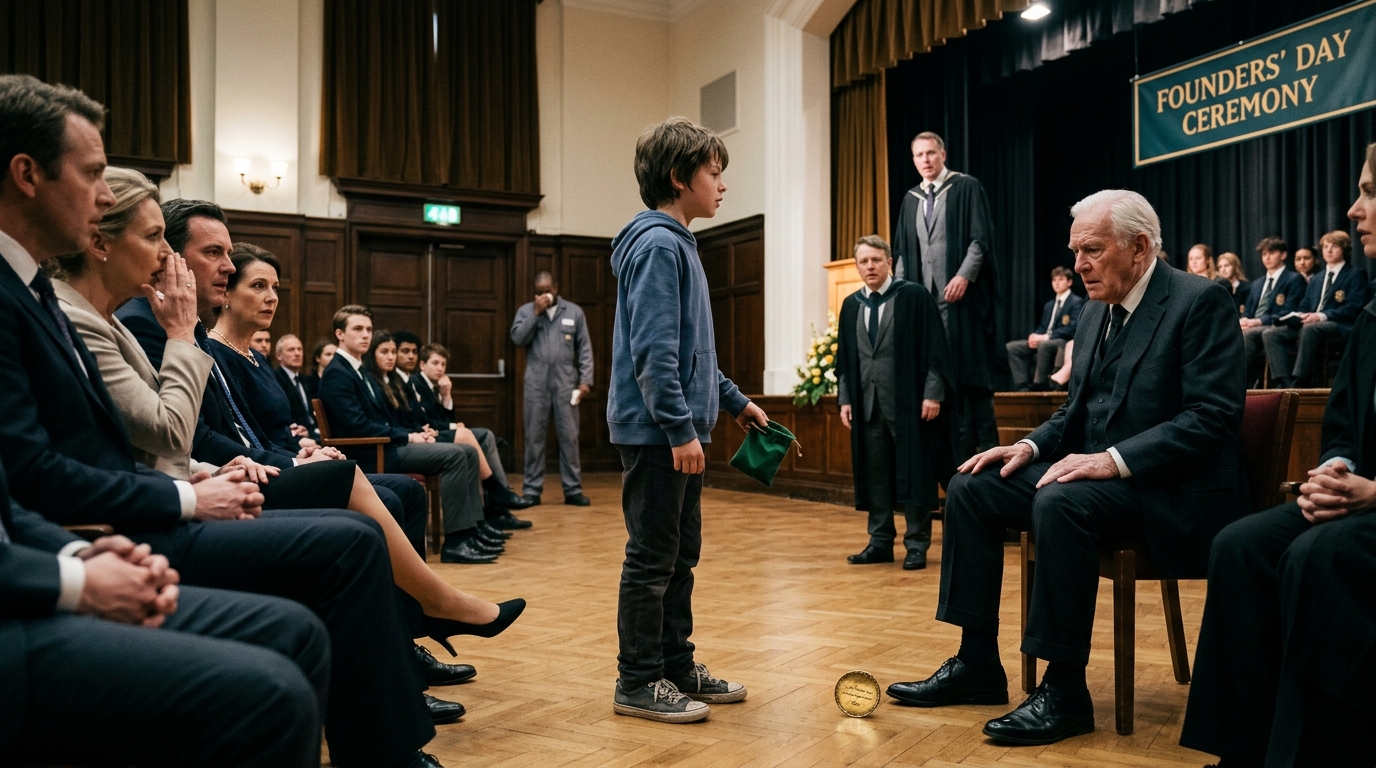
Then the doors at the back opened.
At first, no one paid attention.
A late parent, perhaps.
A staff member.
A lost child.
Then the whispers began.
I turned.
A small boy stood beside the janitor’s cleaning cart.
He was no older than nine. His sweater was too large, faded at the cuffs, and not part of the official uniform. His shoes were worn thin at the toes. His hair was messy in the way children’s hair gets when no one has time to fix it before morning.
But it was his hands I noticed.
He clutched a small cloth pouch against his chest like it contained a living thing.
Behind him stood Mrs. Rowan, the elderly janitor who had cleaned the school halls for as long as I could remember. Her gray uniform looked freshly pressed, but her face was pale. Afraid.
The boy looked back at her.
She nodded once.
Not encouraging him.
Releasing him.
He started walking down the aisle.
The room changed immediately.
Heads turned.
Students shifted.
Parents leaned toward one another, their whispers sharp enough to cut skin.
A woman in pearls, seated three rows behind me, murmured loudly enough for half the room to hear.
“Why is the cleaner’s boy walking toward the stage?”
A few people laughed softly.
The boy heard.
His face flushed, but he kept walking.
That was the first thing that unsettled me.
Poor children learn early how to disappear in rooms built for wealth. They lower their eyes. They step aside. They apologize for taking up space.
This boy did none of that.
He was terrified.
But he did not stop.
Principal Vale saw him when he reached the front aisle.
Her smile froze.
Only for a moment.
Only long enough for someone like me to notice.
Then she stepped down from the stage with graceful speed, cutting him off before he could reach the podium.
“Liam,” she said, her voice sweet enough for the audience and cold enough for the boy. “This is not your place.”
The boy swallowed.
His fingers tightened around the pouch.
“I need to give something to Mr. Alden.”
The room went silent.
My name crossed the auditorium like a match struck in darkness.
Principal Vale’s eyes flicked toward me.
Then toward Mrs. Rowan.
Then back to the boy.
“Whatever it is,” she said softly, “you can give it to me.”
Liam shook his head.
His lips trembled.
“My mother said only he can see it.”
Something passed across Eleanor Vale’s face.
Not anger.
Fear.
A thin, fast crack in the polished mask.
She reached for the pouch.
Liam pulled back.
“Give it to me,” she whispered.
He shook his head again.
“I promised.”
Her hand closed around his wrist.
Not hard enough for the crowd to gasp.
Hard enough for the boy to flinch.
The pouch slipped from his fingers.
It hit the polished wooden floor.
Something gold slid out.
The object spun beneath the stage lights, bright as fire, and rolled across the floor until it stopped beside my cane.
A medal.
Old.
Heavy.
Familiar.
I bent down slowly and picked it up.
The moment my fingers touched the engraved edge, the auditorium vanished.
I was no longer sitting in St. Alden Preparatory.
I was standing twenty-three years in the past, watching my son grin under the same lights, holding that same medal, saying, “Dad, one day I’ll make this school honest.”
I turned the medal over.
The engraving caught the light.
Daniel Alden.
Excellence In Moral Courage.
Class of 2003.
The air left my lungs.
No one spoke.
No one moved.
Across from me, Eleanor Vale had gone pale.
Not embarrassed.
Not confused.
Pale.
Like a woman staring at a grave that had just opened.
I looked at the boy.
“Where did you get this?”
Liam’s eyes filled with tears, but he did not look away.
“My mother said my father won it,” he whispered. “Before your school erased his name.”
The Medal That Vanished With My Son
For twenty-three years, I had been told Daniel took nothing with him.
Not money.
Not clothes.
Not the old leather notebook he carried everywhere.
Not the medal he loved more than any trophy, because it was the only award at St. Alden that had nothing to do with money, rank, or family legacy.
Moral courage.
The irony had rotted in me for decades.
That medal disappeared the same night Daniel did.
The school claimed it was lost.
The police treated it like a detail.
My wife cried until she had no voice left, then died five years later still whispering his name in her sleep.
But I never forgot the medal.
And now it was in my hand, warm from the boy’s cloth pouch.
I stood.
The auditorium remained frozen around me.
“Liam,” I said carefully, “who is your mother?”
He looked toward the back.
Mrs. Rowan stood beside the cleaning cart, one hand over her mouth, tears sliding silently down her face.
A janitor.
An invisible woman in a room that depended on invisibility.
Eleanor Vale found her voice first.
“This is highly inappropriate,” she said, turning toward the audience with a strained smile. “Mr. Alden, I apologize. Mrs. Rowan has clearly involved her child in some misunderstanding.”
“Is it a misunderstanding?” I asked.
Her smile twitched.
“Daniel’s disappearance was a painful tragedy for everyone.”
“For everyone?” I repeated.
The medal felt heavier in my palm.
Liam stepped closer to me.
“My mom said there’s a letter too.”
Eleanor’s head snapped toward him.
That was the second thing.
She did not react like a woman hearing a lie.
She reacted like a woman hearing the wrong truth at the wrong time.
“What letter?” I asked.
Liam reached into the empty pouch with shaking fingers and pulled out a folded piece of paper wrapped in plastic.
Old.
Yellowed.
Protected carefully.
He handed it to me.
Mrs. Rowan made a small sound at the back of the room.
I opened the plastic.
The letter inside was written in Daniel’s handwriting.
My son’s handwriting.
For a moment, the world blurred.
The hard slant of his D.
The impatient lines.
The way he pressed too hard into paper when he was angry.
Dad,
If you ever read this, it means I failed to get out with the proof.
They are not just changing grades.
They are taking scholarship money and burying student complaints before inspections.
Vale knows.
The board knows.
And if I disappear, ask Miriam Rowan where she hid the medal.
She is the only adult in this school who still has a conscience.
I read the last sentence three times.
Then I looked at Mrs. Rowan.
Miriam Rowan.
The janitor.
The only adult Daniel had trusted.
The auditorium seemed to tilt around me.
Principal Vale stepped forward.
“That paper could have been forged.”
I looked at her.
“You recognized it before I opened it.”
Her mouth closed.
A murmur spread through the audience.
Parents who had whispered about the cleaner’s boy were now leaning forward, hungry for scandal but afraid of what it might cost them.
I turned to Mrs. Rowan.
“Come here.”
She did not move.
Not at first.
Then Liam ran back to her, took her hand, and led her down the aisle.
She walked like a woman approaching a sentence.
When she reached me, she looked smaller than I remembered. Bent by years of floors, trash bins, chemical burns, and other people’s carelessness.
But her eyes were clear.
“I’m sorry,” she said.
Two words.
Twenty-three years late.
My chest tightened.
“For what?”
She looked at the medal.
“For surviving.”
Eleanor Vale said sharply, “Mrs. Rowan, I suggest you stop speaking.”
Miriam flinched.
Not from the volume.
From habit.
I saw it then.
The years of being spoken down to.
Threatened.
Managed.
Kept.
“No,” I said. “She will speak.”
Miriam looked at me, then at Liam.
Her son nodded.
That gave her strength.
“Daniel came to me the night before he disappeared,” she said. “He was scared, but not for himself. He said they were stealing from the scholarship fund. Poor students were being rejected while donor children received awards they never earned. He found records. Names. Payments.”
The room stirred.
A few wealthy parents looked at one another.
Not shocked.
Calculating.
“And the complaints?” I asked.
Miriam’s lips trembled.
“Girls who reported teachers. Boys beaten by donor sons. Staff who were fired after asking questions. Your son copied everything.”
Principal Vale’s face hardened.
“You were a night cleaner,” she said. “You had no access to administrative records.”
Miriam looked at her for the first time.
“No,” she said. “But I had keys.”
Silence.
Miriam reached into the pocket of her gray uniform and pulled out a small brass key.
Old.
Marked with a strip of red tape.
Eleanor Vale took one step back.
A tiny step.
But the whole room saw it.
Miriam’s voice shook, but did not break.
“Daniel gave me the medal and the letter. He said if anything happened, I should wait until someone could protect my child.”
“Your child?” I asked.
Her eyes moved to Liam.
“He was born nine months after Daniel disappeared.”
The medal slipped in my hand.
No.
Not slipped.
Shifted.
As if it had become a different object entirely.
I looked at Liam.
The dark hair.
The stubborn chin.
The eyes that had looked at humiliation and kept walking.
Daniel’s eyes.
The boy was staring at me now with a fear no child should have.
He did not understand the shape of the silence around him.
But I did.
“Liam,” I whispered.
Miriam lowered her head.
“He is Daniel’s son.”
The Hallway Behind The Trophy Room
I do not remember the next few minutes clearly.
I remember the room exploding into noise.
Parents standing.
Students whispering.
Principal Vale demanding order.
Someone recording with a phone.
Someone else saying my son’s name like it had been forbidden.
I remember Liam taking one step toward me, then stopping, unsure whether he was allowed.
I wanted to hold him.
I wanted to run.
I wanted to break every glass case in that school until the truth fell out bleeding.
Instead, I said one thing.
“Take me to where he hid the records.”
Miriam’s face changed.
“He told me not to open it unless you came back.”
“I’m here.”
Her eyes filled again.
“I waited too long.”
“You waited until you could.”
That was not forgiveness.
Not yet.
But it was the closest truth I had.
Miriam led us out of the auditorium.
I walked beside her.
Liam stayed close behind.
Eleanor Vale followed, along with two board members, three teachers, and half the room pretending they had a right to witness what they had spent years ignoring.
The trophy hallway stretched along the east wing, lined with glass cabinets full of shining proof that St. Alden rewarded excellence.
Gold cups.
Silver plaques.
Framed photographs of boys with family names carved into buildings.
Daniel’s photo was gone.
I stopped when I saw the empty space where it should have been.
Miriam noticed.
“They took it down after the investigation closed,” she said.
“What investigation?”
She looked at me.
“The one they never told you about.”
A coldness moved through me.
At the end of the hallway stood the old trophy room. It had been renovated twice since Daniel vanished. New lighting. New cabinets. New locks.
But Miriam walked past the main door and stopped at a narrow service panel hidden behind a floor-length banner.
She used the brass key.
The panel clicked open.
Inside was a maintenance corridor.
Dusty.
Unlit.
Forgotten.
The air smelled of old wood and metal.
Liam grabbed his mother’s sleeve.
“It’s okay,” she whispered to him, though her own voice shook.
We moved inside.
The board members complained immediately.
“This area is unsafe.”
“We need legal counsel.”
“We should pause until security arrives.”
I ignored them.
Miriam stopped at the wall behind the trophy room. There, beneath a pipe, was a small metal access box.
She knelt, pushed aside a layer of dust, and revealed a combination lock.
Her fingers hovered over it.
“What’s the code?” I asked.
Miriam closed her eyes.
“Daniel’s birthday.”
My throat tightened.
She entered the numbers.
The lock opened.
Inside was a leather notebook.
A stack of photocopied documents.
A cassette tape.
And a photograph.
Daniel.
Alive.
Standing in that very corridor.
Beside him was Miriam, younger then, frightened but determined.
And beside them stood Eleanor Vale.
Not as principal.
As assistant dean.
In the photo, Eleanor was holding a folder.
Daniel was pointing at it.
His face was furious.
Eleanor’s face was exactly what it had been in the auditorium when the medal rolled across the floor.
Afraid.
I picked up the notebook.
Daniel’s handwriting filled the pages.
Names.
Dates.
Payments.
Scholarship diversions.
Disciplinary files erased after donations.
Medical complaints suppressed.
Transfer records falsified.
And then, on the final page, a sentence circled three times.
E. Vale met D.R. at north gate, 11:40 p.m.
D.R.
Daniel Rowan?
No.
I turned to Miriam.
She shook her head before I asked.
“Daniel Alden,” she whispered. “He used initials for everyone.”
Eleanor Vale appeared in the corridor entrance.
Her face had gone hard in a way that made her look older.
“You have no idea what you’re touching,” she said.
I held up the notebook.
“My son’s handwriting.”
“You think Daniel was innocent?” she snapped.
The corridor went silent.
Miriam stiffened.
Eleanor stepped closer.
“He was reckless. Arrogant. He wanted to destroy a school that gave him everything.”
“He wanted to expose theft.”
“He wanted attention.”
“No,” Miriam said.
Everyone turned.
Her voice was soft.
But something in it had changed.
“He wanted you to stop hurting children.”
Eleanor’s eyes narrowed.
Miriam continued.
“I was there that night.”
The board members froze.
Eleanor whispered, “Miriam.”
“No,” Miriam said. “You have used my poverty to keep me quiet for twenty-three years. Not anymore.”
She turned to me.
“Daniel planned to leave through the north gate and bring the files to a reporter. I was supposed to meet him there. But when I arrived, Eleanor was already with him.”
My heart began to pound.
“She was crying,” Miriam said. “Begging him not to ruin her. She said the board would blame everything on her. She said her family would disown her. Daniel told her the children mattered more than her career.”
Eleanor’s lips parted.
No denial came.
“Then a car arrived,” Miriam said. “Black. No plates. Two men got out.”
I could barely breathe.
“What happened?”
Miriam looked at Liam.
Then back at me.
“They took him.”
The corridor seemed to shrink.
All the air gone.
“All these years,” I said, my voice barely human, “you knew he was taken?”
Miriam sobbed once.
“I tried to tell the police. They said I was lying. The next day, Principal Vale showed me security footage of my younger sister stealing medicine from the infirmary. She said if I spoke again, my sister would go to prison and I would lose my job.”
Eleanor said coldly, “Your sister did steal.”
“She was diabetic,” Miriam snapped. “She was stealing insulin because St. Alden cut staff insurance.”
That sentence landed harder than shouting could have.
I opened the folder.
On top was a financial ledger.
At the bottom of the first page was a name I knew better than my own.
Alden Educational Trust.
My family’s trust.
Money meant for scholarship children.
Money my father donated.
Money Daniel died trying to protect.
And beside the ledger were signatures.
Board signatures.
Vale’s signature.
And one more.
My brother’s.
Charles Alden.
The Family Name On The Ledger
Betrayal has a sound.
It is not always a scream.
Sometimes it is paper sliding through old fingers.
I stared at my brother’s signature until it lost meaning.
Charles had chaired the Alden Educational Trust after Daniel disappeared. He had stood beside me at the funeral with one hand on my shoulder and said, “We may never know why he left.”
Why he left.
Not why he vanished.
Not who took him.
Why he left.
He had known.
My hand tightened around the ledger.
Miriam watched my face with terrible pity.
“There’s more,” she whispered.
I did not want more.
But truth does not stop because the heart asks politely.
She reached into the access box again and pulled out the cassette tape.
“My husband had a recorder,” she said. “Daniel borrowed it that week. He said no one believed students unless adults heard adults confess.”
One of the board members backed away.
Eleanor saw him move and snapped, “No one leaves.”
I almost laughed.
She still thought she had authority.
Miriam handed me the tape.
“There’s an old media room upstairs,” she said. “The player still works.”
We went there together.
By then, security had arrived.
So had phones.
So had panic.
But I was still chairman emeritus of the board, still the largest private donor in St. Alden history, and rich men are obeyed even when they are shaking.
No one stopped me.
The media room smelled of dust and plastic. A teacher found the tape player in a cabinet and plugged it in with trembling hands.
I inserted the cassette.
Pressed play.
Static filled the room.
Then Daniel’s voice came back from the dead.
“Say it again,” he said.
My knees nearly gave way.
I gripped the edge of a desk.
Eleanor’s younger voice answered, strained and furious.
“You don’t understand what you’re doing.”
“I understand exactly,” Daniel said. “You stole scholarship funds. You buried assault complaints. You changed disciplinary records for donor children.”
“The board approved the reallocations.”
“And my uncle?”
Silence on the tape.
Then Eleanor said, “Charles Alden only wanted to protect the family trust.”
Daniel laughed bitterly.
“By stealing from poor kids?”
“By keeping this school alive.”
“No,” Daniel said. “By keeping rich parents comfortable.”
The tape crackled.
Then another voice entered.
My brother.
Charles.
“Enough, Daniel.”
A chair scraped.
Daniel said, “Uncle Charles?”
Charles sighed.
“You should have brought this to me privately.”
“I did.”
“You brought accusations.”
“I brought proof.”
“You brought embarrassment.”
The room around me had stopped breathing.
On the tape, Daniel’s voice changed.
“You knew.”
Charles said nothing.
Daniel whispered, “You knew the whole time.”
Charles answered quietly, “You have no idea what families have to do to survive.”
Then there was movement.
Daniel shouted.
Miriam cried out.
Eleanor said, “Don’t hurt him.”
Charles said, “Then he should have stayed quiet.”
The tape erupted into chaos.
A blow.
A fall.
Footsteps.
Daniel groaning.
Then my son’s voice, faint but clear.
“Dad will find out.”
Charles answered.
“No. He’ll grieve. That’s easier.”
The tape clicked off.
No one spoke.
Not the teachers.
Not the board.
Not Eleanor.
Not even Liam, who stood near the doorway, staring at the machine that had just played his father’s final known words.
I turned to Principal Vale.
“Where is my brother?”
She looked ruined now.
But not repentant.
“Dead,” she said.
Charles had died seven years earlier of a heart attack.
He had taken his secrets underground with him.
But Eleanor was still here.
The board was still here.
The school was still here.
And somewhere in this building, the machinery that erased Daniel’s name had kept working long after his blood dried.
I stepped toward her.
“What happened after the tape ended?”
She swallowed.
For the first time, Eleanor Vale looked less like a villain than a coward who had mistaken survival for innocence.
“They didn’t mean to kill him.”
The words struck the room like a shot.
Miriam covered Liam’s ears, but too late.
My grandson heard.
My grandson.
The word tore through me.
I forced myself to remain standing.
“Where is he?”
Eleanor closed her eyes.
“The old boathouse.”
My cane hit the floor.
Once.
Hard.
The old boathouse sat on the far edge of campus, near the lake my family had donated with the land.
It had been closed for renovation after Daniel vanished.
Then demolished.
A memorial garden stood there now.
A garden I had paid for.
A garden where I had once placed flowers for my missing son, not knowing I was standing above him.
The Garden Where The Truth Was Buried
The police arrived before sunset.
Real police this time.
Not the retired officers the school had once paid to tidy up scandal.
State investigators came too, after one of the younger teachers sent the tape to a journalist before the board could stop her.
By nightfall, St. Alden Preparatory was surrounded by flashing lights.
The annual honors ceremony never resumed.
The parents who had laughed at Liam now stood outside in expensive coats, watching cameras gather at the gates.
Miriam sat in the nurse’s office with her son wrapped in a blanket someone had finally thought to offer.
I stood in the memorial garden while investigators marked the ground.
The plaque at the center read:
To The Courage Of Students Past And Future.
My son was beneath it.
I did not cry when they found the first bone.
Grief that old does not always know how to behave.
It goes quiet.
It watches.
It remembers the child at six with muddy shoes.
The teenager slamming doors.
The young man onstage with a medal around his neck.
The son you failed to save because people with clean hands told you he had chosen to leave.
When the remains were confirmed two weeks later, the headlines called it a historic scandal.
They were wrong.
Scandal was too small a word.
Scandal was a donor affair.
A falsified grade.
A boardroom mistake.
This was a burial.
A school had buried a boy to protect its reputation.
A family had buried the truth to protect its name.
And a poor woman had carried a golden medal for twenty-three years because she was too powerless to speak and too decent to throw it away.
Eleanor Vale was arrested first.
She gave the investigators everything after they showed her the tape. Names. Payments. Cover-ups. The private security company that removed Daniel’s body. The board vote that followed. The falsified runaway report. The quiet settlement accounts.
Charles Alden could no longer stand trial.
But his name was removed from every building.
Every plaque.
Every scholarship.
My father’s trust was audited back to the beginning.
Millions were recovered.
Not enough.
Never enough.
But enough to start telling the truth in numbers the world could understand.
Miriam Rowan testified before a grand jury.
She shook the entire time.
But she did not break.
When they asked why she had waited so long, she looked at Liam.
“Because fear is expensive,” she said. “And poor people pay it every day.”
That sentence appeared in every newspaper the next morning.
But newspapers did not show the rest.
They did not show Liam sitting across from me at my kitchen table, touching the edge of Daniel’s medal like he was afraid I might take it from him.
They did not show Miriam apologizing again and again until I finally told her my son had trusted her for a reason.
They did not show me opening Daniel’s childhood room for the first time in years and realizing that grief had kept it frozen, while life had quietly continued outside the door.
The court asked what would happen to Liam.
Legally, he had a mother.
Emotionally, he had a father he would never meet.
Biologically, he had me.
A grandfather who had spent two decades chasing a ghost while the ghost’s son cleaned floors in the same school that stole his future.
Miriam refused money at first.
Pride can be the last possession of people who have lost too much.
So I did not offer charity.
I offered restitution.
Daniel’s estate was reopened.
Liam was legally recognized as his son.
Miriam received the protection she should have had twenty-three years earlier.
And St. Alden Preparatory closed for one year.
When it reopened, it did not reopen under the same name.
The board was dissolved.
The scholarship fund was rebuilt.
Every hidden complaint file was released to investigators.
The admissions policy changed.
Staff received full benefits.
The memorial garden was removed.
In its place, we built a small stone courtyard.
No gold banners.
No velvet curtains.
No donor names.
Just a plaque with Daniel’s words from the tape.
You cannot teach courage while rewarding silence.
On the first day of the new school year, Liam stood in that courtyard wearing a uniform that fit.
Not borrowed.
Not donated publicly.
His.
Miriam stood beside him, no longer in a janitor’s uniform. She had taken a position as student welfare coordinator because she knew better than anyone where invisible children disappeared inside beautiful buildings.
I walked with my cane to the front of the courtyard.
Reporters waited beyond the gates, but we kept them out.
Some moments do not belong to cameras.
I held the golden medal in my palm.
For twenty-three years, I thought it was the last thing Daniel lost.
Now I knew it was the first thing he saved.
I turned to Liam.
“This belongs to you.”
He stared at it.
“My dad’s?”
I nodded.
“Your father earned it for moral courage. Your mother protected it with moral courage. And you brought it into the light with moral courage.”
His eyes filled.
He looked at Miriam.
She nodded.
Just as she had at the back of the auditorium.
This time, she was not releasing him into danger.
She was letting him step into truth.
Liam took the medal.
It looked too large in his hand.
One day, he would grow into it.
The bell rang across campus.
Students began moving toward the doors, laughing, nervous, alive.
For everyone else, it was the beginning of a school year.
For me, it was the end of a lie.
I still think about that day in the auditorium.
The wealthy mother whispering.
The principal smiling.
The boy walking alone down the aisle with a cloth pouch pressed to his chest.
He looked so small under those golden banners.
But he carried more truth than the entire school could bury.
And when that medal rolled across the polished floor, it did not just expose a crime.
It brought my son home.
It gave my grandson his name.
And it proved that even the most powerful institutions can still be undone by one child brave enough to walk toward the stage.
Leave a Reply