The Letter Inside The Cloth Pouch
The auditorium did not breathe.
At least, that was how it felt.
Hundreds of people sat beneath the golden banners of St. Alden Preparatory, but no one moved. No one clapped. No one whispered anymore.
The polished ceremony had cracked open.
And inside that crack stood a poor boy in worn shoes.
Liam.
The janitor’s son.
He was still standing near the stage, his face pale, his small hands trembling around the empty cloth pouch. A few moments earlier, the wealthy parents had laughed at him for walking toward the stage.
Now no one was laughing.
The golden medal had rolled across the floor and stopped beside my cane.
I had picked it up.
I had turned it over.
And there, engraved on the back, was the name I had spent twenty-three years trying not to say in public because every time I said it, people looked at me like grief had made me unstable.
Daniel Alden.
My son.
My missing son.
The boy St. Alden claimed had run away.
The boy the police stopped searching for.
The boy my own family told me to mourn quietly.
But the medal in my shaking hand said something different.
It said Daniel had not vanished without a trace.
It said someone had kept a piece of him hidden all these years.
And when I looked at Principal Eleanor Vale, I saw the truth cross her face before she could hide it.
Fear.
Not confusion.
Not sadness.
Fear.
I turned back to Liam.
“Where did you get this?”
His eyes filled with tears, but he did not lower his head.
“My mom said my father won it,” he whispered. “Before your school erased his name.”
The words seemed to strike every wall at once.
A student gasped.
A parent murmured, “His father?”
Principal Vale stepped forward quickly.
Too quickly.
“That is enough,” she said, her voice smooth but tight. “This child is upset. Mrs. Rowan has clearly filled his head with old stories.”
Mrs. Rowan.
Miriam Rowan.
The elderly janitor stood near the back entrance beside her cleaning cart. Her gray uniform looked plain against the velvet curtains and polished wood, but in that moment, she was the only person in the room who seemed to understand how dangerous truth could be.
Her hands were clasped in front of her.
Her knuckles were white.
Liam looked back at her.
Not for permission.
For courage.
Then he reached into the cloth pouch again.
Principal Vale saw the movement.
Her eyes widened.
Only for a second.
But I saw it.
She had known about the medal.
Now she was afraid of what came next.
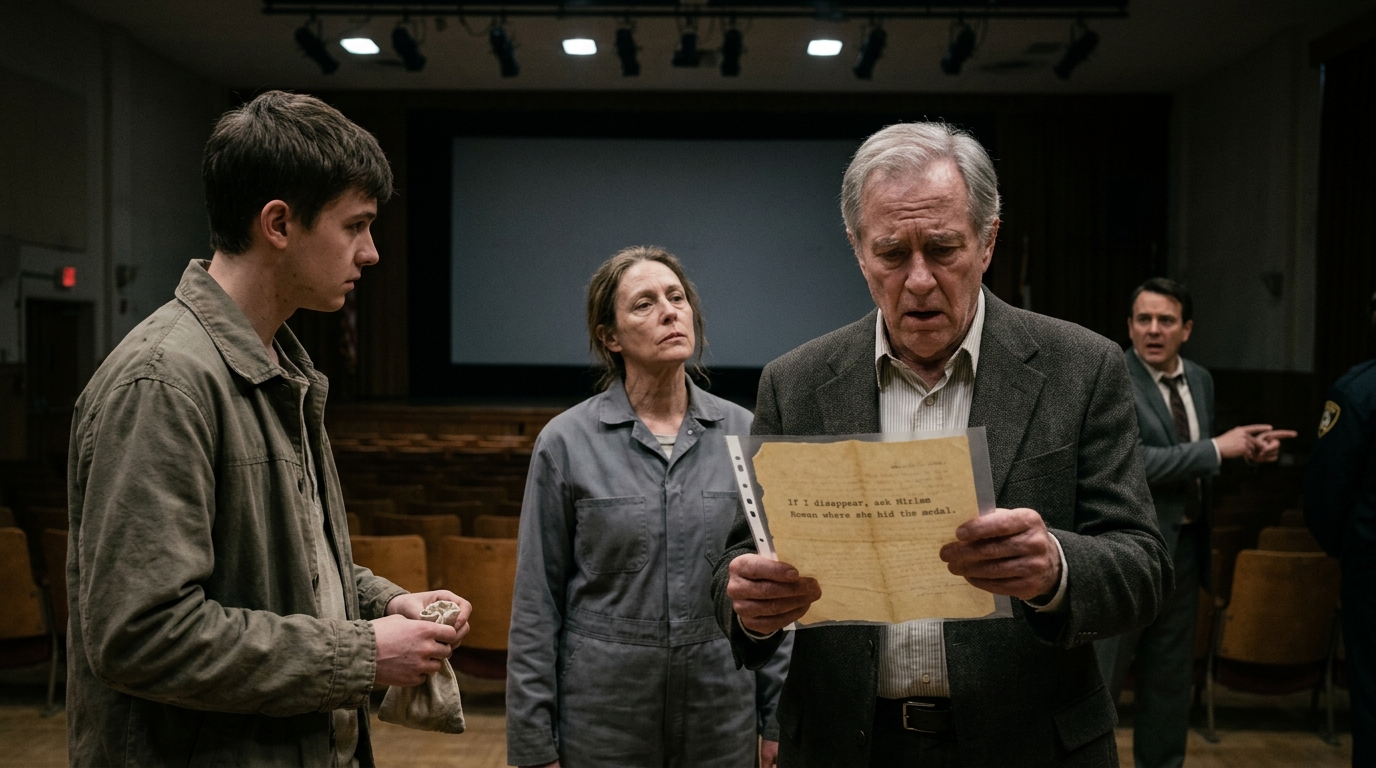
Liam pulled out a folded letter wrapped in clear plastic.
Old.
Yellowed.
Protected like a relic.
The room changed again.
Even the wealthy mother in pearls, the one who had mocked him moments earlier, leaned forward with her lips parted.
Principal Vale took one step toward the boy.
“Give that to me.”
Liam clutched the letter to his chest.
“No.”
Her smile returned, but it was no longer elegant.
It was thin.
Sharp.
Dangerous.
“Liam,” she said quietly, “you are making this much worse for your mother.”
The boy flinched.
There it was.
The threat beneath the manners.
The same old language powerful people use when they cannot say what they really mean.
Obey, or we will punish the person you love.
I stood.
My cane struck the floor once.
The sound echoed across the auditorium.
“Give the letter to me.”
Principal Vale turned toward me.
“Mr. Alden, I strongly advise against entertaining this spectacle.”
I looked at her.
“You advised me once before.”
Her face tightened.
“Excuse me?”
“The night my son disappeared, you told me Daniel was troubled. You told me he had become unstable. You told me he was embarrassed by his own failures.”
The auditorium remained silent.
“I believed you for one hour,” I said. “Then I spent twenty-three years regretting it.”
Principal Vale said nothing.
Liam walked toward me.
Slowly.
Carefully.
As if the floor itself might betray him.
He placed the letter in my hand.
His fingers were cold.
I looked down at the plastic.
There was a name written across the front.
Dad.
My knees almost failed.
Not because of the word.
Because of the handwriting.
Daniel’s handwriting.
The Handwriting Of The Dead
You think you forget details after twenty-three years.
You don’t.
Grief preserves things the living world tries to blur.
The way your child writes the letter D.
The pressure of his pen when he is angry.
The crooked line he makes when he is rushing.
The careless confidence of someone who believes there will always be more paper, more time, more chances to explain later.
I knew Daniel’s handwriting before I opened the letter.
My thumb pressed against the plastic.
For a moment, I could not move.
The auditorium disappeared again.
I saw Daniel at seventeen, sitting at our kitchen island with his sleeves rolled up, scribbling in a notebook while his mother told him not to get ink on the marble.
I saw him at twelve, writing an apology letter to a teacher he did not believe he owed an apology to.
I saw him at six, writing his name backward on a birthday card and insisting it looked better that way.
And then I saw the police officer, twenty-three years ago, sliding a thin folder across a desk and saying, “Mr. Alden, young men leave for many reasons.”
Young men leave.
As if my son had walked out of my life like a guest leaving dinner early.
My hand shook as I opened the plastic.
The paper inside was fragile, but the words were clear.
Dad,
If you ever read this, it means I failed to get out with the proof.
I stopped breathing.
A low sound moved through the crowd, but I barely heard it.
I kept reading.
They are not just changing grades.
They are taking scholarship money and burying student complaints before inspections.
Vale knows.
The board knows.
And if I disappear, ask Miriam Rowan where she hid the medal.
She is the only adult in this school who still has a conscience.
I read the last line silently.
Then again.
Then aloud.
“If I disappear, ask Miriam Rowan where she hid the medal.”
The auditorium turned as one body.
Every eye moved to the back of the room.
To the janitor.
Miriam Rowan stood frozen beside her cleaning cart.
For twenty-three years, she had swept those halls.
Emptied classroom trash.
Scrubbed floors after dances.
Wiped fingerprints from trophy cases that no one ever let her children touch.
She had been invisible to the people in that room.
Until my dead son’s letter made her the most important person alive.
Principal Vale’s voice cut through the silence.
“Miriam.”
It was not loud.
It was worse than loud.
It was a warning dressed as a name.
Miriam lowered her eyes.
I saw the movement and hated myself for how familiar it was.
Power trains people like her to look down before they are struck.
Liam turned toward his mother.
“Mom,” he whispered.
Principal Vale moved closer to Miriam.
Not physically.
With her voice.
“Miriam, I suggest you think very carefully before you say anything.”
Miriam’s lips trembled.
A tear slipped down her cheek.
The boy took one step toward her.
“Mom… tell him.”
Something broke in her then.
Or maybe something finally mended.
Miriam slowly raised her head.
The room waited.
Principal Vale’s face turned cold.
“Do not let her speak,” she whispered to a nearby staff member.
But it was too late.
Everyone had heard her.
Everyone had seen the fear.
And Miriam Rowan, who had been silent for more than two decades, opened her mouth.
“Daniel never ran away.”
The Janitor Who Held The Secret
The sentence did not explode.
It landed quietly.
That made it worse.
Daniel never ran away.
Five words.
Enough to destroy twenty-three years of reports, rumors, family arguments, police assumptions, and carefully arranged lies.
I looked at Miriam.
“Say it again.”
She swallowed.
“Daniel never ran away.”
A sound left me.
Not a sob.
Not a word.
Something older.
Something pulled from the part of a father that never stopped standing at the door, waiting for footsteps that never came home.
Principal Vale snapped, “This is absurd.”
No one looked at her.
That was the first time I saw her truly lose control.
Not because she was shouted down.
Because she was ignored.
Miriam stepped forward.
One step.
Then another.
Liam hurried to her side and took her hand.
Together, they walked down the aisle.
This time, the parents moved aside.
The same parents who had whispered about the cleaner’s boy now leaned away as if shame were contagious.
Miriam stopped in front of me.
She looked at the medal in my hand.
Then at the letter.
Then at me.
“I’m sorry,” she said.
“For what?”
Her face crumpled.
“For being afraid longer than I was brave.”
The answer hurt because it was honest.
I wanted to be angry at her.
Part of me was.
But another part remembered what kind of world we had built.
A world where men like me donated wings to schools and assumed the plaques meant goodness.
A world where women like Miriam cleaned up after our ceremonies and knew more truth than we ever cared to ask.
“What happened?” I asked.
Miriam looked toward Principal Vale.
Vale stood still near the stage, her jaw tight, her hands clasped in front of her as if posture could still save her.
“Daniel came to me the night before he disappeared,” Miriam said. “He was scared.”
“My son was not easily scared.”
“No,” Miriam said softly. “He wasn’t scared for himself.”
Her eyes moved to Liam.
“He was scared for the students no one protected.”
I closed my fist around the medal.
Miriam continued.
“He found files. Scholarship records. Complaints from students. Medical reports. Disciplinary notes that disappeared after certain families made donations.”
A murmur moved through the auditorium.
This time, it came from the students.
Not the parents.
Some of them looked at the floor.
Some looked at each other.
Some looked at Principal Vale.
Miriam’s voice shook, but she kept going.
“Daniel said if he took the evidence straight to the board, it would vanish. He said some of them were involved. He asked me to hide the medal because he knew they would search his room. He said the medal had a number scratched inside the clasp.”
I looked down.
My hands moved faster than my thoughts.
I turned the medal toward the light and opened the clasp.
There, scratched into the inner curve, was a number.
B-14.
The same kind of small, coded clue Daniel used to leave in his notebooks.
“What does it mean?” I asked.
Miriam said, “Basement archive. Cabinet fourteen.”
Principal Vale’s lips parted.
A teacher near the side doors whispered, “There is no basement archive.”
Miriam looked at her.
“Yes,” she said. “There is.”
The room shifted again.
A school built on reputation had rooms its own teachers did not know existed.
Principal Vale moved toward the aisle.
“This ceremony is over.”
I turned to her.
“No.”
Her eyes flashed.
“You may be a trustee, Mr. Alden, but you do not control an active school event.”
I held up my son’s letter.
“No. But my family still owns the land under this school.”
That silenced her.
Finally.
For the first time in twenty-three years, I saw Eleanor Vale understand that power could turn around and face her.
I looked at Miriam.
“Take me to the archive.”
She nodded.
But Liam tightened his grip on her hand.
“There’s something else,” he said.
Miriam closed her eyes.
“Liam.”
He looked up at me.
The poor boy.
The janitor’s son.
The child who had walked into a room built to reject him and changed every face inside it.
“My mom said I should tell you only after you read the letter.”
I crouched slowly so I could look him in the eyes.
“What is it?”
His lower lip trembled.
He looked at Miriam.
She nodded once.
Just once.
And Liam said the sentence that made the medal feel like it had turned to stone in my hand.
“She said Daniel Alden was my father.”
The Boy With Daniel’s Eyes
No one in that auditorium spoke.
Not the students.
Not the parents.
Not the teachers.
Not Principal Vale.
Not me.
The entire room seemed to fall backward into one impossible silence.
I looked at Liam.
Really looked at him.
The shape of his mouth.
The stubborn angle of his chin.
The way he tried not to cry in public.
And then the eyes.
I had seen those eyes glare at me across a dinner table.
Laugh from a bicycle.
Roll dramatically when I gave advice.
Close forever in my worst dreams.
Daniel’s eyes.
My grandson was standing in front of me in a sweater too big for his shoulders.
For twenty-three years, I had searched for my son.
And my son had left behind a child who had been cleaning the edges of my world without me ever seeing him.
I reached toward Liam, then stopped.
I had no right to touch him like a discovery.
He was not evidence.
He was a boy.
So I asked, softly, “How old are you?”
“Nine.”
Nine.
The math did not make sense.
Then I looked at Miriam.
She understood the question before I asked it.
“I didn’t know I was pregnant until after Daniel disappeared,” she said.
Principal Vale let out a sharp laugh.
Everyone turned.
It was not amusement.
It was panic cracking into contempt.
“You expect people to believe this?” she said. “A janitor claims her son is an Alden after producing a suspicious medal and a convenient letter?”
Miriam flinched.
Liam stepped in front of her.
Small.
Furious.
“Don’t talk to my mom like that.”
Several students gasped.
Principal Vale looked at him with open disgust.
“This is exactly what happens when staff forget boundaries.”
The words struck the room differently now.
Before, the wealthy parents might have agreed silently.
Now they heard it.
Really heard it.
Staff.
Boundaries.
The language of someone who believed people came in categories of value.
I stood slowly.
“You will not speak to my grandson that way.”
The word left my mouth before the law could approve it.
Grandson.
Liam stared at me.
Miriam covered her mouth.
Principal Vale went still.
A father knows before a test confirms what the heart has already recognized.
But I also knew power required paperwork.
And paperwork had been the weapon used against Daniel.
So I turned to one of the board members near the stage.
“Call state police.”
Principal Vale snapped, “Security.”
“No,” I said. “State police.”
The board member did not move.
I looked at him until he did.
Then I turned back to Miriam.
“The archive.”
She nodded.
We walked out of the auditorium together.
Me.
Miriam.
Liam.
And behind us, the room followed.
Not all of it.
Only the ones who understood that history was being dragged from behind the walls.
The hallway outside the auditorium seemed different now.
The portraits looked less noble.
The trophies less innocent.
The marble less clean.
We passed display cases filled with medals, plaques, debate cups, championship photographs.
But Daniel’s photograph was missing.
I stopped in front of the empty space.
The outline was faint but visible where the frame had once protected the wall from sunlight.
“What was here?” Liam asked.
My throat tightened.
“Your father.”
He looked at the empty space for a long moment.
Then he whispered, “They took him down too.”
Too.
That word nearly broke me.
Miriam led us toward the east wing, past the trophy room, past a locked maintenance door, and into a corridor that smelled of dust and old pipes.
Principal Vale followed at a distance.
Her heels clicked sharply behind us.
She had stopped pretending this was a misunderstanding.
Now she was watching the way cornered people watch exits.
Miriam removed a small brass key from her uniform pocket.
Principal Vale said, “Miriam, if you open that door, you will regret it.”
Miriam paused.
For one second, fear returned to her face.
Then Liam slipped his hand into hers.
She opened the door.
Behind it was a narrow stairwell leading down.
No sign.
No lights except a dim emergency bulb.
The basement archive.
The place my son had hidden the rest of the truth.
And from the look on Eleanor Vale’s face, whatever waited below was not just about Daniel.
It was about everyone who had ever disappeared inside that beautiful school.
The Door Beneath The School
The air grew colder as we descended.
Each step made the past feel closer.
At the bottom of the stairs stood a metal door with a keypad and a rusted handle.
Miriam looked at the medal in my hand.
“B-14,” she whispered.
I entered the numbers.
The keypad beeped once.
Red.
Locked.
Principal Vale exhaled behind us.
Almost a laugh.
Almost relief.
Then Liam stepped forward.
“Wait.”
He reached for the medal.
I handed it to him.
He turned it over, studying the scratched number inside the clasp. His brow furrowed in the same way Daniel’s had when he was solving something.
“It’s not B-fourteen,” Liam said. “It’s B-one-four.”
Miriam looked confused.
I stared at the medal.
He was right.
The scratch was not a dash.
It was a one.
B114.
I entered 1-1-4.
The lock clicked.
Behind me, Principal Vale whispered one word.
“No.”
The door opened.
Cold air spilled out.
Inside was a room the school had spent decades pretending did not exist.
Metal cabinets lined the walls.
Boxes were stacked from floor to ceiling.
Old student files.
Disciplinary reports.
Medical complaints.
Financial ledgers.
Security tapes.
Names written on labels yellowed with age.
A private graveyard made of paper.
Miriam covered her mouth.
Liam moved closer to me.
I stepped inside.
On the nearest cabinet was a label.
Alden, Daniel.
My hands went numb.
I pulled the drawer open.
Inside was my son’s life after the school erased him.
Copies of his reports.
Letters he had written to board members.
A photograph of him bruised beneath one eye.
A security log from the night he disappeared.
And a sealed envelope marked:
If Alden asks again.
Not when.
If.
As if the school had expected my grief to exhaust itself eventually.
I opened the envelope.
Inside was a single page.
A statement signed by Eleanor Vale.
I read the first line.
Daniel Alden was removed from campus at 11:52 p.m. under board emergency authority.
Removed.
Not left.
Not ran away.
Removed.
The room swayed.
Then a sound came from behind us.
A phone hitting the floor.
Principal Vale stood in the doorway, staring at the file.
Her face was white.
Not pale.
White.
I turned the page.
The second signature stopped my heart.
Charles Alden.
My brother.
Liam whispered, “What does it say?”
I could not answer.
Miriam stepped forward and saw the signature.
Her face collapsed.
“She told me the board did it,” she whispered. “She never said your family signed.”
Principal Vale’s mask finally broke.
Her voice came out raw.
“You don’t understand what Daniel was going to destroy.”
I looked at her.
“My son was trying to tell the truth.”
“He was going to ruin all of us.”
“No,” I said. “You ruined yourselves.”
A noise rose from above.
Footsteps.
Shouting.
Someone had called police.
Or security.
Or both.
Liam clutched the medal to his chest.
Miriam stood in front of him.
And Principal Vale, elegant and cornered, looked at the file cabinet as if it were a loaded gun.
Then she said something that turned the cold archive colder.
“Daniel was alive when they took him from this school.”
I stopped breathing.
“What did you say?”
Her eyes filled, but not with remorse.
With terror.
“He was alive,” she whispered. “When your brother ordered the car.”
The footsteps above grew louder.
Liam looked up at me.
Miriam began to cry.
And in my hand, the old file trembled.
For twenty-three years, I had believed my son vanished from St. Alden Preparatory.
Now I knew the truth was worse.
Daniel had not run away.
Daniel had not disappeared.
Daniel had been taken.
And someone in my own family had signed the order.
Leave a Reply