The Wristband On The Marble
The emergency lights painted the ballroom red.
For several seconds, no one moved.
The chandeliers were dead. The stage screens were black. The Evermere Foundation banner, moments earlier glowing with soft green light and beautiful lies, hung in darkness behind the podium.
People were crying.
Shouting.
Calling names.
A woman near the front table clutched a broken champagne glass and stared at her bleeding palm like she did not understand how pain had entered a room like this.
But I saw only the floor.
The green wristband lay on the marble at my feet.
E-17.
Elodie Vale.
Dated the day after the fire.
The day after my daughter was declared impossible to save.
I picked it up with shaking fingers.
It was real.
Old plastic.
Faded print.
A tiny barcode worn at the edges.
For eleven years, I had lived with a sentence.
No one could have survived.
Now the wristband said my daughter had survived long enough to be numbered.
Behind me, someone screamed that a child had been taken.
Nora.
The poor girl who had walked into my gala carrying a dead Blue Glasswing.
The girl who had brought me my daughter’s message.
The girl who had whispered that Seraphina kept the children under the forest.
Gone.
Just like that.
The butterfly was gone too.
Only the wristband remained.
I turned toward my wife.
Seraphina stood near the stage steps, one hand resting against the railing, her white silk gown still perfect. In the emergency light, her face looked carved from bone.
She was not crying.
She was not searching for Nora.
She was looking at the wristband in my hand.
Not with fear anymore.
With calculation.
“Where is she?” I asked.
My voice did not sound like my own.
Seraphina blinked slowly.
“Who?”
That one word killed the last part of me that still wanted to misunderstand.
“Nora.”
She looked around the room as if seeing the chaos for the first time.
“Adrian, listen to yourself. A disturbed child interrupted a charity event, caused a panic, and ran away in the blackout.”
“She was taken.”
“You were knocked down. You saw nothing.”
“I heard her scream.”
“So did everyone,” Seraphina said. “People scream during blackouts.”
I stared at her.
For eleven years, I had mistaken her calm for strength.
Now I understood.
Calm was just what cruelty looked like when it had practiced in mirrors.
A reporter pushed through the crowd, phone raised.
“Mr. Vale, is it true the message on the butterfly said your daughter is alive?”
Seraphina turned first.
Her grief face returned instantly.
Soft eyes.
Trembling mouth.
One hand pressed to her chest.
“I ask everyone to respect our family’s pain tonight,” she said. “My husband has been through an unimaginable trauma. Someone exploited that trauma in a deeply cruel way.”
I almost laughed.
Not because it was funny.
Because she was still performing.
Even now.
Even with a dead butterfly, a missing child, a medical wristband, and Elodie’s voice coming through the speakers, Seraphina still believed a calm sentence could bury the truth.
Maybe it always had.
A hotel manager rushed toward us with two guards.
“Mrs. Vale, police are on their way.”
“No,” Seraphina said.
The manager stopped.
His face went blank.
She said it quietly, but the order landed like a locked door.
“No police.”
The reporter heard it.
So did I.
Seraphina realized her mistake too late.
I stepped closer.
“You don’t get to decide that.”
She looked at me then.
Really looked.
And for the first time in my marriage, I saw hatred without perfume.
“Adrian,” she whispered, “you have no idea what you are about to open.”
I held up the wristband.
“My daughter was alive.”
Her lips tightened.
“That is not the same as saved.”
The sentence struck me harder than any confession.
Not the same as saved.
Not denial.
Not shock.
Knowledge.
I stepped back.
The room seemed to tilt.
“What did you do to her?”
Seraphina’s eyes moved past me.
Toward the far exit.
The same exit where three men without name tags had been standing before the lights went out.
It was open now.
Just a crack.
Rain blew through it.
Nora had been dragged that way.
I started toward it.
Seraphina grabbed my arm.
“Don’t follow.”
I looked down at her hand.
Then at her face.
“You don’t touch me again.”
She released me.
Slowly.
Not because she was afraid of me.
Because too many cameras were still pointed our way.
I walked toward the exit with the wristband in my fist.
Behind me, Seraphina called my name.
Not like a wife.
Like a warning.
I did not turn back.
The Rain Behind The Hotel
Outside, the service alley smelled of rain, wet concrete, and diesel.
A black van was pulling away from the loading dock.
No lights.
No plates.
One rear door not fully closed.
For one second, in the gap, I saw a flash of dark green fabric.
Nora’s raincoat.
I ran.
I had not run in years.
Not like that.
Not with fear burning through my lungs and my dress shoes slipping on wet pavement.
The van turned hard at the end of the alley.
I reached it too late.
My hand struck the back door as it swung shut.
Then it was gone into the rain.
A security guard rushed out behind me.
Not one of Seraphina’s men.
Hotel staff.
Young.
Terrified.
“Sir, are you okay?”
“Did you see the van?”
He nodded.
“Black. No plates.”
“Where does this alley lead?”
“Service road. Then west tunnel.”
“Where after that?”
He hesitated.
I grabbed his lapel.
“Where?”
“Blackwood access route,” he said. “Foundation vehicles use it for conservation transport.”
Blackwood.
The word moved through me like cold water.
The forest had been sealed for eleven years.
Officially, it was a protected recovery zone.
No public access.
No hiking.
No media.
No independent ecological surveys without Evermere approval.
Seraphina had told me the restrictions were necessary. The soil was unstable. The ecosystem was fragile. The burned area needed time.
I had signed every protection order she placed in front of me.
Every land trust renewal.
Every private security contract.
Every underground climate archive budget.
Because I did not want to see the place where my daughter died.
Because my wife knew I did not want to see it.
Because grief had made me useful.
I pulled out my phone.
No signal.
Still blocked.
The guard looked toward the ballroom.
“They installed temporary signal control for the gala. Security protocol.”
“Who ordered it?”
His face answered before his mouth did.
“Mrs. Vale’s office.”
Of course.
I pushed past him and ran toward the parking level.
My driver, Thomas, stood beside the car, arguing with another guard.
When he saw my face, he stopped.
“Mr. Vale?”
“Keys.”
He handed them over without asking why.
That was why I trusted him.
I slid into the driver’s seat.
Thomas leaned into the passenger window.
“Sir, let me drive.”
“No.”
“You’ve been hurt.”
“My daughter is alive.”
He went still.
Then his face changed.
Not disbelief.
Recognition.
“What do you know?” I asked.
His silence was too long.
“What do you know, Thomas?”
Rain ran down his face.
He looked toward the hotel doors.
Then back at me.
“Miss Elodie sent me a letter once,” he said.
The words stopped my heart.
“When?”
“Eight years ago.”
Eight.
Not eleven.
Eight.
I could barely speak.
“And you never told me?”
“I tried.”
His voice broke.
“I gave it to Mrs. Vale because I thought it was cruel. I thought someone was hurting you. The next day, my son was arrested for possession. Charges disappeared after I signed a nondisclosure agreement.”
The rain seemed to get louder.
Seraphina had not only controlled the foundation.
She had controlled everyone around me.
Every witness.
Every doubt.
Every possible door.
Thomas reached into his coat and pulled out something wrapped in plastic.
“I kept the envelope.”
He handed it to me.
The paper was warped with age.
On the front, written in a hand I knew better than my own heartbeat, was one line.
Dad still doesn’t know where to look.
I stared at it until the letters blurred.
Thomas said, “I’m sorry.”
I wanted to hate him.
Maybe later I would.
But that night, hatred was a luxury.
“Get in,” I said.
He rounded the car and climbed into the passenger seat.
“Where are we going?”
I looked at the service road disappearing into the rain.
“Blackwood.”
The Road To Blackwood
The city ended faster than I remembered.
Glass towers became warehouses.
Warehouses became fields.
Fields became the dark edge of Blackwood Forest.
The road narrowed beneath dripping trees. Rain hit the windshield so hard the wipers barely kept up. Every few miles, green Evermere signs appeared beside the road.
Protected Regeneration Zone.
Authorized Vehicles Only.
Trespassers Will Be Prosecuted.
Seraphina had made the forest sound wounded.
Sacred.
Too fragile for human feet.
But the farther we drove, the less it looked like a dead zone.
Trees grew thick beyond the fence.
Wet leaves flashed under the headlights.
Ferns crowded the ditches.
Vines climbed the old fire signs.
This was not a forest that had been destroyed beyond recovery.
This was a forest being hidden.
At the first gate, a guard stepped out of a booth with a flashlight.
He recognized the car.
Then me.
His expression changed.
“Mr. Vale,” he said, trying to sound polite. “This area is closed tonight.”
I lowered the window.
“Open the gate.”
“I’m sorry. Mrs. Vale’s orders.”
I almost smiled.
Almost.
“Do you know whose name is on this land deed?”
He swallowed.
“The foundation—”
“My name.”
“Sir, I have protocols.”
I held up the green wristband.
“Did this protocol exist the day after my daughter supposedly died?”
He looked at the wristband.
His face went pale.
Not guilty.
Afraid.
Thomas leaned toward the window.
“Open the gate, son.”
The guard hesitated.
Then his radio crackled.
A woman’s voice came through.
Static.
Then Seraphina.
“Do not allow him past the east gate.”
The guard’s eyes lifted to mine.
That was the moment he chose.
Not between me and Seraphina.
Between fear and whatever conscience he still had.
He pressed the button.
The gate opened.
“Camera blind spot is two miles ahead,” he whispered. “If you see the white markers, don’t follow the main road.”
“Why?”
His throat moved.
“That’s where they want visitors to go.”
Before I could ask more, the radio crackled again.
The guard stepped back.
“Go.”
I drove.
Fast.
The gate closed behind us.
Thomas looked at me.
“Sir, what exactly are we looking for?”
I thought of Nora’s voice.
Under the forest.
I thought of Elodie’s recording.
Look under the roots.
“I don’t know yet.”
That was the truth.
But the wristband in my pocket felt heavier than any map.
Two miles later, we saw the white markers.
Reflective posts lined the main road, guiding vehicles toward the official conservation center.
A low modern building appeared in the distance, glass and steel, lit warmly through the trees.
The building from brochures.
The safe one.
The lie.
I turned off the headlights.
Thomas looked at me.
I turned the car onto a narrow maintenance path half-hidden by wet branches.
The tires sank into mud.
The path descended.
Not steeply at first.
Then sharply.
The forest closed around us.
Branches scraped the sides of the car like fingernails.
After half a mile, the path ended at an old stone bridge covered in moss.
Beyond it stood a metal door built into the side of a hill.
No sign.
No windows.
Just a keypad glowing green in the rain.
My heart began to pound.
Thomas whispered, “That wasn’t on any map.”
I stepped out of the car.
The forest was loud with rain and insects.
Alive.
Too alive for a place declared dead.
Beside the metal door, roots from an ancient tree twisted down the hill like hands gripping the earth.
Look under the roots.
I touched the keypad.
It asked for a code.
I tried Elodie’s birthday.
Red.
I tried the date of the fire.
Red.
I tried E-17.
Green.
The lock clicked.
Behind me, Thomas said, “Mr. Vale.”
I turned.
Headlights appeared at the top of the path.
Three vehicles.
Coming fast.
Seraphina had found us.
The metal door began to open inward.
Cold air breathed out from beneath the forest.
And from somewhere deep below, I heard a child crying.
The Green Rooms
We slipped inside before the first vehicle reached the bridge.
Thomas pulled the door shut behind us.
The lock sealed with a heavy sound that felt final.
The corridor beyond sloped downward, lit by green emergency strips along the floor. The air smelled of damp concrete, antiseptic, wet soil, and something floral trying too hard to cover rot.
The walls were not stone.
They were smooth white panels.
Modern.
Expensive.
Foundation money.
My money.
We moved quietly.
Every few yards, there were cameras mounted near the ceiling. Some had red lights. Some were dark.
Thomas pointed at one.
“Active.”
“How do you know?”
“My son works private security now,” he whispered. “After the charges disappeared, he wanted to understand who framed him.”
The corridor ended at a glass observation window.
Beyond it was a room painted pale green.
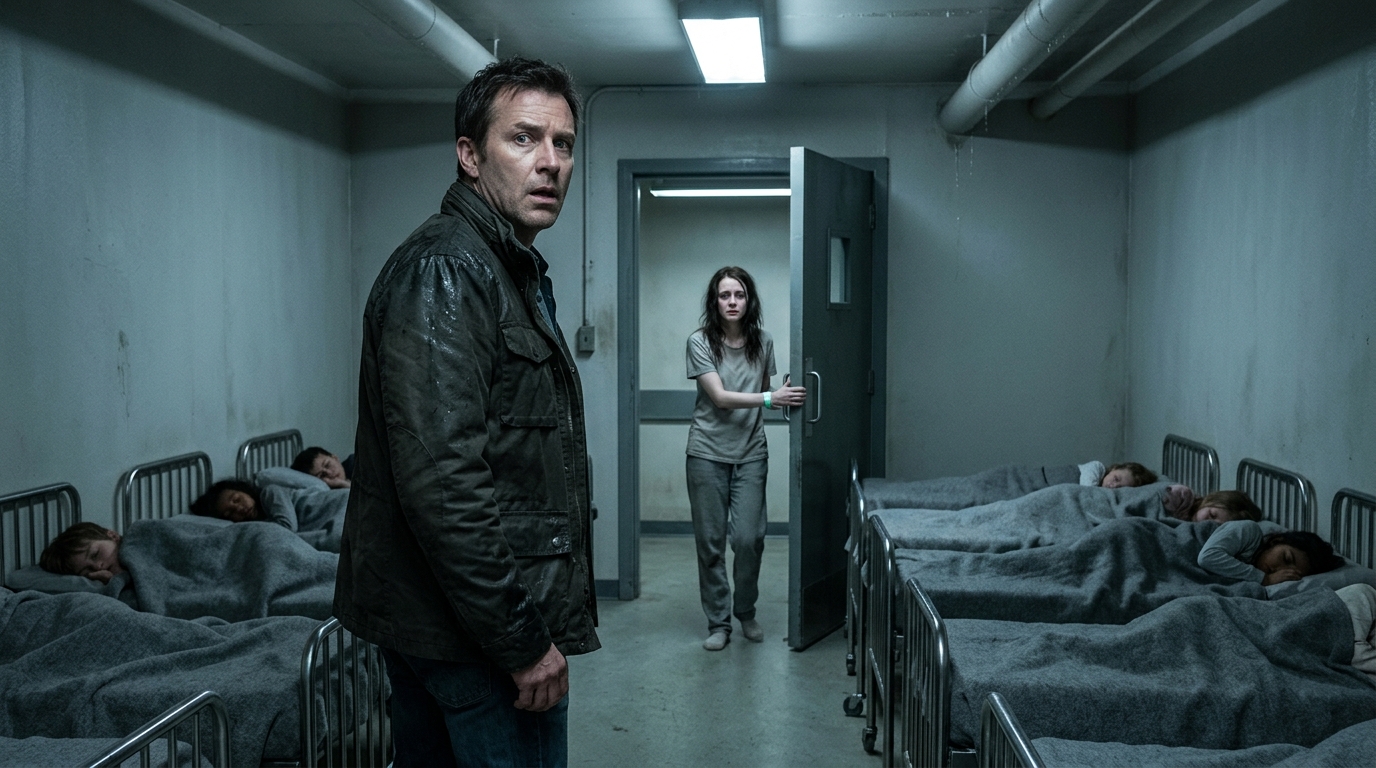
Inside were beds.
Small beds.
Rows of them.
Children slept beneath gray blankets.
Some looked six.
Some older.
All wore green wristbands.
I pressed one hand against the glass.
My stomach turned.
This was not a climate archive.
This was not conservation.
This was a ward.
A hidden children’s ward under the forest I had spent eleven years funding in my daughter’s name.
A nurse in a white uniform moved between the beds, checking a tablet.
No one looked chained.
That made it worse.
Captivity does not always need visible locks.
Sometimes it uses medicine.
Fear.
Names taken away.
A child sat upright in bed near the far wall.
A boy with shaved hair and hollow eyes.
He looked toward the window.
He saw me.
Then he raised one finger to his lips.
Quiet.
Thomas pulled me back.
Footsteps approached.
We ducked into a side storage room.
Through the cracked door, two men passed.
One of them was carrying the cracked glass specimen box.
The dead butterfly was inside.
The other held Nora by the arm.
She was crying silently.
My whole body moved before thought could stop me.
Thomas grabbed my shoulder and held me back.
“Not yet,” he breathed.
The men stopped outside the green room.
Nora looked up.
For one second, through the crack in the door, her eyes met mine.
She saw me.
Hope flashed across her face.
Then fear swallowed it.
She shook her head.
Just once.
A warning.
The man holding her opened a door at the end of the hall.
A sign above it read:
Memory Reintegration
Nora began to struggle.
“No,” she cried. “Please. I delivered it. She said if I delivered it, you had to let me go.”
The man laughed.
“Sweetheart, Elodie says a lot of things.”
The door closed behind them.
I almost broke Thomas’s grip.
But then another voice came from the hallway speakers.
Seraphina.
Calm.
Close.
“Adrian, I know you’re inside.”
Thomas went still.
The speaker crackled.
“You always were predictable once grief made you sentimental.”
I stepped into the corridor.
Thomas hissed, “Sir.”
But I was done hiding from my wife inside the tomb she had built for my daughter.
A camera turned toward me.
I looked directly into it.
“Where is Elodie?”
Seraphina’s voice softened.
A performance for an audience of one.
“She is where she has always been safest.”
“From whom?”
A pause.
Then:
“From you.”
The words were so absurd I almost missed the sound behind me.
A door opening.
Not the Memory Reintegration room.
Another door.
At the far end of the corridor.
A woman stepped out.
Thin.
Pale.
Hair cut short.
One hand gripping the frame as if standing cost her everything.
She wore a green wristband.
E-17.
For one impossible second, my mind refused her.
Because fathers freeze their children at the age they lose them.
I had spent eleven years remembering Elodie at thirteen.
But the woman in the doorway was twenty-four.
Older.
Hollowed.
Alive.
Her eyes found mine.
And I knew them.
“Elodie,” I whispered.
Her mouth trembled.
“Dad.”
The corridor disappeared.
So did the cameras.
The alarms.
The years.
I moved toward her.
She tried to step forward too, but her knees buckled.
I caught her before she fell.
She weighed almost nothing.
My daughter was alive in my arms.
Alive.
Breathing.
Shaking.
And then she gripped my jacket with terrifying strength and whispered:
“You shouldn’t have come yet.”
I pulled back just enough to see her face.
“What?”
Her eyes filled with panic.
“She wanted you to find me.”
The blood in my body went cold.
Behind us, every green light in the corridor turned red.
Locks slammed shut one after another.
Seraphina’s voice filled the hallway.
“Thank you, Adrian. You’ve just opened the only door Elodie never could.”
Leave a Reply