The Girl At The Glass Doors
The rain made the ballroom look like a beautiful lie.
It ran down the glass walls in silver streams, blurring the city lights outside until everything beyond the hotel looked drowned and distant. Inside, the Evermere Grand Ballroom glowed with chandeliers, white orchids, polished marble, and the kind of wealth that knew how to soften its own reflection.
Every table had crystal glasses.
Every guest had a name worth printing.
Every camera was pointed at the stage.
And behind me, glowing in soft green light, was the banner my wife had approved herself.
Evermere Foundation Annual Gala
Saving Lost Children. Protecting Nature.
I should have hated those words.
Maybe some part of me did.
But grief can make a man accept almost anything if it gives him somewhere to put the pain.
Eleven years earlier, my daughter Elodie disappeared in Blackwood Forest.
She was thirteen.
Brilliant.
Stubborn.
Wild in the way only children loved too deeply by nature can be wild.
She collected butterfly wings, argued with university professors twice her age, and once told me that adults only called things extinct when they were tired of searching.
Then the fire came.
That was what the report said.
A lightning strike near the northern ridge.
A research cabin swallowed by flames.
A forest burned so completely that rescue teams found nothing but ash, twisted metal, and one damaged wing from the Blue Glasswing, the rare butterfly Elodie had spent her last summer studying.
No body.
No backpack.
No notebook.
No goodbye.
Just ash.
The official report said no one could have survived.
My wife, Seraphina, repeated that sentence until it became the only truth allowed inside our house.
No one could have survived.
No one could have survived.
No one could have survived.
So I stopped asking questions.
That was my first failure as a father.
On the night of the gala, Seraphina stood beside me in a white silk gown that caught the light like water. Emerald earrings framed her face. Her smile was calm, polished, generous.
Perfect.
People always said she carried grief with grace.
I used to believe them.
She touched my wrist as the applause faded.
“Adrian,” she whispered, “they’re ready.”
I looked out at the donors.
Senators.
Tech founders.
Old family names.
Reporters from magazines that loved stories about loss as long as the room was beautiful enough.
I stepped toward the microphone.
“Eleven years ago,” I began, “our daughter Elodie walked into Blackwood Forest and never came home.”
The room softened.
It always did at that part.
People lowered their eyes. Women touched their pearls. Men looked solemn in the way powerful men do when tragedy costs them nothing.
“Elodie believed every lost thing deserved to be searched for,” I continued. “Every missing child. Every wounded forest. Every voice too small to survive alone.”
Seraphina lowered her eyes beside me.
The cameras loved her.
Then the glass doors opened at the back of the ballroom.
A cold line of rain blew across the marble.
Everyone turned.
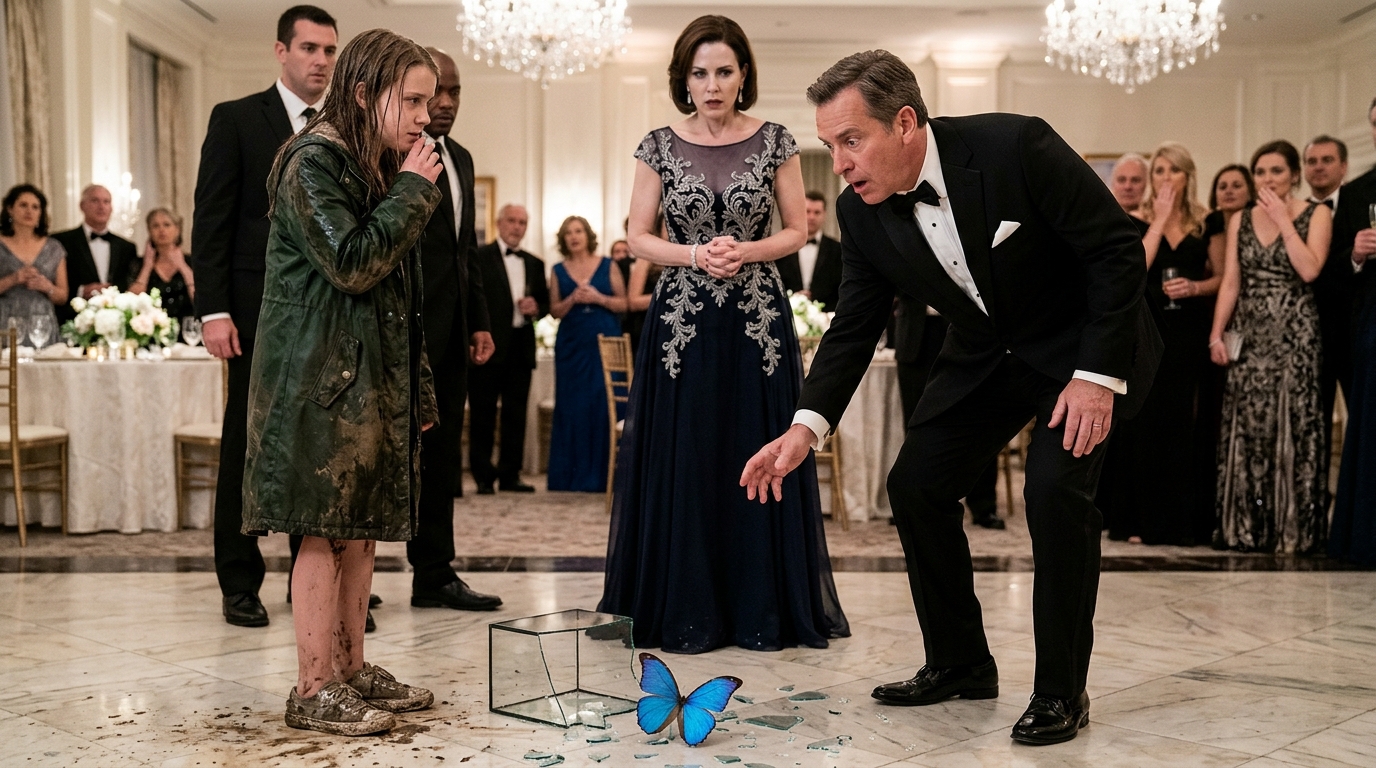
A girl stood in the doorway.
She could not have been more than eleven.
Her dark green raincoat was soaked through. Mud clung to her shoes and streaked her thin legs. Her hair hung wet against her cheeks. She looked exhausted, frightened, and far too real for a room like that.
In both hands, she held a small cracked glass box.
A specimen box.
The kind Elodie used to keep on her desk.
My voice stopped.
The microphone caught the silence.
The girl looked directly at me.
Not at the stage.
Not at the cameras.
At me.
Then she lifted the box with trembling hands and said:
“She said you would recognize the butterfly.”
The Butterfly In The Broken Box
The room did not understand her at first.
That was the worst part.
They did not hear a warning.
They saw a poor child interrupting a rich event.
A woman at table four frowned as if the girl had tracked mud across her reputation. A photographer lowered his camera. A senator’s wife whispered something behind her champagne glass and smiled as if cruelty were a private joke.
Near the velvet rope, a security guard moved fast.
Too fast.
The girl saw him coming and clutched the glass box harder.
“I need to give it to Mr. Vale,” she said.
The guard blocked her.
“You don’t belong here.”
Her face tightened, but she did not move back.
“Please. She told me only he would know.”
“Outside,” the guard said.
He reached for her arm.
I stepped away from the podium.
“Wait.”
But the ballroom was large.
The guard either did not hear me, or he heard me and chose another master.
Seraphina’s voice cut softly through the space beside me.
“Remove her before the cameras make this ugly.”
It was not loud.
It did not need to be.
The guard grabbed the girl’s arm.
She cried out.
The sound went through me with a force I was not prepared for. Maybe because she was a child. Maybe because she was exactly the age Elodie had been the last time she ran into my office holding a butterfly net and told me I worked too much to notice miracles.
The girl twisted away.
The glass box slipped.
It struck the marble floor with a sharp crack.
Not enough to shatter.
Enough to open.
The lid flipped back.
Something blue and impossibly fragile slid out onto the white stone.
The ballroom froze.
It was a butterfly.
Dead.
Pinned.
Preserved.
Its body was black and thin. Its wings were spread open as though it had fallen out of flight. They were almost transparent, but the veins running through them glowed a deep, impossible blue.
I forgot the room.
Forgot the donors.
Forgot the cameras.
Forgot my wife’s hand closing around my wrist.
I walked down from the stage like a man following a ghost.
The guard released the girl.
No one told him to.
He simply understood that something had changed.
I knelt beside the open box.
The butterfly was real.
Not plastic.
Not jewelry.
Not a decoration.
A real specimen.
My daughter had collected enough for me to know the difference. Elodie had filled our dining table with wing charts, field notes, magnifying lenses, jars of soil, and endless arguments about habitat loss.
This was a Blue Glasswing.
Or it should have been impossible.
Because the Blue Glasswing died with Blackwood Forest.
That was what the report said.
That was what Evermere’s memorial wing was built around.
That was what Seraphina had told every donor, every journalist, every investigator, and every grieving version of me for eleven years.
I touched the edge of the glass box, careful not to disturb the wings.
My voice came out low.
“That species died with my daughter.”
The girl shook her head.
Rain dripped from her hair onto the marble.
“No,” she whispered. “She said it survived where they hid her.”
A murmur moved through the ballroom.
Not loud.
Not yet.
But enough.
I looked up at her.
“What is your name?”
“Nora.”
“Who gave you this?”
Her eyes flicked toward Seraphina.
Just once.
But I saw it.
Seraphina saw it too.
“My daughter is dead,” I said.
Nora swallowed.
“She told me you would say that.”
The words hit harder than they should have.
I stood slowly.
Hope is not gentle when it returns after being buried. It does not knock. It breaks doors. It drags bones from graves. It makes a fool of every careful sentence you used to survive.
Seraphina moved beside me.
Her face was composed again.
Too composed.
“Adrian,” she said softly, “someone is using your grief. This child has been sent here to hurt us.”
Nora flinched.
“It’s not a trick.”
Seraphina turned to her.
For the first time that night, the room saw something beneath my wife’s beauty.
Not grief.
Control.
“Little girl,” Seraphina said, “do you understand what happens when children lie to grieving parents?”
Nora’s chin trembled.
But she did not look away.
“She said you would try to make me scared.”
The room went completely silent.
I turned to my wife.
“What does that mean?”
Seraphina smiled.
It was a perfect smile.
And for the first time in eleven years, it made my skin cold.
“I have no idea.”
The Message In The Wings
A photographer shifted near the stage.
One of the spotlights moved with him.
The beam crossed the marble floor, slid over the cracked glass box, and passed through the butterfly’s transparent wings.
Something appeared.
At first, I thought it was a shadow.
A trick of the light.
Tiny dark markings sat inside the blue veins, too small to read from where I stood.
Then the light sharpened.
The markings became letters.
My heart stopped.
Dad.
The word was written across the left wing.
Not ink on top of the wing.
Inside it.
As if someone had marked the delicate veins themselves.
I knelt again.
The room disappeared.
I leaned closer, afraid to breathe.
The second line emerged as the spotlight passed through the right wing.
I’m still alive.
Someone gasped behind me.
Maybe a reporter.
Maybe me.
The final line appeared near the lower edge of the wing, faint but clear.
Don’t trust Mother.
The ballroom broke.
Not loudly at first.
It broke in pieces.
A glass touched a plate.
A chair moved.
A woman whispered, “Oh my God.”
Phones rose from tables.
Cameras turned toward Seraphina.
My wife went white.
Not pale.
White.
The kind of white that does not come from shock.
The kind that comes when something buried hears footsteps above it.
I picked up the specimen box with both hands.
The dead butterfly trembled inside.
For eleven years, I had held my grief like a loyal thing.
I had let Seraphina manage the foundation.
The investigators.
The memorial events.
The restricted land around Blackwood.
The storage of Elodie’s belongings.
The private files.
The sealed reports.
I had thought she was stronger than me.
Now I wondered whether strength had simply been the better mask.
I turned toward her.
“Seraphina.”
She did not answer.
Her eyes stayed on the butterfly.
I held up the box.
“Why does my dead daughter know I’m here tonight?”
The question did not sound like mine.
It sounded like it came from somewhere older.
Somewhere still standing in Blackwood Forest, calling Elodie’s name into smoke.
Seraphina’s lips parted.
Closed.
Parted again.
For the first time in years, my wife had no prepared sentence.
Nora stepped toward me.
The guard did not stop her now.
“She said not to let you go home with her,” Nora whispered.
I looked at the girl.
“Why?”
Nora’s eyes filled again.
“She said your wife keeps the children under the forest.”
The words made no sense.
Then they made too much sense.
Blackwood Forest.
The protected zone.
Evermere’s private conservation land.
The underground climate archive Seraphina once told me was too unstable for visitors.
The annual funding requests I signed without reading because I could not bear another conversation about that place.
Under the forest.
Children.
My mouth went dry.
Seraphina moved suddenly.
Not toward me.
Toward Nora.
“Enough.”
The word cracked through the ballroom.
The wife who had stood beside me on stage was gone.
In her place stood someone harder.
Someone frightened enough to become dangerous.
Nora stepped back.
I moved between them.
Seraphina looked at me with eyes I no longer recognized.
“Adrian,” she said quietly, “give me the box.”
I looked at the butterfly.
At the message in its wings.
At the tiny impossible proof that my daughter had not disappeared into fire.
She had been somewhere.
Alive.
Writing to me through the body of the creature she loved most.
“No,” I said.
Seraphina’s face changed.
Only for a second.
But I saw the hatred in it.
Then she looked past me.
Toward the security guard.
Toward the event staff.
Toward the exits.
That was when I realized she was not trapped.
I was.
The Woman Who Stopped Smiling
The ballroom doors closed.
I heard them lock.
Not loudly.
Just one soft electronic click after another.
Click.
Click.
Click.
The donors noticed.
So did the reporters.
A nervous sound moved through the room.
One of the journalists near the stage tried the side exit.
It did not open.
“Is this part of the program?” someone asked.
No one laughed.
Seraphina lifted one hand slightly.
A signal.
Three men I had assumed were hotel security stepped away from the walls. They were not wearing name tags. They were not looking at guests.
They were looking at Nora.
The girl saw them and moved closer to me.
Her breathing quickened.
“Don’t let them take me back,” she whispered.
Back.
The word drove itself into my chest.
“Back where?” I asked.
Nora looked at Seraphina.
Then at me.
“The green rooms.”
Seraphina smiled again.
But this time, no one in the ballroom mistook it for kindness.
“Children invent stories when they are frightened,” she said.
Nora shook her head.
“You told them stories were safer than names.”
That sentence changed everything.
Seraphina’s smile vanished.
The men near the walls began moving.
Slowly.
Carefully.
As if trying not to startle the wealthy animals in the room.
I raised my voice.
“No one touches this child.”
For most of my adult life, that sentence would have been enough.
Money had made my voice heavy.
Grief had made it pitied.
The Vale name had opened doors, closed investigations, moved politicians, and silenced rooms before I entered them.
But that night, inside the gala my own money paid for, I watched three men ignore me.
That was when I understood the shape of my marriage.
Seraphina had not been standing beside my power.
She had been building her own beneath it.
A reporter called out, “Mrs. Vale, are you denying the message?”
Seraphina turned toward him.
Her face softened so quickly it was terrifying.
“This is a deeply cruel attack on a family tragedy,” she said. “Please put your phones away. No one here is in danger.”
Nora laughed once.
It was not amusement.
It was disbelief.
“That’s what they said before they locked the doors underground.”
The reporter froze.
Underground.
The word spread through the guests like cold water.
I looked at Nora.
“How many children?”
Her eyes filled with tears.
“I don’t know.”
Seraphina said, “Adrian, stop.”
“How many?”
Nora swallowed.
“I only knew the ones in my hall.”
My hand tightened around the specimen box.
“Your hall?”
She nodded.
“The sleeping hall.”
A woman near the front table covered her mouth.
The donors were beginning to understand that this was no longer an interruption.
This was evidence.
Seraphina stepped closer to me.
Her voice dropped.
Only I could hear it now.
“You are embarrassing yourself.”
I stared at her.
“You knew where Elodie was.”
Her eyes sharpened.
“You don’t know what you’re talking about.”
“You signed the fire report.”
“I protected you.”
“From our daughter?”
Her face twitched.
There it was.
The first crack large enough to see from a distance.
Nora reached into the pocket of her wet raincoat.
One of the security men lunged.
I stepped in front of her, but he was faster than I expected.
He grabbed her wrist.
Nora screamed.
The sound ripped through the ballroom.
Something inside me snapped.
I swung the specimen box into the man’s arm.
Not hard enough to break bone.
Hard enough to make him release her.
The box fell again, sliding across the marble.
The butterfly stayed inside.
The room erupted.
Guests stood.
Reporters shouted.
A camera flash exploded white across Seraphina’s face.
And in that flash, I saw what Nora had pulled from her pocket.
A small green wristband.
Plastic.
Medical.
Marked with a number.
E-17.
My daughter’s initials.
Elodie Vale.
Nora held it up with shaking fingers.
“She said this was hers.”
Seraphina whispered, “You stupid little girl.”
Everyone heard her.
The room died again.
This time, there was no performance left.
No elegance.
No grief.
Only the woman beneath the foundation.
And she had just shown herself.
The Forest Beneath The Foundation
I took the wristband from Nora.
My fingers barely worked.
The plastic was old but intact. Faded green. Slightly cracked at the edge. On the inside, written in tiny black letters, was a date.
The day after the fire.
My daughter had been alive the day after the fire.
Alive.
Registered.
Numbered.
Held somewhere.
The ballroom tilted around me.
For years, I had imagined Elodie’s final moment as smoke, heat, fear, and then nothing.
But the wristband offered a worse possibility.
That my daughter had survived the fire.
That she had waited for me.
That she had called for me from a place built with my money.
I looked at Seraphina.
“Where is she?”
Seraphina’s face was calm again, but not because she had control.
Because she had chosen a new strategy.
Coldness.
“Adrian,” she said, “you are unwell.”
The sentence was so familiar it almost worked.
Grief makes you unstable.
Grief makes you imagine signs.
Grief makes you vulnerable to manipulation.
I had heard versions of it for eleven years.
From doctors Seraphina chose.
From investigators she recommended.
From board members she invited to dinner.
From myself.
Not this time.
I held up the wristband.
“This is dated after the fire.”
Seraphina did not look at it.
That was answer enough.
Nora moved beside me.
“She said if I gave you the butterfly, you would come.”
“Come where?”
Nora looked toward the rain-streaked glass walls.
“Blackwood.”
Seraphina laughed softly.
It was the ugliest sound I had ever heard from her.
“You think I will let you walk into a restricted conservation zone because a dirty child brought you a dead insect?”
The room heard that too.
Dirty child.
Dead insect.
Every mask was gone now.
A donor near the front stood slowly.
“Mrs. Vale,” he said, “open the doors.”
Seraphina did not even look at him.
“No.”
The answer chilled the room.
A second reporter tried to upload something from her phone.
“No signal,” she whispered.
Then another guest checked.
Then another.
The phones were dead.
Not powered off.
Blocked.
Seraphina had sealed the ballroom.
The gala had not become a trap.
It had always been one.
Just not for the guests.
For anyone who brought truth inside.
A sound came from the stage speakers.
Low.
Static.
Then a child’s voice.
Not Nora’s.
Not live.
Recorded.
“Dad?”
My body went still.
The ballroom went silent.
The voice crackled through the speakers again.
Older than the Elodie I remembered.
But still hers.
Still my daughter.
“Dad, if you’re hearing this, Nora made it.”
My knees almost buckled.
Seraphina turned toward the sound system, horrified.
She had not expected this.
Good.
For the first time all night, something was happening outside her design.
Elodie’s voice continued, faint but clear.
“Don’t follow her alone. Don’t trust the foundation map. The forest above is not the place you need to search.”
A sharp noise cut through the speakers.
Then Elodie whispered:
“Look under the roots.”
The sound died.
For one second, no one moved.
Then all the lights went out.
The chandeliers.
The stage screen.
The green Evermere banner.
Everything.
The ballroom dropped into blackness.
People screamed.
Glass broke.
Chairs overturned.
In the dark, a hand grabbed my sleeve.
Nora.
Her voice was right beside me, terrified and breathless.
“They’re here.”
“Who?”
She was crying now.
“The root keepers.”
I felt her being pulled away.
I grabbed for her, but someone struck my shoulder hard enough to send me into a table.
The specimen box slipped from my hands.
The butterfly skidded across the floor.
Somewhere in the darkness, Seraphina’s voice came close to my ear.
Calm.
Cold.
No longer pretending.
“You should have let her stay dead.”
Then Nora screamed.
And when the emergency lights finally flickered on, the girl was gone.
So was the butterfly.
Only the green wristband remained on the marble at my feet.
E-17.
The proof my daughter had lived after the fire.
And the first real clue that whatever had taken her was not hidden in the forest.
It was underneath it.
Leave a Reply